Monthly Archives: July 2014

The End

“The World Cup doesn’t end so much as it slips back into itself. As soon as the whistle is blown one last time, the recaps, the nostalgia, and the smart surmises begin. But then, a day later, after the last team has returned to its home country and the cheers of hundreds of thousands of euphoric fans, the specifics start to stretch beyond the immediate recall they enjoyed during these June and July days. The locations and stadia whose names were on the tip of your tongue begin to hang back as you go forth with your life. You’ve suddenly forgotten the name of that player you didn’t know on that team you weren’t familiar with—the player you’d enjoyed so much that you’d learned to pronounce his name perfectly. Or, if you’re American and have grown through this tournament to love the game, the world may suddenly seem farther away again. The excuses to strike up a conversation with a stranger dwindle. The news of the rest of the world starts with the Middle East again. And left to fend for themselves, the details of your World Cup experience begin to connect their own dots.” The Paris Review

A World Cup of Broken Ideas

“When it was all over, Messi stood there dejected and alone, holding the Golden Ball as the World Cup’s best player. It was a hollow consolation, one he didn’t want and probably didn’t think he deserved. As he walked up the stairs to receive his prize, some fans reached out to touch him. But most Argentinians sat—as subdued as they had been in weeks—clapping quietly, watching Messi fail to become the emblematic hero an entire nation had hoped he would. The World Cup has a way of amplifying things. Goals become national statements. A poor performance becomes an affront to the flag. Every action is bigger and holds more importance—and, inherently, holds some symbolic meaning.” 8 by 8

Pelé and Garrincha – Gods of Brazil (Documentary)

pele_gara1
“Documentary telling the story of legendary Brazilian footballers Pele and Garrincha, whose emergence following Brazil’s defeat at home in the 1950 World Cup Final heralded the dawn of a golden age of football for the country. But while one man became known as the world’s greatest footballer, the other died a broken alcoholic at the age of 49.” YouTube: Gods of Brazil 1:09:59

World Cup 2014: How might England line up for Russia 2018?

“As the World Cup drew to its conclusion amid the colour and splendour of the Maracana in Rio, England’s brief and undistinguished contribution to Brazil’s World Cup did not even merit a footnote. Blink and you would have missed them. Months of preparation amounted to defeats by Italy and Uruguay in the space of six days before England manager Roy Hodgson and his squad were making the plans for the flight home. When the story of Brazil 2014 is told, it will be a tale of ambitious attacking football, Luis Suarez’s bite and the World Cup semi-final carnage inflicted on the host in a 7-1 loss to Germany that will be revisited as long as the tournament is staged. England? Move along. Nothing to see here.” BBC

FIFA’s Dazed and Dated Attitude

“Of all the lasting images from the 2014 World Cup, the officials who run FIFA, soccer’s governing body, should be forced to remember one, above all: Germany’s Christoph Kramer staggering around the field in the final, glassy-eyed and dazed, like a sleepwalker. It was a glaring symbol of FIFA’s misguided approach to concussions and how desperately it needs to amend its substitution rules, which now allow for only three replacements per game and dictate that once a player is out of the game, he stays out. Faced with those restrictions, coaches are hesitant to keep a player with a possible head injury from leaving the match.” NY Times

Seeking Soccer Respect, Qatar Looked Abroad

QATAR1-slide-IR2V-sfSpan
“A little more than a decade ago, Andreas Bleicher, then a director of one of Germany’s Olympic training centers, arrived in the tiny gulf nation of Qatar, wooed there by its royal family to help turn the hopeless national soccer program into something worthy of the world’s respect. There were plenty of reasons this would be difficult — the country hardly has a tradition of soccer excellence, and its record of producing premier athletes in any sport is sparse. But there was one problem that seemed insurmountable. With a native population of only 300,000, Qatar simply did not have enough young players to form a team that could hope to compete with the likes of Brazil, Argentina and Germany.” NY Times – 1, NY Times – 2

Photos: Brazilian Riot Police Squashed a Big Protest During the World Cup Finals

“It was a whirlwind of a weekend in Rio de Janeiro. The drama began on Saturday with the third-place match, which is in and of itself a depressing affair. After being on the edge of fulfilling World Cup dreams, two teams are forced to conjure up one last effort to save face. Brazil, in its case, had just suffered one of the worst defeats in World Cup history and didn’t want to compound it with another loss. The Dutch coach, meanwhile, thought everyone should hang up their boots instead of tempting fate once more. Nothing felt right about the match, so instead I decided to visit the Maracanã, the epicenter of the futebol universe, where Brazil never got to play a match as host of this World Cup.” New Republic

Full Time: Fading Images of the World Cup

“Watching sports is, among other things, a special way of experiencing time. Sport is like music or fiction or film in that, for a predetermined duration, it asks you to give it control over your emotions, to feel what it makes you feel. Unlike (most) forms of art, though, a game has no foreordained plan or plot or intention. The rules of a game impose a certain kind of order, but it’s different from the order of an artwork. A movie knows where it wants to take you; no one can say in advance where a game will go. All of its beauty, ugliness, boredom, and excitement, all of its rage and sadness emerge spontaneously out of the players’ competing desires to win. For however long the clock runs, your feelings are at the mercy of chance. This happens and then this happens and then this happens. You’re experiencing, in a contained and intensified way, something like the everyday movement of life.” Grantland – Brian Phillips

Schadenfreude

“How apt that the Brazilians are living off Schadenfreude: after the debacle against Germany and a little extra humiliation from Holland, all Brazil’s fans seemed to want was for Germany to prevent Argentina from victory dancing on the beach at Copacabana. Believe me, I get it. As a lifelong supporter of Tottenham Hotspur F.C. in the English Premier League, much of my soccer pleasure in the last half-century, sadly, has derived only from misfortunes experienced by Arsenal F.C., Tottenham’s arch rivals. In the years 1960–1962, Tottenham was clearly the superior team—since then, not so much. Like Brazil and Argentina, the two clubs are neighbors, and Arsenal, like Brazil, has the larger fan base and more money.” The Paris Review – Jonathan Wilson

World Cup Expectations Rankings: Brazil’s over- and underachievers

Image, 738 × 415 pix
Cesare Prandelli
“Teams come to the World Cup with their own expectations. For some, just being there is enough, reaching the last 16 an almost impossible dream. For others, so exalted were their ambitions that even a quarterfinal feels like a disappointment. This is an attempt to grade teams according to how they did against their own expectations, looking both at results and at how well they played…” SI – Jonathan Wilson

The Two Brazils Revisited: What does the future hold after World Cup 2014?

“I first met Vitor Lira last December, when I was here on a reporting trip for an SI magazine story called The Two Brazils. The article examined the complex nature of a country that can both love soccer and engage in mass protests over the public spending and societal impact of the 2014 World Cup and the 2016 Olympics. Lira, 33, is a community leader in Santa Marta, one of Rio’s oldest favelas. Five generations of his family have lived there, and over the past two years he has organized resistance to the government’s plans for removals of Santa Marta residents as part of the sweeping changes in Rio around the World Cup and Olympics.” SI (Video)

World Cup Tactical Analysis | Germany 1–0 Argentina: Götze ends Germany’s quest for glory

“Lionel Messi’s face appeared on Maracanã’s displays as he stood over a free kick that was, by anybody’s guesstimates, far-flung and too wide of goal to think about shooting. But then this was one of the finest footballers in the world, a goal down in the World Cup final with two minutes remaining and history flitting through his fingers. He skied it and so went the opportunity of probably his lifetime. Replacing a retiring legend came 22 year old, Mario Götze in the 88th minute of the match, with bustling energy – and a fatiguing opposition. When the goal came, it was typical of this Germany side – probe for a flaw, make the opponents slog and punish callously. Götze’s left-footed volley past Sergio Romero at the end of Schürrle’s delivery was enough to affix a 4th star on Die Mannschaft’s crest and become the first European side to claim the trophy on Latin American soil.” Outside of the Boot

State of the Union: An American’s Post-Mortem of the USMNT in Brazil

USA-World-Cup-Interview1
“The United States Men’s National Team (USMNT) has returned home from Brazil but the team does so having escaped a very difficult group and pushing Belgium to the very brink in the Round of 16. The buzz that surrounded the team was really unprecedented in the United States. ‘Watch parties’ across the country drew thousands of people, eager to see the Red, White, and Blue succeed at the World’s most prestigious sporting competition. World Cup games drew millions of viewers even beyond the USMNT’s games. People who never gave ‘soccer’ a shot before were now invested in the tournament. So with the 2014 edition of the World Cup being one that was seen as a success for the team and one that captured the imagination of the American public, it is now important to look forward to what this could mean not only for the USMNT but also for football in America in a broader sense.” Outside of the Boot

The World Cup Is Over. Now What?

“The best team won the 2014 World Cup. Sometimes Germany won its games early—it scored the winning goal in its semifinal against Brazil in the 11th minute; it scored it in the 13th minute of its quarterfinal against France. Sometimes it won its games late—in the Round of 16 against Algeria, Germany didn’t score until the 92nd minute; in yesterday’s final against Argentina, its only goal came in the 113th minute. Sometimes Germany won with offense—Die Mannschaft, or ‘The Team,’ as the German team is nicknamed, scored seven goals against Brazil and four in its opener against Portugal. Sometimes it won with defense—Argentina had zero shots on goal against Germany in the final, and German goalkeeper Manuel Neuer recorded four shutouts in seven matches.” Vanity Fair

World Cup 2014: Top five transfer targets – and those already done

“They may not be new to everyone, but Brazil 2014 brought a handful of players to the attention of a wider global audience who sat up and took notice of them. Even more importantly for the players’ agents, it is likely to have sparked the interest of the clubs with the deepest pockets, who may well be about to spend big on their talents. Here, we look at five stand-out transfer targets to emerge from the World Cup finals – and five deals that were done during the tournament.” BBC

Germany 1-0 Argentina

VD-WorldCup-408x264
Germany 1-0 Argentina (AET): Gotze’s extra-time goal wins the World Cup
“Germany won their fourth World Cup after victory over Argentina in a tense but enjoyable final. Joachim Low’s team selection was compromised by the late withdrawal of Sami Khedira through injury. Christoph Kramer took his place – although he only lasted 30 minutes himself. Alejandro Sabella’s side was unchanged from the semi-final against the Netherlands. Both sides had promising moments in an even match – Argentina had the better chances before Mario Gotze’s late winner.” Zonal Marking

Germans End Long Wait: 24 Years and a Bit Extra
“For years, Brazilians had a phrase they would inevitably utter when things went wrong. ‘Imagina na Copa,’ they said after an endless traffic jam or a construction accident or an ugly rash of violence dominated the news — imagine if this happened during the World Cup. It became a foreboding warning, a pre-emptive sigh at the presumed disasters that lay ahead. Over five weeks, though, Brazil avoided any of the major catastrophes it feared. Thrilling games and entertaining soccer — as well as the national team’s own stunning collapse — generally overshadowed any logistical issues, and the tournament was seen as a global success. So it was fitting, then, that in the tournament’s final game, the Brazilians managed to dodge the ultimate on-field nightmare, too.” NY Times

Germany 1 Argentina 0 (BBC)
“Germany were crowned world champions for the fourth time as Mario Gotze’s extra-time winner beat Argentina in the 2014 World Cup final. Gotze demonstrated perfect technique and commendable calm to chest down Andre Schurrle’s pass and sweep in a left-foot finish with the prospect of a penalty shootout only seven minutes away. Argentina, with skipper Lionel Messi looking subdued despite flashes of his talent, could not respond and Germany claimed their first World Cup since they beat the same opponents in Rome 24 years ago.” BBC

Germany’s World Cup title a result of revamped development, identity
“At the final whistle, after Germany claimed a fourth World Cup by beating Argentina 1-0 in extra time, BastianSchweinsteiger collapsed to the turf, utterly spent. He had given everything, running to the point of exhaustion, the only holding midfielder in the Germany squad still standing by the end, and that only just, a stray arm from Sergio Aguero having caught him across the face leaving him with a gash on his cheek.” SI – Jonathan Wilson

The Party’s Over: A Critic’s Take on Brazil’s Dismal World Cup Legacy
“About a five minute walk from Rio de Janeiro’s historic Maracanã stadium, the site of today’s Argentina vs. Germany final (Update: Germany won, obvsly), there used to be a small community of about 700 families called Favela do Metro. The reason the city demolished the tightly-packed neighborhood is hotly disputed: Residents said it was to build a parking lot, while the city claimed it had more ambitions urbanization plans, such as a park. But at least for now, there is little left except a jumbled mess of concrete and brick.” Fusion

Germans See World Cup Win as a Symbol of Global Might
germanyvictory-videoSixteenByNine1050-v2
“Even normally quiet streets were electrified early Monday by Germany’s dramatic 1-0 win of the World Cup in extra time, a victory that symbolized, at least to fans, not just the country’s dominance of Europe, but its global prominence. Car horns and vuvuzelas honked, and fireworks and firecrackers exploded. On the Kurfuerstendamm, the gleaming street of stores and restaurants that was the symbol of West Berlin during the Cold War, cars quickly jammed traffic and fans draped themselves in the black, red and gold of the German flag.” NY Times

World Cup Pass & Move: Germany Wins It All
The World Cup came to a close on Sunday, with Germany defeating Argentina in extra time, 1-0, in Rio’s Maracanã Stadium. Here, five Grantland writers look at five important characters from the match. Be sure to check out all of our coverage of the final, and the entire month of wonderful soccer action, at our World Cup landing page. Grantland (Video)

A Final Prediction: Germany Wins a Thriller
“Like the Sex Pistols in their prime, World Cup finals rarely fail to disappoint. After all the buildup and hype, the games often turn out to be low-scoring, bad-tempered affairs. In 2010, Holland, the nation that, during the nineteen-seventies, invented “total football,” a free-flowing, attacking style of soccer that enchanted the world, disgraced itself by trying to kick the Spanish “tiki-taka” men off the park in Johannesburg, and almost succeeded. Four years earlier, during the latter stages of a tense 1-1 tie between Italy and France, Zinedine Zidane, the French midfield maestro, was sent off for headbutting an Italian player, Marco Materazzi, who had allegedly called his sister a whore. (Italy went on to win on penalties.)” New Yorker

Germany Grinds Its Way To World Cup Triumph
“Well, I got the result right. But my prediction that it would be a thrilling World Cup final turned out to be wishful thinking. Instead of thrills, we got another tense, low-scoring game, in which both teams accumulated more bookings for bad fouls (two each) than clear-cut chances. By the middle of the second half, it was evident that one goal would settle it, and, in the second period of extra time, Germany nabbed one, thanks to a great piece of finishing by the young striker Mario Götze, who had come on as a substitute.” New Yorker

Success for Brazil, Just Not on the Field
“When Mario Götze settled a crossing pass with his chest and volleyed a goal that won the World Cup, German fans roared in ecstatic release. Those from Brazil were nearly as delirious, even if it was out of relief as much as celebration. It might have seemed an odd sight, Brazilian fans celebrating another team inside their own cathedral of soccer, the Maracanã stadium. But after two demoralizing losses brought national embarrassment, solace finally came Sunday as Germany defeated Argentina, 1-0, to become the first European team to win a World Cup played in North or South America.” NY Times

In a Latino Enclave, the World Cup Puts Everything on Pause
14ROOSEVELT1web-master675
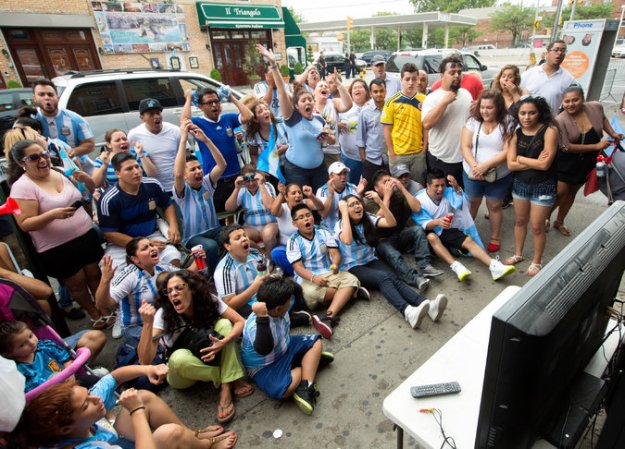
“Something unusual happened on Sunday afternoon on the streets of Jackson Heights, Queens: Quiet. As crowds gathered to watch the World Cup final around the Latin American enclave — in bars and barbershops, in electronics stores and by food trucks — the usually frenetic area beneath the elevated No. 7 train grew uncharacteristically still. Business, which spills onto the streets in the form of carts and trucks and tables, came to a halt. There was no merengue. Or cumbia. Or bachata.” NY Times

Don’t Cry for Messi, Argentina. This Germany Team Is One of the Best in Years.
“Lionel Messi seemed to recognize that he had lost the World Cup several minutes before the final whistle had blown. Moments after substitute striker Mario Götze scored a wundervolley in the game’s 113th minute to put Germany up by the decisive margin of 1–0, the Argentine legend had his last somewhat realistic chance at goal. Defender Marcos Rojo sent a high arcing cross deep into the German area and Messi came flying in for a free header from about 15 yards out. Had his shot gone in, it would have been a glorious goal. Instead, the ball fluttered harmlessly over the bar, and Messi walked away with his head down, staring desperately at the turf.” Slate (Video)

Brazilians Go Back to Real Life
Brazil suffered mightily with its national team’s 7-1 rout at the hands of Germany in the World Cup semifinals last week, but the authorities here breathed sighs of relief as the tournament came to a close on Sunday with Germany’s victory over Argentina, amid muted street protests and a display of Brazil’s ability to successfully organize sporting megaevents.” NY Times

Germany May Be the Best National Soccer Team Ever
“Germany didn’t begin the World Cup as the favorite. That honor belonged to (ahem) Brazil. But that’s a slightly deceptive measure. This was a top-heavy World Cup; not only Brazil but also Germany, Argentina and Spain would have been the front-runners in many past editions of the tournament. By the end of the World Cup, Germany left little doubt it is the best team in the world. In fact, it may be the best national soccer team ever assembled. One simple way to compare World Cup winners is by their goal differential throughout the tournament. Germany, with 18 goals scored and four allowed, comes out at a plus-14.” Five Thirty Eight

Tactical Guide to World Cup finalists, Germany & Argentina

Germany-vs-Argentina-FI
“After an enthralling month of football, the World Cup has finally reached it’s end. It was expected to disappoint like the previous edition, but what transpired in Brazil left many claiming it as possibly among the best yet. It had everything, and a little more; from Spain’s early elimination to Costa Rica’s unbelievable run, Brazil’s humiliation to Algeria’s display, James Rodriguez’ goal to Ochoa’s save, and so much more in between. The spectacle culminates into one final clash between two sides who as the fixture list suggests, deserve to be there. It’s been incredible, and Outside of the Boot have been there every step of the way with regular content for our readers. On this historical day we take a look at this memorable journey of the two finalists through our tactical lens.” Outside of the Boot

World Cup Final 101: All you need to know about Germany – Argentina

“Germany and Argentina square off for the World Cup trophy in Brazilian soccer’s Mecca, Estádio​ do Maracanã, in Rio de Janeiro on Sunday. The game is littered with storylines, legacy implications and star power and promises to provide a thrilling ending to what has been a riveting World Cup. Our live chat for the spectacle will kick off at 2 p.m. ET, leading up to the 3 p.m. first kick (ABC/Univision). In the build-up until then, our Brian Straus, Jonathan Wilson, Liviu Bird, Adam Duerson and Tim Newcomb have compiled everything you need to know about the clash with a World Cup Final 101 crash course…” SI

World Cup Spirits Dampened, Brazilians Show Waning Support for 4th-Place Team

“The yellow-clad fans arrived at Estádio Nacional later, more quietly and with far less face paint than usual. And no wonder: They were attending the World Cup’s third-place game, a match that newspapers around the world had called ‘a meaningless exercise,’ ‘a pointless sideshow’ and ‘the final insult.’ André Gonçalves, 48, an accountant in Brasília who was attending his fifth game in the stadium with his family, was struck by the difference in the scene outside the stadium Saturday afternoon before the Netherlands played Brazil. ‘This silence, this calm,’ he said. ‘It conveys sadness.’ André Galvão, a reporter for TV Bandeirantes, was having trouble finding the usual energy from Brazil fans.” NY Times

Germany’s Haunting Emptiness in Goal

“Manuel Neuer is the latest in a line of German goalkeepers regarded by many as the best in the world. German soccer fans often reminisce about the greatness of Sepp Maier and Harald Schumacher and Oliver Kahn, and if Neuer helps Germany win the World Cup final on Sunday, his place in history — even in the middle of his career — will be secure. Yet there is also a darker side to the lineage of German goalkeepers, an incident that lingers over German fans and also started Neuer along his current path.” NY Times

Pichações: The Streets Against the World Cup

gabriel-7
“As the World Cup in Brazil comes to an end without the predicted large-scale protests, there’s been a subtle but consistent message visible on the streets, as photo-journalist Gabriel Uchida has documented. ‘Pichação’ is the punk brother of graffiti. Pichadores don’t want to make art, they want to shock, to vandalize. It’s made to be ugly and agressive. In Brazil it was born in São Paulo and their main influence was the typography of punk rock and heavy metal band logos. Although it is illegal, it’s the most current cultural expression in the Brazilian streets. It’s possible to see ‘pichações’ everywhere, even at the top of the highest buildings. As it’s made to protest, recently Brazilian ‘pichações’ have found a new target: the World Cup.” World Cup 2014

The Rio the World Cup didn’t show
“There’s shit in the water. Two days after Brazil crashed out of the World Cup, on Thursday morning, one of Rio’s foremost sanitation activists, Leona Deckelbaum, came down to Copacabana Beach to work. She couldn’t help laughing. Tourists swam in the ocean across the street, and up and down the coast in both directions. In a city with a terrible sewage system even in the fancy neighborhoods and no complete sewage or water service in any of the 900-plus favelas, this is a terrible idea.” ESPN

World Cup Adept? Yes. Adored? Not Yet.

“Argentine fans unfurled a banner at a World Cup semifinal match in São Paulo depicting Diego Maradona on one side, Lionel Messi on the other and Pope Francis in the middle. The fans chanted, ‘Olé, olé, olé, Messi, Messi,’ but the relationship with their star remains complicated. A full embrace will not come unless Messi can win soccer’s ultimate prize against Germany on Sunday, just as Maradona did in 1986.” NY Times

What Will We Take From This Tournament?

“In writing on sport there is always a fine line between reading too much into what happens on the field and reading too little into it. The problem is particularly acute when it comes to the World Cup: no other sporting event creates the same torrent of hyperbole and cliché, or incites quite the same kind of grandiose pontificating. The best of sports writing and commentary manages to deal with this through a combination of grace, humor, and true emotion: something that the Men in Blazers have offered us, thankfully, on ESPN, and that has defined the wonderful writing of Brian Phillips for Grantland during the tournament.” New Republic – Laurent Dubois

Germany vs. Argentina, Part III

“Will it be the goal fest of 1986 or the negativity of 1990? History will repeat itself with an Argentina-Germany rematch in the World Cup final. But will we get the thrills of 1986 or the grotesqueness of 1990? Unfortunately, signs point to the prospect of a conservative, low-scoring affair on Sunday at the Maracanã. Nearly everyone realizes the best tactics against Germany are to pack it in and counterattack. (Everyone except Brazil, that is). And that has been Argentina’s approach, anyway, so there is little chance the Albiceleste will change.” Fusion

What the World Cup Looks Like to a Refugee Child

boy
“I wanted to write a post predicting who will win the World Cup, but then truly, who really cares about my prediction? What do I know? I’m no pundit, not that pundits know anything anyway. Also, I’m a firm Bohrian. It was Niels who said, ‘Prediction is very difficult, especially if it’s about the future.’ Basically, a child could do just as well as me. So why not have a child do it? Not just any child, but a refugee. I had friends who work with two NGOs ask kids served by their groups some questions about the World Cup. The first organization is the World Food Programme in Beirut, which provides essential food and nutrition to over a million Syrian refugees in Lebanon. The second is Faros, an NGO in Athens, Greece, that provides individual assistance and long-term, durable solutions for unaccompanied refugee minors, mostly from Iraq and Afghanistan.” New Republic

After Soccer Loss, Dilma Rousseff Soothes Brazil With a Song

“As her country recovers from its humiliating loss to Germany in the World Cup, President Dilma Rousseff sang a samba to express Brazil’s resilience and gave no quarter to opponents who suggest that the soccer disaster may haunt her in the election this fall. ‘Soccer doesn’t mix with politics,’ Ms. Rousseff told a small group of foreign correspondents here on Friday night. ‘We’ll be discussing this defeat in Brazil for a long time to come,” she added, defending her government’s handling of the World Cup, which has unfolded without major problems. “It would have been more serious if we had lost outside the stadium than within it.'” NY Times (Video)

Soccer in Brazil, and Outside the World’s Glare

“Mauricio Lima has been in Brazil for the World Cup. Not exactly at the games, mind you, but going deep into the hearts — and jungles — where love of the game sustains and thrills (at least until the Brazilian team’s loss this week to Germany). He has ventured to a floating village where children kick improvised soccer balls along narrow docks, to a prison where inmates make balls, to an amateur tournament where teams and beauty queens compete together and to indigenous villages that are an overnight boat ride away from the nearest World Cup match.” NY Times

Photos: Displaced Brazilians Protest as Argentina Prevails in Sao Paulo

“I landed early in Sao Paulo after a sleepless night in Belo Horizonte. I was too consumed with the thrashing of Brazil to get any real sleep. I had always thought an early exit from the tournament would be a crucial moment in the Brazilian psyche, but the way it played out was much more complicated. The crippling of Neymar by the knee of Zuniga along with the Thiago Silva ban were daggers in the heart of the host nation. The absolute dismantling of the rest of team by Germany was the fatal twist of the blade. It was shocking and, in the end, humiliating. Newspapers around Brazil trumpeted the great shame brought upon the country. There was a new blight in the history of the beautiful game: the Mineirãzo. It was a time for soul searching, not impetuous rioting as everyone feared. Only fate could have come up with such a tragic ending.” New Republic

The Third-Place Game Is Often the Best Game

“Back in the nineteen-seventies, when Brazil still played the jogo bonito, the Dutch star Johan Cruyff was setting joyous new standards of creative attacking play, and Italy had not yet transformed soccer with the dour technique of stifling defense known as catenaccio (‘door-bolt’), the Austrian writer Peter Handke wrote a play called ‘Die Angst des Tormanns beim Elfmeter’ (‘The Goalie’s Anxiety at the Penalty Kick’). Wim Wenders followed up with a movie of the same name two years later. That title comes to mind as being extraordinarily prescient. With the exception of Germany’s spectacular 7–1 thrashing of Brazil in the first semifinal, the latter stages of the World Cup have, for many years, had a sorry tendency to be dominated by anxieties and goalies and penalty kicks.” New Yorker

When the Only Soccer In the U.S. Was En Español

“In the 1980s and ’90s, most of the sport televised in this country was in Spanish. An American writer says gracias. It wasn’t always like this, flicking to and fro from ESPN to ESPN2, to hear soccer commentary in English: Derek Rae rolling his Scottish Rs; Steve McManaman in sing-songy Scouse-speak; or the Manchester basso profundo of Efan Ekoku. Nor, for that matter, did you hear the flat American accents of Alexi Lalas, Mike Tirico, or Kasey Keller (and, thank goodness, not that in-between-the-pond affectation of Brad Friedel). No, there was a time when the only soccer in this country was broadcast in foreign languages, mainly en Español. And this wasn’t a bad thing. On the contrary: It was glorious.” Fusion

World Cup 2014: Goals, drama & that bite – is Brazil the best?

best-world-cup-comp_v1_624
“Record goals, Suarez gnaws, that James Rodriguez strike, passion, drama, colourful fashion – what a World Cup this has been. It was a tournament that started with a bang as the hosts came from behind to beat Croatia, and has since delivered fantastic entertainment almost game after game. Here, BBC Sport’s chief football writer Phil McNulty and the BBC’s much-loved and most experienced commentator John Motson consider whether this has been the best ever World Cup.” BBC

Man vs. Machine

This can’t be happening. At around the moment when Toni Kroos fired Philipp Lahm’s cross past the diving Júlio César for Germany’s third goal against Brazil, that thought started blinking in my brain like the red light at the top of a radio tower. This can’t be real. Only a minute earlier, Miroslav Klose had made it 2-0, breaking Ronaldo’s all-time World Cup goal-scoring record in the process; two minutes later, Kroos swiped the ball from Fernandinho, played a 1-2 pass with Sami Khedira to slip past Dante in the area, and scored again. 4-0 in the 26th minute. This isn’t possible. Three minutes after that, Khedira got the ball from Mesut Özil and knocked it home from inside the edge of the area. 5-0. I’m imagining this. The Germans had scored four goals in six minutes against the most celebrated nation in soccer history, a team that hadn’t lost a competitive match on home soil since 1975. I’m asleep. After almost four weeks of obliterating expectations, the World Cup finally produced a match that obliterated belief.” Grantland – Brian Phillips

Germany wary of Lionel Messi counter threat in World Cup final

“Nobody, Toni Kroos insisted on Tuesday night, wins the World Cup after a semi-final. Jogi Löw pursued the theme: there had been no exultation in the dressing room, he insisted; there was still one game to go. The response was sensible, admirable even, and it probably is true that there is no team so likely to be capable of moving on from a historic victory as Germany but, still, wins of that nature have their dangers.” Guardian – Jonathan Wilson

How Germany Got its Game On

“Paul Breitner (1974, 1982). Spain, 1982. It was the saddest goal in a World Cup final. Paul Breitner reacted quickly to a loose ball in the Italian box, adjusted his body, and volleyed neatly into Dino Zoff’s bottom right corner. It was a goal that begged to be scored, had to be scored, but there was no joy, no sense of relief, not even hope. It wasn’t even a goal at all, really, but an anti-goal. It marked defeat, not victory. Breitner knew it. He raised his hand to acknowledge his inconsequential achievement and jogged back to the halfway line. Nobody came over to congratulate him. The West Germany vice captain looked like a schoolboy who had come up to the board and solve a problem for which there is no solution. Seven minutes before the final whistle at the Santiago Bernabéu, the time was up—for the World Cup (West Germany were 3-1 down against the Azzurri), for Breitner’s team, and for Breitner himself. …” 8 of 8

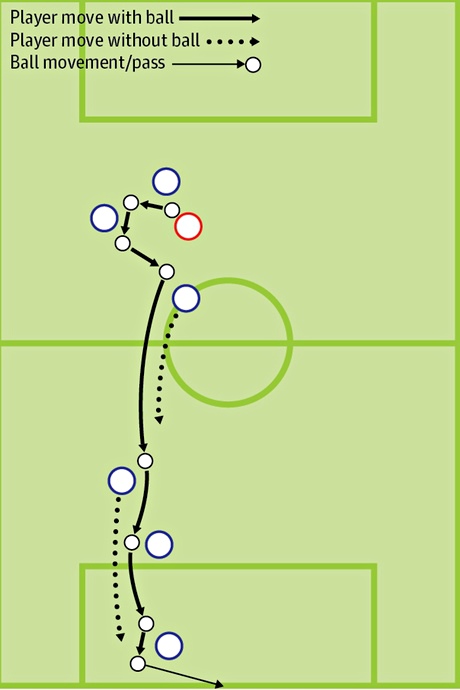
World Cup quiz: name the goal from the chalkboard diagram

Name the World Cup goal
1. Which World Cup goal was this? Saeed Al-Owairan (Saudi Arabia v Belgium, 1994). Diego Maradona (Argentina v England, 1986). Franz Beckenbauer (West Germany v Switzerland, 1966). Archie Gemmill (Scotland v Holland, 1978).

“Everyone loves a tactical chalkboard, don’t they? Don’t they? Oh. Well, anyway see if you can decipher the World Cup goals after looking at our funky stripped-down graphics below.” Guardian

I Love Messi, But I’m Rooting for Germany. Here’s Why You Should, Too.

“I will be rooting for Germany in Sunday’s World Cup final. Now, there’s a sentence I thought I would never write. I grew up with an intense dislike of German prowess on the football field. One of my first memories is of Harald Schumacher flying through the air, almost killing the hapless Patrick Battiston. (To this day, the Frenchman still carries a cracked vertebra and damaged teeth; Schumacher probably still carries his hateful smirk.) Four years later I saw Germany end Mexico’s World Cup dreams in Monterrey through a relentless display of intimidation. They then proceeded to eliminate my beloved French again. Oh, how I hated them, with their canine names: Rummenigge, Littbarski, Briegel, Augenthaler. Yes: almost 30 years ago, when I celebrated Argentina’s triumph in the Azteca as if it were my own, it would have been unfathomable that I, one day, would root for Germany.” New Republic

World Cup Tactical Analysis | Netherlands 0-0 Argentina ( 2-4 pens ) : Netherlands’ discipline and Argentina’s narrow midfield

“After the ridiculously one-sided affair in the first semi-final, the second was always going to be a tight game. After seeing hosts Brazil blown away by Germany, both sides were set-up to primarily not concede. Something that they were successful in not only for the course of the 90′ but through extra time as well. Argentina was labelled as a lot of people’s favourites but are yet to convincingly stamp their authority on the tournament as front-runners. It is a strange accusation to level at the finalists of the tournament and yet there it is. They’ve relied on individual ability on multiple occasions in this tournament and will do so once again this Sunday. While the Dutch too have been beholden to Arjen Robben’s exploits to a certain degree, their progression has been characterized by multiple rabbits being pulled out of the hat by Van Gaal and his staff.” Outside of the Boot

Let’s Get Metaphysical

“Argentina and the Netherlands played yesterday’s second semifinal. That’s as much as should be said about the match, which forced us to appreciate what this World Cup has been, while remembering what it could have been. Throughout 120 minutes of football, there was first, last, and above all an air of safety that had been refreshingly absent from most of the games thus far—and with that absence came gifts of goals and good play. But yesterday, there was so much at stake: safe passage to a World Cup final. Since both teams are middling, professional, and graced by the presence of once-in-a-lifetime, left-footed talents, they took no risks—no playing the ball patiently through the midfield, no attempts at a tactical surprise. It was a game of chicken, and a penalty kick shoot-out was the inevitable collision.” The Paris Review

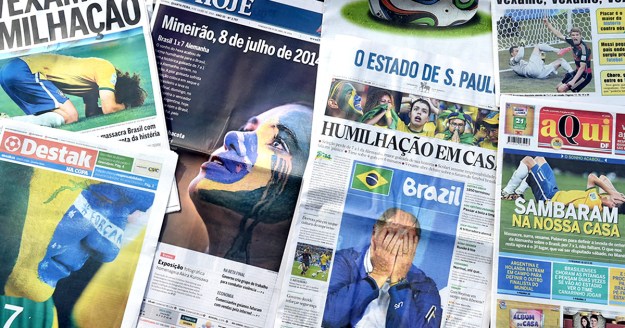
Humiliation, Honor, and Brazil

brazil-newspapers-FB
‘The morning after Brazil’s shocking, numbing 7-1 loss to Germany in the World Cup (which the commentators on ESPN have been instructed to call, robotically, the FIFA World Cup), my soccer-loving son mordantly read out English translations of the Brazilian headlines, which he had found online. All were brokenhearted—“FIASCO,” “AN EMBARRASSMENT FOR ETERNITY,” “EMBARRASSMENT DOES NOT EVEN BEGIN TO DESCRIBE IT,” and “WE CAN’T JOKE ABOUT IT: WE’RE TOO ASHAMED”—but the key word, over and over, was humiliation: “ULTIMATE HUMILIATION,” “HUMILIATING,” “FELIPE MISSES AND BRAZIL IS HUMILIATED,” “FROM DREAM TO HUMILIATION,” on and on like that.’ New Yorker

World Cup 2014: Brazil’s Neymar makes wheelchair claim

“Brazil’s Neymar broke down in tears as he claimed the challenge that ended his World Cup came close to paralysing him. The Barcelona forward, 22, fractured a vertebra in his spine when he was kneed in the back by Colombia’s Juan Zuniga during Brazil’s 2-1 quarter-final win. ‘I thank God for helping me, because if that blow had been a few inches lower I would have risked being paralysed,’ said Neymar.” BBC

YouTube: Brazil’s Neymar makes wheelchair claim

Most Memorable World Cup Moments

“The World Cup final between Germany and Argentina will take place on Sunday at 4 P.M. By now, many of us have watched an absurd amount of soccer, at the expense of work, family, and good sense. A few weeks ago, unwilling to break away from a close match, I resorted to streaming it on my iPhone while slaloming through a crowded train station, something I wouldn’t recommend.” New Yorker (Video)

Whether Wretched or Inspired, Title Match Often Provides a Jolt

“Apart from Germany, the Champagne fizz has suddenly gone flat at a World Cup that was being hailed earlier as the best in recent memory. Goals that seemed to pour from a spigot have now slowed to intermittent drips. The Netherlands once led the tournament with 12 goals, but it has not scored since the Round of 16. In Wednesday’s semifinal loss on penalty kicks to Argentina, the Dutch produced one shot on target. It was the lowest number for the Netherlands in a World Cup match since record keeping began in 1966, according to the Opta statistical service.” NY Times (Video)

25 of the best World Cup photos ever – in pictures

“Our sports picture editor, Jonny Weeks, has trawled the archives to pick out some of the best World Cup images ever taken. From the iconic shot of Diego Maradona taking on six Belgium players in 1982 – the real story of which can be read here – to the moment John Aldridge went berserk on the touchline at USA ’94, the shots range from the eye-catching to the unorthodox, the unforgettable to the bizarre. Beneath each image is a short explanation of why it made the cut.” Guardian

Brazil’s nightmare gets worse: Argentina to play for World Cup title

ARGENTINACUP-master675
“A bad week for Brazil just got worse. There’s not much that could make the humiliation of Tuesday’s 7-1 defeat to Germany feel even grimmer, but Argentina winning the World Cup at the Maracana would be unbearable. The holiest of the holies has already been defiled once, by Uruguay in 1950, but that would be nothing to the desecration of seeing Lionel Messi and his side celebrating there on Sunday. Whether that’s likely is another matter. Argentina will go into the final as the underdog, and understandably so, given the respective performances in the semifinals, but it will not capitulate against Germany as Brazil did. This may be a limited side, but it is one with great character and spirit, a cold-eyed willingness to get the job done.” SI – Jonathan Wilson

Argentina 0-0 Netherlands: Argentina through on penalties
“Sergio Romero was the hero after an extremely uneventful 120 minutes. Alejandro Sabella brought back Marcos Rojo after suspension, while Enzo Perez deputised for the injured Angel di Maria. Louis van Gaal was able to bring back Nigel de Jong after injury, meaning Daley Blind moved across to wing-back in place of Memphis Depay. There was obviously great tension here, but not much happened – of the 62 games at this World Cup so far, this game featured the lowest shot rate, and the lowest percentage of touches in the opposition third.” Zonal Marking

After Long Stalemate, Argentina Breaks Through in Shootout
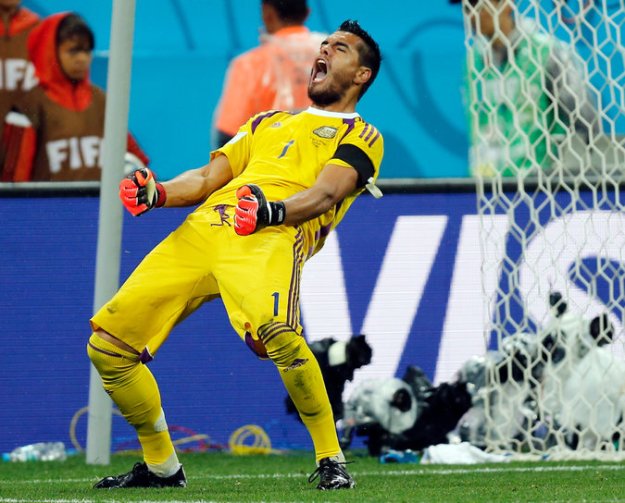
“Regulation and extra time brought 120 minutes of scoreless exasperation in a World Cup semifinal on Wednesday that was by turns tense, cautious, clumsy, gripping and stubbornly unyielding. There was little space to move, few chances to score. Sometimes the match was as dreary as the misty evening chill. If it possessed any beauty, it was not in gracefulness but in stark, struggling exertion. And finally, when grind and strain and labor could not bring a resolution, whimsy and caprice did. Argentina defeated the Netherlands by 4-2 on penalty kicks and advanced to Sunday’s final against Germany.” NY Times

Netherlands 0 Argentina 0 (Argentina win 4-2 on penalties)
“Argentina will meet Germany in Sunday’s World Cup final at the Maracana after winning a penalty shootout to eliminate the Netherlands.After 120 tedious and goalless minutes that were in stark contrast to the spectacular shock of the first semi-final between Brazil and the Germans, Argentina prevailed and a repeat of the 1986 and 1990 finals – when they played West Germany – will be played out in Rio. Goalkeeper Sergio Romero was the hero with penalty saves from Ron Vlaar and Wesley Sneijder, while opposite number Jasper Cillessen was unable to repeat the feats of his deputy, Tim Krul, in the quarter-final win against Costa Rica.” BBC

World Cup Pass & Move: Semi-Charmed Lives
“Two semifinal matches, one penalty shootout, one plain old one-sided shootout. As the World Cup draws to a close, we look at some of the characters who made the semifinal round so wonderful, weird, glorious, ponderous, and heartbreaking.” Grantland

Argentines Sing of Brazil’s Humiliation, Loudly and in Rio

“As the Brazil team has come spectacularly undone in the World Cup, the pain for the host country has been compounded by the prospect that its hated rival, Argentina, could still lift the championship trophy on Sunday in Rio de Janeiro’s fabled Estádio do Maracanã, after Argentina won a tense semifinal against the Netherlands in a penalty shootout on Wednesday afternoon. The tens of thousands of Argentine fans who have invaded Brazil to cheer for their team, and taunt their hosts, brought with them a song that predicts not just triumph for Argentina, but deep humiliation for Brazil. And the players themselves have joined the choir.” NY Times (Video)

29 Minutes That Shook Brazil

“It started, innocently enough, in the 11th minute. Thomas Müller, Germany’s top scorer at this World Cup, slyly slid around the back of Brazil’s defense. When the ball arrived from a corner kick, he blasted it home. The Brazilian fans who made up most of the crowd of 58,000 went quiet for a moment. But then, unbowed, they resumed their defiant chants. In Ceilândia, some 450 miles north of the Estádio Mineirão, a housecleaner shrugged. ‘After the first goal, our reaction was not too much of a shock because Germany is a strong competitor,’ said the housecleaner, Neide Moura de Brito do Nascimento, who was watching on TV with her family. ‘We already expected one or two goals from them.’ Nothing else about Tuesday afternoon followed anyone’s expectations. From that modest beginning, this country went on to witness something never seen before in World Cup soccer: Germany scored five goals — more than many teams scored in the entire tournament — in the first 29 minutes of a World Cup semifinal on the way to a 7-1 victory. Those 29 minutes will be scrutinized for generations in Brazil, poked and prodded and dissected the way Brazil’s dreaded defeat to Uruguay in the 1950 World Cup final has been.” NY Times (Video)

No More Tears

IMG_2531
This “Jesus Wept” photo became a meme in the aftermath of Brazil’s defeat yesterday.
“O Lachryma Cristi, what has happened to our weepy Brazilians? Since day one of this tournament, it seems, they have been in tears. As the technical director Carlos Alberto Parreira reported, ‘They cry during the national anthem, they cry at the end of extra-time, they cry before and after the penalties.’ The sports psychologist Regina Brandão was rushed in, but failed to stem the flow; then it was the Pressure! The Pressure! A nation’s hopes, et cetera, et cetera. And now this 7-1 pasting, the iconic gone-viral boy in the crowd, glasses pushed up, fingers pressed to eyes, sobbing into his Coca-Cola cup; and somewhere else not too far off, the pretty girl with tears streaming down her cheeks, rivulets slowly obliterating the Brazilian flags she had painted there.” The Paris Review – Jonathan Wilson

Why Brazil Lost
“Most people are terrible singers, and yet football crowds are good at picking out a tune. Crowds are often flat on the high notes and tend to rush the tempo, but generally the combination of thousands of wrongs adds up to one big right. The Brazilian national anthem last night was different. All around the Mineirão people stood and roared it so loud that their eyes bulged. The words resounded with startling clarity but much too loudly for any music to be heard. Down on the field David Luiz and Júlio César were holding aloft the shirt of Neymar like a holy relic. The camera picked out a woman holding a placard that read, “Don’t worry—Neymar’s soul is here!” It was as though Neymar had died and was looking down at his former teammates from heaven, rather than watching them on television. The collective emotional frenzy of the scene was awe-inspiring.” Slate (Video)

The World Cup Beyond the Stadiums
“The matches of the FIFA World Cup have played out before crowds in stadiums—some barely finished—throughout Brazil, but the passions of the tournament can, at times, be most acutely felt far from the stands. Here, David Alan Harvey captures scenes from the favelas of Rio de Janeiro to Copacabana Beach.” New Yorker (Photo)

Why Brazil Crumbled
“Peeling back the layers of expectation. The weight of…a team. ‘A player plays for more than himself.’ That’s a common maxim echoed throughout dressing rooms across the globe. Players are also expected to play for teammates, families, communities, countries, continents, gods, and local bodega store owners probably. Every player on a World Cup team has shouldered a cross-section of these burdens on top of self-imposed expectations and demanding, perpetually looming coaching staffs armed with lots of professional badges. And the better the player, the more that weight is amplified. If a player is that good, he can become a meal ticket for all involved. All of that weight can rest on a selection of moments and touches. A final touch ending up in a net or in the lap of a cerveza-guzzling spectator can be the difference between being heralded in tribute videos or becoming an internet sensation for all the wrong reasons. This is the burden of performance, the burden of play.” Fusion

World Cup Tactical Analysis | Brazil 1–7 Germany: Germany run riot to trounce Brazil

“While Brazilians still talk about 1950 with disappointment and horror, what transpired at the Belo Horizonte will bring nightmares to the South Americans for years to come. Aman Sardana analyses what happened, and what went wrong. The enormous pressure, the inflamed anticipation, one nation’s obsession and hysteria amassed on the shoulders of a fervent and useful but ultimately imperfect team. They snapped under the stress, no doubt, but there was more to this than just pressure, or flawed tactics and team choice, or incompetent positional play, or a first-rate German squad filled with incisive passers and composed finishers. It was all of those things, and yet more. A first-half goal barrage saw Die Mannschaft 5-0 up, Miroslav Klose procured his record-breaking 16th strike at the finals and the cruelty prolonged into the second period with Schürrle coming off the bench and bagging a brace. Mesut Özil missed a one-on-one to make it 8-0, moments before Oscar netted a consolatory hit in the final minute of the first semifinal of World Cup 2014. But as it was, in 30 obscene first-half minutes, the Brazilian dream was over. Outside of the Boot

World Cup Players to Know: Argentina Goalkeeper Sergio Romero

“In the John Hughes high school class version of Argentina’s national team, Lionel Messi is the quiet, smiling genius who wins over all the teachers through his sheer brilliance. Ángel di María plays the fragile cello prodigy, performing out there in the wings of the gymnasium before cutting in with his jaw-dropping skill. Sergio Agüero is a legend in his own time for getting it on with the principal’s daughter, in this case Giannina Maradona, child of Diego, to whom the Manchester City forward was married for four years before splitting off and getting called a wimp. (Mr. Hand of God himself needs better writers.) As for Sergio Romero, well, Sergio Romero would no doubt like to remain unseen in the corner.” Grantland (Video)

Thirty-One Nil

“No sport generates extremes of passion like football. And for football, there’s no bigger stage than the World Cup finals, every four years. The road to Brazil 2014 started in 2011 with hundreds of qualifying games in every corner of the world. For teams, players and fans, the games represent national identity, sometimes against backdrops of war, riots and revolution. ‘Thirty-One Nil’, a new book by British author James Montague, chronicles these extremes of hope, joy and despair — sometimes very personal, sometimes felt by entire nations. … Nick Wrenn, editor-in-chief, CNN” CNN

amazon: Thirty-One Nil: On the Road With Football’s Outsiders: A World Cup Odyssey by James Montague

Thirty One Nil: A Book About The Ones We Won’t See in Brazil: Book Review

O Jogo Bonito

“A little more than halfway through Brazil’s horrible, galling victory over Colombia last Friday, I began to wonder what type of foul might actually persuade the Spanish referee Carlos Velasco Carballo to issue a yellow card: A studs-up, two-footed, kung-fu fly-kick to the chest, like the one launched by Eric Cantona against a fan in the stands back in 1995? Any one of the number of egregious fouls, including punches to the head, committed by Italy against Chile, and then by Chile on Italy, in the infamous Battle of Santiago in World Cup 1962? Maybe multiple Suárez-type bites by a hyena pack of players on a prostrate Colombian felled by a scything tackle might have done the trick.” The Paris Review – Jonathan Wilson

Germany 7-1 Brazil: Germany record a historic thrashing, winning the game in 30 minutes

germany-humiliate-brazil-7-1-e1404868594956
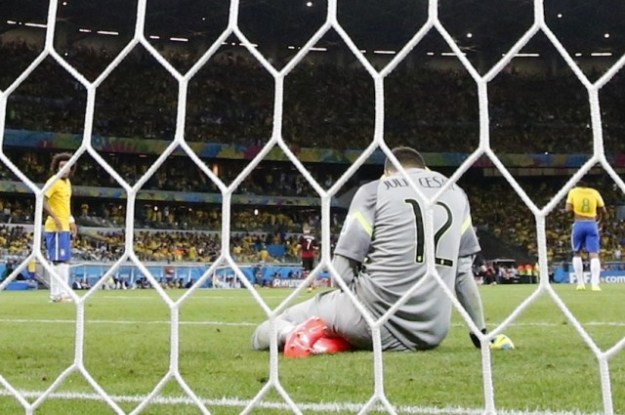
“In one of the most incredible matches in World Cup history, this ridiculous scoreline was an entirely fair reflection of Germany’s dominance. Jogi Low named an unchanged side from the XI that had narrowly defeated France in the quarter-final. Luiz Felipe Scolari was without the suspended Thiago Silva, and the injured Neymar. Dante was the obvious replacement at the back, while tricky winger Bernard was a surprise choice to replace Neymar, with Oscar moving inside to become the number ten. Luiz Gustavo returned after suspension, with Paulinho dropping out. Incredibly, this game was finished after half an hour – it was 5-0, and Brazil were simply trying to avoid further embarrassment.” Zonal Marking

Brazil 1 Germany 7
“Brazil’s World Cup dreams ended in humiliating and brutal fashion as Germany inflicted their heaviest defeat in the first semi-final in Belo Horizonte. A thunderous occasion that began with Brazil riding a tidal wave of emotion was reduced to a nightmare as Germany were 5-0 up inside 29 remarkable minutes in front of a disbelieving Estadio Mineirao crowd. Brazil’s players mourned the absence of the injured Neymar before kick-off, but captain Thiago Silva was an even bigger loss. The result was their first competitive home defeat in 39 years, and the end of their hopes of making it to the World Cup final at the iconic Maracana on Sunday.” BBC

Germany Scored Three Goals in 76 Seconds and Four Goals in Four Minutes
“Everyone, including Slate, has noted that Germany scored five goals in an 18-minute span on Tuesday. That figure, though, understates what the Germans accomplished. For a good portion of that 18 minutes, the ball wasn’t in play because it was sitting in the back of the net and Die Mannschaft was celebrating. The ESPN broadcast made it hard to determine how fast Germany had scored in actual game time, as the copious goal replays were always butting in to the on-field action. In order to get an accurate count, I rewatched the first half using ESPN’s ‘tactical cam’ replay, which shows the game from above and affords a clear view of each goal and the precise moment when play subsequently resumed.” Slate (Video)

Goal, Goal, Goal, Goal, Goal, Goal, Goal, and Brazil’s Day Goes Dark
“The fireworks began at dawn. All around this city, loud pops and bangs rang out as men and women and children, so many dressed in yellow, set off flares and beeped car horns. It was supposed to be a magical day. The Brazilian national soccer team, playing at home, was one game away from a World Cup final. No one could have guessed the tears would come before halftime. No one could have imagined there would be flags burning in the streets before dinner. Certainly no one could have envisioned that any Brazilian fans, watching their team play a semifinal in a celebrated stadium, would ever consider leaving long before full time.” NY Times

Let the Recriminations Begin in Brazil, and Let Them Begin with Scolari
“Then Brazil lost a relative squeaker to France in the finals of the 1998 World Cup, the country’s congress held intensive investigations and hauled some of its most storied athletes before a panel of preening politicians. Conspiracy theories swirled that cast blame in all directions—one widely held notion attributed the defeat to the machinations of Nike. The questions were irrational but give some hint of the mindset of a defeated Brazil and foreshadow the ugly recriminations that will follow this ugly defeat.” New Republic

Nation in Despair
“… Everyone knew it would be difficult for Brazil without the injured star Neymar and the suspended captain, Thiago Silva, but nobody imagined this feeble capitulation — four goals surrendered to Germany in six minutes during a 7-1 rout in a World Cup semifinal. Early on, Brazil’s players bickered, lost their cool, then lost their fight. The country of the beautiful game was left to face a grotesque humiliation. Luiz Felipe Scolari, the coach, flung his hands in disgust amid the flurry of early German goals. Marcelo, a defender, put his hands to his face in embarrassment and disbelief. A boy and a woman cried in the grandstand beneath their glasses, appearing stunned and overcome on camera.” NY Times (Video)

Is Arjen Robben a Jerk, or Does He Just Suffer From Jerk Face Syndrome?

Name: Arjen Robben Home country: Netherlands Known for: Cutting inside and shooting with his left foot, diving, apologizing for diving, diving after apologizing for diving, promising not to dive again, diving after promising not to dive again, inspiring memes, Jerk Face. Why he might be a jerk: He looks like a pretty big jerk. The main manifestation of this jerkiness is the way his entire body explodes in apparent death throes every time he’s touched or nearly touched in the penalty area. His theatrics at the 2014 World Cup have set off this year’s version of the perennial hand-wringing over diving and whether it ruins soccer.” Slate (Video)

Neymar’s Injury Sidelines Effort to End World Cup Racism

“After an episode in Peru earlier this year in which Peruvian soccer fans subjected a Brazilian player to racial abuse by imitating the sounds of monkeys, President Dilma Rousseff of Brazil swiftly pledged a ‘World Cup against racism,’ declaring, ‘Sports should be no place for prejudice.’ Yet when Brazil’s top player, Neymar, broke a vertebra when he was kneed in the back during a match on Friday by a Colombian player, the torrent of racist insults against the Colombian, Juan Camilo Zúñiga, showed how far the host of the World Cup remains from achieving that goal.” NY Times

An Argentine Army Grows in Brazil

“As the Albiceleste goes deeper into the tournament, its fan base gets bigger, louder, and even more unbearable to Brazilians. Until recently, the biggest fan mobilization in Brazilian soccer history arguably came on September 5, 1976, when 70,000 Corinthians fans travelled the 300 miles from São Paulo to the Maracanã in Rio de Janeiro to see their team beat Fluminense in the Brazilian championship playoffs. Twenty-eight years after the Invasão Corintiano, another fan invasion is making headlines in Brazil. There were an estimated 20,000 Argentinian fans at the Maracanã in Rio de Janeiro for Alejandro Sabella’s team’s opening game against Bosnia and Herzegovina, including 50 or so ticketless gatecrashers who jumped over a wall into the stadium. The number had swelled to 30,000 when Messi and co. reached Belo Horizonte for their second game against Iran, and 70,000 hermanos, as Brazilians call their neighbors,swarmed across the border into Rio Grande do Sul for Argentina’s final group stage game against Nigeria.” Fusion

Spain ’82: My First World Cup

“The first World Cup I remember was Spain ’82. I was eleven and in my fifth year of primary school and living at the Holy Child Teacher Training College, in Ikot Ekpene, in southern Nigeria, where my mother taught home economics. This is about an hour from my village. It was two years since I watched Nigeria’s Green Eagles (as they were called then) defeat Algeria to lift the African Cup of Nations for the first time, in 1980. I remember the three goals against the Desert Foxes, or Les Fennecs, by Segun (Mathematical) Odegbami and Muda Lawal and the celebrations that swept through the land. The image of our captain, Christian (Chairman) Chukwu, lifting the cup after the game was something to behold.” New Yorker

Neymar’s cultural significance to Brazil transcends soccer, World Cup

neymar1
“Tweets of sympathy and support from Brazilian president Dilma Rousseff to Kobe Bryant and everyone in between, including super models (Gisele Bundchen), Olympic sprinters (Usain Bolt), footballers (Ronaldo and Lionel Messi) and soap opera stars (too many to mention). Hours of TV coverage devoted to detailed analysis of spinal columns and estimated back injury recovery times. More hours of TV coverage dedicated to discussion of whether Colombian defender Juan Camilo Zuniga’s crushing, knee-raised challenge was premeditated or not (the debate oscillating between ‘a normal part of soccer’ and ‘a cowardly assault’). FIFA Fan Fests all over the country, filled with supporters who minutes before had been wildly celebrating Brazil’s 2-1 World Cup quarterfinal win over Colombia, falling still and silent. On Friday evening, Brazil turned its lonely eyes to Neymar da Silva Santos Junior.” SI

How have Germany tactically set-up so far in the World Cup?

“With the recent domination of German football at club level, Germany were marked as favorites in this World Cup. With a highly talented squad, Low was expected to recreate the incisive and dominant football that Germany were known for. Questions have loomed about where Lahm would start for Germany, how they could deal with the scarcity of out an out strikers and the soft spots in the wider areas of defense. Big things are expected from this German squad and here is how they have lined up so far in this tournament.” Outside of the Boot

How have Brazil tactically set-up so far in the World Cup?
“Prior to the start of this tournament, followers of the Selecao were well aware of the tactics Luiz Felipe Scolari will employ for the side. Though the squad seemed weak, it didn’t surprise many that impressive performances from some Brazilians didn’t earn them a spot in the squad as pragmatic Scolari stuck to his tried & tested team. This piece on Brazil’s tactical set-up prior to the start of the tournament was spot on. This was the case for any Brazilian supporter, as the formation & system was well known before the first ball was kicked, and there has been little change.” Outside of the Boot

Germany Must Out-Invent Brutish Brazil: A Bizarre-But-True Semifinal Preview

“Germany and Brazil are the two most successful teams in World Cup history, so it’s funny to think that they have only met once before in the tournament. That was in the 2002 final, when Brazil claimed its fifth trophy and Ronaldo topped the all-time goal-scoring charts. It was also, incidentally, the day a certain Philipp Lahm, then 18 years old, and Bastian Schweinsteiger, 17, made it to the German youth championship final for Bayern Munich. Sitting on the bus back to Bavaria, Lahm and Schweinsteiger probably could not have imagined that 2002 would be their country’s last international tournament without them. Now, 12 years later, these twin hearts of the German team will line up on Tuesday in the semi-final against Brazil in the hopes of erasing their nation’s reputation as the eternal also rans.” New Republic

Brazil’s Only Hope to Take This World Cup: Win Ugly

“There are three contradictory narratives getting batted around about Brazil’s foul-plagued, back-breaking 2–1 quarterfinal victory over Colombia. The first, one that’s being pushed by the Brazilian press, is that Neymar was assaulted by brutish Colombian defender Juan Camilo Zúñiga, whose late-game challenge was reckless and cowardly. (Sample headlines: ‘Stabbed in the back’ and ‘Damn Colombian.’) An alternate view, one articulated by the New York Times’ Sam Borden among others, is that Brazil got what it had coming. Borden believes that Neymar’s fractured vertebra was the logical conclusion of Brazil’s decision to play a dirty game, and of referee Carlos Velasco Carballo’s refusal to keep the foul-happy Seleção in check. The third perspective, laid out by Forbes’ Bobby McMahon, is that Colombia was the team that came out fouling, that the referee didn’t do much of anything wrong, and that Neymar’s World Cup-ending injury was an unfortunate accident rather than a violent inevitability.” Slate (Video)