Tag Archives: Brazil

Sao Paulo metro strike suspended for two days

skXgJ.SlMa.55
“Metro workers in Brazil’s largest city, Sao Paulo, have suspended a strike over pay to allow for negotiations. The five-day stoppage had caused traffic chaos in one of the world’s most congested cities just days ahead of the football World Cup. The union warned that the strike would resume on Thursday – when Sao Paulo hosts the opening match – if its demands are not matched. A strike would make it hard for fans to reach the stadium on Thursday.” BBC

Diamonds in the Rough

“The human body is 18 percent carbon, which means that if you subject it to high enough pressures at high enough temperatures and hold it there for a long enough time, it will form diamonds. You can try this yourself, in a laboratory. All it takes is, say, a pound of human ash, more than 4,000 degrees Fahrenheit, and 60,000 times the standard atmospheric pressure of Earth at sea level. Extract carbon, bake, compress. Check back in a few weeks. Not a DIYer? No problem. Just FedEx your burial urn to one of the many Internet-facing memorial-diamond companies that have sprung up in the last few years. For between $2,500 and $25,000, outfits like Chicago’s LifeGem and Switzerland’s Algordanza will take the cremated remains of your loved ones and return them, presto chango, in the form of wearable jewelry.” Grantland – Brian Phillips

The World Cup Is About to Begin, and FIFA’s Reputation Has Never Been Worse

sepp
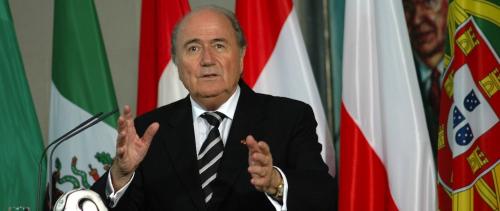
“With the World Cup kicking off this Thursday, the month of June should be FIFA’s moment in the sun. Instead, the skies continue to darken over soccer’s international governing body. It all started on June 1, when The Sunday Times exposed that Mohamed bin Hammam, a former member of FIFA’s executive committee, had secretly bribed soccer officials worldwide nearly $5 million in an attempt to win votes for Qatar’s successful bid to host the 2022 World Cup. This wasn’t the first corruption charge leveled at bin Hammam: he was banned from FIFA in 2012 on charges of bribery, though the decision was later overturned.” New Republic (Video)

Sao Paulo police tear gas protesters

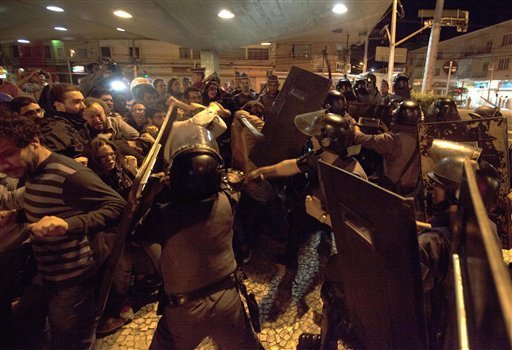
“Brazilian riot police have used tear gas against protesters in Sao Paulo, three days before the World Cup opening game in the city’s main stadium. The BBC’s Katy Watson at the scene said about 300 demonstrators were there and helicopters circled overhead. The protest was called by Sao Paulo metro workers who are striking in support of a 12.2% salary increase. Brazilian President Dilma Rousseff has said she would not allow violent demonstrations to mar the World Cup. Sao Paulo metro workers have been on strike since Thursday, creating traffic chaos in one of the world’s most congested cities.” BBC (Video)

Racism on soccer field in Brazil still hidden not so deep beneath surface

“RIO DE JANEIRO — Close to the geographical heart of Brazil, in the little-known state of Tocantins, soccer players remonstrated with a referee over a decision. Tensions ran high at the state championship match in the small town of Peixe, and in the midst of the ruckus, an official observer called an Afro-Brazilian player a ‘monkey.’  The incident barely made a ripple outside the town of 9,000, and police ignored the victim, a middle school teacher. But as Brazil pulled behind its defender Daniel Alves after a banana was thrown in his direction while he was playing for Barcelona, the episode in Tocantins revealed the country’s complicated relationship with racial identity.” Al Jazeera

World Cup 2014: Rio horror show or a samba sensation?

“Last time the World Cup was held in Brazil, in 1950, it was designed as the propaganda centre-piece of Getúlio Vargas’s Estado Novo, the concrete sweep of the Maracanã, a modernist wonder that would be reflected in Oscar Niemeyer’s designs for the new capital, Brasília. Football, though, can be delightfully unpredictable and rather than consecrating the new Brazilian state, the World Cup offered a national disaster – ‘our Hiroshima’, as the playwright Nelson Rodrigues tastelessly put it – as Brazil, needing only a draw in the final game to seal the title, were beaten by Uruguay.” Guardian – Jonathan Wilson

Brazil will not be perfect but there should be much to savour over the coming weeks

“Inspired by the idea of covering the 2014 World Cup, Danish journalist Mikkel Jensen studied Portuguese and based himself in Brazil to observe the build up to the big kick off on June 12. But in the middle of April he went back home, proclaiming that ‘the dream has become a nightmare.’ He had come to the conclusion that the tournament was doing nothing to help the ordinary Brazilian – indeed, he felt that in some cases it was even making things worse, and he no longer wanted to be part of it.” World Soccer – Tim Vickery

The World Cup Soundtrack

favela5-jumbo
“The volume rattles the bones. The gyrations evoke scenes of lustful abandon. In some of funk’s most explicit forms, tracks sprinkled with the prerecorded sounds of machine-gun fire exalt the drug gangs still in control of some of Rio de Janeiro’s favelas. On certain nights, the bass from the amps resonates from the hillside slums into the bastions of the privileged classes, as if to remind them: Rio doesn’t belong just to you.” NY Times

Brazil’s politicians banking on World Cup victory to help soothe unrest

“Since 1994, World Cups and presidential elections have taken place in the same years, creating an unintended but poetic synchronicity between football and politics. In 1994 the Tetra [the fourth time Brazil won the World Cup] was followed by the election of the centrist Fernando Henrique Cardoso, a cosmopolitan former sociology professor, who served for eight years. In 2002 the Penta was followed by the election of the left-wing Luiz Inácio Lula da Silva, a former shoeshine boy and lathe operator, who also served two terms.” Guardian

A central defensive decline?

th
Thiago Silva
“Major international tournaments are generally underwhelming in terms of attacking football, with managers preferring to play cautiously, keep it tight at the back and then spring quick counter-attacks. This approach, which we can expect at the 2014 World Cup, has delivered more cautious, subtle defending — to the point where some may question where all the highlight-reel worthy tackles among centre-backs have gone.” ESPN – Michael Cox

Croatia, a Work in Progress

Darijo_Srna_-_Croatia_vs._Portugal,_10th_June_2013_(3)_(crop)
Darijo Srna, Croatia
“Next Thursday, Croatia has the privilege of playing the World Cup’s opening match against Brazil, the host nation. The Eastern European country gets to take on a team that has won the World Cup a record five times—and is this year’s favorite—before nearly 70,000 people in São Paulo’s brand new Itaquerao stadium. The game is the first World Cup match to take place in Brazil since 1950, when the country last hosted the event. Brazil was the favorite that year, too, but it lost in the final in a shocking upset to Uruguay—and the country has never forgotten it.” The Paris Review

World Cup 2014: Brazil – is tactical fouling crucial to their chances?

“A fascinating piece of data emerged from the Confederations Cup – the player who committed the most fouls in the tournament was Brazil striker Neymar. The 22-year-old – also the most fouled player – committed 17 infringements during the 2013 competition, closely followed by team-mate Oscar (14). That Neymar was the most fouled player will come as no surprise, for two reasons. Neymar, who joined Barcelona from Santos last summer for £48.6m, is a wonderfully talented dribbler, superbly balanced and capable of changing direction at pace. On form, he is a defender’s nightmare.” BBC – Tim Vickery

The war against the World Cup and the Olympics

dt-common-streams-streamserver
“It must be strange for people who are used to see Brazilians as a smiley and youthful nation, proud of its country’s sporting exploits, to learn that most of them are hating to host the Olympics and the World Cup. While the costs are astronomical and no one knows for sure who actually benefits from these soulless mega-events centred on big business, very few countries get the privilege of hosting them and doing so usually is a matter of big national pride. Brazil seems to be an exception, and the question that comes to mind is why. Ask the average Brazilian and he will give you the standard answer: The anger is because the government decided to throw money on these useless events instead of investing in hospitals, schools and infrastructure.” Lost Sambista

Beyond samba, sex and soccer: The World Cup riots in Brazil
“Only 22 years old, the footballer known simply as ‘Neymar’ is far more than the ‘face of Brazilian soccer’. Since donning the iconic, canary yellow and blue kit for the first time, Neymar has sidestepped defenders as if dancing the samba, and raced up and down the pitch with the cavalier and carnival spirit definitive of Brazilian football. As Neymar sprints into his prime, Brazil is primed to host its first World Cup in 64 years. This year’s tournament, furnishes the Brazilian government with a rare opportunity to showcase its greatest export on its home soil. Brazil and football are synonymous: A conflation the state has engineered to carry forward its policies inside and outside of the country. Its iconic lineage of soccer stars, starting with Pele and ending with Neymar, provide the state with single-named ambassadors known and loved all over the world.” Aljazeera

Brazil’s evicted ‘won’t celebrate World Cup’
“Every four years, Brazilians decorate their streets in green and yellow, celebrating the arrival of the most anticipated sports tournament in the country. With the kick-off for the FIFA World Cup in Brazil less than one month away, the country’s passion for football should be pulsating more than ever. But there are some signs to the contrary. ‘World Cup for whom?’ read the words painted on a wall on a street in Sao Paulo. Many in Brazil’s middle class are unhappy with the effects the World Cup has already had on their lives. The cost of living has risen in the cities hosting the games, traffic jams have worsened, and a construction boom aimed at improving urban mobility has only compounded problems, they say.” Aljazeera

Eric Cantona: Fifa’s corruption divides Brazilian football from its roots
“It will surprise precisely no one who has taken even a passing interest in his life and career, but Eric Cantona is no great fan of football’s governing bodies. Having recently returned from Rio de Janeiro, where he has been making a documentary about Brazilian football and politics that will receive its UK premiere at Amnesty International’s Sidelines film festival next month, he has a jaundiced view of Fifa’s modus operandi.” Guardian (Video)

Police Repression of Indigenous Protest Against Brasil’s World Cup
“Hundreds of indigenous people and thousands of supporters peacefully marched towards the National Mane Garrincha Stadium in protest of the upcoming World Cup in an effort to block the roads. They were met by riot police and Military Cavalry Police of the Federal District on the afternoon of Tuesday the 27th. The demonstration, which had the support of hundreds of Indians left the Pilot Road, but was surrounded by police personnel about 100 meters from the arena to receive seven games of the World Cup 2014. Police blocked the march and soon were using tear gas, sound grenades and rubber bullets on people to violently disperse the protest march.” Revolution News!

Brazil Is Tired of Being Scolded
“By now, Brazil should probably have been grounded for life, without video games or dessert. Last month, a vice president of the International Olympic Committee, John Coates, said that Rio de Janeiro’s preparations for the 2016 Summer Olympics were the worst he had ever seen. Before that, Sepp Blatter, the president of FIFA — the International Federation of Association Football — claimed that Brazil was further behind in its preparations for this summer’s World Cup than any previous host nation, even though it had had seven full years to prepare. Then, in March, FIFA’s secretary general, Jérôme Valcke, declared we could risk being ‘the worst organizers’ of the ‘worst event.’ He had previously said that Brazil needed “a kick up the backside.” Well, that was harsh.” NYT: The Opinion Pages
Can Goldman’s economists predict who will win the World Cup?

media_httpdldropboxco_xyBEr
“The economists at Goldman Sachs apparently can’t wait for the beginning of the World Cup next month. They issued a 60-page report — billed as ‘an unnatural mix of football and economics’ — with detailed analyses of each team and a forecast for outcome of the tournament. Now we know what they’ll be doing once the matches begin in Brazil. Brazil, the host country, is strongly favored to win the championship, according to Goldman’s predictions. These predictions are derived from a formula that estimates the number of goals a team is likely to score in a game based on its past performance as well as on a few other factors, such as whether the team is playing at home. Brazil’s home-field advantage is a major reason why Goldman expects it to do so well.” Washington Post

[PDF] The World Cup and Economics 2014

Bosnia: Divided by war, united by football

Žilina, Slovakia, September 2013. Slovakia’s third largest city is close to the Low Tatras Mountains, the natural border with Poland. The cold wind and rain hint at snow and winter’s early arrival. On the pitch, the Bosnia national football team is training in silence ahead of their next World Cup qualifier against Slovakia in 24 hours’ time. Their coach, Safet Sušić, buried deep in a thermal jacket and hood, is being soaked by a nagging drizzle. The 50 or so Bosnian journalists watching in the stands shuffle their feet and chain-smoke to keep warm. But they, too, watch in silence. No one – not the players, the coach or the journalists – looks as if they want to be here. Which is strange. Bosnia are currently top of Group G in World Cup qualification.” CNN – James Montague

How Soccer Used to Explain Brazil

“Beginning in 1938, when Brazil sent its first integrated team to the World Cup, the players chosen to represent the Seleçao have also represented the country in terms of its ethnic, social, and religious makeup. The current crop of stars still mirror changes to Brazilian society, but in certain ways they have also come to represent the country’s upper class—the very target of Brazilian protestors.” Fusion

Brazil’s World Cup training starts amid protests

“Brazil’s national team has started its World Cup preparations amid protests in Rio de Janeiro. A bus bus carrying the players to its hilltop training camp was surrounded by striking teachers chanting slogans against the tournament. Later, upon arriving at Granja Comary, players were greeted by fans – and more protesters. Thousands of people have protested against the cost of staging the tournament beginning next month.” BBC

‘The Greatest Victory’

“Elmo Cordeiro is 80 now, but he still stands ramrod-straight, with a ready smile and eyes that shine under a set of bushy gray eyebrows. It isn’t hard to turn back the clock and imagine him 64 years ago, his white hair a darker shade, his skin wrinkle-free, his compact frame darting around the edge of a soccer field chasing down errant balls. In 1950, Cordeiro was a ballboy at the Estádio Independência here in Belo Horizonte, Brazil—stationed yards away from the historic goal itself—for perhaps the most famous upset in the 84-year history of the World Cup.” SI (Video)

Duel: Is the World Cup a poisoned chalice?

“To describe the World Cup as a ‘poisoned chalice’ for the host nations is to ignore the fact that its value goes beyond the economic—it brings people and nations together. It’s also a fantastic platform from which to spread the message that racism and homophobia in sport are wrong. I’m not denying that it costs a huge amount of money to host the World Cup but Brazil currently has the seventh largest economy in the world, is rich in natural resources and has a population of over 198m people. It is a nation that loves football and has a strong tradition of excellence in the game; this event has forced them to upgrade their stadiums and ensure they maintain a world-class standard. It has also made it essential for the Brazilian government to improve the nation’s infrastructure. Brazil is supposed to be this new country coming out and showing the world how powerful they are. I believe that hosting the World Cup will, in the long term, be a huge benefit to Brazil’s economy and global status.” Prospect: Sol Campbell and Simon Kuper

2014 World Cup in Brazil

“This summer, 32 countries will compete in the 2014 World Cup in Brazil. Although each country has distinct histories, customs, and cultures, soccer ties these countries together and bridges their differences. Thus, soccer acts as a mode of universal language or, perhaps, even transcends language, due to its simplicity and global appeal. As a ubiquitous sport, soccer appeals not only to players, but also to millions of fans—some of who play soccer and others of who have never played. For four years, these fans wait anxiously for the quadrennial World Cup, which attracts more fans than any other sporting event in existence. This blog page is a background and travel guide for all of those fans who plan to travel to Brazil to witness the spectacle firsthand. It is also a useful resource for those fans that will witness the event on television and might want additional insight into the Brazilian culture and history that make this summer’s World Cup so meaningful. We hope you enjoy our guide and find it useful in answering any questions you may have. Enjoy Brazil, savor the exhilarating soccer matches that are sure to take place and, for those of you making the journey, safe travels!” Soccer Politics

Body Politic: Contemporary Art and Culture In Rio


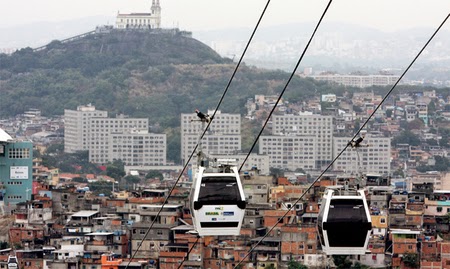
Gondola lift, Complexo do Alemão, Rio de Janeiro, July 7, 2011.
“FOR THIS ISSUE’S Dispatch, Artforum goes south, to Rio de Janeiro—a city as defined by myths of sensualist extravagance as it is by horror stories of yesterday’s military dictatorship and today’s slum violence. Yet one does not have to subscribe to cliché to recognize that Rio is somehow singular; that, in the past half century alone, it has been a place of extraordinary innovation and devastation alike, from the decadent inventions of bossa nova and Tropicália to the human-rights abuses of the postwar period and the unsettling rise of the modern favela in the 1970s. Such paradoxical histories are still with us: This year, as Rio prepares to host the World Cup in June and gears up for the Summer Olympics in 2016, spending astronomical amounts on infrastructural changes and in many instances attempting to eradicate portions of the favelas, it also observes (without celebrating) the fiftieth anniversary of the 1964 coup that brought the military to power.”
ARTFORUM, GUILHERME WISNIK, IRENE V. SMALL, DANIEL STEEGMANN MANGRANÉ

Brazilian anti-World Cup protests hit Sao Paulo and Rio

“Riot police in Brazil have fired tear gas to disperse thousands of protesters in Sao Paulo and Rio de Janeiro who marched against the cost of hosting the football World Cup. Some demonstrators hurled stones while other burned tyres and blocked roads. They say they are angry that billions of dollars are being spent on next month’s football tournament, rather than social projects and housing. Protests also took place in many other cities, including the capital Brasilia.” BBC

World Cup 2014: police will wear ‘Robocop’ style suits of armour to protect themselves

Brazil-Robocop_2909949b
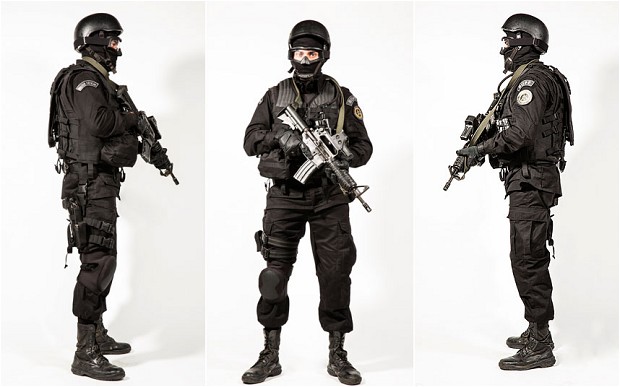
“World Cup police in Rio de Janeiro will be kitted out in a ‘RoboCop’ style suit of armour to protect officers in the event of violent protests during the tournament. Members of a special unit set up for the World Cup and 2016 Olympics in Rio received 200 sets of the special 22lbs (10kg) protective equipment, which is flame resistant to up to 427C.” Telegraph

2014 Fifa World Cup draw: Guide to Group A

Luiz-Felipe-Scolari
“Gary Lineker’s verdict. … Style & formation: The flicks and tricks remain second nature, but this Brazil side is also resilient and well organised, moulded by the pragmatism of 2002-World Cup winning coach Luiz Felipe Scolari. They press the opposition high up the pitch, while midfielder Luiz Gustavo acts as an auxiliary third centre back – allowing the full-backs and the likes of centre-back David Luiz to venture forward. Brazil usually adopt a 4-2-3-1 formation and are not afraid to be direct, often seeking out the flamboyant Neymar on the left with long balls from the back. …” BBC – Group A: Brazil, Croatia, Mexico, Cameroon

Game of two halves: the ugly side of Brazilian football

“In 1958 a Brazilian team starring the black teenager Pelé and several other dark-skinned players won the country’s first World Cup. After the victory, wrote the playwright Nelson Rodrigues, ‘I saw a small black woman. She was the typical slum dweller. But the Brazilian triumph transformed her. She walked down the sidewalk with the charm of Joan of Arc. The same was true for black men, who – attractive, brilliant, luxurious – seemed like fabulous Ethiopian princes.’ Brazil, said Rodrigues, ‘was no longer a mongrel among nations’. Football has helped Brazil construct its national identity. The game also functions as a lens on to this poorly understood country. Football helps us see Brazil’s beauty, its ugliness and the usually ignored lives of the Brazilian poor. Admittedly, most accounts of Brazilian football omit women but so, for much of history, did Brazil’s public sphere. So what does football reveal about Brazil?” FT – Simon Kuper.

Scolari given easy ride over Brazil World Cup squad

“The press conference at which Luiz Felipe Scolari announced his World Cup squad was arguably the easiest 45 minutes the veteran Brazilian coach has ever faced. The 23-man list named was largely devoid of controversy as the assembled media patted friendly questions in his direction. Scolari himself recalled that by contrast in 2002 he had to change hotel at the last minute to free himself from media intent on pursuing the issue of the non-selection of Romário, one the heroes of the 1994 World Cup win.” WSC

The next big talent coming through from Brazil – Gabigol!

“A certain 17-year-old kid from Brazil, more specifically Santos, has been doing the rounds in the footballing world over the past few months. Here’s a Scout Report on the latest sensation from the nation that produces the most exciting talents in the world. His name is Gabriel Barbosa, commonly known by the nickname Gabigol.” Outside of the Boot

Schizophrenic Brazil hopes World Cup works its magic

protestors
“‘I see the enthusiasm outside Brazil,’ said Ronaldo at the end of March in his capacity as a member of the World Cup Local Organising Committee. ‘I’m very happy when I see that same enthusiasm here as well.’ The very statement hints that the commodity might be in short supply; that the apparent dream relationship between the World Cup and the Brazilian people is on the rocks and in need of marriage guidance.” World Soccer – Tim Vickery

Edin Dzeko and 5 Bosnia-Herzegovina World Cup Players to Watch in Brazil

afc664a018283a0acad96addb058f_crop_north
“Safet Susic will face journalists next Monday and recite 23 names that will be on the passenger list on the flight to Rio. However, not many surprises are expected. On more than one occasion, the man himself admitted that his selection is very limited and that he has to rely on the team that he had in the qualifiers. The difference in quality between first-choice players and their alternatives is huge, so Susic has pinned his hopes to a nucleus that has been built in the previous three campaigns. This is the same generation that lost to Portugal in the play-offs twice, but also had France on the ropes in Paris in 2011 when a controversial Samir Nasri penalty denied them a place in Poland and Ukraine.” Bleacher Report

Brazil 2014 – Messi’s crowning glory?

“When Lionel Messi received the honour of a fourth successive Ballon d’Or in January 2013 the record books had been rewritten. The Argentinian forward had surpassed Michel Platini’s haul of three successive FIFA World Player of the Year awards with Juventus and cemented his place as one of footballs all time greats at a mere 25 years of age.” backpagefootball

Is Samba fullback Wendell ready to waltz yet?

“German clubs, and Bayer Leverkusen in particular, have a long tradition of acquiring Brazilians. The latter club has also been very successful in doing so. Lúcio, Zé Roberto, Paulo Sérgio, Juan, Jorginho, Renato Augusto, França and Emerson each played over 50 matches for Die Werkself, most of them have even featured in over 100 games. Robson Ponte, another canarinho who had two periods in the outfit from North Rhine Westphalia, even got a techno tune of his own. Considering that only the most successful Brazilians are mentioned here, it’s safe to call Leverkusen a good destination for the boys from Brazil.” Bundesliga Fanatic

Chile tactics will ask a lot of the Socceroos

“In the final of the 2004 Copa America in Peru, Argentina dominated an experimental Brazil side. With three minutes to go La Albiceleste went 2-1 up. Surely the title was won. But with the last kick of the game, Brazil scored the equaliser. Argentina blundered into the penalty shootout with the air of men who had been blinded by the light, and Brazil kept its nerve to lift the trophy.” The World Game – Tim Vickery (Video)

World Cup 2014: Man Utd’s Valencia key to Ecuador in Brazil

br
“With his ability to fill in at right-back as well as his more customary position higher up the flank, Luis Antonio Valencia is an extremely useful member of the Manchester United squad. For Ecuador, though, he is much more than that. A year ago national team coach Reinaldo Rueda referred to him as ‘the main reference point for Ecuadorian football, as a result of everything he has achieved’. A British readership might be unaware how special it is for Ecuador to have one of their own playing at one of the world’s major clubs, and in action in the closing stages of the Champions League. Less than 30 years ago Ecuador was a Latin American Luxembourg in footballing terms.” BBC – Tim Vickery

How does Brazil keep the World Cup party going? Send in the army

rio-de-janeiro-sec-XIX
Rio de Janeiro Sec. XIX
“Eighty days before the start of the World Cup, the Brazilian government has deployed the army to occupy one of Rio de Janeiro’s largest groups of favelas. On Monday it was announced that, following a recent escalation in violence across the city, the army will soon be present in the Complexo da Maré for an ‘indefinite’ period. Rio’s favelas are, unfortunately, well known for their violence. Yet, a strategy launched by the government in 2008 to combat the entrenched power of drug traffickers by using community police units (UPPs), designed to bring security alongside investment and social services, has yielded some impressive results. For example, one formerly violent favela has not had a murder for more than five years.” Guardian

History of Rio de Janeiro’s Military Police Part I: 19th Century Beginnings
“To fully understand the nature of the Brazilian police force today, it is necessary to know about the context in which it was originally created. In 1808, threatened by the impending invasion of Napoleon, the Portuguese royal family took the decision to move to Rio de Janeiro, taking its Court of nearly 15,000 people with it. Rio´s law enforcement until that point had consisted in unarmed watchmen (guardas) chosen by the town council working alongside neighbourhood inspectors (known as quadrilheiros) employed by local judges. However, the arrival of the monarchy clearly necessitated a more organized force.” Rio On Watch – Part I: 19th Century Beginnings, Part 2: From Dictatorship to Drug War, Part 3: Community Policing

Rio Looks Like A War Zone As Troops Raid Slums Only Months Before The World Cup
“Brazil has deployed federal troops to Rio de Janeiro in an effort to rid slums of violent crime, drug traffickers, and gangs ahead of the FIFA World Cup in June. The drug lords are fighting back against the authorities, trying to recapture their territory after years of police occupations. This violent battle has raised concerns about safety and security at the upcoming World Cup soccer tournament in Brazil, which hundreds of thousands of foreigners are expected to attend. The final game in the tournament will take place at the Maracaná stadium, a few miles from the Manguinhos slums.” Business Insider (PHOTO)

Protesters in Brazil: ‘There Will Not Be a World Cup!’
“An Agência Pública reporter searched out the activists that mounted the first protest of the year against the World Cup due to be hosted in Brazil this year; what he found was a mixed group determined to stop the sporting event throughout protest and without ‘violent acts’.” Global Voices Online

World Cup path clear for Brazil v Argentina final

“The Rio samba schools steered well clear of the 2014 World Cup when they selected their themes for Carnaval. The winner based its parade on the idea of speed, with pride of place for Ayrton Senna. Another school paid tribute to Zico, and finished fifth. But no one wanted to touch the coming World Cup. One school in the Sao Paulo parade took the plunge – one from the Itaquera district, where the new stadium is being built. They were relegated. Even the weather turned against their parade, which celebrated the fact that the World Cup kicks off in their neighbourhood. They had to strut their stuff in heavy rain and a hailstorm. There are signs of protest fatigue, but it is obvious that the 2014 World Cup has a public relations problem with the Brazilian people, upset at how much it is costing and how little it is giving back.” BBC – Tim Vickery

That Brazilian conveyor belt of talent

“Brazil continue to craft talented players week in, week out with Grêmio producing two fine defenders recently but can they find another with important Copa Libertadores matches coming up and how will the latest conveyor belt of youngster cope with expectation. One of the greatest things about covering Brazilian football is the opportunity to get an early glance at the future stars of the global game. The production line of talent never stops working, there are always promising new players appearing. Some will fall by the wayside, others will become household names all over the world, and it is fun to spot them early and follow their progress. Let us take the example of Gremio. Last year. For their Libertadores campaign, they repatriated left back Andre Santos from Arsenal. The team were knocked out of the competition relatively early, he was not a spectacular success and moved on to Flamengo – leaving space for Alex Telles to make the position his own.” Sambafoot – Tim Vickery

Brazil’s ‘hidden’ racism threatens to cast shadow over the World Cup

“As if Brazil needed any further irritants, beyond the World Cup preparations fiasco, it has found itself exposed over ‘hidden’ racism. For the eurocentric international media, racism in football had become an issue in which eastern and southern Europe and England, to a lesser extent, were easy to kick around. No-one in Europe ever gave a thought to the uneasy truth which lies below the tip of the iceberg perception of Brazil as a land in which blacks (Pele etc) and whites (Zagallo etc) were happy world champions together.” World Soccer

Mixed emotions after latest El Tri friendly

“I’ve been replaying Rafa Marquez’s header from the first half over and over again in my head. It’s not a conscious decision, but every time I even begin to think about the Nigeria friendly, the replay rudely interjects and occupies my mind. The memory nudges its way past Guillermo Ochoa’s remarkable saves and shoves Hector Herrera’s movement forward out of its sight. I can’t help it.” ESPN

El Tri depth chart: Not much has changed for Herrera
“With fewer than 100 days until the World Cup kicks off in Brazil on June 12 in Sao Paulo, this is now a crunch time for coaches chiseling down their squads to be as effective as possible at the summer tournament. Players know that the window of opportunity is shrinking, but that it’s still there with a run of performances. It is a time when every slight injury to a player causes ripples of panic through nations, and a couple of bad games from a star striker becomes a topic of national conversation.” ESPN

Futebol = life

A38A-AB58B5F252EA}Img100
“‘Life imitates art far more than art imitates life,” wrote Oscar Wilde, who might not have spent much time in Brazil. For here, it is not art that life imitates, but football. There is arguably nowhere in the world where the game is so gloriously and tragically tied to the feats and failures of the society that surrounds it, and it is hard to think of another country whose history is so symbiotically linked to the sport or that looks so pleadingly to the success of its national team for self-validation.” ESPN (Video)

2014 World Cup: Pressure starting to rise for hosts Brazil
“‘We’re working in conditions where the cement is not yet dry,’ said Fifa secretary general Jerome Valcke as preparations for the 2014 World Cup move towards the final straight. The strain is showing on Valcke. Fifa wanted all 12 stadiums ready by December, to give plenty of time for test events. Sao Paulo, scene of the opening game, may not be handed over until May. Curitiba got itself so far behind that there was a real danger of the city being cut from the schedule.” BBC – Tim Vickery

Battling the elements in Brazil
“‘President Blatter,’ asked a Fortaleza-born journalist during the World Cup draw last December, ‘in Fortaleza we never play soccer until early evening to avoid the heat. Why,’ the journalist continued, referencing the local times, ‘have you scheduled matches at 1 p.m. or 4 p.m.?’ FIFA president Sepp Blatter’s predictable answer mentioned Brazil’s time difference with the body’s biggest market, European TVs. Given that those kickoff times won’t change, some squads will have to prepare for a grueling mixture of heat and muggy weather, tiring factors to be added to the huge distances between certain venues.” ESPN

Futebol: The Brazilian Way of Life
“The Brazilian football team is one of the modern wonders of the world. At its best it exudes a skill, flamboyance and romantic pull like nothing else on earth. Football is how the world sees Brazil and how Brazilians see themselves. The game symbolises racial harmony, flamboyance, youth, innovation and skill, and yet football is also a microcosm of Latin America’s largest country and contains all of its contradictions. Travelling extensively from the Uruguayan border to the northeastern backlands, from the coastal cities of Rio de Janeiro and Sao Paulo to the Amazon jungle-Bellos shows how Brazil changed football and how football shaped Brazil. He tells the stories behind the great players, like Pele and Garrincha, between the great teams, like Corinthians and Vasco de Gama, and the great matches, as well as extraordinary stories from people and pitches all over this vast country.” amazon

Don’t Take Julian Green to the World Cup

“It’s becoming increasingly clear that Julian Green is a special soccer player. The 18-year-old winger already made his first-team debut for Pep Guardiola’s world-destroying Bayern Munich, and has scored nearly a goal a game for its reserve team this season. Born in Tampa, Green has lived in Germany since he was 2. He is, at worst, an exceptionally promising prospect. At best? Who knows; projecting the future of a teenage soccer phenom is an exercise in cloudy crystal-ball reading under the simplest circumstances, and Green’s situation is far from simple. He’s not Lionel Messi, but he’s closer to him than he is to Freddy Adu. Let’s just say he’s the type of player who, in the right situation, could dramatically improve the fortunes of the United States national team this summer in Brazil.” Grantland

The Indomitable Tino

“September 5th, 1993 is more or less regarded as major event in Colombian history, a sort of soccer version of Independence Day. That is the date that the Colombian and Argentinian national football teams met in Buenos Aires for the last of their qualifying matches for the 1994 USA World Cup. Whichever team won would go straight to the World Cup. The loser would face Australia in a playoff. A tie would have sufficed for Colombia, but instead they won the match 5-0. It remains the biggest win in Colombia’s history. A player known simply as “El Tino” scored the second of Colombia’s goals—skilfully evading two defenders and the goalkeeper, and then scoring as he fell to the ground—and the fourth, a clever chip, before assisting teammate Freddy Rincón for the fifth. The day cemented Faustino Asprilla’s place in Colombian history.” ROADS & KINGDOMS

Will the World Cup Return to the Democratic World?

“The Brazilians are pissed off and their protests are increasingly directed against the World Cup, and rightly so. Romário explained why: I supported Brazil’s World Cup bid, but even I am against it now. Their main complaint is that a lot of public money is poured into stadiums that many will turn into expensive white elephants. It happened in South Africa, which hosted the World Cup in 2010 and it will happen in Brazil as well. I’m also pretty sure that will happen in Russia and Qatar.” Soccer Issue (Video)

The Beautiful Language

“I had been in Teresópolis, Rio de Janeiro state, for two days and already I was running out of things to do. School children ambled between shops whose wares they must have known by heart. In the sleepy town square, old men gathered to play dominos and chat, whiling away the hours under a winter sun rendered impotent by altitude. There is a mountain trail that weaves through a jungle before coming up for air above the canopy, eventually scrambling up one of the mountains that flank the town. You can almost see Rio itself from the summit; almost feel its sands between your freezing toes. The youth of Teresópolis migrates to the city during the school holidays to escape their parents and the cold. Eventually, even the tasty steaks, breads and fine local beers lose their charm. With little to do, I soon found myself wishing I could play soccer with someone.” Road and Kingdoms

Can 2014 finally be Paulo Henrique Ganso’s year?

“On a radio show last week I was hit with a surprise question; who did I think would win this year’s Brazilian Championship? It is, of course, very early for predictions. The competition is not set to start until the end of April, and at this moment we don’t even know how many teams will be taking part. The controversy over the Portuguesa relegation rumbles on. But there was an instant answer that popped into my head. A big club without the distraction of the Copa Libertadores. A team that has recently made some very interesting foreign acquisitions. And a squad that already looks to have considerable depth, in some positions at least. That club is Sao Paulo. And leading their creative charge, with a coach who knows him and believes in him, is Paulo Henrique Ganso.” Sambafoot – Tim Vickery

Brazil and its ‘relatively simple’ World Cup delays

“In a rare question-and-answer huddle with Brazilian journalists this week, President Dilma Rousseff pronounced with confidence that the beleaguered new football stadium in the southern city of Curitiba would ‘definitely’ be ready for the World Cup. Mrs Rousseff was speaking on the pitch at the Arena das Dunas in the northern coastal city of Natal, which she had just officially opened with a rather nervous kick of a ball from the centre-spot. It was a rare high-point for Brazil – and its World Cup organisers – after a disastrous week during which a high-level Fifa delegation had seen, warts and all, the state of the country’s readiness for the tournament that begins in mid-June.” BBC

World Cup 2014: Lionel Messi and Sergio Aguero can shine in Brazil

agueroandmessireuters
“Federico Insua is one of those number 10 playmakers that Argentine football produces in such quantity. With a nice left foot and a good range of passing he is an interesting player, although at 34 his best days are now behind him. He was not quite good enough to impose himself on the European game – he had disappointing seasons in Spain, Germany and Turkey – but he has been a strong club player in Argentina, where he currently turns out for Velez Sarsfield.” BBC – Tim Vickery

Hernanes: The unsung hero of Lazio

“Beginning his career at Sao Paulo in 2005, Hernanes had won many trophies with the Brazil superpower. The midfielder had netted a sum of 28 goals in 184 official games and assisted many more. Hernanes is very effective on the pitch and the price tag of more than €11 million paid by Lazio was the cutest of examples to prove the Brazilian’s quality. Eddy Reja, who took the head coach role at Lazio from the struggling Davide Ballardini in early 2010, has taken the praise for landing this talented Brazilian midfielder in Italy.” Backpage Football

Are economic hardships in Brazil set to overshadow the 2014 World Cup?

“The lead up to a World Cup is a period where fans of the sport are filled with excitement and a child-like enthusiasm for a game; a game where nations compete in arguably the biggest competition in world sport. The years leading up to this colossal event are filled with building up hopes and expectations as they soar to an unrealistic level; hopes which come with the apprehension of the nightmare scenario which could be beheld or the joyous dream option which many will pray for well in advance. All this adds to the sheer spectacle a country puts on for the fans and players, and no other country has a carnival reputation like Brazil. However, in these modern times, it seems passion and zeal for the sport is not enough as money matters are playing a more important role than ever before. Brazil 2014 is not immune to this, and is possibly the most economically analysed World Cup in history.” Think Football

2014 Fifa World Cup: A huge year in the history of Brazil

“Going back home from a game on the underground can be a fascinating experience. At first nearly everyone in the carriage has been to the match, which seems like the only thing that counts. This is soon diluted as fans get out and new people get on, at which point the mix can be interesting. A couple of months ago I was taking the tube back from a midweek game at Rio’s Maracana stadium. The local side in action had been Fluminense, the traditional club of the Rio elite, and a group of young, self-proclaimed playboys were drawing attention to themselves, banging a rhythm on the side of the carriage as they belted out their songs.” BBC – Tim Vickery

Peladad

“The Brazilian state of Amazonas is one of the most awe-inspiring places on the face of the Earth. Home to an incredible array of plant and animal life it is undoubtedly one of the world’s most well-known natural wonders. Yet outside of South America, it seems few people are aware that in the depths of the jungle, there is a large city now home to over two million people. Even less celebrated is the fact that each year it holds what locals claim to be the largest football tournament in the world. Manaus is a city of contradictions. It’s a functional modern concrete metropolis yet leave the suburbs behind and you are engulfed by the vastness of the rainforest. In Manaus people go about their daily lives as they would in any big city in the world yet a few miles down the Rio Negro there are jungle tribes whose lives have changed little in centuries. The climate is stiflingly hot and humid all year round and it is well over a day’s travel by road to any other city. Yet despite the unlikely isolated location, people have been flocking to Manaus for decades and it continues to be one of the fastest growing and most economically thriving places in Brazil.” In Bed With Maradona

No Happy New Year for Brazilian Football

fifa-world-cup-brazil-2014-zoom-hd-wallpapers-images-download-wallpapers-sports-football-photo-world-cup-brazil-wallpapers
“The war cry of Ronaldo, Sepp Blatter, the President of Brazil Dilma Rousseff and the rest of Brazil and FIFA’s great and good is about as considered a pronouncement as a turkey’s gobble. And yet in its sunny patriotism and glossing over of the cold reality of delays, mismanagement, overspending and dead construction workers it neatly captures a chunk of the troubled optimism/pessimism dichotomy that lies at the heart of Brazilian society. Everything may be a mess and there isn’t much sign of improvement on the way, but hey — God is Brazilian, carnaval is coming, we’re still pretty good at football and the weather is nice most of the time. So things could be worse. Life in Brazil can sometimes seem not so much a case of if it isn’t broken, don’t fix it; but rather it’s always been broken, so there’s not much point in trying to fix it.” ESPN

Are Brazilian managers an endangered species?
“For Latin American and Portuguese news crews running around the Costa do Sauipe resort in northeastern Brazil during the buildup for the 2014 World Cup final draw, life was hectic. Argentines, for example, needed to be sure they kept tabs on the Albiceleste manager Alejandro Sabella; at the same time they “doorstepped” fellow countrymen Jorge Sampaoli and Jose Pekerman for a reaction on Chile’s and Colombia’s expectations before and after the draw. The Portuguese had to worry about ‘Quinas’ manager Paulo Bento, but also make sure that former Real Madrid commander and Sir Alex Ferguson deputy Carlos Queiroz, now in charge of Iran, would also be covered, as well as Greece’s ‘mister’ Fernando Santos.” ESPN

What’s next for Ronaldinho?

“Another magisterial free kick goal from Ronaldinho, this time against Guangzhou Everglade in the Club World Cup third place-off, serves as further testimony to the extraordinary depth of his talent. The way that he flitted around on the game’s periphery, even against a team from China, was an all too eloquent statement of how much of this talent has been wasted. What a puzzling enigma he is! The question is not easy to answer; should we be grateful for the fabulous moments Ronaldinho has given us, or frustrated that he could have delivered so many more of them?” ESPN – Tim Vickery

Heat is on for all but Argentina

“And so after the trip way out west to Cuiaba to take on Chile, it’s the frozen wastes of the south for Ange Postecoglou’s Socceroos. Winter can bite a little bit in the cities of Porto Alegre and Curitiba, where Australia will face Netherlands and Spain respectively. Whoever wins Group B is then in for something of a shock – up to Fortaleza in the north east for a second round match, which is due to kick off at 1pm local time. It will probably be hot enough to fry. A Brazilian first division game would never get going at such a time. A few days ago I was on a TV show with Tite, who has just stepped down from a hugely successful spell in charge of Corinthians – and who could well be the next Brazil coach, once the 2014 circus has packed up and left town.” The World Game – Tim Vickery

Infographic: The Boys in Brazil | England at the World Cup

“The stage is set for the greatest show on earth and the ball is rolling. The countdown has begun for the grand World Cup in Brazil next year, as the beautiful game goes to its spiritual home. Of course, it’s inevitable that the competition would attract interest, but a few old men in suits hogged all the World Cup attention this week. The draw for the competition was released, and the customary search for the group of death ends with Group D. Italy, Uruguay and Costa Rica find themselves pitted alongside England.” Outside of the Boot

Brazilian thugs promise “World Cup of terror”

“Football fans have been warned to expect a ‘World Cup of terror’ at the hands of Brazilian crime gangs. The threat was issued by the First Capital Command (PCC as it is better known in its Portuguese acronym across Brazil) in Sao Paulo, who last year was behind the murder of more than a hundred of the city’s police officers. The gang, the biggest criminal organisation in Brazil, is operated from within the country’s prison system and membership numbers run into the thousands.” Backpage Football

El Fantasma helps bitter rivals unite

“The ghost of 1950 is back to haunt Brazil. With Uruguay snapping up the last place in the 2014 World Cup, the possibility opens up of history repeating itself – of Brazil organising the party only for its tiny southern neighbour to walk off with the prize. In the final game of the 1950 tournament host Brazil needed just a draw to become world champion for the first time. It seemed to have a hand and a half on the trophy when it took the lead early in the second half but Uruguay hit back, silencing a huge crowd in the newly-built Maracana stadium to win 2-1.” The World Game -Tim Vickery (Video)

Stadium tragedy shows peril of World Cup rush

soc_g_brazilstadium_576x324
“RIO DE JANEIRO — There are times when it seems that Brazil’s World Cup was born under a bad sign. On Wednesday, the cascade of bad news just got worse, with the accident at the new Itaquerao Stadium in Sao Paulo killing at least two workers and possibly more. It appears that a crane collapsed onto the structure of the stadium that’s due to host the opening game of the World Cup in less than 200 days’ time. The soil reportedly gave way beneath the crane, perhaps a consequence of the heavy rain that has fallen on the city over the past few days. A key question now needs to be answered.” ESPN – Tim Vickery (Video)

Brazil venues struggle to meet World Cup deadline

“After a spate of building problems and public protests in Brazil, the governing body of world football, Fifa, repeatedly warned there would be “no compromise” over the delivery of World Cup stadiums. But with Fifa’s end-of-year deadline looming, several stadiums are well behind schedule and one host city, Cuiaba, has told the BBC that not only will be it unable to finish its stadium on time, but there are not even enough hotel rooms for visiting fans.” BBC (Video)

A Yellow Card

brazil
“Three points make a trend, but in a World Cup year, two points are good enough. So here’s one: Early on the morning of October 29, 31-year-old Geisa Silva, a social worker with the Brazilian military police, found her husband’s backpack on their front porch in Rio de Janeiro. Joao Rodrigo Silva Santos was a retired professional soccer player, a journeyman who’d spent most of his career knocking around the Brazilian lower leagues; post-retirement, he ran a food shop in the city’s Realengo neighborhood. He hadn’t come home the night before, and Silva had been worried, jumping up at the sound of every car. Before dawn, she got ready to leave for her job with a police unit responsible for conducting an anti-gang crackdown. When she opened the front door, she saw the backpack. It contained her husband’s severed head.” Grantland – Brian Phillips