“Summer is a hellish time to be in Buenos Aires. First, because the temperatures are enough to wilt even the strongest constitution – I type this whilst sitting in the living room in my pants, with the air conditioning on, and thanks to the 40 degrees Celsius outside, I’m still sweating. But for the football fan, there’s a more prosaic reason: from mid-December until early February, the Argentine league shuts down, and with clubs relocating to coastal resorts or holiday towns far from the capital to undergo ‘pre-season’ (I use inverted commas because technically, we’re actually halfway through the season), there’s no competitive football to enjoy. Still, this is Argentina. And so it is that, amongst the phalanx of meaningless kickabouts involving the likes of Argentinos Juniors against a Uruguayan second division side playing two halves of 35 minutes each way in front of a crowd of ten people, we also have some equally meaningless – but far more famous – fixtures. Saturday night will bring the first of three (three!) pre-season friendlies between River Plate and Boca Juniors.” In Bed With Maradona
Author Archives: 1960s: Days of Rage
Chelsea v Man Utd: What if United had chosen Jose Mourinho?
“When Manchester United were plotting the line of succession to Sir Alex Ferguson, it was the Scot himself who had the casting vote. The two men touted – albeit briefly – were managers who find themselves in opposition at Stamford Bridge on Sunday when United meet Chelsea. Ferguson went in favour of his fellow Scot David Moyes when many thought United might go for the more combustible, but also far more successful, Jose Mourinho.” BBC
Juary enjoying hero status in Avellino and Porto
“Back in the early eighties Italy was the centre of the world of football and would remain such for the best part of a decade. The richest clubs in the world played in the Serie A and, in turn, these attracted the best players. Juventus had Platini and Boniek, Napoli played to the tune set by Maradona whilst Milan had the trio of Van Basten, Gullit and Rijkaard. Even a small club like Udinese could attract a player like Zico.” Worad Soccer
The Crucifixion Of David Moyes
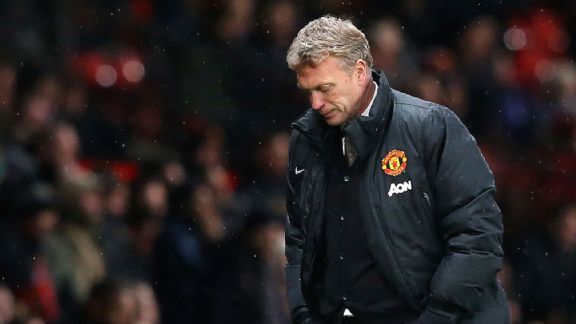
“The floodlights are blinding. This is after all, a stadium of light and its illumination is searing. There is no place for me to hide my nakedness from its hostile radiance. Beads of sweat weep down my furrowed brow but I cannot mop them. My hands have been nailed. Flesh sandwiched between metal and wood. Bones shattered, blood spattered, a mortal man broken and left to slowly rot on this very public cross as spectators, both faithful and non, jeer my every pained movement. I stretch every sinew to delay the inevitable feasting of the scavengers on my still-beating heart.” Dispatches From A Football Sofa
Defensive woes continue to hinder Rodgers and Liverpool
“It is a concept their watching owner ought to find easy to understand. Liverpool are a team of two halves. John W. Henry comes from a sport in baseball where the division between offence and defence is clearer than it usually is in football. Not at Liverpool, however. Even if the nuances of the beautiful game are lost on a businessman with a greater grounding as the owner of the Boston Red Sox, it should be obvious his other sporting investment are terrific going forward and threaten to be terrible at the back.” ESPN
Mikel and Anderson: victims of a distrust of creativity

“In Chelsea’s match with Manchester United this Sunday afternoon, arguably the most fascinating battleground will be the central midfield zone. That is entirely common in matches between two big clubs, but usually because of the vast quality on display. This weekend’s match is different, as both teams are weakest in that very position: the central midfield, the heart of the side. There are injury problems: Chelsea may be without Frank Lampard while David Moyes will probably still be unable to call upon Marouane Fellaini.” ESPN – Michael Cox
Benfica 2-0 Porto: good midfield pressure and quick attacking from the home side
“Benfica went top of the league with a controlled, confident victory at the Estadio da Luz. Jorge Jesus played his usual outfield players, although in goal Artur Moraes was unavailable so back-up Jan Oblak played instead. This was Nemanja Matic’s final game before his return to Chelsea. Paolo Fonseca played Carlos Eduardo at the head of his midfield trio, with Lucho Gonzalez deeper, and Josue and Steven Defour on the bench. Nicolas Otamendi was at centre-back, rather than Maicon. Benfica were clearly the better side throughout this contest, more organised without the ball and more purposeful in possession.” Zonal Marking
The Basque Connection
“The Basque country is something of a historical relic. The region was never conquered by the Romans and the Basque language, bears no resemblance to any other living language. The Basque people are notorious for doing things their own way and have fought fiercely for decades to protect their local customs from the imposition of Spanish culture. This independent spirit extends to the region’s biggest football club, Athletic Bilbao. The club, nicknamed Los Leones (“The Lions”), are a unique organisation in world football, having achieved considerable success whilst preserving their core traditions and maintaining close ties to their local community.” Back Page Football
Are economic hardships in Brazil set to overshadow the 2014 World Cup?
“The lead up to a World Cup is a period where fans of the sport are filled with excitement and a child-like enthusiasm for a game; a game where nations compete in arguably the biggest competition in world sport. The years leading up to this colossal event are filled with building up hopes and expectations as they soar to an unrealistic level; hopes which come with the apprehension of the nightmare scenario which could be beheld or the joyous dream option which many will pray for well in advance. All this adds to the sheer spectacle a country puts on for the fans and players, and no other country has a carnival reputation like Brazil. However, in these modern times, it seems passion and zeal for the sport is not enough as money matters are playing a more important role than ever before. Brazil 2014 is not immune to this, and is possibly the most economically analysed World Cup in history.” Think Football
Julian Draxler: Scout Report | The next big Bundesliga talent
“We’ve learnt in the past few years that Germany produces some of the best talents of World football. It is the DFB’s insistence on home-grown talents that has seen the national team flourish, and clubs like Bayern Munich to dominate the European stage. A look through the sides in the Bundesliga throws up a whole host of emerging talents; but the one that catches the eye more than all the others, is a certain Julian Draxler.” Outside of the Boot
Juan Iturbe: Scout Report | The special ‘Juan’ from South America
“It’s taken a little longer than expected, but Juan Iturbe is finally starting to realise his enormous potential that led him to being dubbed ‘the new Lionel Messi’ only a few years ago. Of course, when any big talent emerges from Argentina, they are instantly dubbed and hyped up to be the next Maradona or the next Riquelme.” Outside of the Boot
The Best of Football Writing in 2013

“This is the third year that The Best Football Writing list (2012, 2011) has come into existence. We’ve seen blogs come and go, as well as writers rise and get the recognition they deserve. 2013 was no exception, but the continued domination of social media in sport created a new landscape for writing. With a flood of information hitting us every day, it can be difficult to find the long reads amongst a pile of memes. This year’s list was the hardest to compile, but there was hardly a shortage of quality writing. In fact, we were overwhelmed with tweets and emails recommending great writing in football.” A Football Report
New Film Series, “30 for 30: Soccer Stories”, Surrounding 2014 FIFA World Cup on ESPN
“ESPN Films, creators of the critically-acclaimed 30 for 30 film series, will premiere a new series in April surrounding the 2014 FIFA World Cup on ESPN. 30 for 30: Soccer Stories will include a mix of standalone feature-length and 30-minute-long documentary films from an award winning group of filmmakers telling compelling narratives from around the international soccer landscape. In addition, a collection of 10 vignettes about Brazil’s rich culture will be featured throughout ESPN’s FIFA World Cup programming.” ESPN
In first coaching role, Seedorf faces daunting task at Milan
“After the news had broken that Clarence Seedorf was to be the new manager of AC Milan, the Curva Sud ultra group erected a banner outside the club’s old offices. Its message was simple: ‘Seedorf, no grazie.’ Given that it’s only two months since the ultras were confronting players over poor performances, there’s something unexpected and slightly touching about their on-going support for Massimiliano Allegri, who was dismissed following Sunday’s 4-3 defeat at Sassuolo after a little over three seasons in the job. The Curva Sud have been consistent in this, though, acknowledging the turmoil behind the scenes at the club, and releasing a statement in May in which they explicitly stated they didn’t want Seedorf or any other manager who lacked experience.” SI – Jonathan Wilson
A new Gerrard?
“Steven Gerrard was employed as a holding midfielder in the 5-3 win at Stoke City on Sunday. The Liverpool skipper has the ability to thrive in any position but Adam Bate believes a change of mentality could be key to his long-term success in the role.” Sky Sports
Player Focus: Berardi’s Seamless Progression to Serie A Stardom
“It’s a long journey, Cariati Marina to Modena. Almost the length of Italy. By car, it can take you eight or nine hours. Quite the road trip. But Domenico Berardi was keen to make it. He wanted to visit his brother Francesco who was studying there at university. So off he went up north. This was in 2010. It was a trip he’d never forget. Like many students, Francesco was involved in a five-a-side league. While Domenico was in town, he invited him to play. Only 15 at the time, the lads he came up against were bigger, stronger and older than he was, but not to worry. Berardi dominated.” Who Scored?
The Ballon D’Or and why objective player rankings are pointless – The State of Analytics
“When Cristiano Ronaldo won the Ballon D’Or, this blog’s resident pro-Messi troll came out of the woodwork using a crude homophobic play on Ronaldo’s name to make a series of rambling arguments as to why the Portugal and Real Madrid winger shouldn’t have won the top prize in world football. I won’t reprint those comments but I’ll give you the gist of them—Ronaldo shouldn’t have won because he was sent off in the Copa Del Rey final against Atletico, Ronaldo shouldn’t have won because Mesut Ozil created most of his goal-scoring chances (which of course doesn’t explain his incredible goal-scoring record since the German international went to Arsenal), Ronaldo shouldn’t have won because he didn’t make enough assists, didn’t have the same goal-per-game average as Messi (not even a decent metric as we’ll see), didn’t win ‘trophies’.” The Score
Keith Hill and the ‘never go back’ maxim
“These quiet mid-January weeks used to be devoted to anticipation while we waited between rounds 3 and 4 of the FA Cup and if many will have you believe that matters Premier League and transfer window are the only ones worth thinking about as Burns Night approaches, quite a few of us still hark back to the old days. Not least Rochdale, who along with thoughts of the world’s greatest knockout competition, are also relishing a promotion battle in League 2. Here, Stuart Howard-Cofield, curator of the Grumpy Old Fan website and contributor to The Football Pink, runs the rule over ‘Dale – you can follow Stuart on twitter here. A quiet revolution in the hills.” thetwounfortunates
Barcelona, Atlético’s tactical clash ends in a stalemate

“All season, it’s been impossible to separate Barcelona and Atlético Madrid. They’ve chugged along at the top of the table, trading blow for blow, and when they met in the Copa del Rey, they exchanged a pair of draws and Barcelona went through only on away goals. They couldn’t be separated on Saturday either, a tight goalless draw leaving Barcelona top of La Liga at the halfway point by virtue of having a goal difference five better than that of Atlético.” SI – Jonathan Wilson
Atletico Madrid 0-0 Barcelona: different styles but similar lack of invention upfront
“La Liga’s top of the table clash was intense and intriguing, but ultimately goalless. Diego Simeone named his expected side, with right-back Juanfran available after his suspension was overturned. Despite Lionel Messi’s return in midweek against Getafe, he wasn’t risked from the start – he joined Neymar on the bench, and Cesc Fabregas played as the false nine. A draw was a fair result – both sides’ gameplan was clear, but the defences came out on top.” Zonal Marking
Atletico Madrid 0-0 Barcelona: Tactical Analysis | Atletico’s Physicality versus Barca’s Passing
“The top 2 in Spain faced off for the first time in the league this season, in a clash that generated almost as much hype as most El Clasico’s. This season, Atletico have surprised one and all with their tremendous run in the league, staying 5 points clear of their city rivals Real for this long. Barcelona have been imperious, scoring almost at will, despite the absence of their talisman, Messi, and new acquisition Neymar. One of the meanest defences in the league was up against a free flowing attacking force, and it made for a great spectacle.” Outside of the Boot
Messi, Ronaldo and Ibrahimovic: football’s new superheroes
“The other night, I was standing outside the players tunnel before a Paris Saint-Germain game when Zlatan Ibrahimovic walked past. It was scary. Up close, the Swedish forward looked like a superhero: 1.95m tall, a chest the size of Pamela Anderson’s and the hungry glare of a man who has done his exercises, eaten his greens and had his afternoon nap every day for years. Today’s great footballers are incomparably fitter than their predecessors. But their perfection goes beyond the physical. This is the best time in football’s history to be a star. The game has been restructured in their service. When the Golden Ball for the world’s best player of 2013 is awarded on Monday – most likely to Cristiano Ronaldo of Real Madrid – it will resemble an Oscars ceremony in the golden age of Hollywood.” FT – Simon Kuper
Regal Rodgers and Mediocre Moyes
“It’s been a while since we’ve been able to look down on Manchester United. Funnily enough, it’s quite a nice feeling. It may not last, of course, as football’s like that – you may laugh, but someone always laughs later (and no-one laughs last) – but right now I can’t help but feel that ‘we’ have got the better manager and they have got the bigger problems. In fairness to Moyes, there were challenges – maybe even poisoned chalices – at United: replacing a club legend who bequeathed a mixed squad (albeit one containing plenty of talent, and one capable of walking the league in 2012/13). I’ve never thought Moyes to be a bad manager, but like Roy Hodgson, he always struck me as unremarkable, and ultimately that means uninspiring.” Tomkins Times
The Bayern Supremacy: The most attractive club in the World

“The abundance of football talent that’s on display for the entire world to see week-in week-out is unreal. What’s even more intriguing is the fact that so many players sustain the same level of performance over the span of the entire season. The quality of players in a club in a given season predominantly defines its chances of winning silverware in that season. However, in my opinion, success isn’t measured merely by the number of trophies a club has in its cabinet. There are other facets – such as a good reputation, loyal fans, consistent performances, etc., which can be built only in the long run. Therefore, a club that produces generations of quality players that consistently win trophies, creating history at every possible turn, is a lot more respectable and likable than clubs that achieve success overnight.” Outside of the Boot
Why can’t Juan Mata and Jose Mourinho just get along?
“It would have been an enormous shock for Juan Mata last summer, when he realised he had been deemed unsuitable for the strategy of the incoming Chelsea manager, Jose Mourinho. Not only had Mata been consistently exceptional throughout his first two seasons in English football, he’d also thrived under three different managers — and, arguably, in four very different systems. The first system was under Andre Villas-Boas, an ideologue who refused to compromise his major beliefs during his period at Chelsea. This involved a high defensive line, and transferring the ball quickly into attack. Mata had a huge responsibility — he arrived as the main playmaker for a club who’d been without a player of his creative potential for years, arguably since Gianfranco Zola in the pre-Abramovich days.” ESPN – Michael Cox (Video)
Atletico Madrid proving tackling can be a quality
“This weekend, Atletico Madrid host Barcelona at the Vicente Calderon stadium in the biggest game of the European season so far. The two sides are level on points, and therefore it is literally a top of the table clash – La Liga’s rules mean teams are separated by head-to-head results rather than goal difference, and therefore having not played each other this season, the sides can’t be separated. Halfway through the season, La Liga’s best two clubs are neck-and-neck, joint first.” Zonal Marking
Lionel Messi: Are Barcelona a better team without him?

“Barcelona manager Tata Martino faces a major selection dilemma as he prepares for Saturday’s table-topping La Liga meeting with Atletico Madrid. Don’t feel too sorry for the Argentine boss, though, because Martino is contemplating the ultimate ‘nice problem to have’ as he wrestles with the conundrum of how to accommodate fit-again compatriot Lionel Messi in his team. Messi is just back from a hamstring injury, having made his return in spectacular fashion with a two-goal substitute’s outing in Wednesday’s 4-0 thrashing of Getafe in the Copa del Rey.” BBC
‘
Putting the big bucks to better use
“There are some interesting firsts in Irish media history, one of them is the first live field sports broadcast in Europe on the national radio station, 2RN as it was then, which covered a hurling match between Galway and Kilkenny. This was not without controversy though; the GAA worried that live broadcast of the game could affect attendance and insisted that the coverage of the game start only after a post kick-off delay. This was not unique to the GAA; in Britain such was the concern that radio or TV coverage could affect the all-important revenue generating gate receipts that for decades conservative forces in the FA and club ownership fought against the regular live broadcast of matches or even of extended highlight packages.” Backpage Football
Whatever Is God’s Will: Juary
“Back in the early eighties Italy was the centre of the world of football and would remain such for the best part of a decade. The richest clubs in the world played in the Serie A and, in turn, these attracted the best players. Juventus had Platini and Boniek, Napoli played to the tune set by Maradona whilst AC Milan had the trio of Van Basten, Gullit and Rijkaard. Even a small club like Udinese could attract a player like Zico. If the Serie A was the cream of world football, then Avellino was the curd. Promoted to the Serie A for the first time in 1978, they had defied expectation by staying there year after year despite being billed as relegation favourites at the start of each season.” In Bed With Maradona
Afro-Europe in the World Cup

“It isn’t fair. Though Africa has more countries and a larger population than Europe, the continent only has five berths in the World Cup compared to Europe’s thirteen. And they had to fight for that: it was only a boycott in 1966, led by Kwame Nkrumah, that changed the policy that allowed only one spot for either an African or an Asia team. There are all kinds of justifications, of course, offered for this inequality. And it will likely to a long time for change to happen, and then it will come incrementally. While we wait patiently for institutions to change, however, the world has a way of rendering a kind of justice. Post-colonial migration has created a loophole of sorts in FIFA’s global apportioning of representation. This year, there will be two additional African teams in the competition: France and Belgium. If they are going to the World Cup at all, it is thanks to goals scored by the children of African migrants: Romelu Lukaku for Belgium, and Mamadou Sakho for France. I’m not sure if these old colonial powers deserve the help, but they’ve gotten it: Africa has come to the rescue. In fact, it might be worth giving new names to these two football teams: Françafrique and AfroBelgica, perhaps?” ROADS & KINGDOMS – Laurent Dubois
2014 Fifa World Cup: A huge year in the history of Brazil
“Going back home from a game on the underground can be a fascinating experience. At first nearly everyone in the carriage has been to the match, which seems like the only thing that counts. This is soon diluted as fans get out and new people get on, at which point the mix can be interesting. A couple of months ago I was taking the tube back from a midweek game at Rio’s Maracana stadium. The local side in action had been Fluminense, the traditional club of the Rio elite, and a group of young, self-proclaimed playboys were drawing attention to themselves, banging a rhythm on the side of the carriage as they belted out their songs.” BBC – Tim Vickery
Juventus 3-0 Roma: Juventus sit extremely deep to prevent Roma counter-attacking
“Juventus took a big step towards a third consecutive title with a convincing victory over their closest challengers. Antonio Conte welcomed back Andrea Pirlo in the deep playmaking position, and was able to select his first-choice starting XI. Rudi Garcia had Francesco Totti back after injury, and opted for Adem Ljajic rather than Mattia Destro in the forward trio. Juventus created little in open play, but defended solidly and pounced at set-pieces – it was something of an ‘underdog’ victory, even though the home side started as favourites.” Zonal Marking
Peladad
“The Brazilian state of Amazonas is one of the most awe-inspiring places on the face of the Earth. Home to an incredible array of plant and animal life it is undoubtedly one of the world’s most well-known natural wonders. Yet outside of South America, it seems few people are aware that in the depths of the jungle, there is a large city now home to over two million people. Even less celebrated is the fact that each year it holds what locals claim to be the largest football tournament in the world. Manaus is a city of contradictions. It’s a functional modern concrete metropolis yet leave the suburbs behind and you are engulfed by the vastness of the rainforest. In Manaus people go about their daily lives as they would in any big city in the world yet a few miles down the Rio Negro there are jungle tribes whose lives have changed little in centuries. The climate is stiflingly hot and humid all year round and it is well over a day’s travel by road to any other city. Yet despite the unlikely isolated location, people have been flocking to Manaus for decades and it continues to be one of the fastest growing and most economically thriving places in Brazil.” In Bed With Maradona
Venezia’s woes threaten to make football a relic in city of rich history

“The rain runs down the grimy windows of the vaporetto. Somewhere through the murk is the church of San Giovanni Battista and then the gardens where the Biennale is based. A quarter of an hour after leaving San Marco, we arrive at Sant’Elena. The most obvious landmark as you leave the vaporetto station is the bell tower of the church, an imposing brick rectangle that frowned down on the low floodlights that nestle in its lea. This is the Stadio Pierlugi Penzo, the home of the third-flight side Union Venezia. It’s the second oldest stadium in Italy, and it looks it. Opposite the main stand – which, thank goodness, has a functioning roof – it’s not immediately clear where the dilapidated brickwork of the stadium ends and the 15th-century monastery begins. On another day there might be a ramshackle beauty to the Penzo, with the masts of boats in the harbour visible beyond the north stand and the bell tower looming to the south-east. But as the rain teems down, it’s a damp, grey place.” Guardian – Jonathan Wilson
A Stadium in Greenland That’s More Than a Stadium
“On my recent trip to Copenhagen, Jennifer and I had the pleasure of visiting the Danish Architecture Centre, which sits near the quays of Nyhavn, surrounded by gleaming, angular buildings and the brick and timber structures of the old dock area. The Centre featured an exhibition on attempts by a quorum of Danish architects and their Greenlander cousins to develop homes and civic buildings for Greenland, which included a wonderfully bold cruciform airport and a multipurpose civic centre, which would include both space for theatre and local government, along with sports facilities. Much has been made of Iceland’s recent run in World Cup qualifying to an ultimately unsuccessful play-off place against Croatia. Iceland, like Greenland, struggles with bitter temperatures and frozen pitches, which can stymie attempts to play football all year round.” Put Niels In Goal
Manchester United, West Ham unable to escape FA Cup embarrassment
“At this stage, for Premier League teams, the FA Cup doesn’t much matter — unless you lose, and even then, only if you lose in particular circumstances. It seems barely credible in the modern context of the competition that, 24 years ago, a late goal from the substitute Mark Robins in a third-round tie away at Nottingham Forest was credited with saving Sir Alex Ferguson’s job at Manchester United. David Moyes, Ferguson’s successor, could have beaten Swansea City comfortably without it making much difference to his standing at Manchester United, but the defeat to Wilfried Bony’s last-minute goal amplified the general disgruntlement at Old Trafford.” SI – Jonathan Wilson
More questions for Moyes after Swansea shocker

“The worst aspect for Manchester United was that — yet again — nobody could say it had not been coming. Three times in the last 10 minutes, Swansea attempted the same move, which saw Wayne Routledge run at stand-in right-back, Darren Fletcher, before crossing, specifically trying to pick out Wilfried Bony. Despite the warnings, United were powerless to do anything about the forward’s 90th-minute goal, which secured a 2-1 win for the Swans. United manager David Moyes, meanwhile, seems powerless to solve so many of the issues at Old Trafford that are increasingly evident. Were it not for the manner in which impressive upsets like Swansea’s restore some energy to the competition, it could be argued that the current United reflect the FA Cup itself: a fading institution that has lost its magic and is seemingly being overtaken by circumstance.” ESPN
Man Utd 1 – 2 Swansea
“Swansea won for the first time in their history at Old Trafford as Wilfried Bony’s 90th minute winner knocked 10-man Manchester United out of the FA Cup. The Ivory Coast striker, who had caused anxiety in the United defence for most of the game, headed in Wayne Routledge’s cross to book a fourth-round spot against Birmingham, Bristol Rovers or Crawley Town. The game looked like it was heading for a replay as the hosts held on following Fabio Da Silva’s red card 10 minutes from the end after he had scythed down Jose Canas.” BBC
Tactical Analysis: What explains the rise, fall and rise again of the 4-4-2 in the Premier League?
“Since the arrival of Jose Mourinho at Chelsea in 2004, the 4-4-2 has been out of favor in England’s top flight. It hung on for a few more years, most notably in Tottenham Hotspur’s 2009/10 campaign when Spurs finished fourth while playing an extremely conventional 4-4-2 with two orthodox wingers, a target man up top, and a poacher playing alongside the target man. But there hasn’t been a title contender that played a strict 4-4-2 since Mourinho’s arrival–until this year. One of the most interesting developments in 2013 has been the return of 4-4-2, as Jonathan Wilson noted in his year in review piece for The Guardian. As it stands right now, the league leaders in Italy, France, and England all use a two striker system and Atletico Madrid, level with Barcelona on points at the summit of La Liga, has also favored such a system–so that’s the league leader or joint league leader in four of Europe’s five biggest leagues. It’s safe to say the two striker system is back. (It will be interesting to see how the four Bundesliga sides in the Champions League last 16 handle these teams that favor two strikers up top.) But in this piece we’re going to focus primarily on the Premier League and the three different types of 4-4-2 on display in 2013.” Think Football
Liverpool 2 Hull 0: In-Depth Tactical Analysis
“Liverpool’s previously threadbare squad took another hit for this game as Sakho and Allen were injured and couldn’t feature. Cissokho and Aspas made the starting XI, with Gerrard only deemed fit enough for the bench. Since we played them at the KC stadium, Hull have played their subsequent games exclusively with a 3-1-4-2 formation. The only exception was the Fulham game where they used a 4-4-1-1. As such, it was logical to see Bruce’s main dilemma being whether to continue with the 3-1-4-2 shape, or revert back to the 3-5-1-1 that worked so well the last time against Liverpool. Presumably Hull’s success in stifling Liverpool that day had more weight as the team started with the 3-5-1-1 variant.” Tomkins Times
No Happy New Year for Brazilian Football

“The war cry of Ronaldo, Sepp Blatter, the President of Brazil Dilma Rousseff and the rest of Brazil and FIFA’s great and good is about as considered a pronouncement as a turkey’s gobble. And yet in its sunny patriotism and glossing over of the cold reality of delays, mismanagement, overspending and dead construction workers it neatly captures a chunk of the troubled optimism/pessimism dichotomy that lies at the heart of Brazilian society. Everything may be a mess and there isn’t much sign of improvement on the way, but hey — God is Brazilian, carnaval is coming, we’re still pretty good at football and the weather is nice most of the time. So things could be worse. Life in Brazil can sometimes seem not so much a case of if it isn’t broken, don’t fix it; but rather it’s always been broken, so there’s not much point in trying to fix it.” ESPN
Are Brazilian managers an endangered species?
“For Latin American and Portuguese news crews running around the Costa do Sauipe resort in northeastern Brazil during the buildup for the 2014 World Cup final draw, life was hectic. Argentines, for example, needed to be sure they kept tabs on the Albiceleste manager Alejandro Sabella; at the same time they “doorstepped” fellow countrymen Jorge Sampaoli and Jose Pekerman for a reaction on Chile’s and Colombia’s expectations before and after the draw. The Portuguese had to worry about ‘Quinas’ manager Paulo Bento, but also make sure that former Real Madrid commander and Sir Alex Ferguson deputy Carlos Queiroz, now in charge of Iran, would also be covered, as well as Greece’s ‘mister’ Fernando Santos.” ESPN
Tactical review of 2013: Strike partners in crime are bad news for defenders
“For a decade or so, it seemed inconceivable that a top team could play with a pair of forwards and still prosper. Operate with two forwards, the logic ran, and you surrender control of the midfield. International football always lags behind club football when it comes to innovation, but even there, by Euro 2008, 4-2-3-1 had become the default. Yet this season, front pairings seem to have returned to fashion. When Manchester City pair Álvaro Negredo and Sergio Agüero, that is a strike duo: it’s true that they may not play exactly alongside each other at all times, but neither can it be argued that one is operating in an attacking midfield role, as would be required legitimately to describe the formation as 4-2-3-1. Liverpool, similarly, have used Luis Suárez and Daniel Sturridge to great effect. At Atlético Madrid, Diego Costa and David Villa have thrived, while the Paris Saint-Germain pair Zlatan Ibrahimovic and Edinson Cavani. Fernando Llorente and Carlos Tevez are working well as a pairing for Juventus – although in a system that uses a back three rather than a back four.” Guardian – Jonathan Wilson Part 1, The false nine is an accepted role but with different interpretations – Part 1
The top 13 stories from American soccer’s unforgettable 2013
“The year in American soccer was bracketed by bitter cold, which brought out the best in those who rose to the occasion and helped shape the sport in 2013. Way back in January, Jozy Altidore exuded dignity and determination during a Dutch Eredivisie game that featured snowballs and racial abuse cascading from the stands. In March, a beleaguered U.S. national team began its dramatic climb to the top of CONCACAF in a fearsome Colorado blizzard. And in early December, Sporting Kansas City and Real Salt Lake contested an unforgettable MLS Cup final that was hampered, yet somehow heightened, by a frozen field and record-low temperatures.” SI
Losing the battle of the mind
“I was recently doing a spot on a London-based radio where the presenters were asking listeners to send in examples of activity they considered more important than the FIFA Club World Cup. Amongst the answers; turning out the lights after the monthly meeting of the church authorities. Or picking up the washing after a gust of wind had blown it off the line. Amusing? Perhaps. Infuriating? No doubt about it!” The World Gage – Tim Vickery
Unlike Moyes and AVB, simple approach has paid off for Sherwood
“Tottenham’s dreadful record at Manchester United was once one of the Premier League’s most famous pieces of trivia. Like no Englishman ever winning the Premier League as manager, Robbie Fowler scoring the Premier League’s fastest-ever hattrick, or Dennis Bergkamp coming first, second and third on Match of the Day’s Goal of the Month competition in September 1997, Spurs’ failure to win at Manchester United was legendary.” ESPN – Michael Cox
The Best and Worst in German Football in 2013

“It has been a great year for German football. The Champions League final this spring featured for the first time in the competition’s history two German teams on the pitch, Bayern have been breaking records left, right and centre and the Bundesliga seems to produce exciting story lines and talents almost on a weekly basis it seems. But, what have been the stand out players and moments, both good and bad, in the calendar year 2013? Our team of editors sat down to give their views about the subject!” Bundesliga Fanatic
Best XI of the 2013/14 Bundesliga Hinrunde
“With half of the season out of the way, there has been no shortages of surprises, excitement and the usual and expected Bayern Munich dominance in Germany’s top flight. The league maintained its reputation for great fan support, youthful exuberance and goals galore. Most of all, the Hinrunde was characterized by several outstanding individual performances. Unsurprisingly, a lot of those came from Bayern players but there were also many players who surprised and really took their game to the next level. Some were veterans who had somewhat of a comeback year while certain young players kept on making a name for themselves. Here are the standout performers of the 2013/14 Bundesliga season so far.” Bundesliga Fanatic
Premier League mid-term report
“This weekend’s fixtures marked the mid-way point in this season’s Premier League, as a perfect time if any to take stock of this season’s participants and cast cruel judgement over their respective performances thus far. So without further-a-do…” Back Page Football – (part one), (part two)
FC Barcelona: Five of the Best Individual Performances of 2013
“With 2013 behind us, it’s time to remember five of the best individual performances of 2013 according to the Barca Blaugranes Community Player Ratings”
Barca Blaugranes (Video)
Premier League: 2013 in numbers
“Thirteen Premier League titles, 27 years, 1,500 matches managed at Manchester United – Sir Alex Ferguson’s retirement was the biggest story of the year. But what else happened in 2013? English football said goodbye to Gareth Bale and hello again to Jose Mourinho, while Luis Suarez provoked plenty of headlines – good and bad. Statisticians Opta have crunched the year’s numbers for us.” BBC
David Moyes – A half year in review
“Sixth in the league, six wins in a row, sixth in the form table and six months on, David Moyes’ time as manager of Manchester United could be summed up in many ways – Indifferent. Underwhelming. Inept. Transitional. Promising. From the first day that Moyes got the job the expectations of the vast majority of United fans seemed to drop dramatically and it became apparent very quickly that this was rubbing off on the everybody else connected with the club, especially the players. It all started so poorly.” Back Page Football
Man City 2 Liverpool 1: In-Depth Tactical Analysis

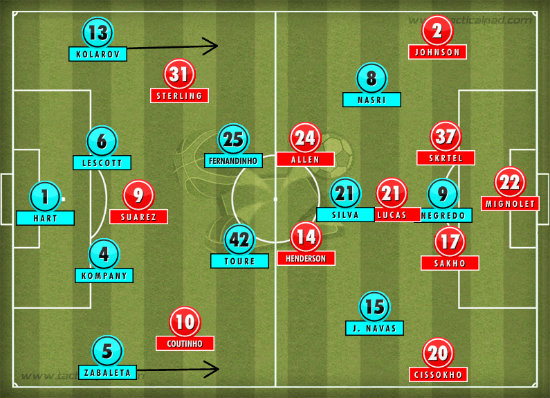
“As anticipated Pellegrini solidified his midfield by both switching to a 4-2-3-1 formation and having Silva as the third midfielder behind Negredo. This meant Nasri was placed on the left, adding another midfield body by drifting infield. With Zabaleta fit to start the home team re-established his fearsome wide partnership on the right with Navas. Rodgers continued with the same 4-1-2-3 formation as has been the case lately. The only change was due to Flanagan’s injury, he was replaced by Cissokho. However, in contrast to the recent games, Coutinho played closer to the touchline and only occasionally venturing infield.” Tomkins Times
Manchester City 2-1 Liverpool: Tactical Analysis | City keep Suarez quiet
“The festive season is loved in England because of the flood of matches that it brings, and the competitive spirit that the games are played in. Santa’s present to the football world this year was a terrific top of the table clash between Liverpool and Manchester City at the Etihad, as the Christmas leaders attempted to achieve the impossible; return from the Etihad with points.” Outside of the Boot
Tactical review of 2013: Strike partners in crime are bad news for defenders
“The return of the strike partnership. For a decade or so, it seemed inconceivable that a top team could play with a pair of forwards and still prosper. Operate with two forwards, the logic ran, and you surrender control of the midfield. International football always lags behind club football when it comes to innovation, but even there, by Euro 2008, 4-2-3-1 had become the default. Yet this season, front pairings seem to have returned to fashion. When Manchester City pair Álvaro Negredo and Sergio Agüero, that is a strike duo: it’s true that they may not play exactly alongside each other at all times, but neither can it be argued that one is operating in an attacking midfield role, as would be required legitimately to describe the formation as 4-2-3-1. Liverpool, similarly, have used Luis Suárez and Daniel Sturridge to great effect. At Atlético Madrid, Diego Costa and David Villa have thrived, while the Paris Saint-Germain pair Zlatan Ibrahimovic and Edinson Cavani. Fernando Llorente and Carlos Tevez are working well as a pairing for Juventus – although in a system that uses a back three rather than a back four.” Guardian – Jonathan Wilson
With fatigue affecting Giroud, is it time for Wenger to spend?
“The period leading up to the January transfer window was supposed to be the time when Olivier Giroud proved that Arsenal didn’t need another centre-forward. Instead, the Frenchman is currently going through his leanest goalscoring form — seven starts — since joining the club in the summer of 2012. Giroud’s all-round game continues to impress, and Arsenal have learnt to make the most of his excellent link-up play, which he demonstrated when setting up Lukas Podolski’s fine strike against West Ham.” ESPN – Michael Cox (Video)
The 54 Club – Italy
“As usual my parents escaped England for Christmas, thus shirking any festive responsibilities, and 2012 saw them wintering in Rome. Taking up their kind offer to join them I deliberately arrived late in December with the aim of fulfilling the dream of every child who grew up watching James Richardson sip coffee and hold the Gazetta Dello Sport aloft outside the Pantheon, watching some live calcio. With the winter break arriving I expected my options to be limited and would have been quite content to seeing one of the Roman teams play a basement dweller but luck was on my side and Roma had a home fixture against my childhood sweetheart, AC Milan.” Back Page Football
What has caused Borussia Dortmund’s disappointing form?
“Going into the winter break Borussia Dortmund sit fourth in the Bundesliga standings after collecting 32 points from the first 17 games. They are twelve points adrift of the defending champions Bayern Munich who have a game in hand. Even at just the halfway mark of the season, the title race appears over with the runaway leaders Bayern Munich seven points clear of Bayer Leverkusen having played a match less. Even with a managerial change, Bayern have simply continued from where they left last season.” Outside of the Boot
Russia and Ukraine merged league a small part of a bigger play
“In Soviet times a creeping network of veins and arteries kept the footballing and state machines in the eastern bloc beating together as one like some great socio-vascular monolith. Owned and run by government branches, clubs’ fortunes peaked and dipped contingent upon their utility to the Nomenklatura. In Bulgaria the military team CSKA were richly resourced from above whilst rivals Levski, historically synonymous with social resistance, were manipulated by the Interior Ministry to render them forever runners-up. Elsewhere Kaparty Lviv, a beacon for Ukrainian nationalism at a time when communism was creaking under the weight of its own bureaucratic waste, were shut down by the party leadership in 1981, seven years before state-favourites Dynamo Kiev were given permission to privatise and further entrench their legend as Ukraine’s famously immoveable object. Ask not what your country can do for you, and all that.” World Soccer
Liverpool’s midfield to thrive in absence of Steven Gerrard?

“At the age of 33, Steven Gerrard remains an integral part of the Liverpool team. So far this season, he has recorded six assists (joint second in the league) and averaged 2.7 key passes per game – third highest after the unstoppable Luis Suarez and the pass master Mesut Ozil. These qualities of the England skipper are hardly a revelation to anyone with an interest in LFC news. The question is – how do Liverpool perform in games of high intensity with Gerrard in the side? How do they deal with opponents pressing them high up? And equally as important, do Liverpool themselves press effectively enough with Gerrard at the heart of midfield?” Backpage Football
The Suárez Conundrum
“I first made it to Montevideo shortly after Richard ‘Chengue’ Morales scored the winning goal against Australia in a World Cup playoff in 2001. Ragged horses and carts danced through the streets like Lipizzaner stallions. Children begging on the streets got extra portions of Pollo Milanese from diners leaving fine restaurants. Beautiful girls shared their grappamiel. And posters of Chengue, a bare-chested Afro-Uruguayan, waving La Celeste (the iconic sky blue Uruguay shirt) were in every shop window. It was a poor, but proud city. On my second visit in 2007, I saw the remarkable progress of the country under newly elected President Tabaré Vázquez. Under Vázquez all social and economic indices were up. He was the first member of the left wing Frente Amplio to be elected President. Poverty levels plummeted, child hunger was greatly reduced, smoking in public places was banned and Uruguay confronted the crimes committed in the military dictatorship years of 1973 to 1985.” Road and Kingdoms
The 100 best footballers in the world 2013 – interactive
“Welcome to the Guardian’s choice of the world’s top 100 footballers for 2013. We asked our international panel of experts to name their top players in action this year and rank them in order of preference. You can see who the judges are and read how we compiled the final list here. Starting with No100 in the bottom right, click on individual players in the interactive to read more about their year.” Guardian
Top 50 Players in the World 2013: Part 5 – 10-6
“Not long to go until we reveal this year’s winner but for now, here’s the first batch of players to crack the top ten. Two of last year’s top five have dropped slightly and feature here, while a certain Welshman jumps 15 places to 6th after a massive 12 months.” Backpage Football
Pedro sparks Barca comeback

“Pedro scored a hat-trick in the space of eight minutes as Barcelona came from two goals down to beat Getafe 5-2 and return to the top of the Primera Division for Christmas. A much-changed Barca side, without the suspended Neymar plus the injured trio of Xavi Hernandez, Lionel Messi and goalkeeper Victor Valdes, conceded twice in the opening quarter of an hour, with Sergio Escudero breaking the deadlock and Lisandro Lopez scoring a header.” ESPN
Arsène Wenger at Arsenal and Sir Alex Ferguson at Manchester United prove the value of the ‘manager’
“Some self-admiring owners invade the dressing room, diluting the power of the manager, a damaging trend. If Arsène Wenger guides Arsenal to glory in the Premier League it would be a wonderful, well-timed triumph for the managerial profession. Managers are not just for Christmas. Even Wenger’s rivals would surely acknowledge privately the long-term benefit for their industry of the success of a manager who will have been in his job almost 18 years, who alone decides recruitment and loan policy, whose influence is so all-pervading at the Emirates that he even chose the wall colours.” Telegraph – Henry Winter
What’s next for Ronaldinho?
“Another magisterial free kick goal from Ronaldinho, this time against Guangzhou Everglade in the Club World Cup third place-off, serves as further testimony to the extraordinary depth of his talent. The way that he flitted around on the game’s periphery, even against a team from China, was an all too eloquent statement of how much of this talent has been wasted. What a puzzling enigma he is! The question is not easy to answer; should we be grateful for the fabulous moments Ronaldinho has given us, or frustrated that he could have delivered so many more of them?” ESPN – Tim Vickery