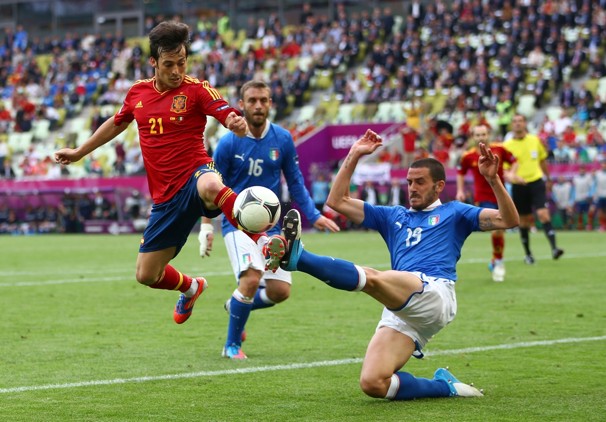
“A fascinating tactical battle between two systems rarely seen at international level. Vicente del Bosque supposedly had a three-way choice between Alvaro Negredo, Fernando Llorente and Fernando Torres upfront – but instead chose to play with a false nine, with David Silva and Cesc Fabregas both becoming the highest player up the pitch at different points. Cesare Prandelli went with the 3-5-2 system he’s been using in training over the past two weeks, which meant Daniele De Rossi dropping into the defence, and Emanuele Giaccherini making his international debut as a left wing-back.” Zonal Marking
Three thoughts: Spain’s striker-less attack cost them vs. Italy in draw
“1. Spain’s striker-less attack: Spain’s system, a 4-3-3-0, was the most radical seen in a major international football tournament for decades. Usually the international game, because of the lack of time the players have to work together, lags way behind the club game, but this placed Vicente Del Bosque firmly in the avant-garde. Unusual systems that have been termed “strikerless” at least have a forward — a Francesco Totti, Cristiano Ronaldo or Lionel Messi — to drop back and create space for runners from deep while still getting forward to score goals themselves. But Spain’s shape, with Andres Inietsa, Cesc Fabregas and David Silva across the nominal forward line had three players who have spent most of the season operating as orthodox attacking midfielders.” SI – Jonathan Wilson
Tactics key in Italy-Spain draw
“A mouthwatering matchup between the past two World Cup winners became all the more engrossing as both managers made brave tactical decisions ahead of the game. After a 1-1 tie, one man, Italy’s Cesare Prandelli was left seeming bold. The other, Spain’s Vicente del Bosque, appeared more desperate. The decisions were different responses to a similar problem — the lack of the team’s best-fit striker. Spain’s David Villa was unable to recover from the broken leg sustained at the Club World Cup last December. Italy’s Giuseppe Rossi has been a long-term absence after suffering a double ACL tear.” ESPN (Video)
Euro 2012: Spain v Italy – as it happened
“In the end, a draw is probably the right result and both teams will perhaps be as disappointed as they are satisfied with a point. Italy had the better chances and played in an engaging fashion for much of the game, while Spain’s strikerless formation left much to be desired. But Spain’s response once behind was excellent and a fine goal from Cesc Fabregas got them out of jail; from there, they could and would have won it if Fernando Torres hadn’t been Fernando Torres. Overall another entertaining match in what is becoming a very entertaining tournament, but Spain can produce so much more than they managed in the first half, as indeed they showed in the second half. In the end, I just about forgive them for that ridiculous starting line-up.” Guardian
Rapid Reaction — Spain vs. Italy
“There was elation for Antonio Di Natale, vindication for Cesc Fabregas, and more misery for Fernando Torres. Add it all up, and it made for an action-packed 1-1 tie between Spain and Italy in the Euro 2012 opener for both sides. Italy had broken on top in the 61st minute, when Di Natale ran onto a gorgeous through ball from Andrea Pirlo and coolly finished past Spain goalkeeper Iker Casillas. But three minutes later, Fabregas hammered his shot past Gianluigi Buffon after taking a deft pass from David Silva.” ESPN (Video)
Spain, Italy draw in Group C
“For Spain, a tie counted as a bit of a stumble. For Italy, a bit of a reprieve. Opening their bid for a third straight major title, the Spanish rallied to earn a 1-1 tie Sunday against Italy, which entered this year’s European Championship amid another match-fixing scandal. Antonio Di Natale put Italy in front after an excellent setup from Andrea Pirlo in the 61st minute, but Cesc Fabregas tied it for the defending champions three minutes later by finishing off a dazzling display of Spain’s trademark passing game.” SI
 Scissors Kick