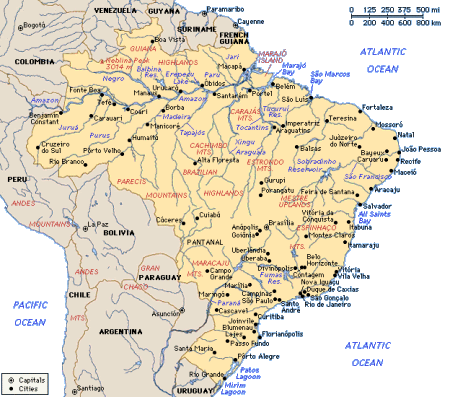
“After a spate of building problems and public protests in Brazil, the governing body of world football, Fifa, repeatedly warned there would be “no compromise” over the delivery of World Cup stadiums. But with Fifa’s end-of-year deadline looming, several stadiums are well behind schedule and one host city, Cuiaba, has told the BBC that not only will be it unable to finish its stadium on time, but there are not even enough hotel rooms for visiting fans.” BBC (Video)
Tag Archives: Brazil
A Yellow Card

“Three points make a trend, but in a World Cup year, two points are good enough. So here’s one: Early on the morning of October 29, 31-year-old Geisa Silva, a social worker with the Brazilian military police, found her husband’s backpack on their front porch in Rio de Janeiro. Joao Rodrigo Silva Santos was a retired professional soccer player, a journeyman who’d spent most of his career knocking around the Brazilian lower leagues; post-retirement, he ran a food shop in the city’s Realengo neighborhood. He hadn’t come home the night before, and Silva had been worried, jumping up at the sound of every car. Before dawn, she got ready to leave for her job with a police unit responsible for conducting an anti-gang crackdown. When she opened the front door, she saw the backpack. It contained her husband’s severed head.” Grantland – Brian Phillips
South American sides to show World Cup credentials
“Over the next few days South America’s World Cup sides will present their case for the defence. The continent’s sides made a strong showing in South Africa 2010; all five made it out of the group phase, four reached the quarter-finals and Uruguay (who had finished fifth in qualifying) made it into the semis. Naturally, good things are expected next year when the World Cup finally returns to South America. But on the evidence of the 2014 qualifiers, there could be a problem. A common theme of the campaign was teams tended to be better in attack than defence.” BBC
Why a South American experiment could be a boost to Europe

“How can the prestige and profile of the Europa League be raised? A second cup competition always has the problem of being in the shadow of the first, like a consolation prize for those who have missed out on the main event. There is, though, a relatively simple means of improving things; use the prestige of the leading cup competition to help pull along the second. The winners of the 2014-15 Europa League will automatically qualify for the Champions League, giving clubs a powerful incentive to take the competition seriously and field their strongest sides.” BBC – Tim Vickery
The Beautiful Game Leads to a Beheading
“The field in Centro do Meio, Brazil, where two young men were killed after an altercation at a pick up soccer game last June. Late last week, Jeré Longman and Taylor Barnes of The New York Times relate one of the most chilling stories I have ever read in briliant, gory detail. This is a story of violence, poverty, anger and of course, soccer.” Soccer Politics
The biggest problems facing World Cup contenders
“The fascinating thing about international football is that managers must cope with a very definite group of players. Whereas at club level, weaknesses can be solved by signing new players, at international level it’s not unusual for a top-class side to completely lack quality in one particular position. Sometimes, this forces managers to formulate innovative new tactical ideas to compensate for that weakness – but often, it simply means the side has a weak link. With eight months to go until the World Cup, here’s a look at six big international sides who have an obvious problem position.” ESPN – Michael Cox
The price of stardom can be a big one
“I won a prize! Some days ago Brazilian journalists voted me as foreign correspondent of the year. I had also won in 2011 but that time I was in London at the time of the ceremony. This time I turned up and was somewhat taken aback by how prestigious and sophisticated the whole thing was. I improvised a little acceptance speech, threw in the odd quip – which seemed to go down very well. In the shameless tradition of the British scoundrel (one local compared me to 007). I used the occasion to heap praise on a stunningly gorgeous journalist who had also just won a prize. She loved it, and sought me out to tell me afterwards. Her husband took it well, and didn’t glower at me too badly. I decided I deserved some wine and it turned out to be that good stuff that doesn’t give you a hangover. I had a wonderful time.” The World Game – Tim Vickery (Video)
Ronaldinho’s thigh injury blow to comeback hopes
“The torn thigh muscle he sustained in training last week is, amazingly enough, the most serious injury Ronaldinho has had in his long career — and its timing is most unfortunate. There were occasions over the past five years when it would hardly have mattered, times when a once-great player seemed barely interested in his extraordinary gift for the game. But however naturally talented, it is almost unthinkable that someone can become as good at anything as Ronaldinho was at his height without being truly in love with the activity. Skills take countless hours of honing.” ESPN – Tim Vickery
Building a World Cup Stadium in the Amazon

“The most challenging aspect of building a World Cup soccer stadium in the middle of the Amazon is debatable. Some might say it is figuring out how to get oversize cranes and hundreds of tons of stainless steel and concrete into a city surrounded by a rain forest that stretches for about 2.1 million square miles. Others might mention the need to put most of those materials together before the rainy season floods the entire construction site. Then, of course, there are those who might point to the need to install the special chairs. Yes, the chairs. It may seem like a small concern — at least compared with the whole everything-being-flooded possibility — but one of the less obvious issues that comes with building a stadium in the jungle is what the searing equatorial sunlight here can do to plastic.” NY Times
More than a game in Brazil
“I spent August in London, which means that returning to my adopted city of Rio de Janeiro there is a ritual which I always have to go through – catching the 472 bus to Sao Januario, the stadium of Vasco da Gama. It is the best way I know of ensuring that, in mind as well as in body, I have put London in the past and am focused on events over here.” The World Game – Tim Vickery
Manuel Pellegrini & Mauricio Pochettino buck a coaching trend
“For more than an hour in last Wednesday’s Champions League matches, up and down the continent, every goal had been scored by players from either Argentina or Brazil – an extraordinary example of South America’s contribution to European club football. In comparison to the impressive feats of the players, surprisingly little of that contribution has come from coaches. There have been a few South American success stories on the other side of the Atlantic – Brazil’s Otto Gloria and Chile’s Fernando Riera spring to mind. But opportunities have been limited – hence the general surprise when Argentina’s Gerardo Martino was rushed into the Barcelona job, an appointment which suggests a desire to keep Lionel Messi content.” BBC – Tim Vickery
Scolari’s Seleção – The World Cup 2014
“Condemned as Brazil’s weakest squad in 60 years, the pressure is undeniably on for Scolari’s men as the road to the 2014 World Cup begins. Next year, the 20th World Cup unravels in South America, or more precisely—Brazil. The home advantage, arguably may give a morale boost for the men in yellow, or add even more pressure for such a young side to deliver on the grandest stage of them all. The last time a World Cup was hosted in Brazil, supporters were left heartbroken and distraught as it was local rivals Uruguay who came out victorious in the final so Brazil undoubtedly, will be looking to avenge those nightmares. Inspiring a Seleção to their 6th World Cup title will be by no means easy, but crashing out in the group stages simply isn’t an option for a nation looking to restore international dominance across the footballing globe.” Outside of the Boot
Five things we learned from South American qualifiers
“… 1 — ARGENTINA KNOW WHAT THEY ARE DOING. The first team from the continent to book their place in Brazil, Argentina’s qualification might seem predictable enough – but it looked anything but in the early stages of the campaign, when coach Alejandro Sabella’s side lost to Venezuela and drew at home to Bolivia. Since then, though, the side have made enormous progress. They are not perfect.” ESPN – Tim Vickery
Africa comes to the boil with seven play-off places still up for grabs

Michael Essien – Ghana
“You can tell a World Cup is approaching because Kevin Prince-Boateng has suddenly decided he feels like playing international football again. The attacking midfielder retired from international football in 2011, but has ended his exile to come into the Ghana squad for Friday’s final World Cup qualifier in which Ghana need only to avoid defeat against Zambia to secure a place in the play-off round for World Cup qualifying. The structure of the African preliminaries may be nonsensical, but they do guarantee drama: 10 groups of four, with the top sides going forward to two-leg play-offs, with the winners going on to Brazil.” Guardian – Jonathan Wilson
The pratfalls of moving abroad
“In a couple of weeks, when Australia travels to meet Brazil, Mile Jedinak may well be locked in midfield battle with Paulinho – just as the two were last Sunday at Selhurst Park. I was in the crowd for the opening weekend of the season clash between newly promoted Crystal Palace and a Tottenham team rebuilt in a bid to make into next year’s Champions League. On his competitive debut Paulinho had a solid enough game as Tottenham won by the only goal. But in an outgunned side, Jedinak was a candidate for man of the match. The Socceroos’ central midfielder had an excellent game shielding the Palace centre backs. He was so quick to spot any danger to his side, allowing him to snuff out any number of Tottenham attacks. In possession he did his best to knit the side together with safe, crisp distribution.” The World Game – Tim Vickery
The pratfalls of moving abroad
“In a couple of weeks, when Australia travels to meet Brazil, Mile Jedinak may well be locked in midfield battle with Paulinho – just as the two were last Sunday at Selhurst Park. I was in the crowd for the opening weekend of the season clash between newly promoted Crystal Palace and a Tottenham team rebuilt in a bid to make into next year’s Champions League. On his competitive debut Paulinho had a solid enough game as Tottenham won by the only goal. But in an outgunned side, Jedinak was a candidate for man of the match. The Socceroos’ central midfielder had an excellent game shielding the Palace centre backs. He was so quick to spot any danger to his side, allowing him to snuff out any number of Tottenham attacks. In possession he did his best to knit the side together with safe, crisp distribution.” The World Game – Tim Vickery
Counting the cost of a dream ticket to Brazil
“Sales of 2014 World Cup tickets got off to a brisk start Tuesday. According to FIFA, the 1 million applications received in seven hours included plenty from host nation Brazil, from neighbours Chile and Argentina, and also from the USA and England — a testimony to the strength of Anglo-Saxon fan culture, especially as there is no guarantee that Roy Hodgson’s men will even qualify for the competition. For non-Brazilians the cheapest tickets start at $90. A number of tickets are available to locals at knockdown prices — part of a PR offensive to win Brazilian hearts and minds in the run-up to a tournament that may be a focal point for vociferous protests.” ESPN – Tim Vickery
Javier Mascherano must keep his cool for Argentina to thrive in Brazil
“The start of the Spanish campaign could hardly have been more gentle for Javier Mascherano, watching from the other half as his Barcelona team-mates ran in seven goals against Levante. But come the end of the season he is likely to be right in the thick of the battle with a crucial role to play. The spotlight inevitably settles on Lionel Messi in Argentina’s quest to win next year’s World Cup. But last week’s friendly win in Italy reinforced the view that, in his own very different way, Mascherano is every bit as important to his team’s chances. The stereotype is of Mascherano the warrior, the little enforcer who stomps through matches at the limit of emotional intensity.” BBC
Seedorf thriving in Brazil

Clarence Seedorf
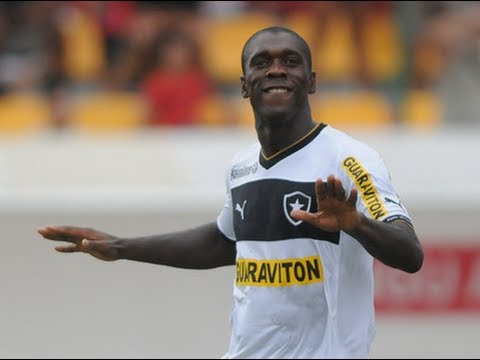
“When Clarence Seedorf went to play in Brazil last year I was sceptical. So were wiser heads than mine. Oswaldo de Oliveira, his coach at Botafogo, was unsure how he could fit the veteran Dutchman into the wide-open spaces of the Brazilian midfield. Twelve months on our fears look ludicrous. The move has been a triumph. Going into the weekend’s 13th round of the Brazilian Championship, Botafogo is only denied top spot on goal difference, and Seedorf is proving the undoubted star turn.” The World – Tim Vickery (Video)
Brazilian fans paying the price for modernisation

“In last week’s second leg of the final of the Copa Libertadores, Atletico Mineiro of Brazil did not only win the trophy – they took the extraordinary sum of nearly $7 million at the box office. A quick, back of the envelope calculation reveals that the average ticket price was over $100. This was a case of exceptional circumstances – the most important match in the history of a big club. But the trend is already out there in Brazilian football.” ESPN -Tim Vickery
Ronaldinho joins select club after Atlético’s debut Libertadores crown
“As Matías Giménez stepped up to take Olimpia’s fifth penalty, Cuca, the Atlético Mineiro coach, knelt on the touchline. Clad in jeans and a T-shirt, he rocked back and forth, head bowed, arms crossed over the sequined pattern on his chest. He didn’t look as Giménez’s shot struck the top of the post. The noise of the crowd told him the kick had been missed and he pitched forward, to lie still for a second or two before being engulfed by his celebrating coaches: Atlético, after another unlikely comeback, were Libertadores champions for the first time.” Guardian – Jonathan Wilson
Ronaldinho joins select club after Atlético’s debut Libertadores crown
“As Matías Giménez stepped up to take Olimpia’s fifth penalty, Cuca, the Atlético Mineiro coach, knelt on the touchline. Clad in jeans and a T-shirt, he rocked back and forth, head bowed, arms crossed over the sequined pattern on his chest. He didn’t look as Giménez’s shot struck the top of the post. The noise of the crowd told him the kick had been missed and he pitched forward, to lie still for a second or two before being engulfed by his celebrating coaches: Atlético, after another unlikely comeback, were Libertadores champions for the first time.” Guardian – Jonathan Wilson
Atlético Mineiro and reborn Ronaldinho attain Libertadores glory
“There might not be second acts in American lives, as F. Scott Fitzgerald once wrote, but it seems that there are in Brazilian football. At least in the case of Ronaldinho Gaúcho and Atlético Mineiro, the new champions of South America, after an exhilarating, at times improbable, Copa Libertadores penalty shootout victory over Paraguay´s Olimpia, at a tempestuous Mineirão stadium in Belo Horizonte last night.” SI
Brazil 2014 blame game

“‘If the protests happen again,’ said FIFA president Sepp Blatter, ‘we will have to ask ourselves if we took the wrong decision in giving Brazil the right to stage the World Cup. His words would not appear to contain any threat, implied or otherwise, that the venue for the 2014 World Cup might suffer a late alteration. Rather, this would seem to be a public relations exercise, and an attempt to separate two distinct areas of protest. The mass demonstrations that rocked Brazil last month began relatively small and specific – on the issue of public transport in Sao Paulo.” ESPN – Tim Vickery (Video)
The Neymar problem
“The Cristiano Ronaldo problem has become the Neymar problem. That both are superb players is not in doubt; both are supremely skilful, capable of a sudden and devastating acceleration, and both can turn games in an instant. But they can also be negligent of their defensive duties and allow the opposing full-back to get forward untended.” World Soccer – Jonathan Wilson
Brazil’s Confederations outsiders face uphill battle to be included
“Brazil was obviously joyous at winning the Confederations Cup in such convincing style — but it would only be natural if there were some places where joy was somewhat confined. Those players outside the squad, for example, now face a much harder time getting back in.” ESPN – Tim Vickery (Video)
Deal with it: Brazil will host the World Cup

“If you were in Beijing or New York last week, you would have to be sitting down when reading the news. According to a report by Folha de S. Paulo, a leading newspaper in Brazil and Latin America, that was obviously replicated by international outlets, there was a chance that the FIFA Confederations Cup semifinals and final would be hosted by one of those cities. Other reports also revealed plans for next year’s World Cup to be moved to safer pastures after FIFA and international authorities were scared by the scale and intensity of the protests on Brazilians streets during this summer’s test event. Yours truly was even asked to take part in a discussion themed ‘Brazil should give up the World Cup.'” ESPN (Video)
The Brazilian lesson: shout
“It’s a peaceful winter’s day in the favela of Monte Azul, São Paulo. Customers sit chatting around the hot-dog stand (which accepts credit cards). A state “health agent” patrols the undulating main street, looking for sick people to advise. At the crèche, the purple curtains are closed to let the children nap. And the rain runs neatly into the gutters, instead of flooding the street. A lot has changed since 20 years ago, when some local men worked as ‘security guards’ for bakeries and supermarkets – which meant they were paid to murder suspected thieves.” FT – Simon Kuper
Hasn’t the Confederations Cup been great?
“Well, hasn’t it been great? From the opening minutes of that opening game when Neymar was firing home that impeccably executed volley, through the thrills and fun of the group games and semi-finals, to the final. I honestly cannot recall one bland game in over the 2 week duration of this year’s Confederations Cup. If this competition is merely Brazil’s supposed warm-up for the real deal of the 2014 World Cup, then we are in for a treat. Here are my 6 reasons why I believe the Conferedations Cup has been so flipping fantastic.” Outside of the Boot
Is the need for speed more important than tika-taka tactics?
“The Confederations Cup final between Spain and Brazil was a highly anticipated clash of two opposing brands of football. In fact, while Spain are well known for playing a possession based style of football, Luis Felipe Scolari has reshaped a traditionally flamboyant Brazilian side into a more defensive minded, counterattacking team.” Think Football
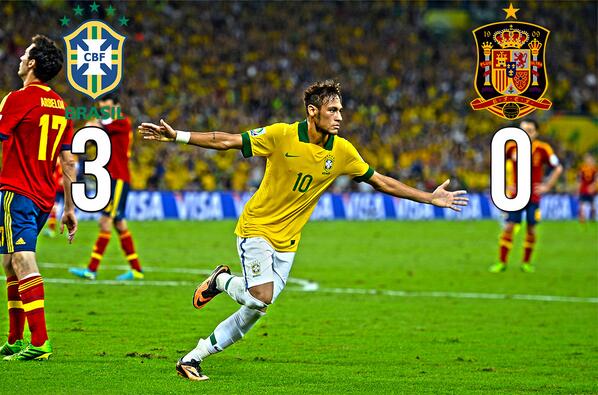
Brazil 3-0 Spain: Spain unable to cope with Brazil’s pace and power on the break

“Brazil won the Confederations Cup at the Maracana after a convincing demolition of the world champions. Luis Felipe Scolari stuck with his usual side – in five games he only deviated from this XI once, when Paulinho wasn’t 100% fit for the final group game. Vicente Del Bosque brought in Juan Mata on the left of his 4-3-3 system, but otherwise the side was unchanged. Brazil yet again started superbly – but Spain failed to mount a significant fightback.” Zonal Marking
“Brazil produced a breathtaking performance at the Maracana to overwhelm Spain and claim their third consecutive Fifa Confederations Cup. Driven on by the passion of a fiercely partisan crowd, the five-time world champions signalled their intent ahead of next summer’s World Cup by ending Spain’s 29-match competitive unbeaten record with a majestic display. Fred scored twice, but Neymar again stole the show, scoring Brazil’s second goal with a rasping left-foot shot. To compound Spain’s misery, Sergio Ramos missed a second-half penalty before Gerard Pique was sent off for bringing down Neymar as last man, with 22 minutes remaining.” BBC
Dream final a sub-plot to urban uprising (June 28)
“And so the 2013 Confederations Cup has its dream final – Brazil against Spain, the match the world has been waiting years to see. It is a clash of two philosophies. For the Brazilians, the star player (known over here as the ‘craque,’ from the English ‘crack’) tips the balance with a moment of individual inspiration. For the Spaniards the collective idea is all important – the constant passing at pace, the continuous formation of triangles, each one opening up new possibilities for a new combination, until a runner can be slipped through on goal.” The World – Tim Vickery
Brazil on the verge of greatness
“Forget history and superstition. You have to be pretty twisted to believe that because Brazil won the Confederations Cup in 1997 and 2005 and 2009 and then failed to win the big one the following year, beating Spain and lifting the trophy at the Maracana was anything but a good thing. Anyone who witnessed the performance against Spain, who felt the goose bumps from the Torcida, who saw Fred, then Neymar, then Oscar, then just about every member of the Selecao vault the pitch-side barriers and celebrate with the supporters will know just how important this was.” ESPN (Video)
Confederations Cup: police clash with protesters outside Maracanã
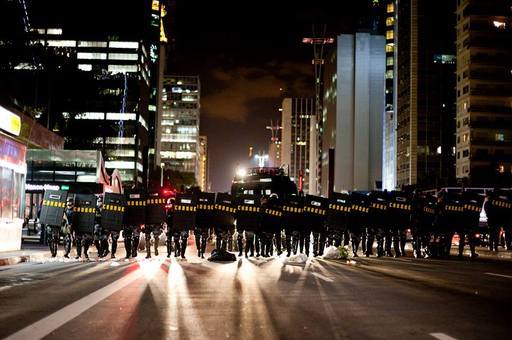
“Protests against the rising cost of hosting the World Cup and a raft of other social inequalities in Brazil see police and demonstrators clash outside the Maracanã on the night of the Confederations Cup final. Brazil won the game against Spain 3-0 to win the trophy. Protests have taken place for the duration of the tournament, involving hundreds of thousands of people” Guardian (Video)
FIFA World Cup – Everybody Wants To Rule The World

“The article below covers the financial impact of the 2010 World Cup in South Africa and was first published a couple of years ago in Issue One of The Blizzard, the thinking fan’s football magazine of choice. Each issue can be purchased on a pay-what-you-like basis and includes some of the finest writing in the world of football, so I would encourage you to visit their website and invest some of your hard-earned cash. Trust me, you won’t be disappointed. Although this is an old piece, I thought that it might be worth republishing on my blog, as it seems very timely given the recent criticism aimed at FIFA over the money it will make from the World Cup in Brazil – in stark contrast to the billions invested by the host country. As you will see, many of the concerns are nothing new and would surely find resonance with many of the South African people.” Swiss Ramble
How delicious: Sepp Blatter has kicked off Fifa’s Arab Spring in Brazil
“It may be a little early to call this, what with several days of the Confederations Cup and an entire World Cup to run, but there’s a nagging sense that Sepp Blatter is somewhat miscast as a Brazilian counter-revolutionary. At time of writing, Fifa had yet to request covert support from the CIA in the form of arms shipments and financial backing. But with protests in Brazil continuing to make the most explicit of links between the money the country’s government has spent on Fifa tournaments, and the money it hasn’t spent on less uplifting things such as healthcare and education, Herr Blatter finds his usual arsenal increasingly wanting.” Guardian
Incitement

“‘Tear gas is a magic potion,’ writes Chris Gaffney from the streets of Rio. ‘Those who launch it are weakened while those forced to inhale it are strengthened.’ For those of you interested in the politics of football in Brazil, his blog – as well as his excellent book on Stadia in Argentina and Brazil – is a key place to go to understand the ways in which preparations for the 2014 World Cup have served as a trigger for what may become a major political and social movement in Brazil. As is often the case, the state’s response to what were initially small protests has energized a movement that is tapping into a powerful vein of dissatisfaction in the country.” Soccer Politics
Can Brazil protests can be traced back to a 2003 Fifa decision?
“Of all the unimportant things in life, as the wise old saying puts it, football is the most important. Which means, wonderful as it is, that the global game comes below education, health and public transport in any rational list of governmental priorities. It is the poor standard of these public services which has brought millions of Brazilian people onto the streets. No-one saw this protest movement coming and no-one knows where it will end. Most agree that the complaints are justified.” BBC – Tim Vickery
Brazil 2-1 Uruguay: Brazil through to the final after substitutes help increase the pressure
“Brazil weren’t on top form, but Paulinho’s late header sends them through to the final. Luiz Felipe Scolari brought back Paulinho after injury kept the Tottenham target out of the victory over Italy – so Hernanes dropped to the bench. Having changed his entire side for the win over Tahiti, Oscar Tabarez reverted to the side that defeated Nigeria. This was a disappointing match in technical sense, with none of the attacking players sparkling, although it was interesting in tactical sense.” Zonal Marking
Brazil reaches Confed Cup final
“Brazil’s players wept with joy inside the stadium, and Brazilian protesters were sprayed with tear gas outside it as the country’s national football team reached the Confederations Cup final despite another wave of mass demonstrations on the streets. Brazil beat neighbors Uruguay 2-1 with an 86th minute header from Paulinho in a performance that failed to reach the commanding heights of earlier games. As thousands of anti-government protesters clashed with police nearby, inside the Mineirao Stadiujm, Brazil’s footballers reached Sunday’s final in Rio de Janeiro with a patchy display.” ESPN (Video)
Scarred Brazil still hopeful of World Cup success

“Football supporters fleeing tear gas and rubber bullets. Angry mobs torching banks and buses. Gleaming new stadiums encircled by activists. These are images few Brazilians would have predicted they would see on the streets of their country just 10 days ago, images the organisers of the next year’s World Cup could not have imagined would blight the Confederations Cup.” BBC
Neymar scores, Brazil tops Italy 4-2 to finish Confed Cup group play
“Neymar scored for the third straight Confederations Cup game, curling in a delightful free kick, as Brazil beat Italy 4-2 to complete Group A with a perfect record on Saturday. Dante, who replaced the injured David Luiz, put Brazil ahead in first-half stoppage time but Emanuele Giaccherini levelled six minutes after the re-start after being sent clear by Mario Balotelli’s clever back-heeled flick.” SI
Brazil 2-0 Mexico: Brazil start strongly but fade

“The opening suggested Brazil would win comfortably – but they spent the majority of the second half clinging onto a one-goal lead. Luiz Felipe Scolari kept the same XI that defeated Japan in the opening game. On the right flank, Jose Manuel de la Torre stuck with the duo that ended the defeat to Italy – Gerardo Flores on the wing and Hiram Mier at full-back, with winger Javier Aquino on the bench. Carlos Salcido switched from left-back to the centre of midfield, with Jorge Nilo coming into the side. Brazil started ferociously and pinned Mexico back into their own half, but their overall performance was disappointing.” Zonal Marking
Mexico continues frustrating, sluggish form at Confederations Cup
” There has been good news for Mexico during the Confederations Cup this week, but little of it has come from any of the match outcomes in Brazil. Victories for the USA over Honduras and Costa Rica over Panama have kept Mexico in the third automatic qualifying slot from the Concacaf hexagonal, but the team’s own form continues to frustrate. There is nothing shameful about losing to Italy and Brazil and if that were all there was to it, there’d be little reason for concern. The problem is context. Mexico has now won just one of its last 11 games — admittedly eight draws mean it was unbeaten in nine before the tournament — but the sense of optimism stimulated by its success in last July’s Olympic Games has all but evaporated. The crispness and rhythm of the team’s performance in London last summer has been replaced by sluggishness, despite the fact that six of the players who faced Brazil on Wednesday were in that same Olympic squad.” SI – Jonathan Wilson
“Neymar produced a commanding performance as Brazil secured their place in the Confederations Cup semi-finals with victory at the Estadio Castelao in Fortaleza. This was not the dominant performance that some had expected but it was Brazil’s first competitive victory over Mexico in nine years and a third successive win under head coach Luiz Felipe Scolari.” BBC
Violent protests mar Brazil-Mexico match in Fortaleza
“Brazilian police have fired tear gas and rubber bullets to disperse some protesters in the city of Fortaleza, as unrest continues across the country. At least 30,000 people rallied in the north-eastern city ahead of the Confederations Cup game with Mexico. The unrest was sparked by transport price hikes in Sao Paulo but it has now grown into broader discontent over poor public services and corruption.” BBC (Video)
Latest Story Brazil 3-0 Japan: Brazil start the Confederations Cup with an encouraging performance

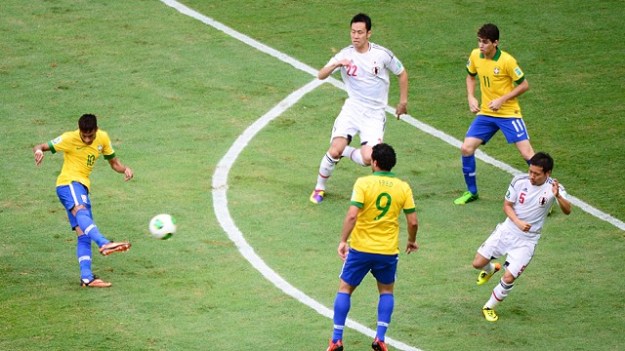
“Brazil scored at the start of the first half, at the start of the second half, and in the final minute. Luiz Felipe Scolari named his expected side, unchanged from the XI that defeated France 3-0 last week. Alberto Zaccheroni left out Ryoichi Maeda, using Shinji Okazaki as the lone striker, with Hiroshi Kiyotake playing on the right of midfield. Brazil got off to a tremendous start through Neymar’s brilliant strike from the edge of the box and controlled the majority of the game.” Zonal Marking
Demonstrations mar Brazil’s Confederations Cup win over Japan
“Brazil opened the Confederations Cup with a comfortable 3-0 win over Japan, but the event was marred when police clashed with protesters outside the Mane Garrincha National Stadium. A stunning third-minute goal from Neymar set the hosts on their way before Paulinho added a second three minutes into the second half, as they dealt competently with the Asian champions. The substitute Jo completed the scoring in stoppage time.” Guardian
Neymar, Brazil control Japan 3-0
“Neymar lit up the opening match of the Confederations Cup with a stunning early goal but the final scoreline reflected a more laboured victory over Japan than the home fans were hoping for.” ESPN (Video)
“Neymar’s spectacular third-minute goal set hosts Brazil on their way to a comfortable victory over Japan in the opening game of the Confederations Cup. The Barcelona striker met Fred’s knockdown on the edge of the area with a blistering shot into the top corner.” BBC
Confederations Cup: 39 injured & 30 arrests in Brazil protests
“Brazil’s opening Confederations Cup match was affected by protests that left 39 people injured. Up to 1,000 Brazilians demonstrated outside the country’s national stadium to vent their anger at the amount of money the country is spending on staging next year’s World Cup. Police used tear gas and pepper spray to control protestors before the match, in which Brazil beat Japan 3-0. There were also reports rubber bullets were used and 30 arrests were made.” BBC
Confederations Cup 2013: Spain remain team to beat in Brazil

“Despite some resistance from the Republic of Ireland at the Yankee Stadium, they outgunned Giovanni Trapattoni’s men 2-0 in their last game before the Confederations Cup campaign gets under way in Brazil this weekend. On Sunday, the world and European champions play their first group game against Uruguay, as La Roja begin their bid to bring yet another international trophy back to Madrid.” BBC
Uruguay’s fighting spirit comes to the fore
“Uruguay turning up for a tournament on Brazilian soil is enough to send a shudder down the local spine. The other day Pele was remembering the World Cup final of 1950, and his father in tears as the sky blues came from behind to shock the host in Rio’s newly built Maracana stadium. Now Uruguay is back once more, this time for the 2013 FIFA Confederations Cup.” The World Gane – Tim Vickery
Confederations Cup 2013: Spain team profile
“… Whether in a 4-3-3, 4-2-3-1 or 4-6-0 formation, the modern-day Spanish side, with a little help from their free-flowing Barcelona contingent, have ripped up the formation book – even winning tournaments with the false number nine/strikerless line-up. Barcelona’s Victor Valdes is expected to start the tournament as Spain’s number one goalkeeper in the major change from Euro 2012, with Iker Casillas missing out.” BBC
Face of World Cup host Brazil? Look no further than Neymar
“When the World Cup hopes and dreams of arguably the world’s most successful footballing country rest on your skinny shoulders, you’re going to need all the help you can get. It is not known what great works of literature Neymar chose when packing his suitcases for Barcelona, but he could have done worse than to seek solace in a little Shakespeare. Dank and drizzly though it can sometimes be, Santos’ Vila Belmiro stadium, our hero’s erstwhile home, is a long way from the gloomy battlements of Hamlet’s Elsinore. Nevertheless, there are more than a few parallels between the life and times of Brazil’s current idol and Shakespeare’s classic paean to troubled young manhood.” SI
Confed Cup Preview: 5 storylines to watch
“The Confederations Cup (June 15-30) is the ritual eight-team dry run designed to give the World Cup hosts the chance to iron out any kinks in their stadia and transport systems a year before the big show begins. The tournament pitches the hosts, reigning World Cup holders and six confederation champions (with Italy qualifying as Euro runners-up to World Cup holders Spain) into battle.” ESPN (Video)
A rare Confederations Cup – all the teams, for once, want to win it
“Tournaments are like birthdays: they are as significant as you want them to be. To many the Confederations Cup is a meaningless intrusion on the football calendar, a rinky-dink competition that proves nothing more than Fifa’s greed. After all, the World Cup already exists to establish the best team on the planet so what, other than money and attention-seeking, is the point of a mini-tournament between the leading teams from each continent?” Guardian
Starting anew: Deeper Spain lacks strong XI
“While club football’s evolution from a ‘team game’ into a ‘squad game’ has been widely acknowledged the past two decades, the situation at the international level remains uncertain. After all, major international tournaments are decided during the course of four weeks, rather than eight months. Whereas the speed and intensity of modern football ensures club managers frequently rotate their squad to prevent burnout in the spring, international managers often squeeze every last drop out of their regular starting XI.” ESPN – Michael Cox
Spoils shared at Maracana
“Superb strikes by Alex Oxlade-Chamberlain and Wayne Rooney rescued some dignity for England after Brazil had handed out a footballing lesson at the Maracana. After toiling against Brazil’s dash and panache, two moments of brilliance saw England take an unlikely lead before Paulinho’s excellent volley gave the hosts a draw at the official re-opening of their famous stadium, the very least they deserved. The strikes by Oxlade-Chamberlain and Rooney, following Fred’s opener for the home side, were not quite of the same standard as John Barnes’ legendary solo goal in this stadium 29 years ago. Nevertheless they will provide much-needed encouragement for Hodgson ahead of the autumn’s World Cup qualifiers.” ESPN
Brazilian football must get real
“In professional football, money is, always has been, and always will be a key factor. However, not necessarily a decisive one. If it was then Brazil would have at least three representatives in the semi-finals of the Copa Libertadores – South America’s Champions League. Instead, Brazil was only a penalty miss away from losing all interest in the competition at the quarter-final stage. The country’s last standing survivor, free-scoring Atletico Mineiro, was 12 yards and 30 seconds from elimination. All Tijuana striker Duvier Riascos had to do was score the stoppage-time penalty and his club, Tijuana of Mexico, would be through to the last four.” The World Game – Tim Vickery
C is for Cosmos

“Take a deep breathe, it’s going to be alright. It has to be alright. Sure, things didn’t begin so well, but you learned. You learned from the handful of fans who watched you play at Yankee Stadium, and you learned from the scattering who followed you to Hofstra. You learned not to be average. You couldn’t be average. Not in New York. Not in Andy Warhol’s New York.” futbolintellect
Ronaldinho’s time looks to have passed
“Is this the end? Has the door slammed shut on Ronaldinho’s chance of redemption? That must surely be the likely conclusion of Brazil’s Confederations Cup call up. Coach Luiz Felipe Scolari read out his 23 names. When he had got to the end and the assembled journalists realised that Ronaldinho had not been included, the room became a hornets’ nest of buzzing voices, as excited radio reporters reached for their microphones to spread the news. They had every right – it is important news. For some nations the Confederations Cup might be a collection of friendlies with a trophy at the end – but not for Brazil. There is too much at stake. As 2014 World Cup host it has suffered from a lack of competitive games, and ever since the last World Cup neither results nor performances have been convincing.” The World Game – Tim Vickery (Video)
Luiz Felipe Scolari’s Seleção – An Analysis
“It’s all happening in Brazil. We’re just two months away from the start of a three-year sporting bonanza beginning with the 2013 Confederations Cup and ending with the 2016 Olympic Games in Rio de Janeiro. In the middle of that is the 2014 World Cup, a tournament that has belonged to Brazil more than any other country in international history. And the pressure is on for Seleção boss Luiz Felipe Scolari.” Outside of the Boot
Political football: how Brazil’s military hijacked the beautiful game

“As five-time World Cup champion, the Brazilian national team has become known the world over not just for winning, but for winning with a joyous panache that has become synonymous with the beautiful game. However, behind every one of Ronaldinho’s toothy grins and camouflaged by the color-shocked mohawk clinging to Neymar’s head lies an intensely complicated relationship between nation and sport.” World Soccer
“Brazil is a country commonly associated with the highest level of soccer. The world has grown used to Brazil winning, but the Brazilians themselves seem to have an insatiable appetite for world football dominance. Their nation has produced soccer players that have come to represent spontaneity, creativity and skill on the playing field. The bandy-legged Garincha, a walking paradox, the goal scoring machines Friedenreich and Ronaldo, the modern hope Kaká, and, of course, the eternally great Pelé – all these players have left their indelible marks on football’s canon.” Soccer Politics
Zero Dark Thirteen – Brazilian football wallows in the mire of corruption
“If the 2014 World Cup is to signal the arrival of Brazilian football’s brave new world, a desperately needed fresh start for the game in a country where on-field majesty is usually matched by administrative skulduggery, it can’t come soon enough. The year is not yet four months old but it feels, to misquote autocratic former president Getúlio Vargas, as though Brazilian football is standing in a sea of mud. Worse, it often appears as though chaos has become the norm.” Independent
Socrates and the Corinthians’ Democracy
“As the global sporting world faces one corruption scandal after another, former Manchester United star Eric Cantona presents the stories of five football heroes whose social conscience led them to challenge unjust regimes, join opposition movements and lead the fight for democracy and human rights. Football Rebels looks at a side of football that does not always make the headlines.” Aljazeera (Video)
All the President’s Torturers
“Chosen to host both the 2014 football World Cup and the 2016 Olympic Games and with abundant natural resources and one of the fastest growing economies in the world, one way or another Brazil is set to become a major player in the affairs of the 21st century. With an ambitious, progressive government, a population of around 193 million, now well established federal democratic structures and apparent political stability, many even see it as a global superpower in the making, perhaps even deserving of a permanent seat on the UN Security Council in the not too distant future. But its solid international reputation has not always been so glossy.” Aljazeera (Video)
The Copa Libertadores and differing stories for Ronaldinho and Riquelme
“The Copa Libertadores this season has been the story of two brilliant players in the twilights of their careers: one having immense fun as though he can’t quite believe he’s still getting away with it, the other grumpily raging against his waning powers. For Ronaldinho and Atlético Mineiro, this has been, so far, a tournament of glee, of great goals and big wins; for Juan Román Riquelme and Boca Juniors, it has been all about suffering. Both will be in the last 16, but their journeys could hardly have been more different. It’s also been the story of the continuing development of Ecuadorean football.” Guardian – Jonathan Wilson
Neymar! Reducing Brazil’s Football ‘Trade Surplus’
“It’s time for another sporting feature since we haven’t had one for quite some time now. Fortunately, there’s interesting stuff courtesy of TIME Magazine about the changing complexion of ‘the beautiful game.’ Even if the Brazilian economy has cooled off markedly in recent times, it has had a strong run-up and most folks remain optimistic about its economy’s future. Contrast its fate with that of the European football powerhouses that traditionally import South American players in droves–especially Portugal, Spain,and the United Kingdom–and you begin to understand the reduced “trade surplus” of Brazil sending away its best footballers time and again…” International Political Economy Zone
Room for improvement
“Of all the great football rivalries, my favourite is the one between the national teams of Brazil and Argentina. There is nothing to get in the way – no real military history between the two countries, as is the case with the Netherlands and Germany, for example, of England and Germany, and even England and Argentina. When Brazil meets Argentina the rivalry is one of pure football, a battle for supremacy on the pitch between two neighbours vying to be considered the number one nation of the global game.” The World Game – Tim Vickery
Forward Brazil

“As five-time World Cup champion, the Brazilian national team has become known the world over not just for winning, but for winning with a joyous panache that has become synonymous with the beautiful game. However, behind every one of Ronaldinho’s toothy grins and camouflaged by the color-shocked mohawk clinging to Neymar’s head lies an intensely complicated relationship between nation and sport. Over the course of the 20th century, the average Brazilian’s rabid devotion to football allowed the game to be manipulated – serving as an opiate to anesthetize the Brazilian people toward the actions of their government. This wicked transformation has never been more apparent than during the 1970’s. Then, the military dictatorship under Emílio Médici spared no expense to ensure that its brutal totalitarian measures were shaded by the blinding brilliance of joga bonito.” In Bed With Maradona
Criciúma’s return to the big time revives memories of past glories
“Heading south from Sao Paulo, Brazil’s largest city and football hotbed it is a little over 500km before you reach the state of Santa Catarina. Bordering Argentina to the west and the Atlantic Ocean in the east it is one of the smallest in the country. Despite this it boasts a strong economy largely fuelled by tourism thanks to a few hundred kilometres of golden beaches and large areas of wildlife and even snow-capped peaks further inland. Santa Catarina proudly claims to have the highest standard of living in Brazil and possibly all of South America. However on the football pitch it lags well behind its larger neighbours in the heavily populated South East of the country.” World Soccer
The Scramble to Finish Rio de Janeiro’s 2014 World Cup Soccer Stadium

Workers remove mud after heavy rains outside Maracanã Stadium. March 6, 2013
“Here’s the plan: On June 2nd, a bronze statue of Pelé will be unveiled at the inauguration of Rio de Janeiro’s renovations, just before Brazil defeats England in a friendly soccer match. Weeks later, Brazil will win the Confederations Cup on the same field, portending the glorious final match next summer when the national team returns the World Cup to this hallowed ground. Yet with fewer than 100 days until the Confederations Cup begins, the stadium is unfinished—and sometimes underwater—after months of delays and weeks of unwelcome thunderstorms.” The Atlantic
2014: A Very Brazilian World Cup?
“In an ever-increasingly globalised world, national football teams offer a rare beacon of consistency and separation, a unit that cannot be corrupted or diluted, influenced or relegated. Fans can embrace their shared culture and nationality, with no fear of players being poached or tempted away by bright lights and bulging pay packets. The national identification allowed by international football also drives the assimilation and acceptance of diverse racial groups into modern society, predominantly in Western Europe. Countries are building squads that reflect the growing diversity of their nations, particularly in the poor, urban youth; the breeding ground for so many of the world’s footballing superstars.” In Bed With Maradona
Corinthians: brilliance in solidity
“Corinthians truly are the sum of their parts but they will need to buy themselves time inside Chelsea’s half to do justice to the nature of their football. Incision, precision and an ability to maintain shape both when attacking and defending are the identity of this side. Players are rotated, the formation is tweaked and yet coach Tite (pictured below) knows his game plan will be adhered to. Sitting pitchside in the October balm of the Joaquim Grava training-compound on the outskirts of São Paulo, Corinthians coach Tite knows what elements his team needs if it is to triumph against Chelsea two months later in Yokohama. In fact, Tite has been clear about this since, well, who knows: perhaps since his team’s July conquest of the Copa Libertadores which settled the identity of South America’s representative to be sent to the Club World Cup. Conceivably, it could even have been as far back as May when Corinthians’ participation was yet uncertain and Didier Drogba and Company conjured up an east-bound ticket from Munich. This is because, beyond the vagaries of micro-tinkering in the face of impending opponents, Corinthians know what they play at, and play it well.”
santapelota
The forgotten story of … Heleno de Freitas

“For most in Brazil, what happened in the Rasunda Stadium in 1958 was a gleeful affirmation of what they had always known. They were the world’s great football nation and beating the hosts, Sweden, in the final was vindication after the trauma of the defeat to Uruguay in the Maracanã eight years earlier. In an asylum in Barbacena in the state of Minas Gerais, patients clustered anxiously round a radio as the game entered the final minute. A cross came over, Pelé rose and made it 5-2: the world title was confirmed. Patients and staff celebrated together – all except one. In his room, alone, Heleno de Freitas filled his mouth with cigarettes, lit them all and tried to smoke himself to death.” Guardian – Jonathan Wilson
Heleno de Freitas
“Heleno de Freitas, nicknamed Prince Cursed, (born 12 February 1920 in São João Nepomuceno, Brazil; died 8 November 1959 in Barbacena) was a Brazilian footballer. The striker spent most of his career with Botafogo, scoring 209 goals for the club, most with his head. In 1948 he transferred to Boca Juniors in Argentina, but returned to Brazil the following year, winning the 1949 Campeonato Carioca with Vasco. He ended his career with América in Rio, he played only one match for the club and it was the first and last game in the Maracanã. He died in 1959 in a sanatorium in Barbacena.” Wikipedia
Brazil’s goal: a clean sheet
“Brasília – the Brazilian capital carved from the savannah 50 years ago – is a hard city to love. I hate to say this while its architect, 104-year-old Oscar Niemeyer, lies ill in a Rio hospital, but Brasília was built for cars and architecture critics, not for people. It’s a place for bureaucrats to have a quiet life, a Bonn in the tropics. Traffic jams are rare, even at 5pm when the ministries empty and everyone sails home along the huge central axis. This is a middle-class town.” FT – Simon Kuper
Brazil milestone evokes memories of Pele and Moore
“‘One of the biggest blasts of hot air, which I’ve been hearing ever since I was an adolescent, is the idea that top level sport is a good place to learn and develop ethical and moral values. It never was. Ambition, the desire to be a hero and to make lots of money are usually much stronger.’ So wrote 1970 Brazil great Tostao in Sunday’s version of his always interesting column, a twice weekly space where football is analysed by someone of great knowledge and intelligence who loves the game but is even more fascinated by the subtleties and contradictions of the human being.” BBC – Tim Vickery
Palmeiras appeal could decide club’s destiny
“All’s fair in love, war and relegation battles – or Palmeiras seem to think so. The Sao Paulo giants, the team of the city’s Italian community, are in trouble. Back in July they won the Brazilian Cup, guaranteeing a place in next year’s Copa Libertadores, South America’s Champions League. However, results have since suffered in the domestic league and they now need to make up a seven-point gap with just four rounds of the season left. Their hopes could perhaps rest on the outcome of a hearing to be held in the next couple of days. The focus of their appeal is a disallowed goal from Argentine centre-forward Hernan Barcos against Internacional on October 27.” BBC – Tim Vickery
Never a dull moment in Bolivian football
“Firstly, let me set the scene. It’s my first game from the Bolivian LFPB (Liga del Fútbol Profesional Boliviano) with Universitario de Sucre facing Oriente Petrolero, two teams languishing in the mid-table region of the Apertura half of the competition. Going in to the game, Oriente Petrolero had drawn a mind-boggling 8 of their 11 games, and had only lost once. Universitario were just a point better off but were playing at the Estadio Olímpico Patria, where they had a fine record. Football tends, more often than not, to follow certain formulae and basic principles. Being a Bolivian football newcomer (save for a few games in the Copa Sudamericana and a harrowing experience with Aurora in the Libertadores), I applied these principles to the game and assumed it would be a turgid, boring, low quality draw. Despite my inexperience with Bolivian football, I’ve commentated on scores of South American games from Brazil, Argentina, Uruguay, Paraguay, Peru – well, you get the picture.” World Soccer
Brazil look on target without a number nine
“‘I was too busy scoring goals to learn how to play football,’ says Dario, a legendary figure in Brazilian football from the 1960s and 70s. A charismatic character, Dario invents phrases as easily as he used to put the ball in the net. ‘There’s no such thing as an ugly goal,’ he once said. ‘Ugly is not scoring goals.’ If both remarks sound a little defensive, it is easy enough to explain. Brazilian football has been gifted with so many artists – players capable of snapping their marker in two with a sway of the hips, wrong-footing the keeper and then sliding home – that a little prejudice sometimes persists about the centre forward. The target man number nine whose game is restricted to getting the ball over the line can be seen, at best, as the exponent of a minor art.” BBC – Tim Vickery
Brazil’s ‘Stray Dog’ Complex
“In the early twentieth century Latin American football was growing rapidly. Uruguay had won the triple crown of the Olympic Games in 1924, ’28 and the inaugural World Cup held in Uruguay 1930. Since then football had sprung up across the continent reaching all sections of society and social class, from Copacabana beach overlooked by Sugarloaf Mountain to the country clubs. This new samba style football was developed; individual skill and flair outshined the rigidity of European tactics. The flamboyant philosophy is an extension of the carnival. Brazilians like to show off. There is a word in Brazil ufanismo, boastful, arrogant nationalism. When Brazil was chosen to host the 1950 FIFA World Cup, they were going to put on a show to encapsulate their style of play, but come the climax of the competition, the Uruguayans did not read the script, and Brazil paid the price.” In Bed With Maradona
Can Kaka still make his mark on a World Cup?
“During the 2006 World Cup in Germany, the only time Kaka was not seen filming everything around him was when he was on the pitch playing for Brazil. He had expected to record some treasured memories — forming the much-hyped “magic quartet” with Ronaldo, Ronaldinho and Adriano. After the tournament, however, those images could not have made for easy viewing. Kaka produced a man-of-the-match performance in the opening game, scoring the only goal against Croatia. Thereafter, it was downhill all the way. In truth, the team was top heavy.” ESPN – Tim Vickery
A Barcelona Expert On Why Mourinho Is The Special One

José Mourinho
“Modern football has produced many greats on the pitch but few off it. The casual football fan may be more familiar with Argentine genius, Diego Armando Maradona, his Brazilian counterpart, Edison Arantes do Nascimento, or as he is better known, Pelé, or Dutch master Hendrik Johannes Cruijff alias Johan Cruyff. Though they have hanged up the football boots decades ago, their names still resonates with football fans worldwide. The majority of younger football fans have never seen Pelé, Johan Cruyff or Maradona live, due to being handicapped by not being alive during their respective era, but their parents had the privilege to have witnessed some of the greatest footballers of all time.” Sabotage Times