“On Wednesday nights I play bad football with some other old blokes in Paris. I spend the game shouting instructions at my team-mates in bad French. They don’t listen. What is going on here is a clash of football cultures. I grew up in the Netherlands, where football is a sort of debating society. In France, as far as I can gather, talking during football is rude.” (FI – Simon Kuper)
Tag Archives: Brazil
Dunga and Diego are at it again
“Bizarre inclusions? Check. Big name exclusions? Check. Wringing of hands, tearing of clothes and gnashing of teeth (largely metaphorically)? Check. Señores y señoras, it’s World Cup preliminary squad announcement time! And while there won’t be many chairs thrown through windows in rage at the choices made by the managers of Paraguay, Uruguay and Chile, South America’s two giants are grabbing the headlines. Well, what did you expect?” (ESPN)
England remain a World Cup long shot
“Most bookmakers have England as third favourites to win the World Cup this summer. Their odds are always fanciful – driven down by patriotic bets made more in hope than belief. But a cursory glance around the competing squads should discourage any drunken wagering. It is not so much the players in the opposing squads that should deter potential gamblers, but who they can afford to leave out.” (WSC)
Brazil stay focused – Argentina look muddled
“Dunga’s announcement of his Brazil squad for South Africa was a crushing defeat for the nation’s media in one of its favourite sports – trying to force the inclusion of big names players on to the plane for this summer’s World Cup. But it was the perceived excesses of Brazil’s stars that undermined their campaign in Germany in 2006 and paved the way for Dunga’s appointment. He took over with a message that individuals might win matches but groups win titles. Over three and half years later, coherence has been maintained.” (BBC – Tim Vickery)
Ronaldinho Misses Out on Brazil Selection
“Ronaldinho’s gap-toothed grin will be missing from the Brazilian team photos from South Africa. The most dazzling player of a generation was omitted from Dunga’s preliminary roster Tuesday, signaling perhaps that supreme talent alone is not enough to be part of the Seleção, and that training habits and commitment may also be important.” (NYT)
Players, Lives, and ‘A Beautiful Game’

“‘What makes a player?’ Answers to this question, here quoted from Arsenal manager Arsène Wenger’s foreword to the newish book A Beautiful Game, are plentiful in world football. We debate the right age to go pro, the role of intensive youth academies, shifting population demographics, the dangers and benefits of increasing professionalization, and more in hopes of figuring out how to best tap the potential of millions of children playing the game with unstructured joy.” (Pitch Invasion)
Brazil coach Dunga faces World Cup selection challenge
“When Dunga was appointed head coach of Brazil four years ago, many of his compatriots were displeased. In a country where so many new talented coaches emerge every season, it seemed an odd choice to install a former player without any managing experience. It did not help that Dunga was seen as stubborn and hot-headed back in the days when he was captain of the national team.” (BBC)
“Goal by Garrincha:” Eduardo Galeano Reads from Soccer in Sun and Shadow, Part Three
” In the third of six excerpts for Fair Play, Galeano reads ‘Goal by Garrincha,’ in which he recalls the on-field wizardry—and ultimate tragedy—of Brazil’s original free spirit.” (Fair Play – Part Three), (Part One), (Part Two)
Brazil, Campeonato Série A: 2010 season, with average attendances from 2009
“At the upper right on the map page is a list of 2009 atendances of all the clubs in Brazil’s 2010 Campeonato Série A season. Reigning champions are Flamengo, the giant club from Rio de Janeiro, who had last won the title in 1992. The final match of the season at the Maracana drew 80,000, to see a 2-1 win over Gremio. São Paulo had an uncharacteristic stumble in the run-up, losing away to both Goiás and Botofogo in the weeks leading up to the finish. That massive gate pushed Flamengo to the top of the average attendance list once more.” (billsportsmaps)
Soccer legend who supports all African teams – and Brazil

Luis Fabiano
“The African footballer of the century clutches an icepack against his cheek. He is hurting. ‘I like to chew bones, turkey bones,’ mumbles George Weah, in a Liberian accent that further complicates comprehension. Watching television one day he got distracted and bit too hard. Visiting the Netherlands last weekend, Weah spent a lot of time with Dutch dentists. In between he talked about Africa and the coming World Cup in South Africa – and about whether it will be an ‘African’ World Cup.” (FI – Simon Kuper)
Unlike Europe, Brazilian league preserves its competitive balance
“In England, Chelsea and Manchester United are fighting for the domestic title. In Spain, it’s Real Madrid and Barcelona. Inter Milan is out front in Italy, as are Bayern Munich in Germany. It’s the same old same old.” (SI – Tim Vickery)
Gilberto Silva has become a symbol of Dunga’s regime
“Nearing 34 and surely on the downward slope, Gilberto Silva prepares for his third World Cup – but the first in which he is guaranteed a place in the starting line-up. In 2002 he was a squad player with a handful of caps, only recently converted from centre-back to defensive midfielder, when on the eve of the tournament Emerson injured himself in a training-ground kickabout and Gilberto had to step in.” (World Soccer – Tim Vickery)
Brazilian Serie A season previewed

“Last season Flamengo came from nowhere to win their sixth title – and first since 1992 – with perennial stand-in Andrade establishing himself as first-team coach in the process. However, quite apart from the distraction of the Libertadores Cup, a repeat performance will be difficult. The contracts of glamorous strike pair Vagner Love and Adriano run out in mid-campaign – and even if the latter stays his tendency to miss training is always liable to set off mini crises in the club’s ever-turbulent environment.” (World Soccer – Tim Vickery), (World Soccer – Tim Vickery)
Carlos Carmona could be a player to watch in South Africa
“Praise has flooded in for coach Marcelo Bielsa for leading Chile to the World Cup finals in such convincing and attractive style – and rightly so. The Argentinian has clearly done an exceptional job, inheriting a squad in some disarray following the 2007 Copa America and moulding them into a side considered by some to be dark horses in South Africa.” (World Soccer – Tim Vickery)
Nicolas Otamendi is one of Argentina’s unsung heroes
“First, because Maradona has made a point of playing friendlies with a squad solely made up of home-based players. Otamendi featured in the first of them, against Panama in May of last year, and was soon plunged straight into the tumultuous World Cup qualification campaign.” (World Soccer – Tim Vickery)
Which is the best rivalry?
“Rivals. Every nation has one; some have two. Which is the best rivalry in international soccer? Our contributors weigh in … and let’s be honest: It would be fun to see some of these games materialize during the World Cup.” (ESPN)
Reasons To Love (and Hate) All the teams in South Africa
“So with the World Cup coming up, many of you will be looking for a team to follow either as a second team when your team inevitably gets knocked out in the Quarter Finals on Penalties (perhaps that one is just me) or because your team didn’t make it to South Africa. Either way, at some point you are going to need someone to follow. Often this is irrational and you just like a team. Sometimes you need a reason, sometimes you just inexplicably hate someone, or maybe they have a player you like from the club you follow.” (World Cup Blog)
2010 Copa Libertadores, Second Stage, Round of 16, with top 5 leading scorers
“The map shows the 14 clubs through to the Round of 16, plus the two Mexican clubs who were allowed to pick up where they were a year ago prior to the H1N1 scare in Mexico that forced the two clubs, San Luis and Chivas Guadalajara, to pull out of the 2009 Copa Libertadores. Click on the gif below to see photos, with flag of the country of birth listed, for the top 5 scorers in the competition so far.” (billsportsmaps)
Brazil must reform its domestic league if it is to thrive
“The 2010 version of the Brazilian championship kicks off with the presence of all four national team strikers from the last World Cup: Ronaldo, Adriano, Robinho and Fred. Meanwhile, Roberto Carlos is back from Europe, as are Vagner Love, Ewerthon and Lincoln.” (World Soccer – Tim Vickery)
Is the sweeper set for a return to prominence?

Matthias Sammer, a classic sweeper
“Jonathan Wilson recently wrote in his excellent ‘The Question’ series about the possibility of the return of the sweeper to football. The sweeper prospered as the ’spare man’ in a three-man central defence up against a two-man attack, so now we have two-man central defences up against one-man attacks, should one centre-back not become a sweeper? The idea is music to the ears of anyone who fondly remembers Euro 96. The player of the tournament was Matthias Sammer, the sweeper in the German 3-4-1-2 system that went onto win the tournament. As well as being the most important player in defence, clearing up behind the two markers, he also had license to go forward and launch attacks, and found himself scoring (in open play) on more than one occasion.” (Zonal Marking)
Neymar and Ganso the crown jewels of Santos’ new generation
“On the same day the Titanic struck that fatal iceberg in 1912, a club was founded that would raise the profile of Brazilian soccer. All around the world Santos are almost certainly the team from Brazil that most people have heard of. This is a remarkable achievement for a club representing a relatively small city. Santos is a port with a population under 500,000, an hour’s drive away from sprawling Sao Paulo, South America’s biggest city. But the seaside club have often punched well above its weight, getting the best of metropolitan rivals Corinthians, Palmeiras and Sao Paulo, and often anyone else who stood in its path as well.” (SI – Tim Vickery)
Could personal technology stop a winning World Cup squad spirit?
“I have been back in England for a quick visit and I was struck by an outburst that Hull boss Iain Dowie aimed at his squad. ‘Sometimes the players have to forget about the iPods,’ he said. ‘They need to think about what really matters.’ He went on to admit: ‘I’m not a big fan of these big earphones on the way to games,’ and that ‘my thing with the iPod generation is that when they leave the ground and go away to their closeted little lives they shouldn’t forget what’s got them where they are and what impact they can have.’ It is, of course, the complaint of a member of one generation about the desocialising effect of technology on the next.” (BBC – Tim Vickery)
10 World Cup Questions: Brazil
“Chris and myself have been trying our best to profile each of the 32 teams that will compete at World Cup 2010, but our knowledge about each team is miniscule (or at least mine is anyway) when compared to that of our team bloggers.” (World Cup Blog)
Meet the luckiest fan in the world
“While scuffles broke out at South Africa’s ticketing centres and football fans (including myself) grew irritated at yesterday’s computer ticketing collapse, leaving many empty-handed, one man sat exceedingly pretty. He hadn’t needed to sleep overnight on the streets of Cape Town nor Johannesburg – where one devoted couple hired a hotel room near a Fifa centre so they could tag-team for a 20-hour marathon that eventually yielded two much-coveted tickets for the final.” (BBC)
Undercurrents of Violence at the World Cup

Emmanuel Adebayor
“How easy it is to forget that athletes at their peak are, by the very nature of their tasks, young but expected to be wise in their event, world-traveled but isolated and vulnerable. This week, Emmanuel Adebayor, the goal scorer for Manchester City, gave up the captaincy and, he said, the calling to ever play again for his country, Togo. He is 26 and a millionaire, and he said he just cannot get out of his head the day in January when Angolan separatists fired on the Togo team bus, killing three people in it.” (NYT)
The Case of the Soccer Con Artist
“Last summer, CSKA Sofia, the winningest soccer club in the history of Bulgaria, invited an intriguing prospect to train with the team. The player, a Frenchman named Greg Akcelrod, had been climbing the ranks of European soccer, signing with a top-flight Paris club and training with a team in Argentina. He had an agent and a Web site that showed him scoring a goal for the English club Swindon Town. He’d even been chosen as an ambassador for Lance Armstrong’s charity.” (WSJ)
Immigrant pride and working-class thrift

Italy
“A century ago when the Velez Sarsfield club was founded in Argentina their shirts were plain white – the cheapest they could find. Then they went with stripes of red, green and white – a tribute to the Italian origins of the club’s founders. Finally they settled on the current strip – which, with a blue V on a white background looks like something out of rugby league. This is no coincidence. The story goes that they were offered a good deal on the shirts, which a rugby club had ordered and not bothered to collect.” (BBC – Tim Vickery)
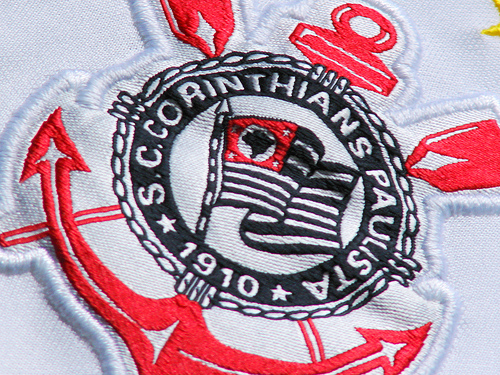
What’s in a Name? – Sport Club Corinthians Paulista

“The story of the mighty Brazilian football club Corinthians begins in the fertile mind of N. Lane Jackson, assistant secretary of England’s Football Association in the 1880s. Jackson came up with the idea of putting together a club that could seriously challenge the dominance of Scottish football (yes, incredibly, there was a time when Scotland was THE world power in football).” (Pitch Invasion)
How Many Africans Bound for South Africa Remains to Be Seen
“As the 32 national team managers evaluate players consider injuries and plot strategy ahead of the 2010 World Cup, millions of soccer fans around the world are completing their own plans for the qaudrennial tournament. Most will watch on TV (some in 3-D). Still, organizers expect as many as 450,000 fans to travel to South Africa and join almost a million vuvuzelas-blowing local fans attending the tournament.” (NYT)
Media glare continues to suffocate Brazil’s stars
“In the 1974 World Cup Brazil took such a beating from Holland that four years later it was obsessed with imitating the ‘total football’ of the Dutch, with their constant positional changes and intense pressure on the ball. It didn’t work. As one Brazilian journalist commented, ‘in a team game like soccer you need to have the right cultural base to introduce modifications’.” (SI – Tim Vickery)
Media glare continues to suffocate Brazil’s stars
“In the 1974 World Cup Brazil took such a beating from Holland that four years later it was obsessed with imitating the “total football” of the Dutch, with their constant positional changes and intense pressure on the ball. It didn’t work. As one Brazilian journalist commented,’in a team game like soccer you need to have the right cultural base to introduce modifications’.” (SI – Tim Vickery)
Caniza experience crucial for Paraguay
“Can Lionel Messi reproduce his Barcelona form for Argentina? Will Wayne Rooney be able to sustain his current level of performance into June and July? Might Cristiano Ronaldo, or even Kaka, be fresher at the end of the club season because Real Madrid are out of the Champions League? The World Cup is where reputations are confirmed and football fans across the planet are hoping the stars to be firing on all cylinders in South Africa.” (BBC – Tim Vickery)
Zonal Marking’s 20 teams of the decade – in full

“After twenty trips down memory lane, this series has finally come to an end. Below are the twenty sides chosen, in descending order, to represent the 2000s in tactical terms. Choosing the sides was a difficult task. The intention was not to choose the twenty ‘best’ sides, but to choose twenty sides who were somehow interesting tactically, or those who made a significant impact upon the game.” (Zonal Marking)
World Cup 2010 Wall Chart
“Wall charts are a World Cup tradition. I’ve had one either pinned, Blu-Tacked or taped to a wall (and one time attached to a fridge with magnets) for every tournament I can remember. They’re useful for two things…” (World Cup Blog)
The World Cup Of National Anthems: Part Four

“For many people, major sports tournaments are the only occasion that national anthems are heard. These peculiar tunes have become a genre of their own, transcending the mere hymns that many of them were in first place, and they range from the gloriously uplifting to mournful dirges. The selection of words has, in many countries, brought about national debate that has been all-encompassing. In the case of Spain, it was decided that it would probably be for the best just to not bother having any for the sake of national unity.” (twohundredpercent)
How the 2000s changed tactics #2: Classic Number 10s struggle
“The decade started with the most attacking, open tournament in modern football, at Euro 2000. The four semi-finalists all played ‘classic’ Number 10s in the hole between the opposition defence and midfield. France, Italy, Portugal and Holland had Zinedine Zidane, Francesco Totti, Manuel Rui Costa and Dennis Bergkamp respectively – it almost seemed essential to have a player in this mould to be successful – helped by trequartista-less England and Germany’s early exits.” (Zonal Marking)
More Shots the Merrier in Quest for Football Goals
“Bobby Charlton perfected his shooting technique through hours spent kicking a football against a concrete well. Oliver Bierhoff developed his predatory instinct by practicing with his eyes closed. Brazilian striker Romario even attributed his ability to stick the ball in the net to a penchant for late nights and love making. But what really separates football’s top goal scorers from the rest isn’t ice-cold nerves, a cannon shot or unerring accuracy. It’s being selfish.” (WSJ)
Brazil coach Dunga still has issues to resolve before South Africa
“With just under 100 days to go until Brazil’s 2010 World Cup gets under way against North Korea, coach Dunga stomped away from Emirates Stadium in London aware that, for at least half of it, that time will be dominated by appeals for the recall of Ronaldinho.” (World Soccer – Tim Vickery)
The Joy of Six: Footballing brawls

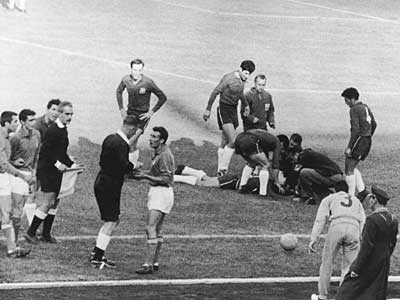
Chile 2-0 Italy, World Cup first round, 1962.
“Chile was recovering from an earthquake that had killed nearly 6,000 people, and didn’t have much money in the first place, so its countryfolk weren’t particularly disposed to tolerate the two Italian journalists who swanned into Santiago ahead of the World Cup finals, sifted through the wreckage, and sent home dispatches painting a picture of Chile’s capital as a poverty-stricken hole full of loose women.” (Guardian)
Spain are the team to beat in South Africa
“Spain’s last game before they name their final squad in June could be summed up in a single word. The same word that could also be used to sum up their qualifying campaign for the 2010 World Cup. The same word could be used again for their Euro 2008 campaign.” (World Soccer)
Analysing Brazil’s fluid system at close quarters

“Dunga’s Brazil side isn’t popular back home. The use of two holding midfielders, the tendency to play on the counter-attack and the overlooking of the likes of Ronaldo, Ronaldinho and Pato have all seen him accused of playing in an un-Brazilian way, by ditching the classic Brazilian principles of yesteryear for a more patient, less spectacular way of playing.” (Zonal Marking), (Must Read Soccer)
Colombia’s time to host World Cup?
“Brazilian midfielder Mauro Silva checked in his luggage to travel to to Colombia for the 2001 Copa America, and then had second thoughts. Scared by the country’s reputation, he decided not to go. I remember feeling a similar trepidation at exactly the same time when I boarded the plane in Rio to fly up and cover the tournament. What on earth was I letting myself in for?” (SI – Tim Vickery)
Fitness the key for Brazillian success
“Following the international friendlies, I wrote last time that the week’s big winner was Argentina coach Diego Maradona. Seven days later, perhaps his Brazilian counterpart can crack the biggest smile. As Andre Kfouri wrote in the sports daily Lance!: ‘Dunga must have loved the elimination of Real Madrid and Milan from the Champions League. The Spanish giant, because Kaka will have a lighter fixture list in the build up to the World Cup. And the Italian giant because the pressure to recall Ronaldinho will diminish. And the national team coach will be cheering for Chelsea to knock out Internazionale – a rest for Julio Cesar, Lucio and Maicon, more work for Drogba’.” (BBC – Tim Vickery)
Argentina boost World Cup credentials
“The warm-up work could hardly have gone better for the South American World Cup sides in action last week. Paraguay had trouble finding opposition and had to settle for a visit to Athletic Bilbao, who fielded an under strength side. No problem. Coach Gerardo Martino had plenty to smile about after his side’s 3-1 win.” (BBC – Tim Vickery)
Spain and Brazil set World Cup pace

“It’s been a week of bizarre contrasts in preparing for World Cup commentaries without forgetting the pressing need to keep on top of the Premier league scene. Michael Owen’s latest injury nightmare took me back to a hot evening in St Etienne 12 years ago. England’s penalty shoot-out defeat by Argentina remains one of the most dramatic games I have ever covered. Owen’s scintillating goal had the tournament gasping in awe – he had the world at his feet.” (BBC)
New-look Brazil go back to basics
“Think of the greats of Brazilian football and you will probably come up with Pele, Garrincha, Rivelino, Socrates – players full of flair, skill and vision. In short, geniuses. The name of Dunga, however, wouldn’t necessarily be on the tip of your tongue. A nuggety defensive midfielder who cut his teeth in Italian football and prizes tactics above flamboyance does not quite fit the Brazilian stereotype.” (BBC)
Should This Move Be Banned?
“Here’s the thing about soccer: When it comes to innovation and creativity, there’s Brazil and then there’s everybody else. To stop the Brazilians, you can try to overwhelm them (good luck with that) or try to steal their techniques. If that doesn’t work, all you can do is change the rules. This weekend in Zurich, as it makes final preparations for June’s World Cup, soccer’s main rule-making body will discuss the latest controversial bit of Brazilian magic: a devastating penalty-kick maneuver known as the paradinha.” (WSJ)
Stereotyping the African: 99 Days to a Change of Imagination?

Abou Diaby
“An article by Jonathan Wilson in the Guardian today asks an interesting question for those of us who grew up in an era in which West African football was the realm of skilled artists such as Abedi Pele, George Weah, Roger Milla, and exciting teams like the ‘original’ Nigerian Super Eagles who played swashbuckling, imaginative football. In a piece that starts out by discussing Egypt’s tactical formation (very interesting as well), he goes on to ask…” (Soccer Politics)
Julio Cesar bears a huge responsibility for Brazil
“It is hard to think of a position in sport that carries the same pressure as keeping goal for Brazil in a World Cup. While there is often little to do, there is even less margin for error. Do it badly and the hopes of an entire nation crash from a height unmatched anywhere else.” (World Soccer – Tim Vickery)
The Joy of Six: matches that never were

“Pele’s Brazil against Gerd Müller’s West Germany in Mexico 1970, plus five other classic games that never took place” (Guardian)
Messi leads list of top 10 South Americans in Champions League

“It’s no secret that without the top South American players, European soccer’s biggest club competition — the UEFA Champions League — wouldn’t be nearly as entertaining. With the amount of South American talent integrated into the competition in recent years, the quality of play has reached a level never imagined before. (SI)
Is the Copa Libertadores better than the Champions League

“There are people who argue that South America’s Copa Libertadores is better than the Uefa Champions League. It’s a perverse view, often motivated by bitterness – a bit like those who like to claim that The Beatles were over-rated. The Champions League congregates the best players from all over the world – it’s where they want to be, and where they need to shine these days in order to be considered truly great. But if Europe’s leading club competition is Lennon and McCartney, it doesn’t necessarily follow that the Libertadores is Herman’s Hermits, as last week made abundantly and gloriously clear.” (BBC – Tim Vickery)
TIm Vickery Interview: EPL Talk Podcast
“On this episode of the EPL Talk Podcast we welcome Tim Vickery, who picks up on some of the theses regarding player developed that we addressed with Andy Brassell two weeks ago. Then, Tim talks to us about some notable players in Brazil, talking about how their styles would fit into the Premier League. Then, we talk about Tim’s support of Spurs, the nature of being a club supporter, and how he found his way to Brazil.” (EPL Talk)
A Brazil legend’s lasting legacy
“Brazilian football lost one of its all-time greats last week when Orlando Peçanha died at the age of 74. If he had to go, then maybe the forces of destiny and the gods of soccer thought it appropriate to take him on the eve of Carnaval. Perhaps they were trying to make a point, juxtaposing his loss with the start of the country’s great party. Because as revelers fill the streets from Rio to Recife, there are many who like to see Brazilian soccer as one giant Carnaval, everyone more concerned with having fun than with the result, in a fabulous land full of skilled strikers and inept defenders.” (SI – Tim Vickery)
The Joy of Six: Long-range screamers

“Long-distance goals should intrinsically have a reduced element of surprise, but tell that to Ronaldinho. Just because you are outside the box doesn’t mean you can’t think outside the box in the way that you shoot for goal. Ronaldinho’s incomparable imagination manifested itself in under-the-wall free-kicks and strikes with scarcely any backlift.” (Guardian)
2010 Copa Libertadores preview

“If one game on Tuesday night is any indication, the 51st edition of the Copa Libertadores — South America’s Champions League — will continue to provide drama and excitement fitting of a premier continental tournament. In one of the most dramatic matchups in recent memory, Universidad Católica ensured its place in the group stage of the competition after a penalty-shootout victory over Colón de Santa Fe in Santiago, Chile.” (SI)
Video Of The Week: All The Goals Of The 1998 World Cup

“This week’s Video of The Week continues the World Cup theme of the last few weeks, with all the goals from the 1998 World Cup, which was, of course, held in France. The optimism that may have existed after England’s decent performance at the 1996 European Championships evaporated over the weeks of the tournament. Tabloid exclusives about the behaviour of the players, rioting in Marseille and a defeat at the hands of Romania were just the build up to a penalty shoot-out defeat at the hands of Argentina. Meanwhile, France and Brazil made the final of a tournament that was the first to feature thirty-two nations. Iran beat the United States of America in the first round but both teams went out,but Jamaica and Japan, who were both arguably beneficiaries of the expansion, brought colour to the tournament off the pitch but offered little resistance on it.” (twohundredpercent)
Transfer Rule Snares Footballers
“Football’s transfer system has always been a murky business. Unlike the National Football League or the National Basketball Association in America, where players enter the professional ranks amid the glitz and razzmatazz of the college draft, the movement of players in football is an altogether more furtive operation. Players are effectively the property of their employers, bought and sold by professional clubs without oversight or regulation from the sport’s authorities. Since every player has a price attached, recruitment is a cloak and dagger process.” (WSJ)
Mexico mounts multiple Copa challenge
“One of the less orthodox after effects of swine flu is the headache it gives the administrators of South America’s premier club competition. In last year’s version of the Copa Libertadores, two Mexican sides, Chivas Guadalajara and San Luis, made it out of the group phase. But how could they stage the home leg of their second round ties? It was at the height of the swine flu epidemic, with Mexico at its epicentre. The South American Federation unsuccessfully tried to find an alternate venue, gave up and announced that the fate of the Mexican clubs would be decided on a single match, the away leg.” (BBC – Tim Vickery)
The perils of judging a football club by its size
“Despite the disappointment for the player and Man City fans, loaning Robinho back to Santos seems a good fit for all the parties involved. The player has been given a chance to resurrect his season in time to make the Brazil World Cup squad, Santos have picked up one of the world’s most expensive players without paying a transfer fee and City have saved a reported £160,000 on their weekly wage bill. Robinho’s loan deal was also thought to be a way for City to secure the first refusal on two of Santos’ most promising players: Neymar and Paulo Henrique Ganso.” (WSC)
The return of Ronaldinho? Maybe
“In a month’s time comes the lone FIFA date for international fixtures before the end of the European season — the only time teams preparing for the World Cup have the opportunity to be at full strength, with all their players available.” (SI – Tim Vickery)