“Zé Carlos knew he didn’t belong here. He stood out like a sore thumb. He looked across the training field at his squad mates: the laughing and joking duo of Roberto Carlos and Denílson, the lantern jawed Claudio Taffarel and Dunga both brimming with experience, the mercurial Ronaldo with the world at his feet. And Cafu, the legendary full-back who he was assigned to replace; whatever planet this was it wasn’t his.” World Soccer (Video)
Category Archives: World Cup
The Ball
“Omar Larossa played over 400 times for Boca and Argentinos Juniors, Huracan and Independiente, winning four domestic titles and the 1978 FIFA World Cup. Now, flanked by Boca and national team luminaries Alfredo Rojas, Silvio Marzolini and Antonio Rattin on a low stage inside La Bombonera, he begins to explain how it felt to lift the trophy to his lips. “I wish I could tell you, to put into words, but whenever I think of that moment…” His voice wobbles, tears begin to well. Unprompted, a Special Olympics athlete – one of 35 young players Boca provide free weekly training sessions for – moves out of the crowd to give the world champion a hug. “It’s ok,” he says as the two remain interlocked, the rest of the room silent. “Thank you,” Larossa replies. “Thank you.”” In Bed With Maradona
Pelé and Garrincha – Gods of Brazil (Documentary)

“Documentary telling the story of legendary Brazilian footballers Pele and Garrincha, whose emergence following Brazil’s defeat at home in the 1950 World Cup Final heralded the dawn of a golden age of football for the country. But while one man became known as the world’s greatest footballer, the other died a broken alcoholic at the age of 49.” YouTube: Gods of Brazil 1:09:59
Germany vs. Argentina, Part III
“Will it be the goal fest of 1986 or the negativity of 1990? History will repeat itself with an Argentina-Germany rematch in the World Cup final. But will we get the thrills of 1986 or the grotesqueness of 1990? Unfortunately, signs point to the prospect of a conservative, low-scoring affair on Sunday at the Maracanã. Nearly everyone realizes the best tactics against Germany are to pack it in and counterattack. (Everyone except Brazil, that is). And that has been Argentina’s approach, anyway, so there is little chance the Albiceleste will change.” Fusion
When the Only Soccer In the U.S. Was En Español
“In the 1980s and ’90s, most of the sport televised in this country was in Spanish. An American writer says gracias. It wasn’t always like this, flicking to and fro from ESPN to ESPN2, to hear soccer commentary in English: Derek Rae rolling his Scottish Rs; Steve McManaman in sing-songy Scouse-speak; or the Manchester basso profundo of Efan Ekoku. Nor, for that matter, did you hear the flat American accents of Alexi Lalas, Mike Tirico, or Kasey Keller (and, thank goodness, not that in-between-the-pond affectation of Brad Friedel). No, there was a time when the only soccer in this country was broadcast in foreign languages, mainly en Español. And this wasn’t a bad thing. On the contrary: It was glorious.” Fusion
How Germany Got its Game On
“Paul Breitner (1974, 1982). Spain, 1982. It was the saddest goal in a World Cup final. Paul Breitner reacted quickly to a loose ball in the Italian box, adjusted his body, and volleyed neatly into Dino Zoff’s bottom right corner. It was a goal that begged to be scored, had to be scored, but there was no joy, no sense of relief, not even hope. It wasn’t even a goal at all, really, but an anti-goal. It marked defeat, not victory. Breitner knew it. He raised his hand to acknowledge his inconsequential achievement and jogged back to the halfway line. Nobody came over to congratulate him. The West Germany vice captain looked like a schoolboy who had come up to the board and solve a problem for which there is no solution. Seven minutes before the final whistle at the Santiago Bernabéu, the time was up—for the World Cup (West Germany were 3-1 down against the Azzurri), for Breitner’s team, and for Breitner himself. …” 8 of 8
25 of the best World Cup photos ever – in pictures
“Our sports picture editor, Jonny Weeks, has trawled the archives to pick out some of the best World Cup images ever taken. From the iconic shot of Diego Maradona taking on six Belgium players in 1982 – the real story of which can be read here – to the moment John Aldridge went berserk on the touchline at USA ’94, the shots range from the eye-catching to the unorthodox, the unforgettable to the bizarre. Beneath each image is a short explanation of why it made the cut.” Guardian
O Jogo Bonito
“A little more than halfway through Brazil’s horrible, galling victory over Colombia last Friday, I began to wonder what type of foul might actually persuade the Spanish referee Carlos Velasco Carballo to issue a yellow card: A studs-up, two-footed, kung-fu fly-kick to the chest, like the one launched by Eric Cantona against a fan in the stands back in 1995? Any one of the number of egregious fouls, including punches to the head, committed by Italy against Chile, and then by Chile on Italy, in the infamous Battle of Santiago in World Cup 1962? Maybe multiple Suárez-type bites by a hyena pack of players on a prostrate Colombian felled by a scything tackle might have done the trick.” The Paris Review – Jonathan Wilson
Spain ’82: My First World Cup
“The first World Cup I remember was Spain ’82. I was eleven and in my fifth year of primary school and living at the Holy Child Teacher Training College, in Ikot Ekpene, in southern Nigeria, where my mother taught home economics. This is about an hour from my village. It was two years since I watched Nigeria’s Green Eagles (as they were called then) defeat Algeria to lift the African Cup of Nations for the first time, in 1980. I remember the three goals against the Desert Foxes, or Les Fennecs, by Segun (Mathematical) Odegbami and Muda Lawal and the celebrations that swept through the land. The image of our captain, Christian (Chairman) Chukwu, lifting the cup after the game was something to behold.” New Yorker
Shades of Oranje
“France ’98 remains the standard for World Cups in my lifetime. The number of great players in their prime, the quality of the games in the knockout rounds, the last-second drama of the now (thankfully) abolished Golden Goal—a rule by which the first team to score a goal in extra time won—it all proved irresistible. France as a nation had turned to embrace the right, and up had risen the National Front; nevertheless, people traveled in happy droves to spend days, if not weeks, in their dream of Romantic France. During those June days, football flourished under what should have been a crushing paradox of love and hate, more felt than fully understood.” The Paris Review
The World Cup’s top 100 footballers of all time – interactive

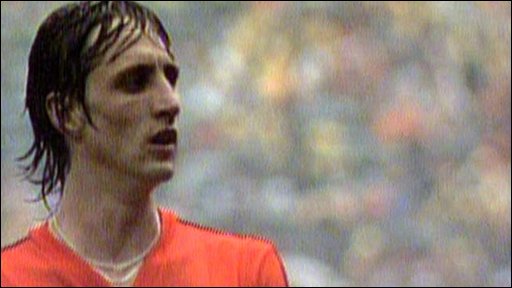
6. Johan Cruyff
“Welcome to the Guardian’s choice of the World Cup’s top 100 footballers. Led by Lothar Matthäus and Zico, our international panel of 40 experts compiled a countdown of the finest players to grace the globe’s greatest sporting event. You can see who the judges are and read how we compiled the list here. Starting with No1 in the top left corner, click on the individual players to read more about them.” Guardian
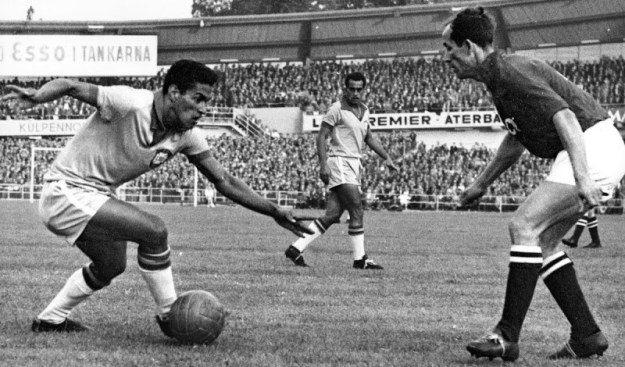
Garrincha

“Manuel Francisco dos Santos (28 October 1933 – 20 January 1983), known by the nickname ‘Garrincha’ (Portuguese pronunciation: [ɡaˈʁĩʃɐ], ‘little bird’), was a Brazilian footballer who played right winger and forward. He is regarded by many as the best dribbler in football history. The word garrincha itself means wren. Garrincha was also known as Mané (short for Manuel) by his friends. The combined ‘Mané Garrincha’ is common among fans in Brazil. Due to his immense popularity in Brazil, he was also called Alegria do Povo (Joy of the People) and Anjo de Pernas Tortas (Angel with Bent Legs).” Wikipedia
YouTube: Garrincha – The Genius of Dribble ( Documentary ) Part 1, Part 2
Restored Footage from the First World Cup: Uruguay, 1930
“The 19th FIFA World Cup is now underway in Brazil, and that gives us an excuse to revisit the first World Cup, played in July, 1930 in Uruguay. Only 13 teams participated in the tournament, and all matches were played in Montevideo, Uruguay’s capital. In the semi-finals, the United States lost to Argentina, 6-1. Uruguay crushed Yugoslavia by the same score. In the end, Uruguay, the favorites all along, triumphed over Argentina (4-2) before a home crowd of 93,000, to become the winner of the inaugural FIFA World Cup.” Open Culture (Video)
How We Play the Game

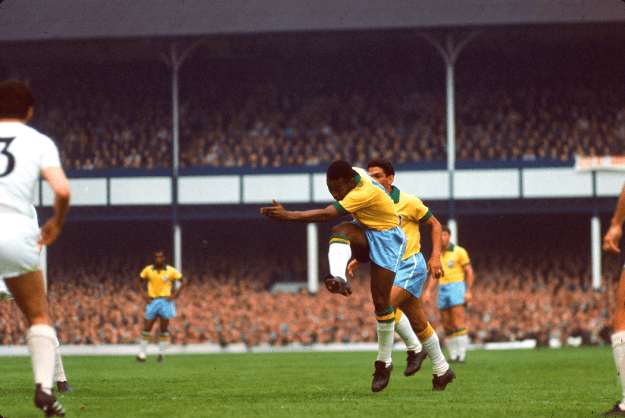
Pelé in a match at the 1966 World Cup in England.
“Every team is simply trying to score goals while preventing its opponent from doing the same. But they all seem to go about it in distinct ways, don’t they? To understand what is happening on the fields in Brazil at the World Cup, one must learn a bit about each country’s history, and literature, and music, and regionalism, and economy – not to mention bicycles and pottery. If you look closely enough at the X’s and O’s, you just might find a national poem.” NY Times
Fabio Cannavaro: The street urchin who became a World Cup ‘legend’
“‘When you win the World Cup, you start to become a legend — for the people around the world, you are different.’ For Fabio Cannavaro, this legendary status was hard earned. At just 5 foot 9 inches tall, he wasn’t built to be the world’s greatest center back. And he certainly never expected to be named the world’s best player.” CNN
20 World Cup goals that changed history

“World Cups are never just about what transpires on the field. When the 2014 soccer World Cup kicks off in Brazil on June 12, tens of thousands of Brazilians will likely protest, angered by the wasteful government spending that has led up to the tournament. What better platform to make a statement than one watched by billions around the planet? Soccer’s unchallenged place in the global imagination also means that what happens on the field carries special resonance. The goals scored aren’t just markers of sporting success: they are moments of national glory and humiliation, acts of cultural expression and political defiance. World Cup goals can change history. Here are 20 that did.” Washington Post (Video)
Cameroon – the team with ‘hemle’ (and Samuel Eto’o) on its side
“In Cameroon’s biggest city, Douala, we name streets and squares for the alcohol and sex trade (rue de la Joie), for corruption (Carrefour des Trois Voleurs, or Junction of the Three Robbers, for three officials who used public funds to build houses in the area), for violent deaths and footballers. All these names are unofficial. The only official names are those of the colonisers. Carrefour Eto’o Fils, the junction named for our striker and captain Samuel Eto’o, is in New Bell, the populous quartier where he was born. It is a few blocks from Place Roger Milla and Carrefour Thomas Nkono, named for past footballers. New Bell is Cameroon’s Soweto – revolutions begin here.” FT
The 10 Most Significant Goals In U.S. Soccer History
“1. THE ‘SHOT’ THAT STARTED IT ALL. In November 1989, the week-long training camp before the most important U.S. soccer game in 40 years was the usual no-frills affair. In the days before cell phones and the Internet, the U.S. players slept two to a dorm room in Cocoa Beach, Fla., and shared a single pay phone among all of them to call home. But they did have basic televisions in each small unit, and one night defender Paul Caligiuri was sitting on the floor when his roommate, goalkeeper Tony Meola, commandeered the couch and started flipping through channels looking for a show to watch. Their talk turned to the game they would play two days later in Port of Spain, Trinidad and Tobago, a World Cup qualifier that bore the highest of stakes. To clinch the U.S.’s first World Cup berth since 1950, the Americans had to win on the road against a team that had not lost at home during the qualifying campaign. If the U.S. tied or lost, tiny T&T would end up grabbing the first World Cup spot in the nation’s history.” SI
Before Pelé there was Andrade
“Colette, the ‘Grand Dame of French literature’, lived with fame and scandal throughout her life. The novelist and performer caused a riot at the Moulin Rouge in 1907 when she simulated sex with another woman on stage. She seduced her stepson when he was 16, telling him: ‘It’s time you became a man.’ She had three husbands, two messy divorces and a string of lovers, both male and female. In 1924, when Paris hosted the Olympic Games, Colette met, and was captivated by, one of its participants: José Leandro Andrade. Their upbringings could not have been more different: Andrade was a Uruguayan footballer who had slept on a dirt floor in his childhood and spent little time at school. But Colette was not the only famous Frenchwoman smitten by Andrade.” Guardian
‘The Greatest Victory’
“Elmo Cordeiro is 80 now, but he still stands ramrod-straight, with a ready smile and eyes that shine under a set of bushy gray eyebrows. It isn’t hard to turn back the clock and imagine him 64 years ago, his white hair a darker shade, his skin wrinkle-free, his compact frame darting around the edge of a soccer field chasing down errant balls. In 1950, Cordeiro was a ballboy at the Estádio Independência here in Belo Horizonte, Brazil—stationed yards away from the historic goal itself—for perhaps the most famous upset in the 84-year history of the World Cup.” SI (Video)
UFWC World Cup Classics: Argentina vs Netherlands, 1978
“The Netherlands had beaten Italy 2-1 to reach their second consecutive World Cup final, and to deprive the Italians of the UFWC title. Dutch defender Ernie Brandts had scored for both sides in that game, with Arie Haan getting the winner. The Oranje were looking impressive despite the fact that they were without star man Johan Cruyff, who had stayed at home to consider his priorities following an alleged kidnap attempt on his family. The hugely experienced Dutch team still featured the likes of Jonny Rep, Johan Neeskens, big keeper Jan Jongbloed, and troublesome twins Willy and Rene Van der Kerkhof.” UFWC
England’s performance at Italia 90 World Cup is venerated too much
“Perhaps, given England’s perceived lack of success, it’s only natural that we should hark always back to 1990, that we should be forever trying to recapture what made that tournament so compelling. Yet it is a little odd. It doesn’t take much of an examination of England’s World Cup record to see how fine the margins sometimes are. In the last eight World Cups, England have reached the last eight (in 1982, the second phase comprised four three-team groups; so for the purposes of this stat I’ve counted the teams who finished second in those groups as losing quarter-finalists) on five occasions. Put like that, England’s World Cup record doesn’t sound too bad – in fact, only Brazil and (West) Germany can beat it.” Guardian – Jonathan Wilson
Can Northern Ireland become UFWC champions?

Uruguay versus Northern Ireland
“The next Unofficial Football World Championships match is just over two months away on the 30 May, and it looks set to be a classic. Two teams with a proud and successful footballing history and plenty of passion will play each other. First ever World Cup winners Uruguay face reigning British Champions Northern Ireland in the Estadio Centenario in Montevideo – the venue where the World Cup began back in 1930. It will be the light blue of Uruguay against the shining emerald green of Northern Ireland.” UFWC
Joe Gaetjens – the footballer who disappeared

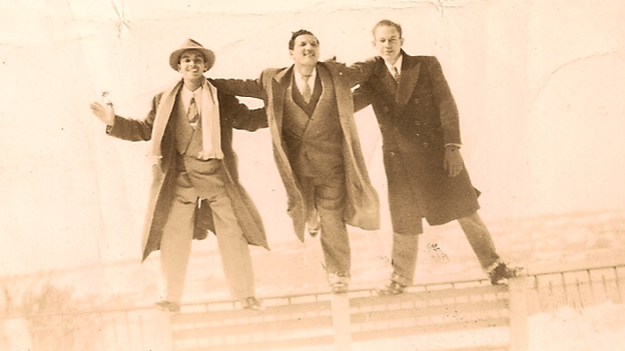
Joe Gaetjens (centre) with friends in New York
“One of the biggest shocks in World Cup history happened in 1950, when the US beat England, thanks to a goal scored by Haitian Joe Gaetjens. After Gaetjens returned to Haiti a hero, he later disappeared and was killed, possibly by the president himself.” BBC
World Cup: 25 stunning moments … No3: West Germany 1-0 Austria in 1982
“You have to pity the youth of today. They were born to banter, they think it’s normal behaviour to tell complete strangers on the internet what they have had for their tea. And worst of all, they have never experienced proper World Cup villainy. There was Luis Suárez’s handball in 2010, yes, but that was a fleeting moment from an individual rather than an extended body of work shared between a whole squad. The World Cup – which is about great stories as much as great football – is so much richer when a team leaves the rest of the football world raging with impotent frustration.” Guardian
Bergkamp Statue Revealed: “Henry Himself, Would Argue That Dennis Was Better.”
“This weekend, whilst a lot of the British press are passing judgements on Arsenal’s current star signing, arguably the greatest Gunners arrival of them all is set to be honoured outside Emirates Stadium. As a big name with a similarly big price tag in 1995, Dennis Bergkamp had a slow start adapting to a new league, but went on to be revered by Arsenal fans. Certainly in the Wenger-era, few would argue that Thierry Henry is the greatest player for the Gunners. Henry himself, would argue that Dennis was better.” Sabotage Times
Peladad
“The Brazilian state of Amazonas is one of the most awe-inspiring places on the face of the Earth. Home to an incredible array of plant and animal life it is undoubtedly one of the world’s most well-known natural wonders. Yet outside of South America, it seems few people are aware that in the depths of the jungle, there is a large city now home to over two million people. Even less celebrated is the fact that each year it holds what locals claim to be the largest football tournament in the world. Manaus is a city of contradictions. It’s a functional modern concrete metropolis yet leave the suburbs behind and you are engulfed by the vastness of the rainforest. In Manaus people go about their daily lives as they would in any big city in the world yet a few miles down the Rio Negro there are jungle tribes whose lives have changed little in centuries. The climate is stiflingly hot and humid all year round and it is well over a day’s travel by road to any other city. Yet despite the unlikely isolated location, people have been flocking to Manaus for decades and it continues to be one of the fastest growing and most economically thriving places in Brazil.” In Bed With Maradona
It’s a squad thing – part 2
“In the second of two posts, Jonny Sharples reminisces about his three favourite squads of all time, who brought unity, glamour, and entertainment to football. If you’ve not read Part 1, do so first…” Put Niels In Goal
The Perfect World Cup
“In Bahia on Friday, the draw for Brazil 2014 represents a crucial stage in the incubation period of World Cup fever. For the next six months, symptoms may include fractured metatarsals, a fixation with Brazilian hotel facilities and cravings for football nostalgia. Much like Second Season Syndrome, there is no known cure, but it is treatable. The 19 previous tournaments have each provided their own iconic moments, images and (possibly apocryphal) tales. Looking back over the competition’s history – and with logistical and ethical fears surrounding the 2014, 2018 and 2022 editions – just what would a perfect World Cup be like?” Football Clichés
World Cup draw set to reveal unique magic

“Day after day, reports from the land of the next World Cup send shudders through the soul. A collapsing crane claims the lives of two construction workers at the stadium in Sao Paulo. The Brazilian FA, the CBF, makes the sad announcement that the legendary left-back Nilton Santos has passed away after a lung infection. Concerns rise over local companies fleecing visiting fans over accommodation and internal flights. Anger at socio-economic problems is expressed through protests. The 2014 World Cup is currently associated with many issues, few relating to the promise of an on-field spectacle.” Telegraph – Henry Winter (Video)
El Fantasma helps bitter rivals unite
“The ghost of 1950 is back to haunt Brazil. With Uruguay snapping up the last place in the 2014 World Cup, the possibility opens up of history repeating itself – of Brazil organising the party only for its tiny southern neighbour to walk off with the prize. In the final game of the 1950 tournament host Brazil needed just a draw to become world champion for the first time. It seemed to have a hand and a half on the trophy when it took the lead early in the second half but Uruguay hit back, silencing a huge crowd in the newly-built Maracana stadium to win 2-1.” The World Game -Tim Vickery (Video)
Dennis Bergkamp: The Man Who Transformed Arsenal
“It was August 1995, and Dennis Bergkamp had just played his first game for Arsenal at the club’s cosy, iconic Highbury Stadium, a friendly against his old club Internazionale. Afterwards, two Dutch journalists and I snuck into Highbury’s marble halls to wait for the great man. Bergkamp’s family was already there, hanging around while Dennis got changed. The father, an electrician, was standing with his hands folded behind his back studying framed pictures of Arsenal greats. He would have known most of them; like many Dutchmen of his generation, Bergkamp Sr. was an Anglophile, who named his youngest son after Manchester United hero Denis Law. The father and a Bergkamp brother greeted us shyly. This was not a loud family.” askmen
The month Senegal were better than France — Remembering Metsu

“As World Cups go, the 2002 edition was not a classic. A combination of stifling heat and a draining European club season combined to leave the best players woefully out of form, with joint favourites France and Argentina both departing at the group stage. There’s nothing wrong with successful underdogs, of course — but there was a feeling that the quality throughout the competition was particularly low. Turkey and South Korea both reached the semifinals, a genuinely remarkable achievement for both — but neither side will be remembered particularly fondly by neutrals.” ESPN – Michael Cox
The Global Theater: The World Cup exhibits the best and worst
“There are two moments from my time in the stadia of the 2010 World Cup in South Africa that I remember particularly vividly. One of them I couldn’t take my eyes off. The other I couldn’t watch. I was in FNB Stadium for the Final between Spain and the Netherlands. It was a grueling game, the frustration and ugliness seeping across the turf as the minutes ticked by. Oddly enough, though they are always riveting spectacles, many World Cup finals are actually pretty disappointing as soccer. Often the best games are in the quarterfinals, or even earlier in the tournament. Watching that final on TV seems to have been particularly frustrating. In the stadium, though, there was something wonderful about being collectively enraged. We could yell, stomp, hold our heads in our hands, and it felt like the Dutch players, the poor referee Howard Webb, and even the heavens above could hear us.” SI – Laurent Dubois
C is for Cosmos

“Take a deep breathe, it’s going to be alright. It has to be alright. Sure, things didn’t begin so well, but you learned. You learned from the handful of fans who watched you play at Yankee Stadium, and you learned from the scattering who followed you to Hofstra. You learned not to be average. You couldn’t be average. Not in New York. Not in Andy Warhol’s New York.” futbolintellect
The great European Cup teams: Ajax 1971-73
“It’s difficult now, given the city’s reputation for liberalism and excess to imagine Amsterdam in the years following the second world war. It was a dull, staid place where, as Albert Camus wrote in the Fall, published in 1955, ‘for centuries, pipe smokers have been watching the same rain falling on the same canal’.” Guardian – Jonathan Wilson
The Beavers and the Champions League
“As the Portuguese Primeira Liga drew to a close at the weekend, all eyes were understandably on Benfica and Porto as they battled it out for the League Championship and, for the latter, the enviable record of enduring the season without defeat. Slipping underneath the radar, however, there has been another big story in Portuguese football this year: that of the relatively unknown Pacos De Ferreira and their qualification for the Champions League. Pacos secured the third and final Champions League qualification spot in the Primeira Liga with a game to spare, and now find themselves only a two-legged playoff tie away from the elusive and lucrative group stages of Europe’s premier club competition.” In Bed With Maradona
The Bundesliga’s True “White Brazilian” – Part I
“‘I’m not in right now… If you want to reach me you can find me down my local pub from five in the evening to five in the morning – Beeeeeeeeeeep.’ It’s not an answer phone message you would want your mum to hear. And it’s certainly not a message you would expect from a professional footballer. But then Ansgar Brinkmann was never a professional footballer in the true sense of the word. He drank, he fought and he womanized. He had run-in’s with the police. And he had a reputation for arguing with his teammates and managers. With Ansgar, you never knew what to expect. And therein lay his appeal, both on and off the pitch.” Bundesliga Fanatic – Part 1, Part 2
The Bringer Of Famine
“Today, the goalkeeper seems eternal. It feels natural that a team should be made of ten plus one, that behind the outfielders scurrying in their or striker less there should be an unspoken other, his place so taken for granted that nobody even bothers to refer to it when discussing formations. That, though, is a relatively modern phenomenon. When the game that would evolve into football began with the foundation of the Football Association in 1863, there was no such thing as a goalkeeper in the modern sense.” [PDF] The Outsider
Dortmund: The Class of 97
“Football Hipsters rejoice! Borussia Dortmund are into the Champions League final! Even more brilliantly for those ‘Bundesliga-philes’ out there, they are taking on league rivals Bayern Munich, a team many are tipping to claim Barcelona’s throne as the most exciting and dominant team in European football for the foreseeable future. ‘FC Hollywood’, as Bayern are known by many fans are exactly that – a team of stars to rival the great.” Outside of the Boot
An Andalusian Summer Of Magico
“While South Americans have dominated Spanish soccer for decades, much rarer is the successful player from the Northern half of the hemisphere. For every successful Mexican like Hugo Sanchez and Rafa Marquez, a disappointing Omar Bravo returns home with his tail firmly tucked between his legs. For Central Americans, the numbers are even sparser. And that’s why Jorge Alberto “Magico” Gonzalez’s 1983 season at Cadiz was so unforgettable.” In Bed With Maradona
When Rachid Mekhloufi took the struggle for Algerian independence to the pitch

“In April 1958, Rachid Mekhloufi, the great St. Etienne striker was 21 years old. Mekhloufi along with nine other players, left their careers in France and returned to Tunis to comprise the first FLN squad. They were playing for a country that did not yet exist. Algeria was in the beginnings of an uprising against its’ colonizer France. Their move would be analyzed, critiqued and applauded by many.” A Football Report
“From Meghni to Yebda, the French academy system has produced many players who have represented Algeria. Long before Algeria’s independence, though, it wasn’t quite so easy. Juliet Jacques looks at early French-Algerian relations in football. In April 1958, Rachid Mekhloufi stood on the brink of international superstardom. Having scored 25 goals in thirty games to help AS SaintÉtienne win their first Championnat the year before, Mekhloufi was about to win his fifth France cap in a friendly against Switzerland, with coach Paul Nicolas including him in the forty-man preselection for Les Bleus’ highly fancied World Cup squad.”
Spiel Magazine
Football Rebels: Mekhloufi and the FLN team
“The FLN football team raised the profile of Algeria’s independence movement. And Rachid Mekhloufi was one of the brave men who refused to play for France. French footballing legend Eric Cantona presents the next part of Al Jazeera’s Football Rebels series.” Aljazeera (Video)
Saving Filadelfia
“In its heyday it stood majestically as the home of Torino. It housed ‘Il Grande Torino’, arguably the greatest side calcio has ever witnessed. It presented a wall of noise in an intimate atmosphere. It was where Torino claimed six of their seven Scudetti. Today the Stadio Filadelfia is a desolate, crumbling shadow of its former glory. The spiritual home of the Granata – claret reds – has few sections remaining. Like an Ancient Roman ruin, pieces of edifice linger to offer a haunting reminder of its majesty. Torino haven’t played a League match at the stadium since May 19, 1963. On that occasion 1982 World Cup winning Coach Enzo Bearzot was on target in a 1-1 draw against Napoli.” In Bed With Maradona
Defending Your League Title: Analyzing Failure
“Historically it’s been said, in football, getting to the top of the league is one thing but staying there is a whole different ball game. More often than not teams fail to defend the league title that they had worked so hard to gain in the first place. Over the past 20 years in some of Europe’s biggest leagues, only a handful of sides have managed to successfully defend their league titles. The question remains what, if any trends, exist between the sides that have managed to win back to back titles and whether there are lessons to be learned by new-be champions from their predecessors who had failed to defend their titles.” Not Just the Bottom Line…
Political football: how Brazil’s military hijacked the beautiful game

“As five-time World Cup champion, the Brazilian national team has become known the world over not just for winning, but for winning with a joyous panache that has become synonymous with the beautiful game. However, behind every one of Ronaldinho’s toothy grins and camouflaged by the color-shocked mohawk clinging to Neymar’s head lies an intensely complicated relationship between nation and sport.” World Soccer
“Brazil is a country commonly associated with the highest level of soccer. The world has grown used to Brazil winning, but the Brazilians themselves seem to have an insatiable appetite for world football dominance. Their nation has produced soccer players that have come to represent spontaneity, creativity and skill on the playing field. The bandy-legged Garincha, a walking paradox, the goal scoring machines Friedenreich and Ronaldo, the modern hope Kaká, and, of course, the eternally great Pelé – all these players have left their indelible marks on football’s canon.” Soccer Politics
Zero Dark Thirteen – Brazilian football wallows in the mire of corruption
“If the 2014 World Cup is to signal the arrival of Brazilian football’s brave new world, a desperately needed fresh start for the game in a country where on-field majesty is usually matched by administrative skulduggery, it can’t come soon enough. The year is not yet four months old but it feels, to misquote autocratic former president Getúlio Vargas, as though Brazilian football is standing in a sea of mud. Worse, it often appears as though chaos has become the norm.” Independent
Socrates and the Corinthians’ Democracy
“As the global sporting world faces one corruption scandal after another, former Manchester United star Eric Cantona presents the stories of five football heroes whose social conscience led them to challenge unjust regimes, join opposition movements and lead the fight for democracy and human rights. Football Rebels looks at a side of football that does not always make the headlines.” Aljazeera (Video)
All the President’s Torturers
“Chosen to host both the 2014 football World Cup and the 2016 Olympic Games and with abundant natural resources and one of the fastest growing economies in the world, one way or another Brazil is set to become a major player in the affairs of the 21st century. With an ambitious, progressive government, a population of around 193 million, now well established federal democratic structures and apparent political stability, many even see it as a global superpower in the making, perhaps even deserving of a permanent seat on the UN Security Council in the not too distant future. But its solid international reputation has not always been so glossy.” Aljazeera (Video)
The Copa Libertadores and differing stories for Ronaldinho and Riquelme
“The Copa Libertadores this season has been the story of two brilliant players in the twilights of their careers: one having immense fun as though he can’t quite believe he’s still getting away with it, the other grumpily raging against his waning powers. For Ronaldinho and Atlético Mineiro, this has been, so far, a tournament of glee, of great goals and big wins; for Juan Román Riquelme and Boca Juniors, it has been all about suffering. Both will be in the last 16, but their journeys could hardly have been more different. It’s also been the story of the continuing development of Ecuadorean football.” Guardian – Jonathan Wilson
Neymar! Reducing Brazil’s Football ‘Trade Surplus’
“It’s time for another sporting feature since we haven’t had one for quite some time now. Fortunately, there’s interesting stuff courtesy of TIME Magazine about the changing complexion of ‘the beautiful game.’ Even if the Brazilian economy has cooled off markedly in recent times, it has had a strong run-up and most folks remain optimistic about its economy’s future. Contrast its fate with that of the European football powerhouses that traditionally import South American players in droves–especially Portugal, Spain,and the United Kingdom–and you begin to understand the reduced “trade surplus” of Brazil sending away its best footballers time and again…” International Political Economy Zone
The Return of Matt Le Tissier

“Matt Le Tissier is coming out of retirement, and I’m going to type that again, because it contains words that deserve to be repeated. Matt Le Tissier is coming out of retirement. If you don’t know who that is — and there’s a good chance you don’t, if you’re American, not a soccer fan, or under 25 — watch the YouTube clip of him scoring against Newcastle on October 24, 1993. This is the second season of the Premier League, all lunging tackles and signboards for Street Fighter II. Le Tissier’s playing midfield for Southampton, the team in red-and-white stripes. The ball comes flying over the left flank to the Southampton striker, Iain Dowie, who heads it down toward the middle of the pitch, where Le Tissier’s running forward at a smooth trot. It’s a bad header; the ball scuds directly behind him. The move should be over. But watch what Le Tissier does.” Grantland – Brian Phillips
Hristo all mighty!
“In the middle of the 4th century B.C., the all-conquering army of Philip II of Macedon swept southwards through the Balkans, thus setting into motion an enduring legacy that would be continued and expanded upon by Philip’s more renowned son; the famous, infamous, and glorious Colin Farrell.” World Soccer
Optimism For the Benna Boyz
“As a previous visitor to the small group of islands known as Antigua & Barbuda I was pleasantly surprised to see the media coverage their national side received in the UK in the summer of 2012 and for the few months afterwards. This coverage came in light of the appointment of Englishman and former Chesterfield midfielder Tom Curtis. His first venture into management Curtis’ appointment certainly helped raised the profile of the national side within England and there was a good degree of optimism going into their World Cup Qualifying clashes with Guatemala.” In Bed With Maradona
Hajduk Split Torcida: trailblazers across Europe
“Astronauts looking down on earth in February 2011 would’ve been greeted with an unusual sight. Alongside the Great Wall of China and Felix Baumgartner on practice missions, thousands of flares lit up the night sky as the Torcida celebrated the 100th year of their beloved club Hajduk Split. Their slogan, ‘Hajduk lives forever’, appears apt.” World Soccer
Brian Clough Television Interview From 1969-70: Cocky And Confident As Always
“I came across a new TV documentary this evening that I hadn’t seen before about Brian Clough. It’s from 1969-70. Uniquely, the TV documentary starts off by asking then Derby County manager Brian Clough what his expectations are for the season. He goes through his entire squad and offers his critique of each player, what they can contribute and how he thinks his just-promoted side will do. Then in the second half of the interview, the same interviewer goes back to Brian Clough at Derby and reviews how well (or not) his predictions did, as well as discussing how the season went.” EPL Talk (Video)
Forward Brazil

“As five-time World Cup champion, the Brazilian national team has become known the world over not just for winning, but for winning with a joyous panache that has become synonymous with the beautiful game. However, behind every one of Ronaldinho’s toothy grins and camouflaged by the color-shocked mohawk clinging to Neymar’s head lies an intensely complicated relationship between nation and sport. Over the course of the 20th century, the average Brazilian’s rabid devotion to football allowed the game to be manipulated – serving as an opiate to anesthetize the Brazilian people toward the actions of their government. This wicked transformation has never been more apparent than during the 1970’s. Then, the military dictatorship under Emílio Médici spared no expense to ensure that its brutal totalitarian measures were shaded by the blinding brilliance of joga bonito.” In Bed With Maradona
Deconstructing the Plovdiv Pistolero
“In the middle of the 4th century B.C., the all-conquering army of Philip II of Macedon swept southwards through the Balkans, thus setting into motion an enduring legacy that would be continued and expanded upon by Philip’s more renowned son; the famous, infamous, and glorious Colin Farrell. In the course of that marauding charge – in 342 B.C., to be precise – Philip passed through the now-Bulgarian city of Plovdiv, renaming it after himself as he did so (Philippopolis). The arrival of Philip preceded centuries – millennia, even – of invading forces pitching their tents at the walls of Plovdiv, attempting to make the city their own. 72 B.C. saw the Romans give it a shot, under the leadership of Marcus Lucullus. More than a hundred years later, in 46 A.D., Plovdiv finally ceded to the Romans and their Emperor Claudius.” In Bed With Maradona
USA did it in 1994, why not Qatar?

“The latest debate in World football is getting ugly. A political agenda is being created. A heated discussion on culture. Questions are being raised over just the nature, ethics and customs of the host nation. As Marina Hyde puts in her piece for the Guardian ‘football may finally be about to go to war’. And this unfortunate chain of events has taken away the beauty of this beautiful game, and put it into a cringe-worthy and down right embarrassing situation. The respect that this ‘World’ sport demands, its very synonym of a ‘Global’ game may seize to exist.” Outside of the Boot
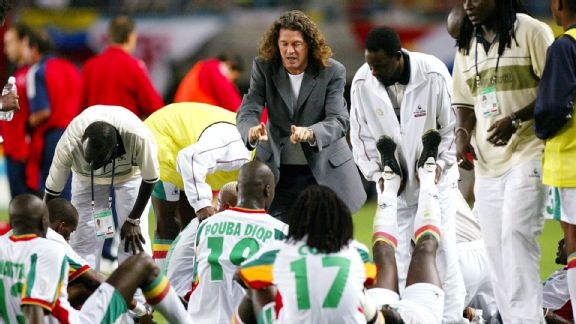
The Heart and Soul Of Khalilou Fadiga
“‘Bouba Diop is there!’ … There is a short but telling pause. John Motson, one does sense, must have been comfortable in the knowledge that nothing would shock him on the pitch that day, that in the world of football he had simply seen too much. And yet the commentator older than time itself, and whose trademark sheepskin coat is probably even older than that, is lost for words. He is forced to repeat himself, this time louder, certainly, but somehow more hesitant, more noticeably taken aback. … ‘Bouba Diop is there!’ Again, momentary silence.” In Bed With Maradona
Allah’s Back Heel

“The tendency to categorise and rate the footballing talents Africa has produced is something of a modern phenomenon. This is due in part to the perception that African players have been somewhat late to the party in terms of making an impact on a global stage. As such the majority of the ‘greatest African footballers’ lists are weighted greatly towards players of the mid- 90s onwards, give or take a dancing Cameroonian. One player who is consistently overlooked is Mustapha Rabah Madjer. A player of unheralded finesse and technical ability on the pitch, only matched by his combative nature off it. His footballing attributes led to him becoming not only Algeria’s greatest footballing export but also a symbol for a nation to latch onto as it searched for its identity. Madjer was born in the costal city of Algiers in 1958. The city was at the epicentre of the Algerian independence movement, which sought to throw off the shackles of French colonialism. A bloody and vicious war was fought between the various factions and the French troops sent to maintain order – a war that resulted in Algerian independence and the fall of the 4th French republic.” In Bed With Maradona
An Obsession With Marcelo: No Madness at All
“On insanity, few have been more veracious than the Chilean writer Roberto Bolaño. In his own inimitable way the nomadic novelist and poet acknowledged what others often refuse to see; that we are all unhinged in our own delicate fashion. To some extent we will freely admit to our peculiarities, but largely our madness is defined by those around us, who witness our behaviour and for reasons of comfort believe it to be more abnormal than their own. How strange it is to be denied even the possession and enjoyment of our own madness by people who yearn to tell us that, yes, we are certainly mad.” In Bed With Maradona
Any way back for one of Scotland’s legendary names?
“Heard the story about the Glasgow based football club who ran into financial calamity and went bust? Of course you have, but this tale of woe isn’t about the collapse of Rangers, but a club whose name is woven into the fabric of Scottish football’s early days – Third Lanark.” World Soccer
England’s World Cup winning captain Bobby Moore: 20 years gone, but never forgotten
“Across town at Wembley, setting for Moore’s finest hours, the flag of St George will fly at half-mast. A skilled surgeon operated on Moore’s colon in 1991 but the cancer would not yield. It spread to the liver. Moore never complained. He simply set about delaying its pitiless impact. Eventually, on Feb 15, 1993, England’s World Cup-winning captain released a statement, revealing his illness was terminal. Two days later he was at Wembley, commentating on England’s game against San Marino for Capital Radio, his collar turned up to hide his paleness. A week later, on Feb 24, 1993, Moore passed away. He was only 51.” Telegraph – Henry Winter
The Dromedaries
“The politics of Western Sahara are complex. Spain renounced control of the territory in 1975 giving Morocco and Mauritania joint administrative control but the Polisario Front rebelled and announced a Sahrawi Arab Democratic Republic (SADR) with an exiled government based in Algeria. Mauritania pulled out and a 1991 ceasefire left Western Sahara largely in Moroccan hands but partly in those of the SADR. The territory has been in political limbo ever since, a story largely ignored by the mass media and the big nations who tend to overlook the divide and push for an agreement.” In Bed With Maradona
The Second Coming Of Third Lanark

“Heard the story about the Glasgow based football club who ran into financial calamity and went bust? Of course you have, but this tale of woe isn’t about the collapse of Rangers, but a club whose name is woven into the fabric of Scottish football’s early days – Third Lanark. The club who were based in the city’s south side were founded in 1872 by the 3rd Lanarkshire Rifle Volunteers after the soldiers were inspired to create their own team by the first ever international match between Scotland and England at Hamilton Crescent, Glasgow.” In Bed With Maradona