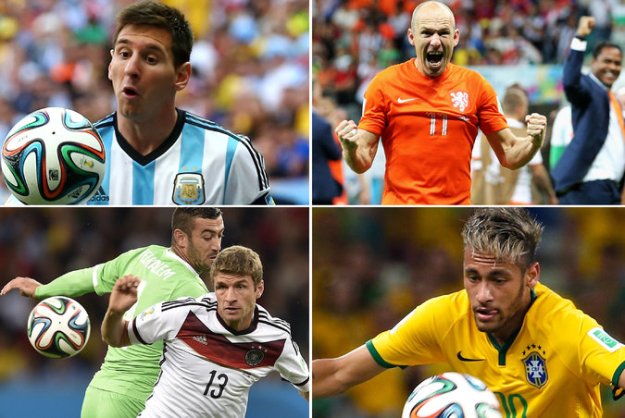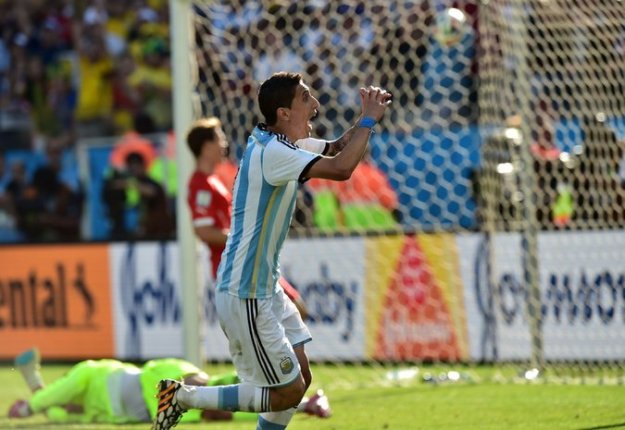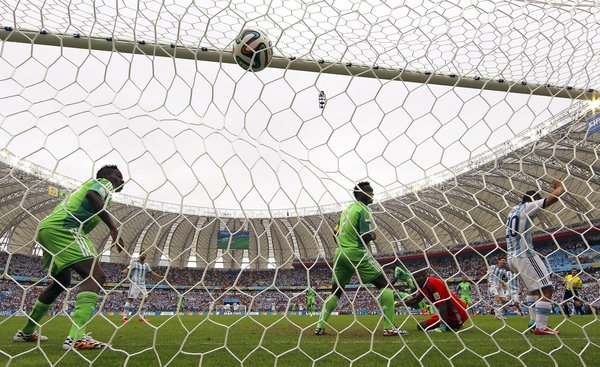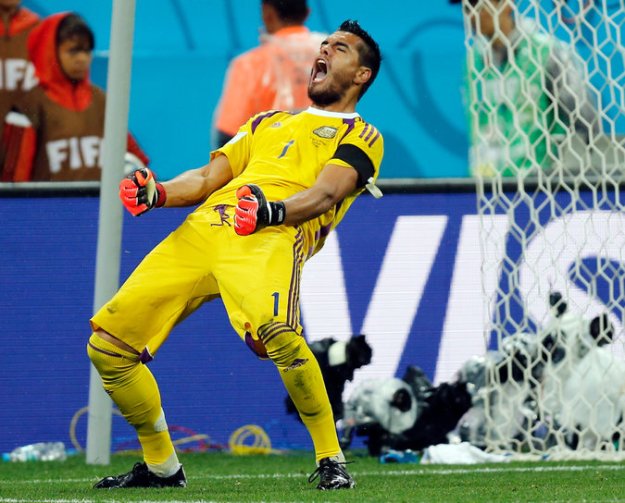
“Argentina and the Netherlands played yesterday’s second semifinal. That’s as much as should be said about the match, which forced us to appreciate what this World Cup has been, while remembering what it could have been. Throughout 120 minutes of football, there was first, last, and above all an air of safety that had been refreshingly absent from most of the games thus far—and with that absence came gifts of goals and good play. But yesterday, there was so much at stake: safe passage to a World Cup final. Since both teams are middling, professional, and graced by the presence of once-in-a-lifetime, left-footed talents, they took no risks—no playing the ball patiently through the midfield, no attempts at a tactical surprise. It was a game of chicken, and a penalty kick shoot-out was the inevitable collision.” The Paris Review
Category Archives: Argentina
Most Memorable World Cup Moments
“The World Cup final between Germany and Argentina will take place on Sunday at 4 P.M. By now, many of us have watched an absurd amount of soccer, at the expense of work, family, and good sense. A few weeks ago, unwilling to break away from a close match, I resorted to streaming it on my iPhone while slaloming through a crowded train station, something I wouldn’t recommend.” New Yorker (Video)
Whether Wretched or Inspired, Title Match Often Provides a Jolt
“Apart from Germany, the Champagne fizz has suddenly gone flat at a World Cup that was being hailed earlier as the best in recent memory. Goals that seemed to pour from a spigot have now slowed to intermittent drips. The Netherlands once led the tournament with 12 goals, but it has not scored since the Round of 16. In Wednesday’s semifinal loss on penalty kicks to Argentina, the Dutch produced one shot on target. It was the lowest number for the Netherlands in a World Cup match since record keeping began in 1966, according to the Opta statistical service.” NY Times (Video)
Brazil’s nightmare gets worse: Argentina to play for World Cup title

“A bad week for Brazil just got worse. There’s not much that could make the humiliation of Tuesday’s 7-1 defeat to Germany feel even grimmer, but Argentina winning the World Cup at the Maracana would be unbearable. The holiest of the holies has already been defiled once, by Uruguay in 1950, but that would be nothing to the desecration of seeing Lionel Messi and his side celebrating there on Sunday. Whether that’s likely is another matter. Argentina will go into the final as the underdog, and understandably so, given the respective performances in the semifinals, but it will not capitulate against Germany as Brazil did. This may be a limited side, but it is one with great character and spirit, a cold-eyed willingness to get the job done.” SI – Jonathan Wilson
Argentina 0-0 Netherlands: Argentina through on penalties
“Sergio Romero was the hero after an extremely uneventful 120 minutes. Alejandro Sabella brought back Marcos Rojo after suspension, while Enzo Perez deputised for the injured Angel di Maria. Louis van Gaal was able to bring back Nigel de Jong after injury, meaning Daley Blind moved across to wing-back in place of Memphis Depay. There was obviously great tension here, but not much happened – of the 62 games at this World Cup so far, this game featured the lowest shot rate, and the lowest percentage of touches in the opposition third.” Zonal Marking
After Long Stalemate, Argentina Breaks Through in Shootout
“Regulation and extra time brought 120 minutes of scoreless exasperation in a World Cup semifinal on Wednesday that was by turns tense, cautious, clumsy, gripping and stubbornly unyielding. There was little space to move, few chances to score. Sometimes the match was as dreary as the misty evening chill. If it possessed any beauty, it was not in gracefulness but in stark, struggling exertion. And finally, when grind and strain and labor could not bring a resolution, whimsy and caprice did. Argentina defeated the Netherlands by 4-2 on penalty kicks and advanced to Sunday’s final against Germany.” NY Times
Netherlands 0 Argentina 0 (Argentina win 4-2 on penalties)
“Argentina will meet Germany in Sunday’s World Cup final at the Maracana after winning a penalty shootout to eliminate the Netherlands.After 120 tedious and goalless minutes that were in stark contrast to the spectacular shock of the first semi-final between Brazil and the Germans, Argentina prevailed and a repeat of the 1986 and 1990 finals – when they played West Germany – will be played out in Rio. Goalkeeper Sergio Romero was the hero with penalty saves from Ron Vlaar and Wesley Sneijder, while opposite number Jasper Cillessen was unable to repeat the feats of his deputy, Tim Krul, in the quarter-final win against Costa Rica.” BBC
World Cup Pass & Move: Semi-Charmed Lives
“Two semifinal matches, one penalty shootout, one plain old one-sided shootout. As the World Cup draws to a close, we look at some of the characters who made the semifinal round so wonderful, weird, glorious, ponderous, and heartbreaking.” Grantland
Argentines Sing of Brazil’s Humiliation, Loudly and in Rio
“As the Brazil team has come spectacularly undone in the World Cup, the pain for the host country has been compounded by the prospect that its hated rival, Argentina, could still lift the championship trophy on Sunday in Rio de Janeiro’s fabled Estádio do Maracanã, after Argentina won a tense semifinal against the Netherlands in a penalty shootout on Wednesday afternoon. The tens of thousands of Argentine fans who have invaded Brazil to cheer for their team, and taunt their hosts, brought with them a song that predicts not just triumph for Argentina, but deep humiliation for Brazil. And the players themselves have joined the choir.” NY Times (Video)
World Cup Players to Know: Argentina Goalkeeper Sergio Romero
“In the John Hughes high school class version of Argentina’s national team, Lionel Messi is the quiet, smiling genius who wins over all the teachers through his sheer brilliance. Ángel di María plays the fragile cello prodigy, performing out there in the wings of the gymnasium before cutting in with his jaw-dropping skill. Sergio Agüero is a legend in his own time for getting it on with the principal’s daughter, in this case Giannina Maradona, child of Diego, to whom the Manchester City forward was married for four years before splitting off and getting called a wimp. (Mr. Hand of God himself needs better writers.) As for Sergio Romero, well, Sergio Romero would no doubt like to remain unseen in the corner.” Grantland (Video)
An Argentine Army Grows in Brazil
“As the Albiceleste goes deeper into the tournament, its fan base gets bigger, louder, and even more unbearable to Brazilians. Until recently, the biggest fan mobilization in Brazilian soccer history arguably came on September 5, 1976, when 70,000 Corinthians fans travelled the 300 miles from São Paulo to the Maracanã in Rio de Janeiro to see their team beat Fluminense in the Brazilian championship playoffs. Twenty-eight years after the Invasão Corintiano, another fan invasion is making headlines in Brazil. There were an estimated 20,000 Argentinian fans at the Maracanã in Rio de Janeiro for Alejandro Sabella’s team’s opening game against Bosnia and Herzegovina, including 50 or so ticketless gatecrashers who jumped over a wall into the stadium. The number had swelled to 30,000 when Messi and co. reached Belo Horizonte for their second game against Iran, and 70,000 hermanos, as Brazilians call their neighbors,swarmed across the border into Rio Grande do Sul for Argentina’s final group stage game against Nigeria.” Fusion
Semifinals Remain an Inner Sanctum Until Further Notice

“The World Cup, ultimately, is a highly exclusive club. To be sure, the World Cup lets in hoi polloi to give a glimmer of hope and inclusion, but the inner sanctum is usually sealed shut by the semifinals, sending home the pretenders. Not our kind. Check out the four semifinalists this time around. The outsider, the long shot, is merely a three-time finalist, respected all over the world for its Total Football, the open, offensive style that has influenced Spain, the nation; Barcelona, the club; and other appealing offensive systems. Yes, the Netherlands, destiny’s darling, is known universally as the greatest soccer nation never to win the World Cup. All over the world, the huddled masses like the United States, yearning to be significant, are asking themselves, What does it take to crash that club, to become a regular, a nation that feels at home in the semifinals? How do countries learn that self-assurance that wins dubious referee calls and takes over game-deciding shootouts?” NY Times
World Cup Pass & Move: Weekend Warriors
“This past weekend saw quite a few footballing fireworks in Brazil. There were brilliant tactical decisions, gravely important injuries, near upsets, penalty shootouts, and Mothra landed on James Rodríguez’s arm. As a way of looking back on the quarterfinals matches, six Grantland writers — Chris Ryan, Brian Phillips, netw3rk, Mike L. Goodman, Graham Parker, and Ryan O’Hanlon — wrote about six characters from the weekend action.” Grantland
World Cup Tactical Analysis : Argentina 1-0 Belgium | Argentina dominate midfield to enter the semifinals

“In the first of the two intercontinental showdowns of the quarter-finals, two time winners and favourites Argentina took on the Belgians, looking to book a place in the semi-finals of the FIFA World Cup for the first time in 24 years. The South Americans didn’t just have to face a strong Belgian team, but also a Brazilian crowd that would have loved to see their fierce neighbours falter in the quarters. With both the teams coming into the match having won all of their previous matches of the tournament, this one was certainly going to be a close call.” Outside of the Boot
Argentina 1-0 Belgium: Argentina become even more reliant on Messi
“In their fifth World Cup game, Argentina recorded their fifth one-goal victory. Alejandro Sabella was without Marcos Rojo so brought in Jose Basanta at left-back, and replaced Federico Fernandez and Fernando Gago with Martin Demichelis and Lucas Biglia. Marc Wilmots played Kevin Mirallas rather than Dries Mertens on the right flank, but otherwise the side was as expected. Belgium remain a group of individuals, while Argentina play to the strengths of one individual.” Zonal Marking
Argentine Fans Mock Neymar’s Injury with Chant and Plastic Spine
“Argentina and Brazil have what is arguably the most intense rivalry in international soccer. The matches between the two countries, whether competitive or nominally “friendly,” are typically rough, tense affairs, with a history of nasty fouls and conspiracy theories. As is the case with most soccer “derbies,” fans also compete to come up with the most creative and insulting chants. But a group of Argentine World Cup fans have pushed the genre into new territory in a recent Youtube video.” Fusion
At Home Abroad, Argentina Shuts Down Belgium
“As unlikely as it may seem given the résumés of the two nations involved, including the seven combined world championships, Argentina and Brazil had never reached the semifinals in the same World Cup until this year. With a 1-0 victory over Belgium on Saturday thanks to a goal by Gonzalo Higuaín, Argentina joined Brazil, which beat Colombia on Friday, in the final four. The possibility exists that the two teams, South American giants and bitter rivals, could face off in the final in Rio de Janeiro, which many feel would provide the most fitting conclusion to this World Cup. Argentina, the winner in 1978 and 1986, is back in the semifinals for the first time since 1990, when a rough group coming off a title relied heavily on the skills of Diego Maradona and Claudio Caniggia, who did just enough to win, before losing to Germany in a desultory final.” NY Times
Argentina 1 Belgium 0
“Argentina reached their first World Cup semi-final since finishing as runners-up in 1990 with victory over Belgium in Brasilia. Gonzalo Higuain scored the only goal at Estadio Nacional, a thunderous early strike that ended his run of six international games without a goal. But Belgium’s so-called golden generation were undone by another quicksilver Lionel Messi performance, as Argentina set up a last-four encounter with Netherlands in Sao Paulo on Wednesday.” BBC
Javier Mascherano, Argentina’s Rock fusion
“Why Lionel Messi’s Barcelona teammate may hold the key to Albiceleste’s success. Lionel Messi was, quite understandably, named man of the match of Argentina’s first four games. But Javier Mascherano is having just as big an influence on the Albiceleste’s World Cup campaign. Mascherano has one of the most difficult jobs at the competition: to make coach Alejandro Sabella’s (or, according to widespread reporting, Messi’s) 4–3–3 system a success, and allow his higher-profile attacking teammates to shine. He’s no stranger to difficult tasks, having spent most of the last four seasons at center back for his club, despite being too small (5-7) and light (170 pounds) for the position. During that time he has won six trophies (including two La Liga titles and one Champions League), while also becoming one of the few “outsiders” to gain acceptance in the Camp Nou dressing room.” Fusion
Argentina 1-0 Switzerland (AET): Switzerland concentrate on stopping Messi
“In a very enjoyable World Cup second round, this was surely the least exciting game. Everything went through Leo Messi, and he eventually assisted the winning goal. Alejandro Sabella was without Sergio Aguero, so brought Ezequiel Lavezzi into the side – he started on the right, and Argentina were pretty much a 4-4-1-1 / 4-2-3-1 system. Ottmar Hitzfeld kept an unchanged side for his last game as a manager before retirement. This was a very poor game, with essentially only one major question – could Switzerland successfully shut down Messi, or would he come up with a moment of magic to win the game?” Zonal Marking
World Cup 2014: Futsal – the game behind Brazil’s superstars
“There is a saying in Brazil that a great footballer is born here every day. A stroll along Rio’s breathtaking beaches is enough to show you why they believe that. As far as the eye can see, footballs dance in the evening air, propelled by one deft touch after another. Alongside the sun-worshippers, towel hawkers, muscle-men and bar-crawlers are boys and girls, men and women, repeating skills and drills, honing their feel for the football, hour after hour.” BBC (Video)
The Powerful Throat is giving favelas a World Cup voice in Brazil
“There’s a little football pitch up on the fifth station of the Santa Marta morro, in the Botafogo neighbourhood of Rio de Janeiro, where a group of Brazilian children who live in the favela are playing against some visiting Argentinian youths. The local kids hold a white ball, worn and battered, and they have challenged the Argentinians, saying if they win they will take their Fifa Brazuca football as the prize. The midday sun shines on the dry top of the morro, where the view of Christ the Redeemer on a nearby mountain top, and the undulating bays of Rio flanked by hills, literally stuns – can such beauty be humanly possible?” Guardian
Messi, as Always Expected, Rescues Argentina

“Lionel Messi is often the smallest player on the field. But it is clear that he possesses his own gravitational pull. Just look at how opposing players — entire teams — drift toward him, one after another, and impulsively flinch at his every step and feint. Look at how magnetically he draws a crowd’s collective gaze, how hushed with expectation a building can become whenever he makes a run. Look at how quickly the ball zips its way back to his feet whenever his team feels the slightest bit of anxiety. Messi’s stature, already large, has grown considerably in this World Cup, and it grew somehow bigger still Tuesday as he inspired Argentina to a 1-0 victory over Switzerland at Arena Corinthians.” NY Times
The Dilemma of Broadcasts: Univision, ESPN, and the Radio
“For this bilingual World Cup enthusiast, the beginning of each game requires a decision: watch the broadcast in English on ESPN (or sometimes on ABC), or in Spanish on Univision. I thought at first that what would make me choose one over the other would be a momentary preference for the agitation and drama associated with the Spanish broadcast or the calmness and restraint of the English broadcast. But later I realized it wasn’t that simple, that my choice was governed by darker motives that had to do with memory and the radio. I realized that the difference between the two broadcasts has to do not only with the languages they use but also in their tolerances for silence.” New Republic
It’s Time for Argentines to Get Behind Their Team
“The Albiceleste won all three first round games, but that hasn’t kept its demanding supporters from complaining. From one Che to another: Shut up and enjoy the team! As Argentina readies for its second-round game against Switzerland, its fans are getting, well, tense. Is Argentina playing to its full potential? No, it is not. Is it the worst team at the World Cup? No, far from it. Yes, many of us have been frustrated by the performance of our team at this World Cup, despite its perfect record in the first round. Alejandro Sabella’s men have been static and even boring at times with neither Sergio Aguero nor Gonzalo Higuaín up to their usual standards.” Fusion
Argentine Fans Feel Right at Home
“Tens of thousands of soccer fans came from all parts of Argentina. It does not matter that there were no tickets left for the match. This seemed an irrelevance. The main thing was to have been here, and to have witnessed Argentina take on Switzerland. In a sliver of park overshadowed by the modern office buildings of downtown São Paulo, FIFA has installed large screens for those without tickets. The fans know that tickets were going for between $2,000 and $3,000. Not that there were any for sale. Those who had come from the Arena Corinthians complain that there are only buyers and no sellers. Even two hours before the match started, the Argentines appeared en masse with their flags of light blue and white. The stripped albiceleste shirts are ubiquitous; even children in strollers were wearing them. The drinking started early. One fan, while being frisked at the turnstile, shouted: ‘Today, we’re all brothers. Boca-River, it doesn’t matter.’ He was referring to the rival clubs River Plate and Boca Juniors.” NY Times
Five Burning Questions for the World Cup Knockout Rounds
“I am here to tell you about fire. The group stage of the 2014 World Cup was one of the most spectacular phases of a soccer tournament in recent memory. We’ve had torrential rains. We’ve had jungle heat. We’ve had moths the size of magazines. We’ve had wild upsets and crushing defeats; we’ve toppled the entire world order. We’ve seen more goals than in any major conflict since at least the French Revolution. And now — at last — this tournament is about to get serious.” Grantland
What we learned in the group stage
“Footballers are known for spouting clichés whenever possible, and when Marcelo was asked to summarise Brazil’s goalless draw against Mexico in the second round of group games, he immediately responded with a classic. ‘At the World Cup,’ he began, ‘there is no easy game.’ Bingo! There are no easy games at the World Cup, despite the fact that some teams are drawing upon the best players in the world, and others are selecting footballers plying their trade in second divisions across Europe. The World Cup sees the greatest players on the greatest stage, but sometimes also features the greatest (apparent) mismatches too. Argentina against Iran? How will the scoreboard cope?” ESPN – Michael Cox
Messi Lifts Spirits of Argentines, Even Those Without Tickets

“An estimated 50,000 Argentines completed the trek to this World Cup city by Wednesday morning. Many of the soccer pilgrims were wearing long faces along with their Lionel Messi jerseys as they roamed the parks and the streets and took in the hazy view of Guaíba lake while carrying hand-lettered signs that read, ‘Compro’ (‘I’m buying’). ‘It’s shameful; the scalpers are asking for 1,200 to 1,500 dollars for a ticket with a face value of no more than 100,’ said Cintia Perri, a young woman from Buenos Aires who had driven 20 hours to get here and spent the night in her car in a nearby camping site. But Messi would soon lift the mood of his sleep-deprived, ticket-deprived compatriots.” NY Times
Magical Messi continues to rise
“At the very least, Argentina coach Alejandro Sabella could say someone else settled the game. It wasn’t Lionel Messi who got the decisive goal; it wasn’t quite so necessary for the playmaker to drag his team forward. Instead, left-back Marcos Rojo kneed home Ezequiel Lavezzi’s corner, and Argentina eventually beat Nigeria 3-2. It gave Sabella’s men a flawless points record from the group stage, with three wins from three games in Group F, but they are far from a flawless team. Although the specific details may have changed, the wider reality remains the same. It is the same storyline around the team tipped as one of the favourites to lift the trophy next month and the developing narrative of this World Cup.” ESPN (Video)
Group F – ESPN
World Cup 2014: group stage, day 14. ARGENTINA 3-2 NIGERIA. BOSNIA 3-1 IRAN. SWITZERLAND 3-0 HONDURAS. FRANCE 0-0 ECUADOR.
“A gentle, open game with both sides already through. Open feel. This game could have gone in two very different ways. With both happy with a draw, it could have been slow, boring and about both teams avoiding injuries. However, there was a sense both wanted to put on a show, having been underwhelming in their opening two matches, and therefore it was open and entertaining. With two goals inside the first five minutes, it was immediately an enjoyable contest. Messi. Nigeria’s main tactic was to track Lionel Messi extremely tightly. Ogenyi Onazi was usually the man with this responsibility, although sometimes Messi was passed on to the other two midfielders when he drifted around the pitch.” Zonal Marking
Messi, Sabella now in tactical tandem
“It’s a peculiar lark, this football management. Use a system that doesn’t suit your best players, and you’re considered an inflexible ideologue. Tweak your system to get the best players in the role they’re happiest, and you’re criticised for having no backbone. Argentina manager Alejandro Sabella and his captain, Lionel Messi, have been criticised this week, after Sabella supposedly bowed to Messi’s demands for the game against Iran. Having played a 5-3-2 system in their opening match against Bosnia, Sabella switched to a 4-3-3 for the Iran contest. It’s tough to work out which criticism is sillier — the idea that Sabella is weak for listening to Messi, or the idea Messi was unprofessional for pointing out the obvious. The reality is simple: Argentina’s use of a 5-3-2 against Bosnia was the managerial cock-up of the tournament so far.” ESPN – Michael Cox
World Cup Tactical Analysis: Argentina 1-0 Iran
“The two teams could not have been further in reputation, Argentina being one of the favourites to challenge for the World Cup, and Iran being one of the ‘favourites’ to get knocked out in the group stages. It was most definitely a David vs Goliath situation. But still, the match had attracted quite a lot of build up considering both the teams’ contrasting strengths. Argentina’s mighty attack versus Iran’s extremely pragmatic approach was always going to be an entertaining contest.” Outside of the Boot
World Cup Tactical Analysis: Germany 2-2 Ghana
“Today, after a first 45 minutes of two sides feeling each other out, we saw a brilliant 2nd half which ultimately failed to separate the two sides. In fairness a 2-2 draw was probably a fair result as it highlighted Germany’s ability to penetrate Ghana’s defense but also rewarded Ghana’s sharp counter-attack and punished Germany’s lack of pace on the back line.” Outside of the Boot
Watch: Lionel Messi breaks Iran’s heart with stoppage-time winner

“For a player criticized for not doing enough for his country, Lionel Messi is sure doing what he can to change the narrative. Messi came through for Argentina yet again, delivering a highlight-reel, stoppage-time winner to give Argentina a 1-0 win over stubborn, valiant Iran on Saturday, giving Argentina six points and a commanding Group F lead. With Diego Maradona watching in the stands, Messi provided his own iconic moment for Argentina, cutting centrally to create space against a defender and curling home a beautiful 20-yard shot after the Albiceleste were frustrated and shut off time and again by a collective Iranian defensive effort. The moment mimicked his goal against Bosnia-Herzegovina, which proved to be the game-winning strike in Argentina’s opening game of the competition.” SI (Video)
World Cup 2014: Argentina Overcomes Iran With a Bit of Messi Magic
“Lionel Messi scored a goal in second-half stoppage time to give Argentina a 1-0 victory over Iran in Belo Horizonte, Brazil, on Saturday and a place in the second round of the World Cup. Iran had a solid defense in the game and took the match to Argentina in the second half, creating several chances to win the match in Group F. But Iran was punished for those missed chances when Messi picked up the ball about 20 yards out and curled a shot into the left corner. It was a moment of individual brilliance by Messi.” NY Times
World Cup 2014: group stage, day 10. ARGENTINA 1-0 IRAN. GERMANY 2-2 GHANA. NIGERIA 1-0 BOSNIA.
“Iran defended solidly and created some great chances, but Lionel Messi’s stunning stoppage time goal won the game. Iran deep and narrow. We expected another defensive-minded performance from Iran, and that’s precisely what we got. They set out to frustrate Argentina, sitting extremely deep and making little attempt to attack in the first half. Iran’s major strategy was to defend extremely narrow. They were aware of the danger of letting Lionel Messi have the ball in central positions, and therefore their five central midfielders formed a solid block in the centre of the pitch, denying Argentina’s central midfielders the passing lanes to feed the ball to Messi, Angel Di Maria and the other two attackers. They encouraged balls out to the full-backs instead.” Zonal Marking
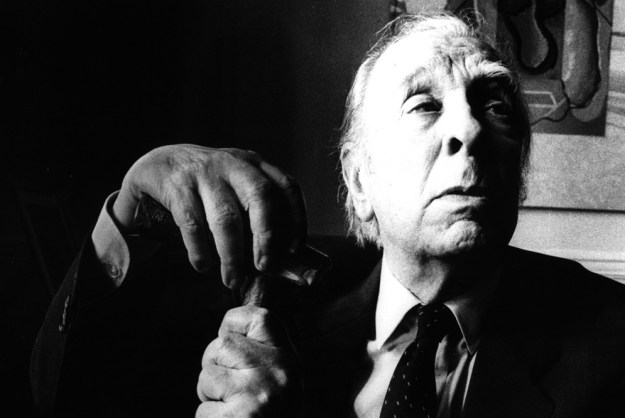
Why Did Borges Hate Soccer?

“‘Soccer is popular,’ Jorge Luis Borges observed, ‘because stupidity is popular.’ At first glance, the Argentine writer’s animus toward ‘the beautiful game’ seems to reflect the attitude of today’s typical soccer hater, whose lazy gibes have almost become a refrain by now: Soccer is boring. There are too many tie scores. I can’t stand the fake injuries. And it’s true: Borges did call soccer ‘aesthetically ugly.’ He did say, ‘Soccer is one of England’s biggest crimes.’ And apparently, he even scheduled one of his lectures so that it would intentionally conflict with Argentina’s first game of the 1978 World Cup. But Borges’ distaste for the sport stemmed from something far more troubling than aesthetics.” New Republic
Restored Footage from the First World Cup: Uruguay, 1930
“The 19th FIFA World Cup is now underway in Brazil, and that gives us an excuse to revisit the first World Cup, played in July, 1930 in Uruguay. Only 13 teams participated in the tournament, and all matches were played in Montevideo, Uruguay’s capital. In the semi-finals, the United States lost to Argentina, 6-1. Uruguay crushed Yugoslavia by the same score. In the end, Uruguay, the favorites all along, triumphed over Argentina (4-2) before a home crowd of 93,000, to become the winner of the inaugural FIFA World Cup.” Open Culture (Video)
Lionel Messi relishes switch to 4-3-3, deals dagger to Bosnia-Herzegovina
“It was a win but far from a convincing one. For much of the 62 minutes between Argentina’s first goal and its second, Bosnia was the better side but it was undone first by a moment of ill-fortune and then by a scintillating goal from Lionel Messi. In the estimation of Alejandro Sabella, the Argentina coach, this was a 6/10 performance with plenty of room for improvement. Messi had had an awkward night. He didn’t play badly as such, but too often he was crowded out, too often forced deep by Bosnia’s pressing.” SI – Jonathan Wilson
World Cup 2014: Lionel Messi shines after tactical change

“On the eve of the Argentina-Bosnia game, a Brazilian newspaper came up with a cruel statistic. In one World Cup game, Neymar had scored more World Cup goals than Lionel Messi had managed in his entire career. The Brazilian was leading by two to one. The little wizard has now levelled the score, and did it in style in his first ever game in Rio’s iconic Maracana stadium. His strike, which turned out to be the winner in Argentina’s 2-1 victory over Bosnia, is the moment a packed crowd will guard in their memories of Sunday’s game. It was Messi at his best, cutting in with the ball tied to his left foot, exchanging quick passes with Gonzalo Higuain and curling a shot in off the post. Without a slight deflection off a Bosnian defender the ball would probably have gone just wide, but few would complain – apart from Bosnians, and some Brazilians.” BBC
Lionel Messi lights up World Cup with stunning strike in Group F victory as Argentina triumph against Bosnia
“Messi at Maracana: what an event. This was part-homage to one of the game’s greats and part-launch of Argentina’s World Cup campaign. The two themes were inevitably intertwined as Lionel Messi embarked on his mission, using his phenomenal footballing capabilities to try to guide his country to victory in these finals that are already being hailed as one of the finest ever. The tone of the tournament has been on attacking and here it was Messi’s turn. He was short of his highest standards, short of the brilliance that has defined his Barcelona career but he still created Argentina’s first and then scored their second, giving the feeling of a special cameo being performed in front of an audience of 74,738, the majority enrapt by his work. It was astonishing to think that this was only his second ever World Cup goal in nine games.” Telegraph – Henry Winter
World Cup Tactical Analysis: Argentina 2-1 Bosnia
“In a game that was expected to be Argentina’s announcement of intent in this World Cup, the favorites met stern opposition in the form of Bosnia and Herzegovina. And though Argentina certainly did the business by walking away with the 3 points, it may have been Bosnia and Herzegovina who perhaps made the bigger statement.” Outside of the Boot
Argentina vs. Bosnia in GIFs
“Messi strikes in Argentina’s opener at the Maracanã. What else could a fan ask for? Argentina and Lionel Messi in Brazil’s greatest stadium, the Marcanã in Rio. Will Argentina be there on July 13? Maybe, maybe not, but it would start today for Argentina against talented World Cup first-timers Bosnia. Let’s look at our favorite GIFs.” Fusion (Video)
World Cup 2014: group stage, day 4. Switzerland 2-1 Ecuador. France 3-0 Honduras. Argentina 2-1 Bosnia.
“… Argentina 2-1 Bosnia. Alejandro Sabella made the competition’s biggest tactical error so far with his use of a 3-5-2, but he had the intelligence to correct it at half-time. Argentina shape. This match was basically all about Argentina’s formation. Throughout qualification they had one of the most settled sides and formations around, and while they sometimes played a 3-5-2 / 5-3-2 system, this was only away from home, often when playing at altitude. It was a highly defensive plan B. It was very strange, then, that Sabella decided to use that system in Argentina’s opening game.” Zonal Marking
While the World Watched
![]()
1978 World Cup and the simultaneous political strife …
“INSIDE A BUENOS AIRES restaurant named El Cuartito, sky-blue paint covers the walls, along with photographs and banners from important athletes and teams. In the center of the largest wall is a shrine to Diego Maradona, the star of the 1986 World Cup. That title is so important that Maradona, a recovering drug addict, still basks comfortably in a nation’s warming love and goodwill. People celebrate the ’86 title with vivid street art murals, and with photos and signed jerseys and posters in nearly every place of business, including El Cuartito. The restaurant celebrates civic heroes, which is why one particular omission is jarring. Argentina has won two World Cups, the famous one in 1986 and the other just eight years before, in 1978, when Argentina played host. That team is barely honored at all inside El Cuartito. In the back corner of the main room, as far away from the door as you can get, hang two team photos. That’s it.” ESPN
2014 World Cup Roundtable: Planet Futbol’s prediction panel
“The 2014 World Cup kicks off Thursday, when Brazil and Croatia open the highly anticipated competition in Sao Paulo. Every World Cup is met with excitement and intrigue, but there’s something extra special about the 2014 edition. Perhaps it’s the host and its tradition of excellence. Perhaps it’s the loaded tournament field. Or perhaps it’s that transcendent stars like Lionel Messi and Cristiano Ronaldo are in their primes at the most ideal time. Regardless, there is quite the chapter of international soccer that is on the cusp of being written. Our reporters on the ground in Brazil — Grant Wahl, Brian Straus, Jonathan Wilson and James Young — and our contributors throughout the tournament — Liviu Bird and Ben Lyttleton — offer their picks as the world’s spotlight gets firmly planted on Brazil for the next month.” SI
The Burden of Being Messi
“In much of Argentina, where Lionel Messi lived until he was 13, native speakers replace the ‘y’ sound with a ‘sh’ sound. Yo, the personal pronoun for ‘I,’ becomes ‘sho,’ and calle, which other Spanish speakers would pronounce ‘ka-yay,’ becomes ‘ka-shey.’ The sound gives Argentine Spanish a slurry softness that resembles aspects of the Portuguese spoken in Brazil. More important to this story, that ‘sh,’ and the fact that Messi has retained it all his life, has at times been the sole lifeline between the greatest soccer player in the world and the country he plays for.” NY Times
World Cup 2014: Rio horror show or a samba sensation?
“Last time the World Cup was held in Brazil, in 1950, it was designed as the propaganda centre-piece of Getúlio Vargas’s Estado Novo, the concrete sweep of the Maracanã, a modernist wonder that would be reflected in Oscar Niemeyer’s designs for the new capital, Brasília. Football, though, can be delightfully unpredictable and rather than consecrating the new Brazilian state, the World Cup offered a national disaster – ‘our Hiroshima’, as the playwright Nelson Rodrigues tastelessly put it – as Brazil, needing only a draw in the final game to seal the title, were beaten by Uruguay.” Guardian – Jonathan Wilson
Brazil will not be perfect but there should be much to savour over the coming weeks
“Inspired by the idea of covering the 2014 World Cup, Danish journalist Mikkel Jensen studied Portuguese and based himself in Brazil to observe the build up to the big kick off on June 12. But in the middle of April he went back home, proclaiming that ‘the dream has become a nightmare.’ He had come to the conclusion that the tournament was doing nothing to help the ordinary Brazilian – indeed, he felt that in some cases it was even making things worse, and he no longer wanted to be part of it.” World Soccer – Tim Vickery
2014 Fifa World Cup: Guide to Argentina’s Group F

“Style & formation: Argentina often fielded a bold 4-3-3 formation in qualifying, although a more conservative 5-3-2 was deployed for tricky away fixtures. The former system allows Lionel Messi to play as a classic number 10 behind two strikers – typically Manchester City’s Sergio Aguero and Napoli’s Gonzalo Higuain – who stretch play. But with Angel Di Maria deployed as part of a midfield three, the formation offers little defensive protection.” BBC – Argentina, Bosnia-Hercegovina, Iran, Nigeria
World Cup 2014 Tactics: How will Argentina set-up at the 2014 FIFA World Cup?
“The two-time winners topped the South American qualification for the 2014 FIFA World Cup and, as ever, will go into the tournament as one of the favourites. An Albiceleste victory on Brazilian soil would be the perfect way to rub salt into the wounds of the hosts and Alejandro Sabella’s men will be desperate to repeat the feats of ’78 and ’86.” Outside of the Boot
Portrait Serial Winner Luis Suarez Soccer Most Beautiful Player
“BEFORE GETTING TO the alleged mob hit or the mystery of the missing referee, there should be an explanation about how this quest began. An assigned profile of Luis Suarez led to a stack of things to read about his past. Whether it was a tabloid calling him Cannibal! or The New York Times calling him Luis Alberto Suarez Diaz, the portrait is of a cheat and a lunatic. If someone breathes on him near the goal, he falls down like he’s been knifed. He has bitten an opponent. Twice. And, back in his childhood in Uruguay, there’s an oft-reported incident that serves as explanation, or maybe proof, that he is, in fact, batshit crazy. When Suarez was 15, overcome with anger, he headbutted a referee and received a red card in a youth match, making the man’s nose bleed ‘like a cow,’ as a witness said.” ESPN (Video)
Key Battles: How to Defend

“How can defenders like Spain’s Sergio Ramos even hope to shut out the world-class strikers they’ll see in Brazil? It all starts at training camp with a clear strategy and a willing body double. Heading into the World Cup, most of the focus has been on the tournament’s large group of elite goal scorers: Ronaldo, Messi, Neymar, Suarez. All told, 14 goal mongers expected at this year’s Cup scored at least eight times in qualifying — and that doesn’t include the best from Brazil, which qualified automatically as host. But history shows it’s the team with the stingiest defense that hoists the trophy. Of the past five champions, all but one had the best goals-against average among the quarterfinalists. (Brazil was second to runner-up Germany in 2002.)” ESPN
UFWC World Cup Classics: Argentina vs Netherlands, 1978
“The Netherlands had beaten Italy 2-1 to reach their second consecutive World Cup final, and to deprive the Italians of the UFWC title. Dutch defender Ernie Brandts had scored for both sides in that game, with Arie Haan getting the winner. The Oranje were looking impressive despite the fact that they were without star man Johan Cruyff, who had stayed at home to consider his priorities following an alleged kidnap attempt on his family. The hugely experienced Dutch team still featured the likes of Jonny Rep, Johan Neeskens, big keeper Jan Jongbloed, and troublesome twins Willy and Rene Van der Kerkhof.” UFWC
World Cup Watch: Mario Balotelli, Sergio Aguero, Louis van Gaal
“The World Cup is only 37 days away, with the opening match between host nation Brazil and Croatia taking place in Sao Paulo on 12 June. BBC Sport, with the help of European football expert Andy Brassell, is taking a weekly look at happenings from across the world of football and what impact they could have on the tournament in the summer.” BBC
The problem with the Copa America Centenario

“The oldest continental competition in the world, the Copa America, was first played in 1916. Four countries participated — one of them was Chile, who have still never won it. The others were Argentina, Brazil and Uruguay, who between them have gone on to accumulate nine World Cup wins. The seeds for such triumphs were planted in the early years of the Copa America — played almost annually until the Great Depression.” ESPN – Tim Vickery
San Lorenzo look to divine alignment to help break Copa Libertadores duck

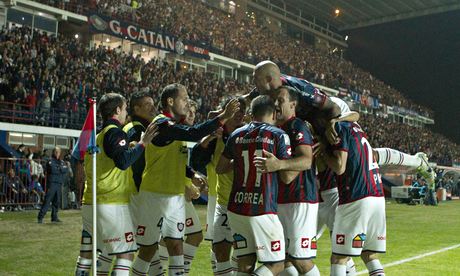
“These are unexpectedly heady times for San Lorenzo. They are the Argentinian champions, and Wednesday night’s 1-0 over Grêmio in the first leg of their last-16 tie took them a step closer to winning the Copa Libertadores for the first time. There’s a long way to go yet, but this is a ferociously competitive side blessed with an exceptional young forward in Ángel Correa and, moreover, they are playing with a self-belief that defies rational explanation.” Guardian – Jonathan Wilson
Argentina’s 10 Best Home-Based Talents Bound for Europe

Natacha Pisarenko
“Argentina has a reputation as a footballing giant for a good reason. With the possible exception of Brazil, no other country exports so many wonderful talents across the world, giving leagues from Spain to Sweden and Italy to Israel a South American flavour. As the Torneo Final reaches its closing stages, many of the latest generation of youngsters are already being watched attentively by European scouts, hopeful of finding the next Messi or Kun Aguero. But who are the top young players currently playing in the Primera Division?” Bleacher Report
Brazil 2014 – Messi’s crowning glory?
“When Lionel Messi received the honour of a fourth successive Ballon d’Or in January 2013 the record books had been rewritten. The Argentinian forward had surpassed Michel Platini’s haul of three successive FIFA World Player of the Year awards with Juventus and cemented his place as one of footballs all time greats at a mere 25 years of age.” backpagefootball
Argentina fret over form of Lionel Messi and fitness of Fernando Gago

“Football is always, ultimately, about compromise. Everything had been looking rosy for Argentina, who had qualified for the World Cup – for once – with games to spare and the sense of a cohesive team coming together, but then the injuries began. When the draw is made, the World Cup exists in a world of perfect possibility and you imagine every player at peak form and fitness, but it is never like that, and the job of a manager is always to balance the idea with what is possible.” Guardian – Jonathan Wilson
Lionel Messi’s Argentina better for Carlos Tevez absence
“In a last-gasp attempt to get the stocky Juventus striker on the plane to Brazil, an Argentine musician has written a tango for Carlos Tevez. Daniel Ursini is using the medium of music to send a message to national team coach Alejandro Sabella, once an elegant midfielder for Leeds and Sheffield United. Entitled ‘Sabella, you’ve forgotten Carlitos’ the song’s melancholy tones accuse the coach of having taken the wrong path. ‘You can’t be so stupid as to leave out one of Argentina’s most popular players,’ argues Ursini. A year ago, Ursini wrote a song to mark the birthday of Lionel Messi, and separate songs for the two stars may well have been a wise move because it could boil down to a choice between one or the other in the Argentina national team. And that is not a particularly difficult decision to take.” BBC – Tim Vickery
Chile tactics will ask a lot of the Socceroos
“In the final of the 2004 Copa America in Peru, Argentina dominated an experimental Brazil side. With three minutes to go La Albiceleste went 2-1 up. Surely the title was won. But with the last kick of the game, Brazil scored the equaliser. Argentina blundered into the penalty shootout with the air of men who had been blinded by the light, and Brazil kept its nerve to lift the trophy.” The World Game – Tim Vickery (Video)
World Cup 2014: Man Utd’s Valencia key to Ecuador in Brazil

“With his ability to fill in at right-back as well as his more customary position higher up the flank, Luis Antonio Valencia is an extremely useful member of the Manchester United squad. For Ecuador, though, he is much more than that. A year ago national team coach Reinaldo Rueda referred to him as ‘the main reference point for Ecuadorian football, as a result of everything he has achieved’. A British readership might be unaware how special it is for Ecuador to have one of their own playing at one of the world’s major clubs, and in action in the closing stages of the Champions League. Less than 30 years ago Ecuador was a Latin American Luxembourg in footballing terms.” BBC – Tim Vickery
Episode 137: Colón still lead the way, Independiente in meltdown & previewing Boca v River
“The hundred-and-thirty-seventh episode of Hand Of Pod sees Sam, Peter and Andrés joined by German Dan to discuss an interesting weekend of matches, at the end of which Colón were still top of the Torneo Final pile, and looking increasingly likely to avoid relegation, points deduction or no points deduction. There were surprising results on Saturday and more predictable ones on Sunday, which concluded with a dire goalless draw between Quilmes and Boca Juniors. Boca’s next match is of course at home to their arch rivals River Plate, so as ever we dedicate a chunk of this week’s pod to previewing the superclásico; will River get their first win in La Bombonera in a decade? Can Boca lift their game? We also discuss Dan’s side Argentinos Juniors, and what’s gone wrong for them, and Peter tries to give us a quick lowdown of what mentalness is happening at Independiente this week. All this and more awaits…” Hand Of Pod
World Cup path clear for Brazil v Argentina final
“The Rio samba schools steered well clear of the 2014 World Cup when they selected their themes for Carnaval. The winner based its parade on the idea of speed, with pride of place for Ayrton Senna. Another school paid tribute to Zico, and finished fifth. But no one wanted to touch the coming World Cup. One school in the Sao Paulo parade took the plunge – one from the Itaquera district, where the new stadium is being built. They were relegated. Even the weather turned against their parade, which celebrated the fact that the World Cup kicks off in their neighbourhood. They had to strut their stuff in heavy rain and a hailstorm. There are signs of protest fatigue, but it is obvious that the 2014 World Cup has a public relations problem with the Brazilian people, upset at how much it is costing and how little it is giving back.” BBC – Tim Vickery
Unlike Simeone’s Atletico, Seedorf’s AC Milan still searching for identity
“The most fascinating aspect of Atletico Madrid is how the club resembles its coach, Diego Simeone. The Argentine was a hugely talented central midfielder, winning titles in both Spain and Italy, while becoming the first Argentine to collect over 100 caps for his national side — only Roberto Ayala and Javier Zanetti, two of his contemporaries, have beaten his tally. Simeone could pass astutely, he scored more goals than expected, he was superb in the air and he was highly mobile.” ESPN – Michael Cox (Video)
We Went There: A 72-Hour Whirlwind Tour of European Football
“Stuttgart’s Mercedes-Benz Arena used to be called the Gottlieb-Daimler Stadion, which used to be called Neckarstadion, which used to be called Century Stadium, which was first called the Adolf-Hitler-Kampfbahn when it was built in 1935. And it was in the shadows of this stadium that I was handed a VIP card — with ‘Einttritt frei!’ on it — for a strip club called Macabu Four Roses. I don’t know if it was because we didn’t speak German and therefore couldn’t say ‘no,’ but people kept trying to hand us stuff. Our hands were full of beers and bratwurst — we’re tourists, all right? — but that didn’t stop the women from Commerzbank from coming over, multiple times, and handing us schedules for the World Cup. And it didn’t stop the older woman in the German-flag smoking jacket from slipping us a card for the only-€84.95 Germany Jacket, which she casually suggested we buy as an ‘alternative jersey’.” Grantland
Carlos Tevez should be at his peak, but is destined for World Cup despair
“A vineyard near Mendoza, June 2011. The manager had just learned I was a journalist covering the Copa América and was determined to find out why I thought Argentina were underperforming – which is to say, she was determined to tell me why she thought they were underperforming. I suggested there was a superabundance of attacking talent, that maybe Carlos Tevez and Lionel Messi couldn’t usefully play together. ‘Then we must drop Messi,’ she said.” Guardian -Jonathan Wilson
River Plate v Boca Juniors: Argentina’s ultimate rivalry
“Summer is a hellish time to be in Buenos Aires. First, because the temperatures are enough to wilt even the strongest constitution – I type this whilst sitting in the living room in my pants, with the air conditioning on, and thanks to the 40 degrees Celsius outside, I’m still sweating. But for the football fan, there’s a more prosaic reason: from mid-December until early February, the Argentine league shuts down, and with clubs relocating to coastal resorts or holiday towns far from the capital to undergo ‘pre-season’ (I use inverted commas because technically, we’re actually halfway through the season), there’s no competitive football to enjoy.” World Soccer
Ricardo Bochini’s long wait to become Argentina’s legend of la pausa

“With five minutes of the 1986 World Cup semi-final remaining and Argentina leading Belgium 2-0, Ricardo Bochini came on for Jorge Burruchaga. He was 32, and had been omitted from the squads in both 1978 and 1982. This time, though, Diego Maradona had demanded that he be picked. Those five minutes plus stoppage time would be the only World Cup football Bochini ever played. As he trotted on, Maradona ran over and shook his hand. ‘Maestro,’ he said, ‘we’ve been waiting for you’.” Guardian – Jonathan Wilson
World Cup 2014: Lionel Messi and Sergio Aguero can shine in Brazil

“Federico Insua is one of those number 10 playmakers that Argentine football produces in such quantity. With a nice left foot and a good range of passing he is an interesting player, although at 34 his best days are now behind him. He was not quite good enough to impose himself on the European game – he had disappointing seasons in Spain, Germany and Turkey – but he has been a strong club player in Argentina, where he currently turns out for Velez Sarsfield.” BBC – Tim Vickery
Monumental Rivalry
“Summer is a hellish time to be in Buenos Aires. First, because the temperatures are enough to wilt even the strongest constitution – I type this whilst sitting in the living room in my pants, with the air conditioning on, and thanks to the 40 degrees Celsius outside, I’m still sweating. But for the football fan, there’s a more prosaic reason: from mid-December until early February, the Argentine league shuts down, and with clubs relocating to coastal resorts or holiday towns far from the capital to undergo ‘pre-season’ (I use inverted commas because technically, we’re actually halfway through the season), there’s no competitive football to enjoy. Still, this is Argentina. And so it is that, amongst the phalanx of meaningless kickabouts involving the likes of Argentinos Juniors against a Uruguayan second division side playing two halves of 35 minutes each way in front of a crowd of ten people, we also have some equally meaningless – but far more famous – fixtures. Saturday night will bring the first of three (three!) pre-season friendlies between River Plate and Boca Juniors.” In Bed With Maradona
Juan Iturbe: Scout Report | The special ‘Juan’ from South America
“It’s taken a little longer than expected, but Juan Iturbe is finally starting to realise his enormous potential that led him to being dubbed ‘the new Lionel Messi’ only a few years ago. Of course, when any big talent emerges from Argentina, they are instantly dubbed and hyped up to be the next Maradona or the next Riquelme.” Outside of the Boot
The Suárez Conundrum
“I first made it to Montevideo shortly after Richard ‘Chengue’ Morales scored the winning goal against Australia in a World Cup playoff in 2001. Ragged horses and carts danced through the streets like Lipizzaner stallions. Children begging on the streets got extra portions of Pollo Milanese from diners leaving fine restaurants. Beautiful girls shared their grappamiel. And posters of Chengue, a bare-chested Afro-Uruguayan, waving La Celeste (the iconic sky blue Uruguay shirt) were in every shop window. It was a poor, but proud city. On my second visit in 2007, I saw the remarkable progress of the country under newly elected President Tabaré Vázquez. Under Vázquez all social and economic indices were up. He was the first member of the left wing Frente Amplio to be elected President. Poverty levels plummeted, child hunger was greatly reduced, smoking in public places was banned and Uruguay confronted the crimes committed in the military dictatorship years of 1973 to 1985.” Road and Kingdoms
Super Sunday in South America, with five titles up for grabs

“South America staged its Super Sunday at the weekend – five domestic titles were up for grabs. In Argentina the fixture computer had played its part. Four teams still had a chance of glory, and they faced each other in a dramatic double header. Two draws meant that San Lorenzo, with the Pope’s blessing and an interesting crop of youngsters, came out on top. There was even more drama in Uruguay, where three teams went into the last day with a chance. Favourites were traditional giants Nacional, with a relatively straightforward home game against little Fenix. They took the lead, and with rivals River Plate losing they seemed well on course.” BBC – Tim Vickery