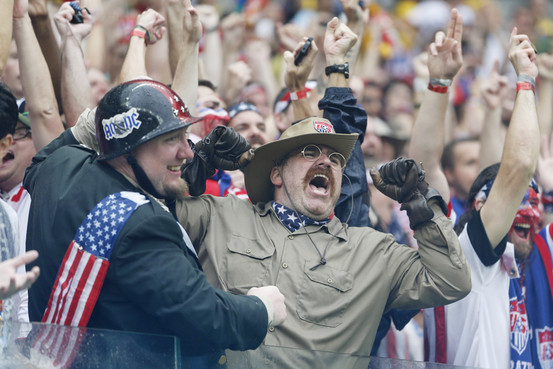
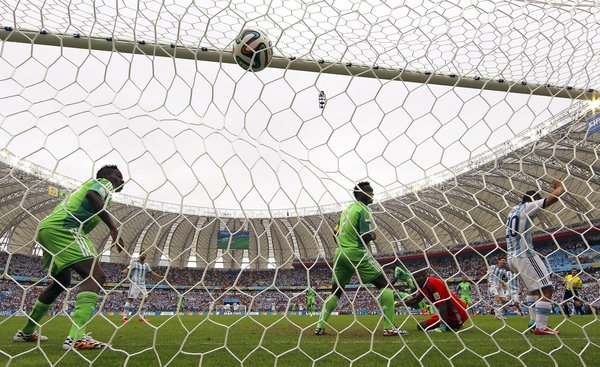
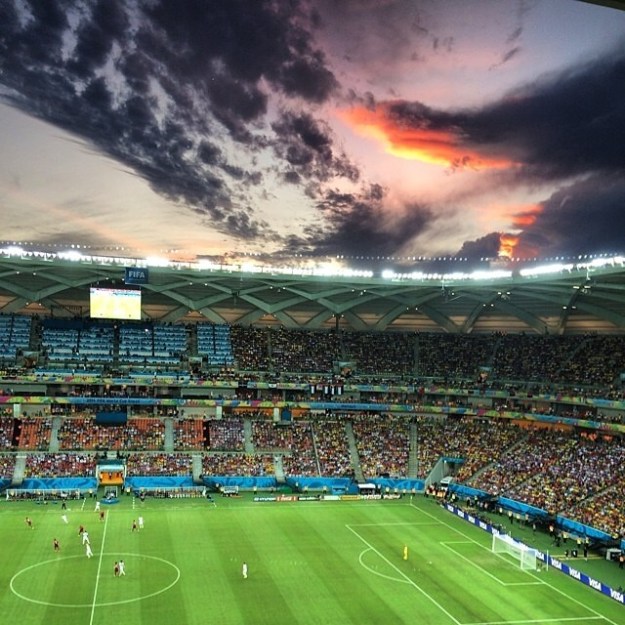
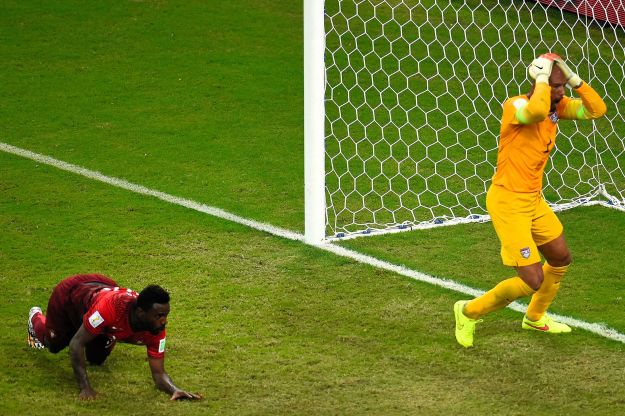
“I am here to tell you about fire. The group stage of the 2014 World Cup was one of the most spectacular phases of a soccer tournament in recent memory. We’ve had torrential rains. We’ve had jungle heat. We’ve had moths the size of magazines. We’ve had wild upsets and crushing defeats; we’ve toppled the entire world order. We’ve seen more goals than in any major conflict since at least the French Revolution. And now — at last — this tournament is about to get serious.” Grantland
Author Archives: 1960s: Days of Rage
What we learned in the group stage
“Footballers are known for spouting clichés whenever possible, and when Marcelo was asked to summarise Brazil’s goalless draw against Mexico in the second round of group games, he immediately responded with a classic. ‘At the World Cup,’ he began, ‘there is no easy game.’ Bingo! There are no easy games at the World Cup, despite the fact that some teams are drawing upon the best players in the world, and others are selecting footballers plying their trade in second divisions across Europe. The World Cup sees the greatest players on the greatest stage, but sometimes also features the greatest (apparent) mismatches too. Argentina against Iran? How will the scoreboard cope?” ESPN – Michael Cox
The Germans Are Young, in Their Prime, And Really, Really Good

“In the fall of 2000, 11-year-old soccer wunderkind Thomas Muller left TSV Pahl, the local team near his hometown of Weilheim in Oberbayern, and joined Bayern Munich’s youth academy. That same year, 22-year-old Miroslav Klose was co-leading the Bundesliga club FCK in goals, becoming a star in his own right. Fourteen years later, they’re both on the same Germany squad, with Muller chasing the World Cup goals record that Klose just tied. In Germany, one generation is being eclipsed by the next. On Thursday, the United States will have to tussle with both. The U.S. faces Muller, Klose and the rest of the German juggernaut in a match that FiveThirtyEight’s World Cup prediction model gives the Americans only a 15 percent chance of winning.” fivethirtyeight
Dispatch from Berlin: Germany v. Germany
“Here in Berlin, despite the disagreeable weather, World Cup fever is now fully epidemic. There’s hardly a bar or restaurant that hasn’t got a large flat screen TV set up for the benefit of its smoking, drinking, screaming football clientele. The other night, sitting outside at a Mediterranean place in Kreuzberg, I could hear the TVs of the neighboring restaurants echoing across the square, as though the world’s most intricate surround sound system had been installed here.” 8by8
The great Dutch football tradition
“When I arrived in the Netherlands in 1976, I was six years old and had never previously heard of the country. My father just happened to have taken a job there. We moved into a typical small Dutch terraced house, with big front windows through which passers-by could peer to make sure nothing untoward was happening inside. On our first Dutch evening, my brother and I ventured on to the street to meet the other children. They greeted us by singing what were probably the only English words they knew: ‘Crazy boys!’ But we soon became regulars in the street’s daily football match. It turned out that we had landed in the middle of a golden age. In 1974 Holland had reached the World Cup final playing glorious passing football. In 1978 they got there again. And the present Dutch team, which faces Mexico in the second round of the World Cup on Sunday, is in that tradition. It isn’t as good, yet it won its three group games. Holland’s football team may be the last surviving unmistakably Dutch cultural product.” FT – Simon Kuper
World Cup: The art of protest — Brazil’s graffiti artists tackle Brazil 2014
“If graffiti is the voice of the street, what better way to take a nation’s pulse than by gazing upon the walls of its inner cities? In Brazil, like many nations, graffiti has long been a way for urban artists to decorate their neighborhoods, voice an opinion or tag prominent buildings with their signature style. As the 2014 World Cup approached, however, many works began to take on the role of a complex social commentary. Like the diverse spectrum of emotions and opinions surrounding the hosting of the event itself, graffiti appeared that was both aggressive and welcoming; political yet playful. Brazilians love their football after all — as evidenced by the passion displayed inside stadia throughout the World Cup so far — but many remain appalled by the amount of money being spent to host the tournament. We asked Cranio and Paulo Ito, two prolific graffiti artists from Sao Paulo, to explain how the sentiment of the Brazilian street has impacted their work and been transported onto walls and buildings across the vast country. Interviews and captions by Eoghan Macguire, for CNN.” CNN
Don’t Call It Luck: The Divine Powers of the Soccer Fan
“There is a saying in this coastal city of mixed religious heritages and many creeds that goes more or less like this: If superstition decided soccer matches, all matches would end in a tie. Still, that has never kept fans here from turning to rituals, magic, prayer or just odd practices to give a helping hand to their club, or to the Brazil national soccer team, which plays Chile on Saturday in the Round of 16 at the World Cup. Whether it is wearing the same shorts for as long as the team is winning or leaving a sacrificial chicken and other offerings on a street corner to some African deity, fervent soccer fans in Salvador and beyond believe the outcome of the matches is somehow in their control.” NY Times (Video)
Is This Soccer’s Moment in America?

“The World Cup is enjoying a surge in TV ratings thanks to excitement surrounding the U.S. team’s strong performance, putting the tournament among the elite telecasts in all of sports. But can soccer sustain its burst in popularity in the U.S. The evidence suggests that some skepticism is in order The U.S. lost 1-0 on Thursday to Germany, but still advanced to the knockout stage of the tournament, having survived this year’s Group of Death The surprising run has made for captivating television. Ratings for the Germany match weren’t available on Thursday, but it is clear already that this year’s telecasts are setting records. The U.S. match versus Portugal on Sunday wasn’t just the highest-rated soccer game ever in the U.S. The combined viewership of the game was 24.7 million between ESPN and Univision, making it the most-viewed sporting event of the year so far, excluding American football, a perennial ratings juggernaut.” WSJ
World Cup: Do Latin Americans care more?
“… So too did world champions Spain, much-fancied Italy as well as England, who managed just one point from three games in a group that saw Costa Rica and Suarez’s Uruguay reach the last 16. Remarkably Costa Rica topped one of the tournament’s toughest groups with two impressive wins over Uruguay and Italy and a draw against England. For European observers, who perhaps don’t have the chance to watch much Latin American football, this has been a World Cup that has arguably showcased the tactical innovation and passion of the Americas.” CNN
I Was Wrong About Klinsmann
“Three weeks ago, I wrote in this space that Jurgen Klinsmann had to deliver now. Wins in friendlies and the Gold Cup and CONCACAF qualifiers are great (and, at this point, expected), but his job was to get the U.S. national team into the knockout rounds. I went further and said that he hadn’t been the best candidate for the job when he was hired in 2011 because his coaching resume was thin. Klinsmann’s main achievement was bringing a German team, playing at home, to the 2006 World Cup semifinals. But German teams have made the final four in nine out of 13 tournaments since the World Cup resumed after World War II in 1950. It didn’t seem like a big deal.” Fusion
World Cup As a Bandwagon Fills, a Team Fails Forward

“The United States soccer players seemed to pass the ball to Germany more often than they did to their own teammates. Late in the game, two Americans — Jermaine Jones and Alejandro Bedoya — were left splayed on the field after running into each other and knocking heads. Jones had also hit the turf earlier when he ran at full speed into the referee. No matter. After their World Cup match here on Thursday, a 1-0 loss, the American players hugged, high-fived and pumped their fists, while their coach flashed a goofy grin. Their fans, soggy from the torrential rain, chanted: ‘U-S-A, U-S-A.’ Weird thing, this World Cup. It generously laid a giant red, white and blue welcome mat at the back door. The United States escaped the Group of Death by enduring a lot of self-inflicted wounds but never fully losing its pulse. As if by miracle, even in defeat, the United States will advance to the Round of 16, and it is scheduled to play Belgium on Tuesday.” NY Times
World Cup Tactical Analysis: USA 0-1 Germany | Germany expose and dominate wide areas
“On the last day of the group phase, one of the most exciting groups, Group G, drew to an exciting close. All 4 teams were in with a shot of going through to the next round. There was a lot of tension in the air in the build up to this game as a draw was enough to take both sides through, and many had doubts after Germany’s performance against Austria in the 1982 World Cup. That aside though, this was also set to be a very tough game as two very evenly matched sides very going up against one another. Coach Jogi Low, who was assistant to Jurgen Klinsmann during the latter’s time in charge of Die Manschaft went up against his former colleague as well, to add some more spice to the occasion.” Outside of the Boot
U.S. Moves On With Assist From Portugal
“This time, there was no moment. No tingle in the spine, no shiver in the neck, no blood rush to the ears. There was no memory that will live on in hearts and minds and YouTube videos forever. This time, there was only this: About 10 minutes before the end of the United States national team’s World Cup game against Germany on Thursday, a U.S. Soccer staff member sidled up to one of Coach Jurgen Klinsmann’s assistants and informed him that Portugal, playing simultaneously about 1,200 miles away in Brasília, had taken a one-goal lead against Ghana. The assistant, Andi Herzog, then turned to his left on the bench and tapped Klinsmann on the arm.” NY Times
U.S. needs possession to continue run
“The emotional ups and downs the U.S. went through in surviving Group G required a year’s supply of Dramamine. The Americans withstood withering pressure to beat Ghana 2-1, played brilliantly before coughing up a late equalizer against Portugal and finally concluded group play with a 1-0 defeat to Germany. Omar Gonzalez summed up the experience perfectly when he said, ‘Last game’s draw felt like a loss, and today’s loss felt like a win. It’s pretty weird.’ Taking the big picture view, the Americans had every reason to feel joyful. The U.S. had emerged from arguably one of the two toughest groups in the tournament, a magnificent achievement that many observers thought was beyond this side.” ESPN
World Cup 2014: group stage, day 15. GERMANY 1-0 USA. PORTUGAL 2-1 GHANA. ALGERIA 1-1 RUSSIA. BELGIUM 1-0 SOUTH KOREA.
“Thomas Muller’s fine goal won the game, but both sides progress. USA narrow. The major tactical feature was the narrowness of the USA without possession, which is something we’ve become accustomed to. Before the tournament it seemed Jurgen Klinsmann was going to play a midfield diamond, and while they’ve switched to more of a 4-4-1-1 formation, they still focus upon defending the centre of the pitch and preventing the opposition playing through the middle, which made sense against a German side boasting multiple playmakers. It also made sense considering the lack of proper full-backs on the German side. Jerome Boateng and Benedikt Howedes are both more accustomed to playing at centre-back, and therefore the USA were content for these players to have the ball.” Zonal Marking
Group stage round-up
“A few brief points to make… 1. The three-man defence has been highly successful so far. A three-man defence has played a four-man defence (at least from the start) on ten occasions. These matches have produced eight victories for the three-man defence, and two draws. A back four is yet to beat a back three. There have been two meetings between three-man defences, Uruguay 1-0 Italy and Netherlands 2-0 Chile. …” Zonal Marking
In Bronx, Joy and Agony for Ghana’s World Cup Match
“The faithful filed into a tiny back storeroom of the Malata African Market in the Bronx, making their way past the bins of giant yams and the freezer of dried fish, and took their seats in rickety rows. A 46-inch television, propped on a shelf next to 50-pound bags of white corn meal, was tuned to the only soccer match that mattered there: Ghana versus Portugal in the final group play match of the World Cup’s Group G.” NY Times
Group G – ESPN
A Dark Horse Is Adjusting to Rising Expectations
“It was always the neighboring Dutch who painted their houses orange for the World Cup, drove orange cars and wore orange outfits until everything and everyone in the Netherlands was the color of a traffic cone. Belgium, meanwhile, could only wonder when its Red Devils would give fans another chance to carry plastic pitchforks around in foreign lands with yummy drinks and sandy beaches. Sure, Belgium reached the semifinals in 1986, but since then, its most notable achievement might have come at the 1994 World Cup in the United States, when players wore hair gel that also acted as a coolant and sunscreen.” NY Times
Algeria’s Chance for Revenge
“I had been thinking of 1982 World Cup even before the tournament began. Socrates had been on my mind. I wanted to write an essay about him, but couldn’t come up with anything that hadn’t been said many times before. I worshipped him as a player and respected him as a man. I hated the Italy team that defeated Brazil, thought them too cynical for some reason, but not as much as I hated the West German team. I hated them before the tournament that year and loathed them after that scandalous game against Austria. All I had to do was see Rummenigge on the small screen and I’d feel the blood in my face boil, steam whistling out of my ears, and imaginative curses in at least three languages escaping my lips.” New Republic
Group H – ESPN
Messi Lifts Spirits of Argentines, Even Those Without Tickets

“An estimated 50,000 Argentines completed the trek to this World Cup city by Wednesday morning. Many of the soccer pilgrims were wearing long faces along with their Lionel Messi jerseys as they roamed the parks and the streets and took in the hazy view of Guaíba lake while carrying hand-lettered signs that read, ‘Compro’ (‘I’m buying’). ‘It’s shameful; the scalpers are asking for 1,200 to 1,500 dollars for a ticket with a face value of no more than 100,’ said Cintia Perri, a young woman from Buenos Aires who had driven 20 hours to get here and spent the night in her car in a nearby camping site. But Messi would soon lift the mood of his sleep-deprived, ticket-deprived compatriots.” NY Times
Magical Messi continues to rise
“At the very least, Argentina coach Alejandro Sabella could say someone else settled the game. It wasn’t Lionel Messi who got the decisive goal; it wasn’t quite so necessary for the playmaker to drag his team forward. Instead, left-back Marcos Rojo kneed home Ezequiel Lavezzi’s corner, and Argentina eventually beat Nigeria 3-2. It gave Sabella’s men a flawless points record from the group stage, with three wins from three games in Group F, but they are far from a flawless team. Although the specific details may have changed, the wider reality remains the same. It is the same storyline around the team tipped as one of the favourites to lift the trophy next month and the developing narrative of this World Cup.” ESPN (Video)
Group F – ESPN
World Cup 2014: group stage, day 14. ARGENTINA 3-2 NIGERIA. BOSNIA 3-1 IRAN. SWITZERLAND 3-0 HONDURAS. FRANCE 0-0 ECUADOR.
“A gentle, open game with both sides already through. Open feel. This game could have gone in two very different ways. With both happy with a draw, it could have been slow, boring and about both teams avoiding injuries. However, there was a sense both wanted to put on a show, having been underwhelming in their opening two matches, and therefore it was open and entertaining. With two goals inside the first five minutes, it was immediately an enjoyable contest. Messi. Nigeria’s main tactic was to track Lionel Messi extremely tightly. Ogenyi Onazi was usually the man with this responsibility, although sometimes Messi was passed on to the other two midfielders when he drifted around the pitch.” Zonal Marking
How Soccer Explains the World
“Female soccer fans in Iran chuck aside the hijab to celebrate the national team’s victory halfway across the globe. Brazilian managers swindle American corporations abroad and exploit their own players at home. Undisciplined soccer stars from Nigeria are sold to Ukrainian teams and forced to adapt to chess-like coaching strategies in the dead of winter. Globalization never seems so vivid as when seen through the eyes of a soccer fan. In his new book, How Soccer Explains the World: An Unlikely Theory of Globalization, Franklin Foer looks at the passions and rivalries embedded in soccer, and comes up with some surprising theories about our ever-shrinking world.” Mother Jones
amazon: How Soccer Explains the World: An Unlikely Theory of Globalization – Franklin Foer
Why You Should Root for Nigeria (or Brazil, Mexico or Ghana)

“Most of the world considers soccer’s quadrennial World Cup to be the most important sporting competition of all. A growing number of Americans have embraced the event, but many are only vaguely aware of it, and, aside from the United States, not so sure for whom to root. I am offering an alternative, utilitarian guide to help Americans choose a country to support. This guide can also be used if the Americans are eliminated, to help decide whom to root for among the remaining teams. The basic principle is simple, drawn from utilitarian principles: Root for the outcome that will produce the largest aggregate increase in happiness. So I came up with a simple index, calculated by a country’s passion for soccer multiplied by its average level of poverty multiplied by its population. It’s perhaps a bit crude, simply to multiply these factors by each other, but the exercise highlights some important truths about the world.” NT Times
World Cup 2014: A Tie Sends France Through and Ecuador Out
“The goals came so easy, and so often, for France in its first two games at the World Cup that one could be forgiven for assuming it might never end. Three against Honduras. Five against Switzerland. When the well went dry in a scoreless tie against Ecuador on Wednesday, there were bound to be questions. Just do not bring them to France’s coach, Didier Deschamps. Unbeaten and safely in the second round as the first-place team in his group, he was not really interested in hearing them.” NY Times
Ramadan Poses Test to Muslim Players at World Cup
“Down the quiet, tree-lined Rua Gonzaga Bastos, less than half a mile from Estádio do Maracanã, the custodian of this city’s only mosque was preparing for the busiest time of the year. Mohamed Zeinhom Abdien, the custodian, was sitting at a desk opposite messy piles of boxes containing thousands of leaflets about Islam written in Portuguese, English and Arabic. The observance of Ramadan, one of Islam’s five pillars, is a religious obligation in which Muslims fast and forgo any liquids from dawn until dusk over the course of a month. The month begins Saturday night, and Abdien’s usually quiet mosque has been inundated with newcomers.” NY Times
Group E – ESPN
Why Are These Fans Showing Up to World Cup Matches in Blackface?

“Racial attitudes, historian Barbara Fields wrote in a classic essay, are ‘promiscuous critters that do not mind cohabiting with their opposites.’ If I were FIFA, I’d consider hang that from a banner in the World Cup stadiums to provide a little inspiration for self-reflection among certain fans. It might ultimately do more good than the more satisfyingly pedantic ‘Say No to Racism,’ which is of course an unimpeachable as a command but has the disadvantage that it requires the people at whom it is directed to understand what racism is. But to interpret, understand, and confront racism in sport is to enter into a labyrinth of contradictions. And it forces us study the denials and tactics of deflection and self-exoneration on the part of fans and institutions alike.” New Republic
The Ivory Coast’s Golden Generation Comes to a Cruel End
“The soccer gods can be cruel. Nobody knows that more than Les Éléphants of Ivory Coast. For the third-straight World Cup, the nation finished third in its group and failed to move on to the knockout stages. In a way, this exit is more painful than previous departures in Germany and South Africa. For this trailblazing collection of superstars, the dream is over, almost certainly for good. The tale of Les Éléphants becomes more popular with each passing World Cup (although it can often carry with it a faint unpleasant scent of paternalism).” Grantland
Reality Bites
“When Zinedine Zidane head-butted Marco Materazzi during the 2006 World Cup final between France and Italy, he more or less blew any chance France had of winning the game. Materazzi is believed to have made some provocative suggestions about Zidane’s sister, and what’s winning the World Cup next to defending one’s sister’s reputation? Luis Suárez’s action yesterday—he left an impression of his teeth in Giorgio Chiellini’s left shoulder—will, after his inevitable ban, have the same effect of terminally harming his country’s chances of victory. But unfortunately for him, Suárez doesn’t have a chivalric excuse. Human beings frequently act against their own self-interest. Think of the highly successful British pop group KLF, two of whose members, self-described as the K Foundation, withdrew a million pounds of their own money from the bank back in 1994 and ceremonially burned it.” The Paris Review – Jonathan Wilson
Blue, as in Happy

“Victory, even in the group stage of the World Cup, can make Uruguayans feel like champions again. After the closing 10 minutes against Italy on Tuesday — 10 minutes in which all fans of the diminutive republic were on tenterhooks for a 1-0 victory — the cheers rang out. Renditions of ‘Soy Celeste … Celeste Soy Yo!’ (‘I’m sky blue … Sky blue, I am!’) were followed by the ubiquitous chants of winning the World Cup again (just like the first time, in 1930). There was much swinging of the national shirt.” NY Times
World Cup Tactical Analysis | Italy 0 – 1 Uruguay: Man marking all-over the place
“The Azzurri were expected to be comfortably through already following an opening-match win over England, but Costa Rica ended hopes of a quick qualification for Cesare Prandelli’s team. Uruguay were also left stunned by the Group D’s surprise team when they lost 3-1 to the Costa Ricans in their first group match. However, the return of Liverpool striker Luis Suarez to the starting XI against England proved to be the catalyst for a 2-1 victory. Therefore, the setting was simple. Uruguay needed a win, Italy needed to avoid defeat to progress to the knockout rounds.” Outside of the Boot
Uruguay’s Suárez, Known for Biting, Leaves Mark on World Cup
“The most ruthless soccer players often use their hands or elbows or knees to rough up opposing players. The most reckless — or dirtiest — might even use their cleats. Then there is Luis Suárez. Suárez, the Uruguayan striker who has emerged as one of the best players in the world over the past year, is a biter. And, it seems, a serial one. For the third time in his career, Suárez is facing potential punishment for appearing to sink his teeth into an opponent. This time, it happened on the biggest soccer stage of all, the World Cup, during Uruguay’s 1-0 victory over Italy on Tuesday. Late in the second half, Suárez bumped into Giorgio Chiellini, an Italian defender, while jockeying for position in the penalty area and then dropped his head into Chiellini’s shoulder. Chiellini immediately recoiled as both fell to the ground.” NY Times
Luis Suarez ‘bite’: Uruguay striker ‘should be banned’
“Uruguay striker Luis Suarez should be banned for ‘as long as possible’ if he is found guilty of biting Italy defender Giorgio Chiellini, according to former England captain Alan Shearer. Liverpool forward Suarez appeared to bite Chiellini just before Uruguay scored their winning goal. The Italian certainly felt he was bitten, pulling his shirt down to show an apparent mark on his left shoulder.” BBC
Your ‘Luis Suárez Bit a Guy!?’ Reaction Post
“Chris Ryan: Hey, Mike! Hungry? It sure looks like Uruguay forward Luis Suárez just bit Italy defender Giorgio Chiellini in a World Cup match. Uruguay, already up a man, went on to win the match and advance to the Round of 16. This is the third time Suárez has taken his Dracula imitation a little too far. In 2010, while playing for Ajax, he chomped on a PSV player. …” Grantland
Group D – ESPN
World Cup group stage: day 13. URUGUAY 1-0 ITALY. COSTA RICA 0-0 ENGLAND. GREECE 2-1 IVORY COAST. COLOMBIA 4-1 JAPAN.
“… Colombia counter-attacked excellently even with a second-string side. Expected pattern. This was another frustrating performance from Japan – lots of possession, some pretty build-up play, but little in the way of penetration. Even more than usual, they needed to commit men forward to increase their attacking threat, so inevitably left gaps at the back for Colombia to break into, with Juan Cuadrado – the only first-choice attacker not rested – having another excellent game. The only genuinely interesting factor was the positioning of Alexander Mejia, who on paper was a midfielder, but stuck so tightly to Japan’s number ten Keisuke Honda – who was determined to move forward to become a second striker – that he basically became a third centre-back. It meant Colombia retained a spare man at the back, and were generally comfortable despite having to withstand lots of pressure.” Zonal Marking
Colombia Pulls Away From Japan to Win Group C
“James Rodríguez scored a brilliant goal and set up two more for Jackson Martínez as Colombia routed Japan, 4-1, on Tuesday to clinch the top spot in Group C and eliminate the Asian champions from the World Cup. Already assured of advancing, Colombia guaranteed first place with its third straight win, setting up a second-round match against Uruguay. The Colombians started with a virtual second-string lineup but still went in front when Juan Cuadrado — one of the few regular starters — drilled in a 17th-minute penalty kick.” NY Times
Costa Rica Makes History at the World Cup
“Of all the surprises so far at this World Cup, perhaps none has been more unexpected than the success of Costa Rica, a country of 4.7 million and, relatively speaking, about the size of host country Brazil’s toenail. The team had been drawn into a group with three of the sport’s most storied nations: England, which is home to arguably the best soccer league in the world; Italy, which has won four World Cups, more than any country that isn’t hosting the event; and Uruguay, the team whose ghost haunts this year’s World Cup, having won the last one to be held in Brazil, in 1950. Nearly every pundit the world over had predicted that Costa Rica would function more as a punching bag than a soccer team this summer. And yet, after Tuesday’s draw with England in the final group match, Costa Rica finished in first place in the group.” Vanity Fair
Improbable Late Penalty Sends Greece to Round of 16
“Georgios Samaras scored on an added-time penalty kick to put Greece into the second round of the World Cup with a 2-1 win over Ivory Coast on Tuesday. Samaras, who was ruled to have been tripped in the area by the substitute Giovanni Sio, calmly slotted in the spot kick for a victory that put Greece through to the knockout stage as the second-place finisher in Group C. Ivory Coast would have advanced with a draw.” NY Times
Group C – ESPN
Passing the World Cup’s Soccer Idealist Torch From Spain to Chile
“Soccer ideology on the international level is a rare thing. Managers are faced with a limited, static pool of talent and a training schedule that consists of, at most, a couple of weeks at a time most years. The ultimate result is qualifying for and performing well in the World Cup. It’s a goal that prioritizes getting results right now, because if you don’t you’re out, and if you’re out you’ve failed. Losing games in the present makes it hard to focus on building for the long term.” Grantland
Shades of Oranje
“France ’98 remains the standard for World Cups in my lifetime. The number of great players in their prime, the quality of the games in the knockout rounds, the last-second drama of the now (thankfully) abolished Golden Goal—a rule by which the first team to score a goal in extra time won—it all proved irresistible. France as a nation had turned to embrace the right, and up had risen the National Front; nevertheless, people traveled in happy droves to spend days, if not weeks, in their dream of Romantic France. During those June days, football flourished under what should have been a crushing paradox of love and hate, more felt than fully understood.” The Paris Review
Policing FIFA-Space
“What’s happening in the stands, where the fans meet the field? Scalpers, ticket touts, and cambistas operate freely around the Maracanã, exploiting fans desperate to get into matches. Outside the Spain vs. Chile match, an Englishman was selling three tickets for a total of $2,500—a sum that is maddeningly expensive and theoretically illegal. And this was one of dozens of such transactions happening on a newly constructed overpass that leads to the stadium before the game.” Fusion
Messi, Sabella now in tactical tandem
“It’s a peculiar lark, this football management. Use a system that doesn’t suit your best players, and you’re considered an inflexible ideologue. Tweak your system to get the best players in the role they’re happiest, and you’re criticised for having no backbone. Argentina manager Alejandro Sabella and his captain, Lionel Messi, have been criticised this week, after Sabella supposedly bowed to Messi’s demands for the game against Iran. Having played a 5-3-2 system in their opening match against Bosnia, Sabella switched to a 4-3-3 for the Iran contest. It’s tough to work out which criticism is sillier — the idea that Sabella is weak for listening to Messi, or the idea Messi was unprofessional for pointing out the obvious. The reality is simple: Argentina’s use of a 5-3-2 against Bosnia was the managerial cock-up of the tournament so far.” ESPN – Michael Cox
World Cup Tactical Analysis | Cameroon 1-4 Brazil: Neymar guides the Selecao to the Round of 16

“Neymar netted twice to help put Brazil into the last 16 of the World Cup as his side flounced aside Cameroon on Monday night. The Barcelona star was at the crux of every move and scored once either side of a Joel Matip strike to ensure the Selecao would continue their World Cup campaign on home soil. Brazil No. 9, Fred finally got off the mark with his first World Cup goal in eight years, and although it should have been ruled offside, it stood and will give the Fluminense striker a major uplift. His goal gave Brazil some extra cushion, only to be topped by Fernandinho, who came on for Paulinho and added the clincher late to give Brazil an extra boost on its way out of the group stage.” Outside of the Boot
We Went There: Mexico Qualifies for the Round of 16 in a Green Sea
“The ‘Meh-he-co’ chants drowned out the AC/DC blaring from the speakers at Arena Pernambuco as the kickoff of El Tri’s match against Croatia drew closer. When the 15-by-25-foot LCD screens showed the starting lineups, the Mexican fans hurled their favorite FIFA-sanctioned slur at the head shots of their opponents.” Grantland (Video>
Mexico Finds Itself Knee-Deep in Victory
“When Andrés Guardado of Mexico finally freed himself from a swarm of teammates Monday and emerged back under the floodlights of the crammed stadium here, he crouched along the sideline, pointed a finger down to his knees as he comically wiggled his legs, and vigorously shook his head from side to side. A smile stretched across his face as he soaked in the deafening cheers. The night before Mexico and Croatia met in this Group A game, with a spot in the World Cup’s knockout round very much up for grabs, Croatia Coach Niko Kovac suggested that his team had nothing to fear, that if anyone’s knees were to tremble, it should be the players of Mexico.” NY Times
Brazil Romps Past Cameroon and Into Knockout Rounds
“An anxious nation and its capital exhaled on Monday. Their beloved national soccer team, which has not played with the precision and dominance that many had hoped for in the World Cup, nevertheless moved on to the next round with a convincing win. Playing in front of a pulsating record crowd at Estádio Nacional, Brazil beat Cameroon, 4-1, behind two goals from Neymar to win Group A. On Saturday it will play Chile, the runner-up in Group B, in the Round of 16.” NY Times
Group A – ESPN
World Cup 2014: group stage, day 12. NETHERLANDS 2-0 CHILE. SPAIN 3-0 AUSTRALIA. MEXICO 3-1 CROATIA. BRAZIL 4-1 CAMEROON.
“… Mexico would have been happy with the draw – but were the better side for long periods, and deserved the victory. Croatia wingers v Mexican wing-backs. This was always likely to be the key battle, considering both Mexico’s previous opponents had problems containing their wing-backs. But the Croatian wingers had been extremely impressive in terms of their work rate and discipline in this tournament, and had constantly looked the most likely players to find the target. Could they pin back the Mexico wing-backs, or find space in behind them?” Zonal Marking
A Cruel Match in an Unforgiving Jungle

“The US team was in a stadium in the middle of a city in the middle of a jungle, getting ready to take the field to play Portugal. The sun had dropped behind the arena and it was getting darker. And hotter. Manaus was built into the Amazon. Fly in on a plane or go out on a boat and you get a sense of the enormity of the uninhabited world surrounding it. Unlike other parts of Brazil, where the natural landscape—the stunning beaches, the looming mountains—seems as much a part of the city as the buildings, Manaus is a clearing in a forest. It feels like an intrusion on nature. The jungle hangs all around city, stifling heat and huge bugs reclaiming its streets and the people living in a place they don’t belong.” 8By8
Heartbroken, but Hardly Hopeless
“Forget about that last goal. Pretend it never happened, as if that soccer ball never ricocheted off the head of a perfectly positioned Portuguese player and into the United States’ net. Do not dwell on those last 30 seconds of that game on Sunday night in the Amazon that stomped on the throat of an otherwise sublime night. Emotions are hard to temper at a time like this — when a surprising American victory seemed all but guaranteed, until that header suddenly proved that it wasn’t — but the broader picture is not at all bleak. Even after tying Portugal, 2-2, the United States remains on a trajector.” NY Times
In Time Warp of Soccer, It Ain’t Over Till … Who Knows?
“… Such situations would be unthinkable in other sports, but vagaries of time are the norm in soccer. Games do not end when a clock expires, but only when the referee decides they are over. In a world where quantities as varied as footsteps and mouse clicks can be measured with scientific precision, soccer is a land where time remains a mirage. The most recent example came in the World Cup game here Sunday night, when the United States scored to take the lead in the 81st minute of a 90-minute match only to see the advantage slip away when Portugal scored — wait for it — 14 minutes later.” NY Times
World Cup Tactical Analysis | Netherlands 2 – 0 Chile: Dutch successful on counter
“With both teams already qualified for the knockout stages, this match would decide which team would finish top and which team would have to be content with second. While the winner would gain first place outright, a draw would be enough for the Dutch to qualify first on goal difference. Both teams knew the importance of first place, with the second placed team most likely facing the daunting possibility of a round of 16 match-up with hosts Brazil. Even though the Netherlands beat Brazil in the quarter-finals in 2010, Brazil at home are a different proposition. Chile, of course, are well acquainted with their South American counterparts; in their last two World Cups (1998 and 2010), Chile were knocked out in the Round of 16 by Brazil. Neither team wanted to lose, setting up a cagey, tactical battle.” Outside of the Boot
World Cup 2014: Netherlands Defeats Chile, 2-0, to Win Group B
“Both the Netherlands and Chile entered the final match of group play knowing they were through to the knockout stage, but the Dutch are moving on as the champions of Group B thanks to 2-0 victory. The Chileans had their chances, controlling much of the possession and play early in the first half, but after the 35th minute it felt very much like the Netherlands’ game. The first goal didn’t come until the 76th minute, on a header by Leroy Fer. The Dutch offered a final exclamation point in stoppage time, when Arjen Robben raced up the left side and sent a cross to Memphis Depay.” NY Times
Group B – ESPN
World Cup Pass & Move: I Can’t Believe That We Did Draw!

“Looks like we picked the wrong week to stop sniffing glue! That was a pretty turbulent soccer match on Sunday. To try to make sense of it all, we’ve got a bunch of Grantland writers on hand to talk it out. This is a safe space! Blame Game. Bill Barnwell: When the clock struck 94:00, DeAndre Yedlin had the ball in the opposite corner of the pitch while trying to shield it from Portuguese defenders. At 94:24, the ball was up for grabs in the Portuguese half of the field. Eight seconds later, at 94:32, a bullet header from substitute Portuguese striker Silvestre Varela hit the back of the net. Given that the final whistle blew almost immediately after the ensuing kickoff, had the United States managed to hold the ball for another 10 seconds, it would have come away from Manaus with three points. It’s a bitter blow.” Grantland (Video)
USA eyes bigger picture after letting World Cup chance slip vs. Portugal
“They were 30 seconds away — half a minute from clinching a spot in the knockout stage of the 2014 World Cup after only two games, an achievement few could have expected prior to the tournament. ‘It’s the Group of Death,’ goalkeeper Tim Howard said. ‘Most people counted us out.’ They were 30 seconds away from writing a new chapter in U.S. soccer history. Never before had the U.S. men advanced beyond the first round in consecutive World Cups. Only 30 seconds separated the Americans from a seminal victory over a European power that would have opened the eyes of millions around the world and galvanized an increasingly engaged public back home. Thirty seconds proved too long.” SI (Video)
Late Shock Interrupts U.S. Party
“The ball was barely past United States goalkeeper Tim Howard, and already he had put his hands to his head. On the bench, Jurgen Klinsmann spun away as if he had seen a ghost. Up the field, not far from where he lost the ball, Michael Bradley could only stare. This was what shock looked like. The Americans had advanced, hadn’t they? Hadn’t they? The celebration had been epic after Clint Dempsey, the captain, the man with the black eye and the broken nose and the swollen cheek, scored just nine minutes from the end to put the Americans in front and surely — surely — into the knockout round of the World Cup. It was bedlam. It was overwhelming. It was historic.” NY Times
World Cup Tactical Analysis | USA 2 – 2 Portugal: The Americans exploit down the right
“The two sides came into this game with contrasting opening fixtures. While the Americans were lacking expectations at the World Cup, they managed a positive result against Ghana, while the Portuguese disappointed with a 4-0 loss to Germany (though a victory was never likely). In what was the last late game of the World Cup, both teams certainly left it late. Although they shared the points, the US certainly were the more impressive side and looked deserving of all three points, while the Portuguese can count themselves extremely lucky for not having been knocked out of the tournament already.” Outside of the Boot
How the Portugal Draw Boosts the U.S.’s World Cup Advancement Odds
“The United States was seconds away from defeating Portugal on Sunday when Michael Bradley, normally one of the steadiest American players, mishandled a ball in midfield and gave Portugal a last opportunity. Silvestre Varela took advantage, scoring on a header. But the 2-2 draw was a result the U.S. might have been happy with before the match began. It improved the Americans’ odds of advancing to the knockout round of the World Cup. Those chances are up to 76 percent, according to the FiveThirtyEight forecast, an improvement from 65 percent before Sunday’s match.” fivethirtyeight
World Cup 2014: group stage, day 11. BELGIUM 1-0 RUSSIA. ALGERIA 4-2 SOUTH KOREA. USA 2-2 PORTUGAL.
“… A very exciting game – USA dominated for the majority, but conceded a very late equaliser, meaning all Group G sides can still qualify. Portugal left / USA right. There were various changes to the sides for this game – Portugal’s backline was decimated through injury, while Jurgen Klinsmann switched to a 4-2-3-1 in the absence of Jozy Altidore, with Clint Dempsey upfront alone. Incidentally, this is probably what should have happened after Altidore’s injury against Ghana, and USA played much better football in this match, even if they didn’t eventually record a victory. But this game was basically all about the battle in one area of the pitch, as always with Portugal’s matches. Usually Cristiano Ronaldo starts on the left flank and cuts inside onto his right foot before shooting. The starting structure of Portugal’s side suggested this was the plan again, but Ronaldo played an even freer role, appearing as something of a second striker for the latter period of the second half, before eventually becoming Portugal’s highest man up the pitch. The left-wing position was left bare.” Zonal Marking
World Cup 2014: Belgium Defeats Russia, 1-0
“Belgium booked a place in the Round of 16 after a late goal from Divock Origi earned a 1-0 victory over Russia in Group H. It was the second game in a row that Belgium needed a late score from a substitute to win. Origi, who replaced the ineffective Romelu Lukaku in the 57th minute, is only 19 years old and became Belgium’s youngest ever World Cup goal scorer. He combined with Eden Hazard, the skillful midfielder, down the left wing to engineer a counterattack in the 88th minute. Both goals in Belgium’s previous match, a 2-1 win over Algeria, came from second-half substitutes.” NY Times
World Cup Tactical Analysis: Belgium 1 – 0 Russia
“A game which was fairly fought out for 80 minutes, was suddenly stolen away from a team that showed it’s individual brilliance. A game in which man to man ability was the thin line between three points and zilch.” Outside of the Boot
World Cup 2014: Algeria Defeats South Korea for First Cup Win in 32 Years
“First-half strikes by Islam Slimani and Rafik Halliche helped Algeria defeat South Korea, 4-2, on Sunday and become the first team from Africa to score four goals in a World Cup match. Algeria led by 3-0 at halftime and withstood a stronger South Korean performance in the second half to claim its first Cup win since 1982 and move into second place in Group H with one match left.” NY Times
Towards an Ethic of World Cup Fandom
“Sometime before he died, my uncle told me that in his youth, his dream had been to watch a World Cup game in person. He passed away before he could do it, so when Costa Rica qualified for the FIFA World Cup, I seized the chance to go. I contacted welcoming friends in Brazil, bought a ticket to see my team play football against England, and planned my trip. Like many fans around the world, I wanted to appreciate the beautiful game played at the highest level.” New Republic
The World Cup’s top 100 footballers of all time – interactive

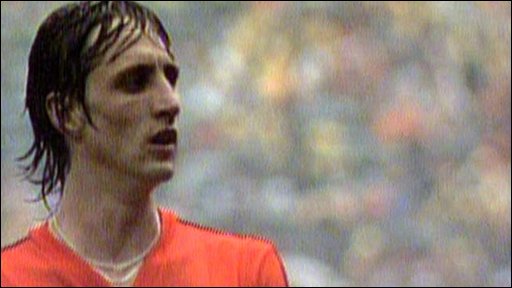
6. Johan Cruyff
“Welcome to the Guardian’s choice of the World Cup’s top 100 footballers. Led by Lothar Matthäus and Zico, our international panel of 40 experts compiled a countdown of the finest players to grace the globe’s greatest sporting event. You can see who the judges are and read how we compiled the list here. Starting with No1 in the top left corner, click on the individual players to read more about them.” Guardian
World Cup Brasília, a Capital City That’s a Place Apart
“The Brazilian flag reads, “Ordem e Progresso” — “Order and Progress” — which is somewhat curious in this wonderfully jumbled and beautiful country. For an outsider who has visited the samba-infused nightclubs of Rio de Janeiro, the Amazonian jungle or São Paulo, with its ramshackle favelas and snarled traffic, order is not what springs to mind. Until you arrive in Brasília. In a country known for its flair for improvisation, Brasília stands in jarring contrast, a city so orderly, it is hard to believe it is really in Brazil.” NY Times
World Cup Tactical Analysis: Argentina 1-0 Iran
“The two teams could not have been further in reputation, Argentina being one of the favourites to challenge for the World Cup, and Iran being one of the ‘favourites’ to get knocked out in the group stages. It was most definitely a David vs Goliath situation. But still, the match had attracted quite a lot of build up considering both the teams’ contrasting strengths. Argentina’s mighty attack versus Iran’s extremely pragmatic approach was always going to be an entertaining contest.” Outside of the Boot
World Cup Tactical Analysis: Germany 2-2 Ghana
“Today, after a first 45 minutes of two sides feeling each other out, we saw a brilliant 2nd half which ultimately failed to separate the two sides. In fairness a 2-2 draw was probably a fair result as it highlighted Germany’s ability to penetrate Ghana’s defense but also rewarded Ghana’s sharp counter-attack and punished Germany’s lack of pace on the back line.” Outside of the Boot
If the English Premier League is the Best in the World, Why do the Three Lions Crash and Burn?
“Did Luis Suarez surprise England? Apart from killing them? It’s hardly feasible that Glen Johnson, Steven Gerrard, Jordan Henderson, Daniel Sturridge or Raheem Sterling could say they’d never seen anything like that before. They’d all played through a season at Liverpool with Suarez in which he scored 31 goals in 33 games and won just about every award anyone could invent. And never bit into more than a burger. No, Suarez wasn’t a shock. The England team knew Luis was going to be murder, insolent, and laughing in their faces. There’s no one they’d seen more likely to carry an injury into a big game and be the decider. At the end of the devastating 2-1 defeat by Uruguay, Luis went up to Steven Gerrard and gave him a hug, kind words and not so much as a nibble. They’re chums, you see.” New Republic
Watch: Lionel Messi breaks Iran’s heart with stoppage-time winner

“For a player criticized for not doing enough for his country, Lionel Messi is sure doing what he can to change the narrative. Messi came through for Argentina yet again, delivering a highlight-reel, stoppage-time winner to give Argentina a 1-0 win over stubborn, valiant Iran on Saturday, giving Argentina six points and a commanding Group F lead. With Diego Maradona watching in the stands, Messi provided his own iconic moment for Argentina, cutting centrally to create space against a defender and curling home a beautiful 20-yard shot after the Albiceleste were frustrated and shut off time and again by a collective Iranian defensive effort. The moment mimicked his goal against Bosnia-Herzegovina, which proved to be the game-winning strike in Argentina’s opening game of the competition.” SI (Video)
World Cup 2014: Argentina Overcomes Iran With a Bit of Messi Magic
“Lionel Messi scored a goal in second-half stoppage time to give Argentina a 1-0 victory over Iran in Belo Horizonte, Brazil, on Saturday and a place in the second round of the World Cup. Iran had a solid defense in the game and took the match to Argentina in the second half, creating several chances to win the match in Group F. But Iran was punished for those missed chances when Messi picked up the ball about 20 yards out and curled a shot into the left corner. It was a moment of individual brilliance by Messi.” NY Times
World Cup 2014: group stage, day 10. ARGENTINA 1-0 IRAN. GERMANY 2-2 GHANA. NIGERIA 1-0 BOSNIA.
“Iran defended solidly and created some great chances, but Lionel Messi’s stunning stoppage time goal won the game. Iran deep and narrow. We expected another defensive-minded performance from Iran, and that’s precisely what we got. They set out to frustrate Argentina, sitting extremely deep and making little attempt to attack in the first half. Iran’s major strategy was to defend extremely narrow. They were aware of the danger of letting Lionel Messi have the ball in central positions, and therefore their five central midfielders formed a solid block in the centre of the pitch, denying Argentina’s central midfielders the passing lanes to feed the ball to Messi, Angel Di Maria and the other two attackers. They encouraged balls out to the full-backs instead.” Zonal Marking
Talent Radar: Mario Götze improves his defensive contribution in Germany’s 2-2 World Cup draw with Ghana
“In what turned out to be a hugely attractive encounter in one of the most open and end-to-end 2014 World Cup games, Germany & Ghana played out an enthralling 2-2 draw with fast paced counter-attacking football at it’s best. The two sides had met at the previous World Cup as well with the Europeans getting the win, but this time it seemed more likely that we’d witness an African triumph until the legendary Miroslav Klose turned up and scored his record equaling 15th World Cup goal.” Outside of the Boot
An Enduring Touch Proves as Essential as Ever
“The shaky front flip was not vintage Miroslav Klose, but the critical goal that led to it was definitely a classic Klose poach. Even if he is now an injury-prone, 36-year-old substitute, playing for Germany still brings out the essential man in Klose, and less than two minutes after he trotted onto the field in Fortaleza, Brazil, he smelled a chance and pounced. The far post has been one of his happiest hunting grounds through the years, and after his teammate Benedikt Höwedes flicked on a Toni Kroos corner kick, Klose was already moving toward empty space near the goal line, a half-step and a fully formed thought ahead of the closest Ghana defender.” NY Times
World Cup 2014: Germany Ties Ghana as Miroslav Klose Ties Goals Record
“Ghana held Germany to a 2-2 tie on Saturday in Fortaleza, Brazil, although the veteran striker Miroslav Klose came on as a substitute to match the World Cup scoring record with the tying goal in a highly entertaining Group G match. Klose has 15 career World Cup goals, equaling the mark set by the former Brazil star Ronaldo. Klose scored the equalizer in the 71st minute, less than two minutes after coming on, when a corner by Toni Kroos was flicked to the far post by Benedikt Höwedes, and Klose slid in to knock the ball in.” NY Times
The Anchor on an Evolving Team
“Tim Howard did not always like what Jurgen Klinsmann was doing to Howard’s closest friends. He actually hated it. One by one, all of the veteran players on the United States national team had their moments with Klinsmann, the coach from Germany, who had made clear since the moment he was hired in 2011 that history and past performance meant nothing to him. Klinsmann dropped Carlos Bocanegra, the former captain. He benched Michael Bradley. He denigrated Clint Dempsey. With Landon Donovan, he pretty much did all three. All the while, Howard, the longtime goalkeeper, played the role of supportive teammate and steady hand.” NY Times
Soccer Dives: Simulation Is Just a Part of the Game

“Last Thursday, the World Cup opened with the play nobody wants to see: an appallingly incorrect penalty call. After a pass came into the penalty area, Croatian defender Dejan Lovren lightly touched Brazilian forward Fred, who had the ball at his feet, on the shoulder. Instantly, Fred threw his arms in the air, opened his mouth to scream, and fell to the ground like a popped balloon. The referee whistled a foul, and Brazilian star Neymar scored on the ensuing penalty kick. The goal turned out to be the winning one in a match that seemed destined to end in a draw. There is no call more controversial in soccer than the penalty. Quickly after Fred’s flop, nearly every soccer forum in the world ridiculed the call as a refereeing failure.” Vanity Fair
The Officiating Apologist: Time to get over the World Cup ‘gaffes’
“The outrage a Fred’s flop in the box during the opening game of the World Cup has been pervasive. I know that the American sentiment is that diving or ‘simulation’ is an egregious affront to good sportsmanship, but most people that have soccer as their primary source of sports entertainment view it as a part of every day life. Sure, some players are more regularly overdramatic in their dives, but as it stands now, being able to sell a call is a skill in international soccer, and Fred executed, and it payed off for his team.” The Rhino and Compass
Its Dragons Felled, Bosnia Reflects on Defeat
“In Sarajevo, a city ever running out of parking space, the downtown area was closed last night to traffic for the match between Nigeria and Bosnia. I suppose a massive victory celebration was anticipated. Everyone had been speculating about the outcome, the game largely already won. Everyone, that is, except the national team manager Safet Susic, who was repeatedly quoted as saying that Bosnia just needed a tie with Nigeria. The game to win was the next one, against Iran.” New Republic
Ctrl + ← A Sticker Collector, America’s Center of Mass and Gooooooooals
“This is Ctrl + ←, our weekly data journalism roundup. You’ll find the most-read FiveThirtyEight articles of the past week, as well as gems we spotted elsewhere on the Internet (not surprisingly, several this week are World Cup-related).” fivethirtyeight
Brazilian Media Activist Arrested After Warning About Repression
“Twenty-four hours before getting arrested on Friday night, Filipe Peçanha, one of the founders of the media collective known for its edgy citizen-journalism coverage of street demonstrations in Brazil, warned of the dangers of increasing police repression and the criminalization of protests. ‘With the increasing wave of repression, we’ve seen an emptying of the streets. There’s been a criminalization of the movements,’ the founder of the Midia Ninja collective Rio de Janeiro told Fusion in an exclusive interview Thursday evening.” Fusion
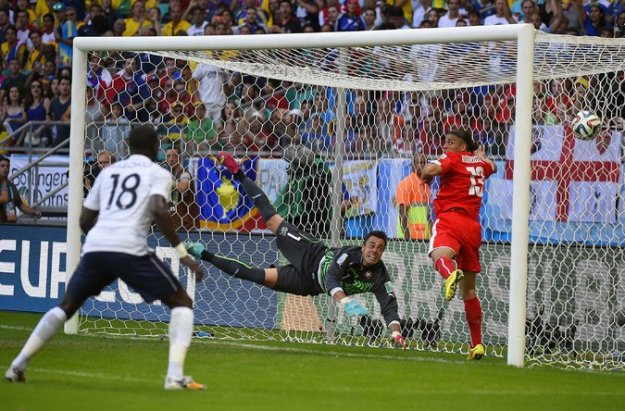
In Tournament Packed With Goals, France Stuffs in Five More

“It was a gorgeous, ruthless finish from Karim Benzema: a perfectly timed swing of the right leg on the move from the French striker that put the ball into the upper-left corner of the Switzerland goal. The problem was that it did not count, with the referee Bjorn Kuipers indicating that he had blown the final whistle just before Benzema pounced. On a normal night and in a normal World Cup, this could have been pivotal, at the very least a source of heated debate, but at this stage it only produced Gallic shrugs. Everyone — except for Swiss players and fans — had already seen or scored enough goals to feel satisfied. So it has gone all over Brazil, and France’s 5-2 victory on this steamy Friday night was merely the latest indication in this delightful World Cup that defenders no longer rule.” NY Times