“One down, one to go for Lucimar Da Silva Ferreira, or as he far prefers to be known, Lucio. On May 22 the combative and classy center back helped Internazionale to the big club prize, Europe’s Champions League. And now he’s in South Africa, preparing and hoping to scale the summit of the international game and bring home the World Cup.” (SI – Tim Vickery)
Author Archives: 1960s: Days of Rage
The Supporters Trust Movement Reaches Serie A
“Yesterday was an important day in Italian Football Culture, as Serie A’s first Supporters Trust – Azionariato Popolare AS Roma – was formed, as the first attempt to run a football club by the fans in Italy. Azionariato Popolare AS Roma are the second Trust to be formed it Italy, after Società Cooperativa Modena Sport Club was formed in 2008, by fans of Serie B Modena.” (twohundredpercent)
World Cup Coaches, By Nationality and Numbers

“Below you’ll find a complete list of the 32 coaches at World Cup 2010. You’ll also find their nationality, and their age going into the tournament. Beneath that you’ll find some amateur hour number crunching I did with pen, paper and the calculator on my cell phone to work out a few statistics.” (World Cup Blog)
World Cup Preview: Group G
“The 2010 FIFA World Cup kicks off in just two weeks today, which is so exciting the hair on my legs keeps on spontaneously erupting into flames. By this time next week – when your correspondent Dotmund (to use his Brazilian footballer nickname) completes his guide to the groups – all the final squads will be announced and we’ll be good to go. This is especially useful for him, as he’s just realised he’s not written the preview for Group H yet. Group G, however, is in the can. Let’s suckle at the teat of knowledge and learn about the fortunes of Brazil, North Korea, Ivory Coast and Portugal.” (twohundredpercent)
Video Of The Week: Argentina vs Netherlands – The 1978 World Cup Final
“This week’s Video Of The Week is a little late due to other commitments, but it is an absolute belter – the 1978 World Cup final between Argentina and the Netherlands. There will be more on here about the Netherlands at the 1978 World Cup finals over the weekend, and this is something of a taster for it. We get to see the Argentinian protests over Rene Van De Kerkhof’s lightweight cast before the match, then the entire match itself, including extra-time. The Dutch team, often overlooked in comparison with their 1974 team, came very close to winning the match, as you will see.” (twohundredpercent)
European Team of the Season 2009-10

Pastorale, François Boucher
“Hot on the heels of the Goals of the Season, we move on to the Football Further European Team of the Season. As in any decent dream team this side is strongly, perhaps even foolishly, oriented towards attack. Feedback, particularly of the irate, finger-jabbing kind, is warmly welcomed.” (Football Further)
High-fiving the World Cup
“There’s a brief segment of spring weather in Milwaukee that, while it lasts, can generate more excitement, adrenaline and leap-15-feet-off-the-ground happiness than anything else on Earth. We go about things during that time without the sticky humidity of summer heat and the creeping, buzzing insects that come with it. The temperatures are warm enough to make one start asking businesses whether they have a shirt policy. Right now is that time in Milwaukee, and it’s with that mood-enhancing environment in the background that this week I’ve been imagining high-fiving my bus driver about the World Cup.” (Match Pricks), (Must Read Soccer)
2010 FIFA World Cup: map, with the 32 teams’ home jerseys, and the 32 teams’ World Cup titles and appearances list.
“From World Cup Blog.org: ‘The Final Pre-World Cup Rankings’. Thanks to the contributors to the pages at en.wikipedia.org, National team appearances in the FIFA World Cup. Thanks to World Soccer Shop.com, for some of the jersey photos.” (billsportsmaps)
Is Diego Maradona set to surprise people?

Diego Maradona
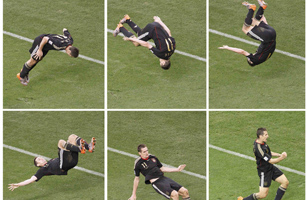
“‘Maradona’s crazy! He doesn’t know what he’s doing!’ is the general attitude towards Argentina’s manager since he took over 18 months ago. The first part is undeniably correct – Maradona is crazy. He celebrated a crucial goal late on in qualifying by diving along a rain-sodden pitch, Klinsmann-style, and when Argentina finally secured qualification, he sat down in the post-match press conference in front of the gathered journalists, and immediately declared, ‘You lot take it up the a**e’. He is definitely crazy.” (Zonal Marling)
Spain: La Selección World Cup squad analysis (23 for 2010)
“With the official announcement of the 23-man squad, we are going to take a look and assess everyone that will be competing for Spain at the World Cup finals this summer. The squad has been fairly settled under Vicente del Bosque but there are a few surprises that will get their chance to shine on the biggest stage next month.” (Just Football)
115. Fabio Capello, 2010
“Click to enlarge, and debate the strip below the line. Keith Hackett’s official answers appear in Sunday’s Observer and here from Monday.” (Guardian – Paul Trevillion)
Tango

“You can find the tango all over Buenos Aires: in it’s mythical cafes, at the milongas, and by walking around the city’s authentic neighborhoods.”
“‘Tango is an improvised movement — at its best and most challenging, a politics of touch — carrying within its sensory mechanisms the potential instantiation of a politics that might be called a politics of friendship. Tango is a challenge to fraternization as the maxim for democracy even while it is the dream of a nationally unified identity. Tango is all of these contradictory movements of desire.’ (Erin Manning, Politics of Touch, p.28)” (Sports Babel)
Legacy of South Africa’s World Cup will take many years to measure
“‘Our society,’ said British writer Johann Hari, ‘is very good at some things, generating wealth, say … But we are very bad at meeting a basic human need for shared collective experiences. Our atomized lonely culture can only meet this need at freak flashpoints.’ Or World Cups.” (SI – Tim Vickery)
Puma does the World Cup ad better, with African footballers and fans, Gnarls Barkley and Kehinde Wiley
“Contrast the above (and its soundtrack) with Nike’s bloated ad, which is seasoned with the most tired forms of machismo and sexism. Here there are even a few girls and women, presented not as sex objects or football failures, but as fans and players (asking the boys to give her the ball!). This ad, furthermore, is actually about African soccer.” (From A Left Wing)
World Cup Tales: The Murder Of A Footballer, 1994

“In amongst the razzamatazz of the 1994 World Cup, which kicked off with Diana Ross putting a penalty kick wide of the goal during the opening ceremony and finished with Roberto Baggio putting one over in a penalty shoot-out that seemed pre-ordained to follow a desperately bad final between Italy and Brazil, the darkest of football’s dark hearts showed its face. It felt as if a parallel universe – a feudal world in which criminality rules and considerations of humanity take a back seat – had momentarily become entwined with ours, and it led to the death of a sportsman, quite possibly for the seemingly absurd reason that he made a mistake under highly pressurised circumstances that cost some very violent and very powerful people a lot of money.” (twohundredpercent)
Netherlands 2-1 Mexico – Video Highlights and Recap – Friendly – 26 May 2010
“Holland (aka the Netherlands) played their first friendly leading up to the 2010 World Cup with a match against Mexico in Germany. They would be without a few players who were playing in the UEFA Champions League final while Mexico would have all their top players available. Neither team will be focused too much on a result but getting their teams fit and ready for South Africa.” (The 90th Minute)
Divided We Stand: the Problem of Parachute Payments
“The Premier and Football Leagues reached a deal over restructured solidarity payments from the former’s coffers two weeks ago, but with the Play-Offs and pre-World Cup mutterings taking precedence there’s been frustratingly limited coverage of the landmark agreement in the national press.” (thetwounfortunates)
An old-fashioned 3-5-2 for Uruguay

“The three-man defence may be fairly unpopular throughout Europe at the moment, but it is alive and well in Latin America. With Chile having used a 3-3-1-3 system throughout qualification and Mexico toying with a 3-4-3, Uruguay will join them, with a more traditional 3-5-2 formation.” (Zonal Marking)
Maradona’s management could be a sight for sore eyes
“Following Argentina’s 5-0 demolition of Canada in their final World Cup warm-up match on Monday evening, Diego Maradona conjured up a rather disturbing image while on radio by promising to run around the centre of Buenos Aires naked if his side are victorious in South Africa. Football managers are prone to offering to go naked in public – Martin Allen and Gary Johnson have both made similar commitments in the past. But is it likely that the world will be exposed to Diego’s untoned frame waddling around the Argentinean capital?” (WSC)
How to sound smart at the watercooler
“Everyone isn’t a soccer expert. Yet many of you will be caught in a conversation that veers toward the World Cup at some point in the coming summer. For those of you not inclined to scour Slovenia’s World Cup roster for hidden clues that could help the U.S. gain possession in the middle third, here are a few lines that will help you sound like you know what you’re talking about…” (ESPN)
Mexico’s fluid shape makes them dark horses
“‘There’s a lot of movement arrows on that diagram’, you might be thinking. And you’d be right – there are, for that’s the key to Mexico’s system – movement from almost every player on the pitch and plenty of width when attacking. The 3-1 defeat to England was harsh on Mexico. They dominated possession and created the better chances – a lack of composure in the penalty area was their downfall.” (Zonal Marking)
How football helped to heal Honduras

“I often see a football match described as a battle or a fight for survival but in 1969 a tie between Honduras and El Salvador proved to be the catalyst that turned simmering border tension and immigration issues into all-out war. The two teams met in a play-off that had more at stake than simply a place at the 1970 World Cup in Mexico and each side was subjected to abuse, xenophobia and hatred when playing in the other country.” (BBC)
Football War
“The Football War (La guerra del fútbol, in Spanish), also known as the Soccer War or 100-hours War, was a four-day war fought by El Salvador and Honduras in 1969. It was caused by political conflicts between Hondurans and Salvadorans, namely issues concerning immigration from El Salvador to Honduras. These existing tensions between the two countries coincided with the inflamed rioting during the second North American qualifying round for the 1970 FIFA World Cup. On 14 July 1969, the Salvadoran army launched an attack against Honduras. The Organization of American States negotiated a cease-fire which took effect on 20 July, with the Salvadoran troops withdrawn in early August.” (Wikipedia)
Salvador–Honduras War, 1969
“An idyllic view of Latin America shows twenty or so somewhat similar countries living in peaceful proximity to each other. Revolutions, yes; wars, no―or so goes the popular concept. Wars are for Europe and Asia, not for neighborly Latin America. The fact is, however, that Latin America has been the site of a number of bitter conflicts, several of which have resulted in large numbers of casualties. The Chaco War, the War of the Pacific, the Paraguayan War, the Peruvian-Ecuadoran War―all of these were international conflicts that disturbed the hemisphere.” (Air Power)
All the Men’s Kings
“And so the 2010 Champions League Final raised its skinny arms up over its head, arched its little back, and dove into the waters of ‘a thing that happened,’ where it slipped in without making a splash. I mean no bitterness toward the participants when I say that, unless you were an Inter fan or could name more than four players on Bayern’s team, this was not an event that sent you scurrying to your secret dictionary. Mourinho’s teams have a way of making their victories look tautological—they perform actions from which winning results, therefore they win—and this one was even more programmatically straightforward than most, a lot of patient defending combined with two inspired stabs from Milito. Bayern should have scored, but they didn’t, and therefore Inter performed the actions that ensured they never would. Mourinho keeps doing it, as Andy Gray twice purred. Code is poetry, except that it totally isn’t.” (Run of Play)
On Massumi’s Logic of Relation: Players
“In the last section of our analysis on Brian Massumi’s logic of relation he asks us to consider the ball as a part-subject that catalyzes the vast field of potential that is the soccer pitch. It is the ball that reconfigures the field of potential while movement plays out or unfolds, since the players continuously move in response to its displacements. Susken Rosenthal’s pencil drawings are interesting in that they make the autonomous agency of the ball explicit by tracing its movements around the pitch during the course of a soccer match. One notices the relatively straight lines that collectively express the displacements of the ball, but also the quite angular vertices showing where the ball changed direction with a well-placed kick.” (Sport Babal)
World Cup Moments: Gheorghe Hagi Scores From There, ‘94.

Gheorghe Hagi, ‘Maradona of the Carpathians’
“Back at the ‘94 World Cup, Romania’s Gheorge Hagi was the bee’s knees. He was so good he was allowed to join that rarified group: players who’ve sidled up on each flank of El Clasico. Good throughout the tournament, but there was a moment, one singular moment, which reigns in the memories of all: that goal, from there.” (World Cup Blog)
Spain Blows Whistle on La Liga
“Spanish football teams are shooting for a new goal: To break even. In an effort to tackle reckless spending and rising debts among the 20 La Liga clubs, the country’s top teams will be subjected to financial regulation by a new independent body established by the Spanish government to ensure that teams are living within their means.” (WSJ)
North Korea: a better side than you might expect
“For obvious reasons, there hasn’t been a great deal of media coverage about the North Korean national team, making a re-appearance in the World Cup for the first time since their famous adventure in the north of England in 1966. Of course, this has only contributed to a sense of anticipation about their side; there were suggestions that throughout the qualification campaign, North Korea played the most defensive game imaginable – telling their strikers to drop back into defence when out of possession. That seems doubtful, but regardless, they have new coach anyway.” (Zonal Marking)
Tactical analysis of England’s system

“With just a couple of weeks until the World Cup begins, this was a game posing more questions than offering solutions for Fabio Capello. Whilst England recorded a 3-1 win, they were outplayed and outpassed by a technically superior Mexico side for large parts of the game. Few individual performances stood out for England – Glen Johnson was awarded the man-of-the-match award, presumably solely for goal, but this was one of his weaker displays; he looked very uncomfortable up against Mexico’s extremely high winger, and contributed little in attack. That he was England’s best player sums up what a poor show it was.” (Zonal Marking)
Prediction: U.S. Will Beat England In World Cup
“Psychology is not to be underestimated when it comes to sport, especially the World Cup and soccer. In this summer’s clash of the giants between the United States and England, I believe the game will not come down to who is the better team on the day, but will instead focus on which team is more psychologically prepared to overcome its opponent. And for that reason, I predict the United States will defeat England.” (EPL Talk)
England win but Fabio Capello finds more questions than answers
“It would have been more satisfying if this friendly had conformed to the tradition of irrelevance. There was instead a good deal for England to reflect on after a night when the losers showed more polish. The modest satisfaction for the home team lies in the knowledge that they still imposed their will.” (Guardian)
England vs. Mexico
(footytube)
World Cup Tales: The Story Of The First World Cup, 1930
“It should come as no great surprise to any seasoned FIFA watchers that the entire history of the organisation has been about its politicking, and still less that this has frequently extended itself into the hosting of its showpiece tournament, the World Cup. When we go back as far as to look at the formation of the organisation, we see one that was at its very formation unilateralist and was riven from its very early days with divisions between nations from different parts of the world. So, how did FIFA and the World Cup come to be, and how was it that an organisation that was largely based in Europe came to hold the first major tournament under its own complete control in a country of just three million people in South America?” (twohundredpercent)
For Nike, women are only good for laughs
“People seem to like Alejandro Iñárritu’s ad for Nike’s 2010 World Cup campaign (‘Write the Future’). I don’t. Women appear in it only as sex objects and jokes. Below is a survey of the three moments in this ad in which women figure…” (From A Left Wing)
10 World Cup Questions: Algeria
“If you’re unfamiliar with World Cup Blog, then allow me to explain: The blog you’re reading now is the front page, but the core of WCB is the multitude of team specific blogs, including one for each of the World Cup 2010 teams. The authors of these team blogs have forgotten more about their sides than I’ll ever know, so I decided to tap that knowledge by asking each of them a set of 10 questions. Today it’s the turn of Omar from Algeria World Cup Blog. Read on to learn all about Les Fennecs…” (World Cup Blog)
Goals of the Season 2009-10

Dejan Stanković
“In the hope of provoking plenty of debate, disagreement and downright indignation, Football Further proudly presents – in purely chronological order – its Goals of the Season 2009-10…” (Football Further)
Algeria eager to make up for lost time
“England’s World Cup rivals Algeria have one of Africa’s most fascinating footballing histories, packed full, as it is, with passion, pedigree and political intrigue. But it is also irrevocably bound up with France. This complex relationship has, at times, defined Algeria’s independence, while also showing its lack of it. Plenty of Algerian talent has risen through French academies before going on to play for Les Bleus, as best exemplified by the great Zinedine Zidane.” (BBC)
My First World Cup: Daniel Alves
“Brazil defender Daniel Alves has told the BBC his team have the best players ahead of the 2010 World Cup finals in South Africa – and that he has not minded having to wait seven years to make his debut in the tournament.” (BBC)
Football Weekly: Treble top for Inter and José Mourinho
“It’s the final Football Weekly of the season, and James Richardson’s got Fernando Duarte, Paolo Bandini and Barry Glendenning in the pod to celebrate and commiserate in equal measure. We start of of course with the Champions League final. Internazionale claimed an historical Treble after the beat Bayern Munich 2-0 at the Santiago Bernabéu. And with José Mourinho now all but certain to join Real Madrid – can the galácticos rightly claim to be managed by the greatest coach around?” (Guardian – James Richardson)
ZM’s end-of-season awards

“The Champions League final has been and gone, so we are now officially at the end of the 2009/10 season. This would not be an internet football site without an article outlining some reasonably pointless ‘awards’, but since this is a site focussed on tactics, hopefully the tactical angle will – like a newly-signed winger that doesn’t appear to fit into the team – ‘provide something different’.” (Zonal Marking)
Post-Invictus: South Africa’s Greatest Soccer Moment
“In early 1996, as the above quote emphasizes, it was South Africa’s Bafana Bafana soccer team—not its rugby ‘Springboks’—that captured South Africa’s imagination. Yet, in the run-up to the 2010 World Cup, the American media has constructed a history implying that the most important sports moment in South African history was their victory in the 1995 Rugby World Cup. This construction is thanks largely to Clint Eastwood’s rendition of those events in Invictus (which was released in DVD last week, ensuring further pre-World Cup attention), though ESPN has also chimed in with a documentary entitled The 16th Man. I prefer the ESPN documentary because it includes some genuine South African voices, but I also find it fascinating that in the hype around that Rugby World Cup the media seems to be missing a somewhat analogous soccer moment that came about seven months ‘post-Invictus:’ South Africa’s victory in the 1996 African Cup of Nations.” (Pitch Invasion)
Soccer On the Big Screen: New York Film Festivals & Screenings For the Soccer Obsessed
“Soccer has indeed made tremendous inroads in the United States, moving beyond the field and into the arts. Filmmakers are beginning to make some incredibly dynamic soccer films. Thankfully, we’ve reached a point in the United States where soccer is now inspiring film festivals solely devoted to the game so at least some of us no longer have to sneak around back alleys to find the films we hear so much about. In the build up to the 2010 World Cup, New York-based soccer cinephiles will have the opportunity to spend their afternoons and or evenings endulging in soccer-inspired films at the following festivals…” (Nutmeg Radio)
World Cup Preview – The rest of Group C
“So we’ve had a look at the 3 Lions, but how will the other three teams in Group C do. The USA side have finally hit their potential by making the Confederations Cup final last year. Algeria have surged up the FIFA rankings in recent years, and had a good African Cup of Nations campaign. Slovenia could be a dark-horse in this competition. England better not get overconfident here then.” (Six Pointer)
Jozy Altidore: The Next Haitian Hero of U.S. Soccer?
“The New York Times just published a nice profile of Jozy Altidore — thanks to my friends at Duke’s FHI for a tweet about this! — and, despite the fact that I know seeking historical and social redemption in football matches is a dangerous game, I can’t help dreaming that this summer will bring us a little echo of 1950. In that year, Joe Gaetjens — a Haitian national recruited onto the U.S. team, in the days when FIFA was a rather easy-going about citizenship requirements — brought the U.S. perhaps it’s greatest footballing victory, a story told a few weeks back in a nice Sports Illustrated story, when he scored a goal against the English team.” (Soccer Politics)
I Scored A Goal

Carlos Alberto
“Here are the stories of men who scored in a World Cup final.” (ESPN)
World Cup Tales – Overcoming The Great Humiliation: Brazil, 1958
“As the second favourites to win the 2010 World Cup after Spain, Brazil are used to the pressure that comes with the eyes of the world being upon them. No other country on earth’s identity is so closely associated with football, yet much of the mythology that surrounds the Brazilian national team stems their failure to win the tournament that they hosted in 1950. It was this national trauma that was to provide the inspiration for what would become the most successful international team on earth, both stylistically and tactically. As such, the story of how Brazil won the 1958 World Cup began eight years earlier, in Rio de Janeiro.” (twohundredpercent)
South Africa Pushes to Make the Cup Its Own
“The official mascot of Africa’s first World Cup — a stuffed leopard with spiked green hair — was made in China. The official World Cup anthem, “Waka Waka (This Time for Africa),” was written by the Colombian pop star Shakira. The official restaurant? McDonald’s. And with less than three weeks before the world’s most watched sporting event, only 36,000 of the almost three million tickets have been sold in Africa outside of South Africa itself, the host. On a continent whose people mostly live on the wrong side of the digital divide, tickets were mainly marketed online.” (NYT)
Inter 2-0 Bayern: Milito the master of Madrid

Jan Massys, Loth et ses filles
“Inter have deservedly won the Champions League – beating this season’s champions of England, Spain and then Germany on the way to collecting the trophy. Jose Mourinho has conquered Europe again, Inter have won the treble for the first time in the history of Italian football, and Italy retains its four Champions League places ahead of Germany.” (Zonal Marking)
How Inter Milan Won its Treble
“Bayern Munich manager Louis Van Gaal is not generally a man prone to hyperbole. On the eve of the Champions League final between his team and Italy’s Inter Milan he was asked whether the two finalists were the best sides in Europe. ‘No,’ he said, pausing a moment for the briefest of frowns. ‘No, these are not the best teams. The three best teams in Europe this season were Barcelona, Chelsea and Manchester United.'” (WSJ)
Bayern Munich 0-2 Inter Milan (Internazionale) – Video Highlights and Recap – Champions League – 22 May 2010
“The UEFA Champions League ended the 2009-10 season with the final of Bayern Munich v Inter Milan aka Internazionale. The two sides made improbable runs to the final which included beating FC Barcelona, Chelsea, and Manchester United. The final was play at the Estadio Santiago Bernabeu which is the home of Spanish La Liga side Real Madrid.” (The 90th Minute)
Official FIFA 2010 World Cup Song – Wavin’ Flag by K’Naan
“The official song of the FIFA 2010 World Cup, Wavin’ Flag by K’Naan.” (The 90th Minute)
The Dreaded Penalty Shootout

Roberto Baggio
“The dreaded penalty shootout. After 120 minutes of exhausting play finishing in a draw, 10 players are chosen to step up to the penalty spot and try to beat the goalkeeper from 12 yards. It sounds simple, but it isn’t. Each player is under immense pressure. The world is watching him kick the ball. The weight of a nation is on his shoulders. And because of this, sometimes the best players miss penalty kicks. It’s all about staying calm under pressure.” (World Cup Blog)
The Map of the Road of the Future
“The day of the Champions League final is, as they say, finally upon us, which means it’s time for a couple of announcements in the way-of-the-future vein. Like, what are we going to do about it, and what to expect for this little festival of truces they’ve got set up in South Africa this summer.” (Run of Play)
Argentina coach Diego Maradona interviewed
“World Soccer: How different is the feeling of going to the World Cup as a player before and now as a coach?
Diego Maradona: It’s been so long ago that I can’t remember, but I feel proud when I see my players killing themselves on the field to gain a place. They are the ones who translate their excitement to me. But of course it was easier as a player. I only thought of getting the ball and having fun. Now I have to control 20-odd players. The other day in training a shot bounced off the crossbar to me and I took a shot at goal. Some must have noticed from my happy face that the player in me came out!” (World Soccer)
What Blogs Should I Read For the World Cup?

Cape Town
“This is the first part of a group of recommended blogs (in no particular order) that I will be introducing non-regular soccer readers to in the weeks before the World Cup. While long-time blog readers might sort of chuckle at themselves softly in the deep recesses of their suburban basements, old Leeds matches from the early seventies playing on a VHS loop on a lonely TV in the corner, this is really meant for the johnny-come-latelies who might not want all their World Cup info coming from John Molinaro. Or anybody attached to Sports Illustrated with the exception of Grant Wahl.” (A More Splendid Life – Part 1: Futfanatico), (Part 2: Treasons, Strategems & Spoils), (Part 3: The Run of Play)
The Manchester United War Of Words
“Never has a football club’s ‘official wine partner’ seemed so important. And while you’re pondering the concept of a football club having a wine partner at all (what next, “prawn sandwich partner”?), I shall explain. Like Wayne Rooney’s Manchester United goals, before he had to score most of them himself, articles about the latest Manchester United takeover battle are coming in clusters. The main story is well told, especially by a very impressive set of Manchester United supporters’ groups. Manchester United’s Supporters Trust (MUST) has run a fluent visual and audible protest against the Glazer family, backed by a proper understanding of how loudly money talks to them.” (twohundredpercent)
David James should note managerial life expectancy
“David James is said to be interested in taking over from Avram Grant as Portsmouth manager. James could be a good fit for the club – if anyone is likely to know what the Portsmouth players need to do, it could be the man who has been standing behind them for the past four years. For the player, however, taking the job could be a disastrous career move. James is not short of job prospects.” (WSC)
Inter v Bayern: Champions League final preview

Jose Mourinho
“This is what the Champions League is all about: England’s best side against Spain’s best side in last season’s final in Rome, Italy’s best side against Germany’s best side this season in Madrid. This is an intriguing match-up between two sides who have underachieved in Europe in recent years, and between two of the greatest tacticians in modern times. The Italy v Germany clash is emphasized when you consider the situation regarding both countries’ UEFA coefficients (which determines the number of European places each national league is allocated) where Germany currently leads Italy by 0.155 points.” (Zonal Marking)
Champions League Final Preview
“The most anticipated event of any European season, this year’s Champions League final looks set to be yet another intriguing battle both on and off the field, with several fascinating plot lines running through the pre-match build-up to further stoke the fire of what should be a wonderful spectacle and, perhaps more appealingly, a struggle for tactical supremacy between two of the game’s most astute Coaches. As one-time Barcelona manager Louis van Gaal’s Bayern Munich and his former translator, Jose Mourinho’s Inter prepare to face off in the magnificent surrounds of Madrid’s Estadio Santiago Bernabeu, The Equaliser looks at the potential line-ups of both sides and tries to get the measure of the personnel and systems these two prestigious sides may look to use on Saturday evening.” (The Equaliser)
CL Comment: Five Ways Inter Can Beat Bayern Munich
“Keep The Tempo Running High. Inter are not a team generally linked with fast flowing football, and many believe that they’d struggle were they plonked straight into a Premier League fixture list. Besides that being a pointless argument, it also overlooks the fact that some of Inter’s better performances this season have come against teams who like to play the ball around at speed (see Chelsea, Barcelona, Genoa, Milan, Palermo…) Therefore, should they go for the spoiling approach in trying to deal with Arjen Robben et al, they may be on the wrong track. By allowing the game to be played at a decent pace it will give them extra opportunities to punish Bayern on one of their notorious counter-attacks.” (Goal)
Champions League Final Is Clash of Coaches
“As Bayern Munich and Inter Milan take the field for Saturday’s UEFA Champions League final, even the most ardent football fan could be forgiven for taking a second glance at the match program: Just who are these guys? In a tournament that’s supposed to be dominated by the world’s greatest players, the 2010 final is conspicuously short on star power.” (WSJ)
Book Review: Soccer, Passion, Politics and the First World Cup in Africa
“Ahead of the World Cup in South Africa, a spate of books on African football was to be expected. Africa, after all, has traditionally been underserved as far as football writing goes. Until last year, the genre could more or less be summed up in three books: Peter auf der Heyde’s Has Anybody Got a Whistle?, Filippo Ricci’s Elephants, Lions and Eagles, and a brilliant chapter by David Goldblatt in his magisterial The Ball is Round.” (Pitch Invasion)
World Cup Preview: Group F
“The 2010 World Cup kicks off in just three weeks time, so by this point the majority of football fans everywhere are only using products made by official tournament sponsors and eating impala for breakfast. Our intrepid Wikipedia monkey Dotmund has once again put his vuvuzela aside for just long enough to take a look at another of this summer’s groups. Today we find out about the reigning champions, a South American dark horse, a team from a very long way away and a European team who have only ever been in the World Cup before in disguise.” (twohundredpercent)
32 Teams: One Dream
The Joy of Six: Things we miss about the World Cup
“The Goddess of Victory. There’s nothing particularly wrong with the Fifa World Cup Trophy. As five-kilo dods of solid 18-carat gold with two malachite layers go, it’s as serviceable as they come. But just look at the name of it again. The Fifa World Cup Trophy. A functional and corporate monicker betraying a complete lack of invaluable – and dear God how they’d love to buy some of this – old-school glamour.” (Guardian)
World Cup Tales: The Battle Of Santiago, 1962
“We hear a lot about the decline and fall of western civilization these days, but moral outrage at the behaviour of footballers is nothing new and, indeed, players at the World Cup finals this summer will have to go a long way to outdo the most serious incidents of player-on-player violence in the history of the tournament, many of which considerably predate the coming of colour television, to say the least. In this respect, the group match between Chile and Italy at the 1962 World Cup finals probably remains the most infamous example of a World Cup match that became something else. It wasn’t the first – three players, for example, were sent off during a quarter-final match between Hungary and Brazil at the 1954 tournament in Switzerland – but, even now, it sets the high water mark for outright violence on the pitch during what is supposed to be football’s showpiece tournament.” (twohundredpercent)
Indy to join with Carolina RailHawks in celebrating soccer with new and classic films
“We’re just three weeks away from the start of a little soccer competition in South Africa. The 2010 FIFA World Cup begins June 11, and to mark the month-long occasion, the Independent Weekly and the Carolina RailHawks will partner to sponsor a series of soccer-themed films.” (IndyWeek)
Scottish Football: A Season Review

Newlandsfield Park, Shawlands“With the Cup Final and the play-offs finishing at the weekend – and no Scottish involvement in any other football that may be taking place in the next few weeks – that’s another season over. It’s been a year that’s seen more nationl team failure, the depatures of George Burley and Gordon Smith, and even more soul-searching than usual about the future of the domestic game. So what’s been happening and where does it all go from here?” (twohundredpercent)
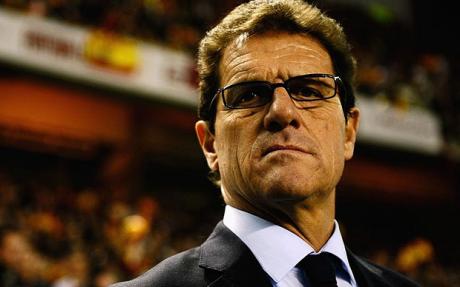
England coach Fabio Capello interviewed
“World Soccer: You have experienced everything in your career as player and manager but never as coach at a World Cup. How are you approaching that? Fabio Capello: Of course a World Cup itself is not a new experience because I was there as a player. Right now we are preparing everything, studying all the different situations which will arise between here and South Africa including during our training camp in Austria. We are working very hard together – not only the players but also everybody else who has to work for us with the media, with the kit, the travel, the logistics, the accommodation and so do.” (World Soccer)