
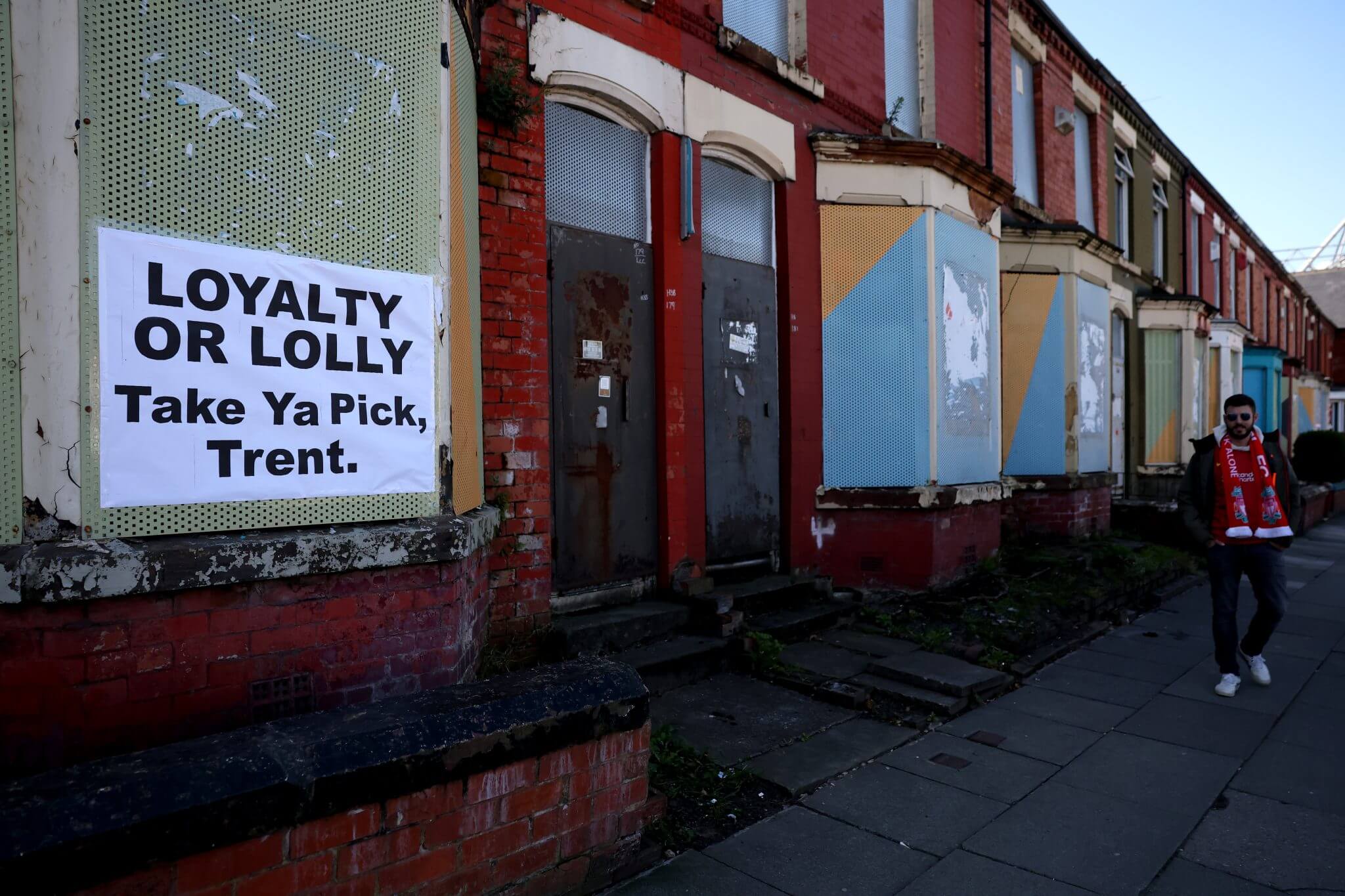
 A poster targeting Trent Alexander-Arnold last season
“It is called Liverpool Football Club, but only a few people who represent it at the most significant levels are either from the city or live there. Owners Fenway Sports Group is American and its main leaders are based out of Boston and Los Angeles. In 2014, it expanded its business operation by opening a bureau in London to help grow what had started on Merseyside. Meanwhile, the organisation’s head of football, Michael Edwards, originally from Hampshire, lives just outside Manchester and runs an office in nearby Altrincham. Edwards appointed Liverpool’s sporting director, Richard Hughes, a Scot who usually travels north for a couple of working days a week from his home on the south coast of England. …”
NY Times/The Athletic
Many of Liverpool’s most important figures don’t live in Liverpool. Does it matter?
Leave a reply
 “This weekend’s crucial game in the title race may be billed as Manchester City versus Arsenal, but for some, the off-field battle between managers Pep Guardiola and Mikel Arteta could almost be as fascinating to watch. While referee Anthony Taylor tries to keep order on the pitch, fourth official Paul Tierney will have a similarly intense task of attempting to manage the technical areas. In the sky-blue corner, Guardiola will doubtless be as moody and intense as ever on his home patch. In the red, Arteta will likely be less ebullient than at the Emirates — and may even spend most of the match inside his technical area for a change — but will still be on edge throughout, depending on the scoreline. …”
 “English Premier League clubs generated record operating losses last season even as revenues soared to new heights, analysis from The Athletic has found. Across the 20 teams in what is routinely cited as the world’s richest football league, underlying deficits hit a combined £1.65billion ($2.24bn) in 2024-25, a 43 per cent increase in a single year. Expenditure across the three main cost categories — wages, transfer fee amortisation, and operating expenses — rose by £911million, almost double the collective’s £462m revenue growth. …”
