“A lot of people asked to see more of these, so here’s a second batch, extending a bit later into the twentieth century.” (Run of Play)
More Wonderful Soccer Postcards
Leave a reply
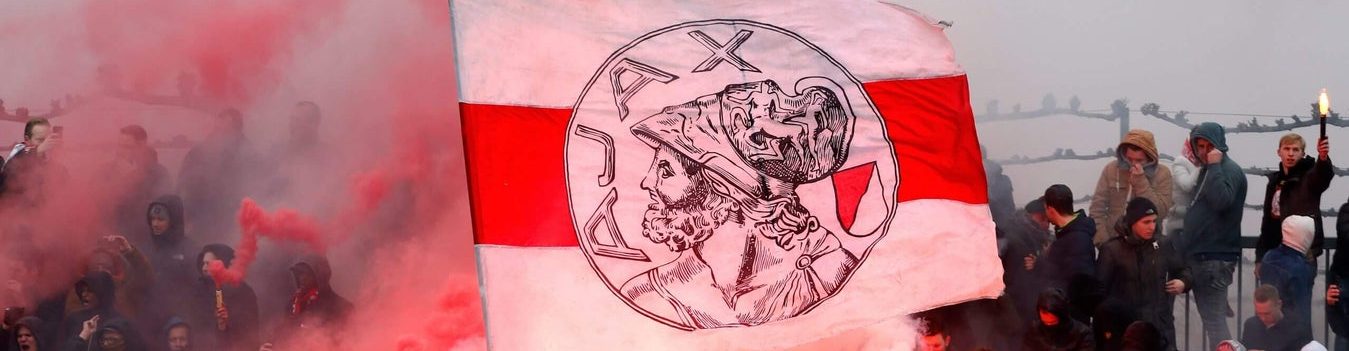
“A lot of people asked to see more of these, so here’s a second batch, extending a bit later into the twentieth century.” (Run of Play)
“I haven’t read, or even seen, Hunter Davies’s Postcards from the Edge of Football, but I love looking at old football postcards. I like the thought that underneath all the large public channels of media and culture, the world is being crisscrossed with these incidental private images of the game, carrying greetings, questions, and experiences from one person to another.” (Run of Play)
“It’s been happening quietly, since for some reason the media don’t seem all that eager to visit the possibility that their original version of the story was full of exaggerations and mistakes, but some of the grandiose claims about the purchase of Manchester City by the Abu Dhabi United Group are finally starting to go up in smoke. For instance: the notion that City’s new owners—usually described as “the investment arm of the Abu Dhabi royal family”—were sitting on $850 billion which they were prepared to pour into the club. This astonishing, not to say newspaper-selling, claim turns out to have been based on a simple misconception.” (Run of Play)
“Ladies and gentleman, friends, family, opium smugglers, torch singers, bicyclists, balloonists, chemists, painters, gangsters, mysterious women in kimonos, and grad students; Three years ago today, armed with nothing but youthful pluck, a Google password, and a biography of Pierce Egan, I set out to create a sports website that would ‘be insanely profitable’ and ‘basically run itself.’ From those springs of innocent idealism, plus electricity and several computer languages, The Run of Play was born.” (Run of Play)
“If this week’s Wayne Rooney saga has done anything other than earn the Manchester United striker a huge pay rise and, presumably, an even huger grudge from his manager, it’s added yet another hammer blow to the wedge that is being driven relentlessly between players and supporters. The nutshell version of the story is that Rooney allegedly nailed a hooker, not-only-allegedly disgraced himself at the World Cup and allegedly briefed journalists that he wanted to leave United.” (twofootedtackle)
For a Break-Up [UPDATED]
“I, personally, have never been the type who dwells on heartache and tragedy. Others may whinge, but it’s never been my way. When a thing goes pear-shaped, you can either throw a bin through a window and steal a pair of trainers, or you can lift a pint to the good times and set about refactoring your tattoo situation.” (Run of Play)
Wayne Rooney, Manchester Uniter and Contempt
“Manchester United supporters have learnt a tough lesson this week. The fact that footballers are mercenaries may be common knowledge amongst fans of most clubs, but Manchester United, by virtue of their sheer scale, have been largely insulated from this. They have been able to hang on to the likes of Paul Scholes and Ryan Giggs for years and years, and have been afford one major luxury that is denied to almost every other club – they sell, by and large, only when they need to sell and they feel that a player is surplus to requirements. Comments to the effect that they are not matching the ambitions of a player (a deliberately ambiguous statement – ‘not matching ambitions’ can quite easily be extended in its interpretation to ‘not doubling my wages’) are not something that they are used to.” (twohundredpercent)
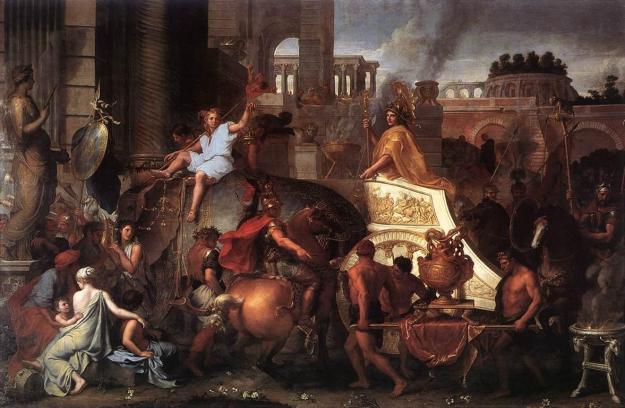
Charles Le Brun – Entry of Alexander into Babylon
“Last Tuesday, a riot broke out at a soccer game in Italy. Its perpetrators were a group of right-wing Serbs who had traveled to Genoa to watch their national team play Italy—or, as it turned out, not to watch it play, since the game was called off after just seven minutes. The Serbs threw burning flares onto the pitch and used a metal bar to try to smash the fence that separated them from the Italian supporters. A large, heavily tattooed man in a black ski mask climbed the Perspex barrier at the front of the stands and started slicing through the perimeter netting with wire cutters, pausing to give the occasional Nazi salute. As Italian riot police moved to surround the visitors, the Serbs set fire to an Albanian flag and unfurled a banner reading ‘Kosovo is Serbia.'” (Slate – Run of Play)
“It’s easy and facile to suggest that morality has no place in football, that ultimately only results count, that money talks louder than ethics, and that fans don’t care anyway. The furore over the hiring of Marlon King by Coventry City aside, it’s obvious that morality, both of the general type and of a more specific version relating to football, is at the heart of most interesting discussions about football. Fans care passionately about the nebulous quality ‘fairness’, about the ‘right’ way to play, and even to which values their club should aspire. Almost everything that makes people angry and passionate about football is to do with some kind of morality. It’s just that they rarely care about what two (or three) consenting adults get up to in a hotel room (allegedly).” (Run of Play)

Wayne Rooney
“It was five years ago today. Five years, a long time. A lot of water under the bridge since then. A lot of Johnnie under the old soft palate. Why, I’ll tell you, Ryan Giggs was a wee lad of 47, back then. Nani wasn’t even a gleam in Anderson’s eye. We’d all heard the rumours, of course. An 18-year-old boy with the instep of Kylie Minogue and the brow of a young Jack Nicholson. So much natural spark it was as if Mr Tommy Taylor had been crossed with Guy Fawkes. Apparently he’d played rather well for Everton over the past two seasons and had starred for England in Euro 2004. Now, like all true United fans, we were excited to see him for the first time.” (Run of Play)
Declining Rooney’s relationship with United in critical condition
“It’s not hard to pinpoint where it all started to go wrong. On March 30, Wayne Rooney put Manchester United ahead in the second minute of a Champions League quarterfinal match at Bayern Munich, a controlled, eminently accomplished finish from a Nani cross. It was exactly what everybody had come to expect from a player who had already scored 33 goals for his club that season and nine more for England.” (SI)

“I was thinking about a huge post on English and American soccer culture, ESPN, Ian Darke, Hicks and Gillett, the Red Sox, barristers in powdered wigs, Steve McQueen in a Mini Cooper, teenaged Beatles, and Bristol Rovers fans lying down in Leadbelly’s graveyard, but the concept got too unwieldy: Make a list of the places where American culture and English culture intersect, even one that includes only the most striking or the weirdest or the most iconic vertices, and pretty soon you wind up with a galaxy instead of a blog post, and you spend an hour debating whether Edmund Burke gets photographic sidebar representation.11 He would, but only as a representative of paleo-Whigdom in general. So now I’m thinking about a medium-sized post on all that stuff, and Steve McQueen waits for another day.” (Run of Play)
Liverpools Day of Reckoning
“So, farewell then, Thomas O Hicks and George Gillett Junior (H&G) – pending appeal. And what have we learned this last week? Well, to misquote Kipling, ‘if you can keep your head, while all around are losing theirs… you haven’t assessed the situation properly.’ And there was plenty of that in and around Liverpool Football Club lately. There was future-ex-owner, pending appeal, Hicks ‘sacking the electorate’ in boardroom vote-rigging that would have made Elbridge Gerry himself blanch. There was the execrable Piers Morgan in the Mail on Sunday to ask ‘what have Hicks and Gillett actually done wrong?’ Oh yes he did.” (twohundredpercent)
Liverpool FC – Nothing Behind the Curtain
“In a decade, a fresh off the print MBA textbook will be opened to a chapter on ‘International Mergers & Acquisitions: Case Studies in Futility.’ The opening section? Hicks, Gillete, and Liverpool – The Importance of Due Diligence & Cultural Understanding.” (futfanatico)
“Brian ‘Buster’ Phillips of Run of Play has a new post up extrapolating some of the ‘cultural shadow’ (my phrase) discussion on Ian Darke and the influence the English have on American soccer into a wider musing on cultural cross-pollination. The thrust of his piece is that perhaps English and American soccer cultures are beginning to blend and fuse as a greater number of Americans throw themselves into the game, English outfits looks to learn American marketing techniques, clubs are passing into American hands and the Internet puts us all into a rolling shared-language conversation on all of the preceding and more. Brian reasons that as time moves along, the language and the growing involvement of Americans will only pull us closer to our cousins across the pond when it comes to this game. That’s the nature of globalization, and soccer isn’t immune.” (Match Fit USA)
“The underdog phenomenon is a complicated one, and I want to do it justice, but even sketching the outlines of what it entails is a herculean task, or perhaps Aristotelian. To follow up on what Supriya said in her last post, one can argue that all stories are either tragic or comic. Human beings, being narrative animals, understand all events in terms of the story they fit into. Underdogs are comic heroes, forever fighting superior forces: Jackie Chan against overwhelming numbers, Jerry against Tom, Josef K against the system. That seems to be true even though, unlike Jerry and Jackie, underdogs in the footballing world rarely win it all. In fact, underdogs rarely win anything at all in football, even in cup competitions, which are much less predictable than leagues. In the five major footballing countries of Europe there has only been one stunning underdog win these past ten years: En Avant de Guingamp winning the the Coupe de France in 2009, when the team was in Ligue 2.” (Run of Play)
“International qualifiers might now lack the quality of top flight European football, but they more than match the major leagues for drama and unpredictability. In the qualifiers for Euro 2012, one feels that anything and everything could happen and probably will. For the likes of Italy and France, things are going to get worse before they get better. Both the fading powers are stuck in what could easily be described as groups of death, were it not for the fact that almost every group contains three or four sides that could finish first or second.11 The exception is Group E, which looks like it’ll be a fairly straightforward Netherlands-Sweden qualification. Only Spain (obviously), England, and Germany look certain to win their groups. Uncertainty lurks in every game—what has happened to the predictable march of the old élite?” (Run of Play)
“So it’s easier to get dropped from your national team than it is to get a yellow card these days. And that’s all to the good, in my opinion. I hate it when referees try to inject themselves into the game. I prefer it when nature, and the intensive care unit, are allowed to take their course. Seriously, just let the players play until full time rolls around, or until they’re incapacitated with injuries that could have been avoided if you occasionally sent someone off. Either way, there’s no need to go occasionally sending people off. Everyone who’s making a big deal about this is just jealous of Manchester City anyway.” (Run of Play)
“I have a new piece in Slate about the Hicks-Gillett-Glazers tycoon implosion and the fan protests at Liverpool and Manchester United. While I was working on the piece, it occurred to me that in this age of billionaire owners, in which every club, no matter how Portsmouth-y, can be plausibly linked to a gasp-wrenching imaginary stock portfolio, there are really two kinds of billionaires: billionaires and fake billionaires. Billionaires live in space, sleep in chocolate and eat a helicopter as a snack. Fake billionaires drive around looking important on the way to being yelled at by suburban bank managers.” (Run of Play)
“For the past two years, the home crowd at Anfield, the larger and more reliably histrionic of Liverpool’s two major soccer stadiums, has increasingly come to resemble a Tea Party rally from another dimension. Populist chants echo from the stands; angry signs bristle like javelins. But where the American resentment machine is fueled by anger at what’s seen as European-style socialism, the Merseyside protesters are incensed by what’s seen as American-style capitalism. ‘Yankee Liar$ Out,’ the placards blare. ‘Thanks But No Yanks.’ Liverpool Football Club, one of the most successful teams in English soccer history, is owned by a pair of American billionaires, and the fans absolutely hate their guts.” (Slate – Brian Phillips)
“It may seem odd to think about football as comedy when it seems to catalyse suffering so effectively for a great majority of its fans. After all, in what other major sphere of secular activity do people return repeatedly to have their hearts battered? Why do footballers—at least in La Gazzetta dello Sport—speak so readily of suffering and sacrifice, in terms that are picked up and incorporated into the way fans talk about their experiences?” (Run of Play)
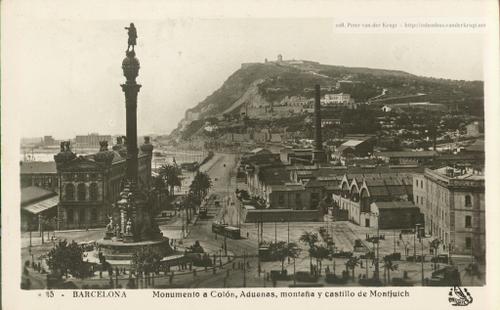
“What goes on behind the scenes of the beautiful game is rarely beautiful. Often, the experience of watching a beautfiul goal or combination on the pitch requires forgetting the transfer-gossip nonsense and arglebargles that allowed it to happen, or at least thinking that they are substantively less important to our experience of a match than they may actually be. For a popular example of this kind of thinking, just read Eduardo Galeano’s Soccer in Sun and Shadow, which suggests that breathtaking goals and legendary players are timeless components of the sport, whereas money and sponsorships unnecessarily pollute what happens on the pitch. In Galeano’s view—and in the mind of many soccer fans—the game itself is pure, but all that surrounds it corrupts our communion with the soul within.” (Run of Play)

“Last week’s Match of the Day 2 closed with a montage of scenes of sickening violence involving Joey Barton during Newcastle’s draw at Molineux. The novelty is that Barton featured as the victim of assorted crunching, scything and slamming, as Wolves’ enforcers targeted him on seven separate occasions.” (Run of Play)
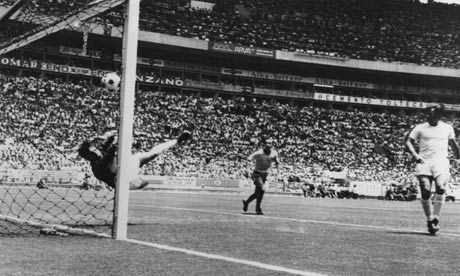
“The end of my years as a teenager is approaching, which means I am soon to leave behind my life’s last opportunity to believe that I know everything. Already I can feel uncertainty slipping into parts of my mind that were once ironclad, airtight. “Is America really the best country on earth?” I ask myself. “Is there any substantive evidence to suggest that my 8th grade Social Studies teacher is the devil?” The perfect life I designed for myself seems increasingly unlikely by the day.” (Run of Play)
Pelé in Brazil
“When I asked to interview Pablo and Dennis about Pelé they both responded with furrowed brows. Neither one liked Pelé, they explained. Pablo called him an idiot. ‘Perfect!’ I said. I chose Dennis and Pablo because they are both Brazilian. That’s it. Just being Brazilian may not seem like much to go on, but it’s a start. If we are really going to figure this Pelé thing out, we need to explore as many perspectives as possible. This is the perspective of two regular dudes that happen to be from Brazil.” (Run of Play)
“The 1950 FIFA World Cup was the first since 1938, mostly because of an intercontinental dust-up commonly known as World War II. Brazil was selected to host the tournament on the back of a third-place performance in the previous World Cup, and it was eagerly anticipated by the newly democratic country, which was looking to establish itself as a global power, in football and otherwise. The mayor of Rio de Janeiro was able to push forward construction His Socks Are Flagsof a controversial stadium named after the Maracanã neighbourhood, opening it about a week before the World Cup began.” (Run of Play)
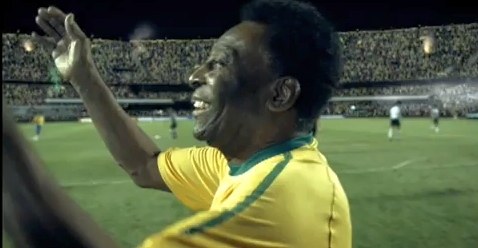
“At the end of the episode entitled ‘Brazil’ in the excellent documentary series The History of Football, Pelé offers the interviewer a few comments on his own footballing genius. He declares that just as there can only ever be one Michaelangelo and one Beethoven, so can there only ever be one Pelé. Why? Because, he says in Portuguese, “my father is a closed shop.” When the female interviewer fails to laugh, he repeats his words in English, and adds a snipping motion with his finger. ‘Do you understand?’ he says, now staring at the camera with his world famous grin. ‘My father is a closed machine.'” (Run of Play)
Pelé v. the Animals
“Why do you watch ESPN instead of Animal Planet? Cute uniforms aside, bears are stronger, giraffes are faster, and kangaroos can jump much higher. Why watch a species that struggles to lift over 300 pounds or run a mile in under four minutes? More intriguingly, how did such a feeble runt of a species come to rule the planet? Luckily, two classic moments from Pelé provide answers.” (Run of Play)
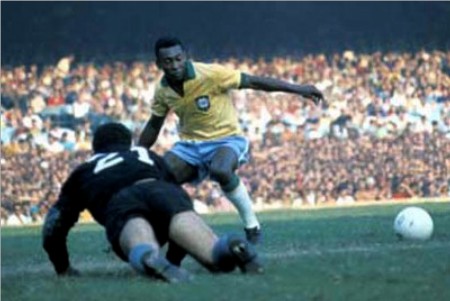
“I owned a football encyclopaedia as a child, dating from around 1980 and now sadly lost, in which Jimmy Greaves rates the top ten footballers of all time. Pelé is number two. Greaves notes that he can’t be considered the best ever, because he was never tested in the English League, the toughest competition in the world. So George Best gets the accolade instead.” (Run of Play)
“When People Who Don’t Like Football ask me why I do, I invariably answer: ‘You know Pelé? Well, it’s not because of him.’ Then I launch straight into the tragic story that is Garrincha’s life. I explain how he was Pelé’s direct opposite in so many ways. I’ve gotten pretty good at telling that story over the years. I try to make the game tangible for those poor lost souls. Lots of passion. Lots of Alegria do povo.” (Run of Play)
“Over Brian’s last few posts about Pelé, we—RoP’s community of contributors/commenters and readers—have advanced the notion that history punishes perfection by consigning it to irrelevance. Perfection is so unrelatable that it becomes ahistorical. It supersedes the ordinary to such an extent that it isn’t even extraordinary: it simply doesn’t belong in any category of our own experience. We have so little truck with it that we forget to adapt it for the generations that will follow us.” (Run of Play)
“Science fiction and fantasy author Michael Moorcock has written an enormous sequence of novels about the Eternal Champion, the same hero reborn in dozens of different persons. Whether the Eternal Champion is named Elric of Melniboné, Oswald Bastable or Ulrich von Bek, he is always first and foremost the Eternal Champion. The particularities of each champion’s life and personality are different, but their role is the same every time, to restore balance to an off-kilter world.” (Run of Play)
“By 1977, the disco starship of the NASL had already blasted off pretty far into its groovy cartoon orbit—that was the year the New York Cosmos dropped the ‘New York’ from their name. It was a league of John Oates mustaches—half the players looked like mellow plumbers—and haystack man-perms, a green festivity of daffy-eyed showmen in 100% cotton shorts. Pelé was in his third season with the Cosmos, deep in his ‘Black Pearl’ phase and now officially representing not only Studio 54 and Andy Warhol’s eight bzillionth Factory, but the glittering expanse of all creation, everywhere: Henry Kissinger went to his games. Pelé had been the MVP of the league the season before, but he was 36 and now he was going to retire.” (Run of Play)
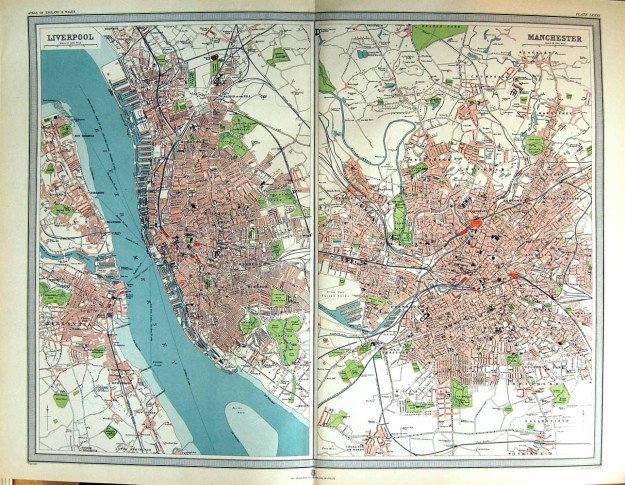
“From the perspective of someone who’s barely been paying attention, one of the more intriguing stories of the offseason has been the weird swerving of the Liverpool crisis-drama, which is still producing twists well into its 24th act. Just when you think the action is about to go stale (with trembling hand, Martin Broughton places a phone call to the Royal Bank of Scotland), they go and follow up the not-one-hundred-percent-intuitive Roy Hodgson hiring by signing Joe Cole, thereby forcing you to realize that, waltzing Elizabeth, the dominant cultural influence in the Anfield locker room next season is going to be…English.” (Run of Play)
“On a typical weekday, the English soccer press devotes itself to unsubstantiated rumors, manufactured scandals, and bikini pictures of players’ girlfriends (who seem to roam the earth together in a giant conjugal yacht, like the Beatles in Yellow Submarine). This week, however, thanks to an ingenious hoax that took in the Times of London, the soccer press has been engrossed by Moldova. Specifically by one Moldovan teenager, who is not, as it happens, a real person.” (Slate – Brian Phillips)
“I read an article this morning about how to build an audience on the internet. People on the internet, it said, don’t want a lot of fancy explanations and preambles. They just want to get in, get the information, and get out. People on the internet don’t need to know why you’re introducing something in a certain way, or where you’re thinking about going with it. They just want facts.” (Run of Play)

“Someone wrote on Twitter yesterday that “Is Spain boring?” is the new “Will soccer ever make it in America?” And yes, it is, in the same way that it’s the new “Can Lampard and Gerrard play in the same midfield?” and possibly the new “Can Asians think?” It wants a word, nevertheless, if only because Spain-Germany was so divisive; and because this is the World Cup final, and a bubble of resentment against the pre-tournament favorites and anointed Best Team on Earth is one of the conditions in which history’s about to happen.” (Run of Play)
“During the quarterfinal between Uruguay and Ghana, maybe a little bit before it started, I had a somewhat startling realization. I didn’t care if Ghana won. I was aware that I should want Ghana to win, and that was fine, but it didn’t really resonate with me emotionally. In the next day’s match between Spain and Paraguay, I could sense a very real antipathy towards the Albirroja. As if they were somehow disturbing the natural order of things by holding Spain goalless for the balance of the match. This has led me to believe that, horror of horrors, I don’t really like an underdog.” (Run of Play)

Giovanni Battista Di Jacopo, Pieta
“‘What does it take to win the World Cup?’ asked Henry D Fetter of The Atlantic a couple of days ago, in a post called ‘What It Takes To Win The World Cup’.” (Pitch Invasion)
Özil the German
“No player has fascinated me more at the World Cup than Mesut Özil. He has the languid self-assurance on the ball that comes only to the greatest footballers. Where others are hurried, he has time. He conjures space with a shrug. His left foot can, with equal ease, caress a pass or unleash a shot.” (NYT)
Tap-in and Taboo
“If this happens, what will people say about Bryan Thomas (on Twitter, in newspapers, on comment threads)? Will anyone say that he has violated the ethics of the game, that he deserves further punishment? Will anyone argue that the rules of the game need to be changed so that teams cannot benefit from committing a penalty? I suspect, rather, that Thomas will be generally credited with a very smart play. How is what Luis Suárez did at the end of yesterday’s match against Ghana any different?” (Run of Play)
when i get older
“Brian at the Run of Play did a very good job crushing the idea floated in The Atlantic that countries with an authoritarian history play more winning football. The idea memed, nonetheless. (Shocked that highbrow soccer dorks — my favourite phrase this World Cup, used by TNR Goalpost to describe their ideal reader base) appear not to check RoP before coffee.) Laughable, snobbish solipsism — it’s not just for FIFA anymore, kids.” (Treasons, Statagems & Spoils)
Time Can Do So Much
“What I want to know is whether we’ll remember any of this in ten years, or if we’ll look back on it as the mass blackout during which we all wrote mystic texts. I can’t remember two more deranged or thrilling days of soccer, or four more shocking games, in any recent tournament, and Euro 2008 made me compare Aphrodite to a Toyota Prius. It was all the more stunning because it came out of nowhere—that’s not to say this World Cup had been boring, but it had rolled along at a pretty regular tempo and, apart from a few moments of madness and bliss, within a fairly livable emotional band.” (Run of Play)
“Here’s how: Win the World Cup final. If you think that’s a simplification, please browse this more extensive version: 1) Qualify for the World Cup; 2) Successfully reach the World Cup final; 3) Win it. Everyone with a calculator is busy reverse-engineering reality to come up with the formula that explains what it really takes—you know, once you peel away the thin scrim of data represented by an actual game and take a Freakonomic, Don DeLilloish look into the depths behind it. But winning the game is what it really takes.” (Run of Play)

Lionel Messi
“Epistemic frustration is the curse and the genius of soccer, which, compared to, say, basketball, obscures causes, disguises responsibilities, and makes all forms of knowing and categorizing moot. Not in a radically skeptical way, but just in terms of guys kicking stuff, I sometimes wonder whether it’s possible to know anything at all.” (Run of Play)
“Jonathan Wilson says that his fine new book The Anatomy of England: A History in Ten Matches has no thesis, but I believe a thesis is lodged within, though perhaps it can’t be expressed in a single sentence. The book’s implicit argument goes something like this…” (Run of Play)
“Five minutes after it happened, Twitter was still in flames, cars were honking, bars were shaking like there’d been an earthquake, ESPN was breaking down in tears. If you spoke Spanish, or were my dad, there was a good chance you’d just heard this. Yahoo! Sports was crashing. My dad, who’s not really a soccer fan, was stuck in the car, couldn’t find the game on English-language radio, and spent 90 minutes trying to follow the Spanish commentary; he called me after the match to find out if what he thought had happened was real. But that was how everyone felt. It’s scary to think how things might have looked if anyone here cared about soccer.” (Run of Play)
“Nothing is funnier than this article, but nothing is faster than this tournament, even if it seems to roll at a regal pace. If you stop to rest, or write a post about John Terry’s failed career as the seditious leader of a crushed splinter sect, two more matches blow past, the tortoise wins the championship, and the only rock with your name on it is covered with vines forever. We have to move with the times. If John Terry’s failed career as the seditious leader of a crushed splinter sect tells us anything, it’s that.” (Run of Play)

“Alex Massie is a smart and fair-minded man, but in this case he is wrong—at least, by the standards he lays out. Alex argues, drawing on this post by Simon Haydon, that because Carlos Bocanegra did indeed foul Nejc Pečnik on Landon Donovan’s 86th-minute cross into the Slovenian box, referee Koman Coulibaly was indeed warranted—or at least not unwarranted—in making the call he made.” (Run of Play)
“hat do we mean when we say a referee’s decision is “harsh”? In talk about soccer it’s a term of art, having shades of meaning it lacks in other contexts. Consider the red card Australia’s Harry Kewell got in Saturday’s match against Ghana. On ESPN’s halftime show, Ruud Gullit and Roberto Martinez debated it. “It is a red card,” Gullit said, “he stopped it with his hand.” (Not true, actually: it was his upper arm, which was nearly pinned to his side. But I digress.) Martinez didn’t simply disagree with Gullit, but said that he thought the red card was “harsh’.” (Run of Play)
“The France crisis was visible from space for weeks before it hit, like a blot on a map churning its way toward some helpless island port. Weather services beeped out bulletins; brave teams of scientists piled in a helicopter and flew toward the raging edge. Rain shredding the surface of the sea told the world that William Gallas was never going to survive a dune-buggy crash so that Patrice Evra could lead his men in peace.” (Run of Play)
“The World Cup is an experience. The sport is exciting, but it’s much more than that. A game is a narrative arc, fulfilling itself in an ending we all see coming. Cascading, pitching, reaching plateaus at completely obvious and utterly unexpected times. It is an arc only in the sense that before the game, there’s nothing but the promise of something. Moments of excitement—whether plentiful or scarce—pitch the game’s progression upward. Then once the 90 minutes are up, the arc once again comes to rest. Draw or not, there is some sort of resolution.” (Run of Play)

“One of the hard things about forming an outlook on the World Cup is that when an event gets this much attention, the flow of commentary is so fast and broad that every possible angle is exhausted and trivial positions develop a kind of insubstantial politics. Conventional wisdom starts to seem like an ideology, and if you’re not careful, your own feelings about what happens will be dictated by where you want to stand in relation to that ideology rather than by what you actually think. There’s a pundit position, a cognoscenti backlash, an uber-cognoscenti counter-backlash, and so on till after midnight. Your heart and the stadium get farther and farther apart.” (Run of Play)
“I made certain vows and promises in the days before this started respecting things I wouldn’t touch, and I can’t break them now. So if it feels like something’s missing from this argument, it’s only that I’m trying to save my soul. You can fill in those blanks better than I could, anyway.” (Run of Play)
“Tim Howard may be Jesus’s desktop, but pride kills progress. You can’t claim honest rivalry on one end and moral victory on the other, especially if you went to the game as a knowing participant in a fury of modern hype. Not even Manchester City does that. So for the sake of self-respect, or whatever the equivalent is when you’re writing about hope and strangers, it has to be acknowledged: our guys missed chances that didn’t want to be missed (Altidore missed one in each half), gave up a goal that didn’t want to be scored, defended clumsily at times, and got pinned back in their own territory for far too much of the second half.” (Run of Play)
“When I heard the news of the broken arm, the confession to Kolo Touré, the ‘for him, he said, the World Cup is finished,’ I did not know what to do. I sat down. I was so flustered that even my thoughts stuttered a little. ‘It’s, it’s n-n-not f-fair’ I thought. This was his World Cup. Even though ESPN is force-feeding Messi to the American public, Didier Drogba was the real face of the tournament. He wasn’t just playing for his country, he was playing for all of Africa; that’s what he’d said. Now the Ivory Coast’s chances were dashed and their matchup with Brazil in the group stage had gone from the most exciting game of the first round to another stepping stone on the seleção’s path to #6. This turn of events was tragic.” (Run of Play)

“The favors I owe Brian Phillips are beginning to stack up. First, he wrote an excellent piece comparing FIFA and FIBA for my blog, 48 Minutes of Hell. Now he has taken time out of his busy schedule to answer a few questions about Brooklyn Asylum F.C., a serial novel about American soccer in the 1920s he is steadily publishing at his site the Run Of Play. If you’re new to the Run Of Play, it’s a bit like getting drunk with Lionel Messi in a bookstore in Nuevo Laredo, only to wake up, roll over, and say, ‘Oh my God, I wasn’t dreaming. That’s Lionel Messi. And he’s wearing nothing but briefs.'” (Norman Einstein’s), (Must Read Soccer)
“Rumor is abroad throughout the Western Kingdoms. Men whisper of trouble in the East, of death upon the great roads, of armies massing for war. It is even said that the worm Drakorath, the dragon of the Rivening, has awakened in the Valley of Bal-Sharom and been seen in the skies over the villages to the south. But fear not, brave warden of the flame. Hope yet survives in the Kingdoms. Wayne Rooney has a 20-sided die.” (Run of Play)
“Kevin Durant is 6′9” and lanky, with a 7′4” wingspan. In a sport where length is all-important, Durant is as long as they come. Lionel Messi, 5′7” with a low center of gravity, is as nimble with the ball at his feet as anyone in the world. Durant has cited his mother and brother as his role models. Messi learned soccer from his father, a coach in Argentina when he was young. Both are modest, say all the right things to the media, and lead unflashy lives. Both seem to accept their success without being absorbed into it, using the love for their respective sports to keep them grounded. Messi has a reputation for shyness, while Durant, though soft-spoken, actively connects with his fans over Twitter. The two might not look it, but they’re very similar athletes, and you can learn a lot by looking at one through the lens of the other.” (Run of Play)
“And so the 2010 Champions League Final raised its skinny arms up over its head, arched its little back, and dove into the waters of ‘a thing that happened,’ where it slipped in without making a splash. I mean no bitterness toward the participants when I say that, unless you were an Inter fan or could name more than four players on Bayern’s team, this was not an event that sent you scurrying to your secret dictionary. Mourinho’s teams have a way of making their victories look tautological—they perform actions from which winning results, therefore they win—and this one was even more programmatically straightforward than most, a lot of patient defending combined with two inspired stabs from Milito. Bayern should have scored, but they didn’t, and therefore Inter performed the actions that ensured they never would. Mourinho keeps doing it, as Andy Gray twice purred. Code is poetry, except that it totally isn’t.” (Run of Play)
“The day of the Champions League final is, as they say, finally upon us, which means it’s time for a couple of announcements in the way-of-the-future vein. Like, what are we going to do about it, and what to expect for this little festival of truces they’ve got set up in South Africa this summer.” (Run of Play)

“It’s something I think murderers struggle with; there are defining acts. It’s possible to do something that becomes more you than you are. I have no idea whether you live in the Middle Ages, but if you do, and you buy an indulgence, can you ever stop being the guy who bought an indulgence? You had twenty florins, and you thought they were the same as your soul. That’s a forever-type deal, as a priest once said to me. Now, maybe the world is a vale of soul-making, and maybe you’d like that to mean that you’re always freely forging your identity. But at some point, if you do a thing finally enough, it means your soul is already made.” (Run of Play)
“I often wonder about human potential. We know that young people learn fast both cognitively and viscerally. It’s as if everything has been juiced for children’s easy consumption while we grownups have to eat things raw.” (Run of Play)
“‘Salzach had never been right”: this was the widespread agreement in Brooklyn, not only in the hours after the catastrophe but in the days and weeks after it. And in this case the consensus was correct, for when the authorities supervising his case sent back to Europe in an effort to turn up his relations, they unearthed to their astonishment a family of ferocious German dukes, who explained—not personally, of course—that Salzach was in fact the fourth male issue of a creature called the Baron von Salzach, from whose house he had disappeared nine years ago, defeating all his family’s subsequent efforts to find him and restore him to his birthright.” (Run of Play)
“It happened in the early years of the City of Brooklyn that a man called Salzach, a German of Bavarian descent, lost his mind. He was ripping apart old sacks in the yard behind the hostelry when it happened. The innkeeper, who glanced out from the kitchen window a few minutes later, was alarmed to see him shaking his fist and furiously addressing a cat that was sunning itself on the tree stump. Brooklyn Asylum postcard, 1893. Evidently harboring some inkling of suspicion against Herr Salzach already, the innkeeper wasted no time in dispatching the Irish boy, Michael, to the police.” (Run of Play)

“The crux of the problem is the Hand of God goal and whether, if you could, you would go back in time and stop the referee from awarding it. This is where you confess to the moon that you view the sport a certain way and that you think of it as a game or a story. I think of it as a story, which is why I wouldn’t change anything about the Hand of God goal even if I had control of all dimensions. But it’s easy to understand both viewpoints.” (Run of Play)
“It happens every few months, like the change of seasons or the media’s en masse attempt to wring some fresh significance out of Sarah Palin: a referee misses an important call, a fan base is outraged, a UEFA executive looks on in silence, and lights flare to life over the metaphoric phone banks at the metaphoric talk-radio stations that, in the imaginations of writers, suggest a groundswell of popular interest. One minute Thierry Henry practices saxophone fingerings on the ball and stops Ireland from reaching the World Cup, the next Didier Drogba whaps like a volleyball player and helps secure the title for Chelsea (twice, actually, if you remember Man City 2006).” (Run of Play)
“Took at this place. Do these look like the living quarters of a criminal mastermind? “A devious architect,” they allege, “who builds his creations for the sole purpose of destroying what is beautiful, what is cherished.” I understand the role I play—that is, the role they have me play. It’s a business, like anything else: of course I know this. It’s just not fair. It isn’t fair that I have to build my own life, my real life, to confirm my existence as I want it to be, not as it has been manufactured by those who disseminate information to the masses.” (Run of Play)
“Every time I write on this subject, self-doubt creeps in. Barcelona’s possession game has seeped into the soccer inteligentista social network, forever altering its philosophical foundations and how we view the “beautiful” game. Every time a defender passes to a goalie, we don’t roar with cheers, but rather applaud quietly in a Starbucks while sipping on a latte and flipping through the Guardian. And if the goalie passes to a defender?” (Run of Play)
“And it was about time, too. I mean, don’t get me wrong. Honduras is an amazing country is I can do footnotes on here now. A person is about to spread his wings. with a proud people who have stood firm through decades of hardship. I am not denying that. And they completely took me in and helped me lay low when that international criminal ring was trying to kill me. That is a given, for real. Much credit for that, Honduras.” (Run of Play)
“There’s so much talk about Barcelona’s style of play in large part because it’s just that: a style. And styles are not easy to come by in soccer. The term can mislead, because it suggests mere aesthetics, how a team looks. But a genuine style is more than that. Just as a poet’s style is not just a few habits of sound-making but a whole way of organizing experience and language, a coherent strategy for marshaling forces of thought and feeling and then deploying them, a soccer style is a complete approach to the game.” (Run of Play)
 Scissors Kick