“BBC Sport’s fourth Price of Football study prompted a national debate about ticket prices, not to mention the sums clubs charge for pies and cups of tea. Football club owners, players, pundits and fans all had their say, but what did we learn? Here, we take a look at some of the key talking points.” BBC
Tag Archives: England
Six recent things I’ve done for other people
“Here is a quick list of six recent articles I’ve had published elsewhere. From the language of football to the First World War, with a healthy dose of Southampton and some very personal, gonzo-style pieces for a new and brilliant site based in Ireland. I will be contributing more ‘flash features’ to The Upright, largely because I enjoy doing them and I really admire the bold editorial stance taken by the site, allowing people to write personal, reflective pieces that are not your standard sort of sports writing (but maybe should be more widely represented?). The False Nine piece is part of a series I want to develop for them, looking irreverently at the use of language in football.” Put Niels In Goal
Wayne Rooney can take England’s goals record but not the glory of his predecessors
“The Sir Bobby Charlton suite is the most luxurious room in the hotel currently occupied by England at St George’s Park albeit hardly the Ritz. The Gary Lineker pitch (No 11) is, contrary to expectation, more than two six-yard boxes. Yet nowhere at England’s training base is there any room or pitch named in tribute to Jimmy Greaves, the distinguished international lying third behind Lineker and Charlton as his country’s all-time goalscorer. Greaves’s photograph does hang alongside those of Lineker and Charlton on the walls of the corridors that Wayne Rooney will walk along on this morning, heading off out to Pitch 6, the main England practice area. Rooney will soon pass the fabled trio in the record books as well as the corridor, starting with Greaves possibly this week. His elevation will stir sadness as well as admiration. Rooney can equal the maths but not the history.” Telegraph . Henry Winter
Maracana Upset Brings Robson Breathing Space
“If you can meet with triumph and disaster and treat those two imposters just the same… A Kipling today might have been tempted to add: You’ll be a successful football manager. For his words possess a sympathetic ring for England boss Bobby Robson. He took his battered, depleted England squad off to South America under round condemnation for the manner — rather than the size — of a 2-0 Wembley defeat by the Soviet Union. He returned with a balanced record of three games played, one won, one drawn and one lost. Respectable by any light. Doubly so in general, international opinion because of that 2-0 victory over Brazil in Rio de Janeiro. Yet critical echoes accompanied Robson and Co on the long flight home from Santiago because the ensuing displays and results against Uruguay and a dismal Chilean Olympic team didn’t match up to the expectations raised in Maracana.” In Bed With Maradona
The Oldest Footballer in England
“Meet Dickie Borthwick. He’s approaching 79, and still plays football. Beyond the immediate desire to want to kick around with him, this short film by Alex Knowles & James Callum focuses on a man who has been fortunate enough to share his whole life with the game. They made the film with the intent to dispel the myth that ‘old people are past it’ and instead introduce us to inspirational people with invaluable insight, exceptional passion, a never-ending supply of wonderful stories and a thirst for life that refuses to fade.” A Football Report (Video)
Brazil is having its ‘England’ moment
“This year was not the first time that England flopped in a World Cup in Brazil. The fall was even harder in 1950, when making its debut in the competition, England also failed to make it out of the group stage, this time going down 1-0 to United States, still one of the most remarkable results in World Cup history. Great winger Stanley Matthews was not selected for that game, and watched horrified from the stands. He was much more impressed by a trip to the newly built Maracana stadium to watch the hosts in action.” The World Game – Tim Vickery
Supporting Coventry City: An Emotional Investment
“The more out of hand the marriage between the Premier League and Sky has become, the more I’ve followed Manchester United, Liverpool, Chelsea et al with an acute sense of alienation. I’m captivated by Premier League football, but it feels distant and remote. If money is limitless and winning every game is a basic expectation, where, as a supporter, do you find joy and exultation? It all seems so routine, the hype machine so hollow and formulaic. I don’t believe in a hierarchy of fandom, but increasingly I feel that those of us following football outside of the Premier League’s top six or seven operate in a separate sphere, where a degree of perspective remains and regularly visiting football stadiums is still viable.” The Inside Left (Video)
Can Jack Wilshere profit for England where Gerrard and Henderson lost?

“There is an unhelpful idealism about international football, or at least about the way England approach international football. Everybody has their favourite to promote, the key creator who cannot be left out, the grand scheme that will secure success, and the result is often a terrible mish-mash – a team designed, if not by committee, then certainly with so many voices at play that a manager’s thinking can become clouded.” Guardian – Jonathan Wilson
Roy of the Rovers celebrates 60 years – football’s comic-book role model
“It is a phrase embedded in the game’s vernacular, a character from a bygone age and a team that, somehow, overcame the odds on a weekly basis. Sixty years ago Roy of the Rovers was first published as a comic strip – six decades since Roy Race’s golden locks and debonair charm first enraptured youngsters and adults alike to evoke dreams of glory and unlikely tales of sporting bravura. … Say the words Roy Race and Melchester Rovers to someone of a certain generation and the eyes mist up, a reflective pause follows before a wistful smile. To many those names represent childhood, escapism and sheer joy – the weekly ritual of buying a comic, reading in rapid time before poring over the same pages again and again until the next edition hit the shelves.” Guardian, Guardian: Roy of the Rovers and other classic comics return to newsstands
Wayne Rooney looks a source of slight sadness as his powers desert him
“Top-level footballers often tend to generate a very specific kind of emotion. In happier times this is a simple sense of joy at seeing them capering about in pursuit of a ball. Dwight Yorke for example – even in the later years when you half expected to look down and notice he was out there running around in a leotard and a pair of plimsolls – always managed to make the basic act of playing football seem unavoidably hilarious. Similarly, the sight of David Beckham scurrying about in an England shirt like a doomed, faithful cartoon horse tended to inspire above all a desire to burst into brave, hot husky tears of moon-faced joy.” Guardian
Idiot Ruins Game? Brief Interviews With Not-So-Hideous Pitch Invaders
“When you see someone running on the field during a sporting event, you probably think, That will never be me. Announcers shake their heads so vigorously it produces an audible rustling of their collars. The word ‘idiot’ gets tossed around a lot — ‘idiot on the field’ is often the phrase of choice. In fact, the Great American Idiot, Homer Simpson, ran onto the field once: The headline read ‘Idiot Ruins Game.’ It seems like there have been a lot of these idiots recently. There was Jordan Dunn, the man who took the free kick in West Ham’s opening match against Tottenham.” Grantland (Video)
The Racist, Homophobic, Xenophobic Text-Message Scandal Rocking English Football
“A few days ago, the contents of two letters sent to the English Football Association — detailing offensive text messages between Malcolm ‘Malky’ Mackay and Crystal Palace executive Iain Moody — hit the news. The inflammatory nature of the texts throws Crystal Palace’s already rocky season into a chaotic jumble and threatens the future employment prospects of Mackay and Moody. It is a ragged and roiling shit show. So, let’s talk about it.” Grantland
Match of the Day: 50 years of broadcasting celebration

Match of the Day’s five main presenters from 1964 to the present day
“The BBC will celebrate 50 years of its iconic football television show Match of the Day with a special programme on Friday at 22:35 BST on BBC One. Packed with classic archive material, it charts the evolution of football’s most famous programme and features new contributions from a host of footballing glitterati, including Jose Mourinho, Ryan Giggs, Thierry Henry, Gary Lineker, Wayne Rooney, Des Lynam and Alan Hansen. As part of the celebrations, legendary commentator Barry Davies will make a one-off special return for the Crystal Palace v West Ham match.” BBC
Premier League Preview: What now for Southampton after mass exodus?
“There is a danger that Southampton will come to stand as a fable for modern football: this is what happens if you dare to dream. Fly too close to the sun, start talking – even in private as Nicola Cortese, the former executive chairman apparently did – of qualifying for the Champions League, and your best players will be plucked away, leaving you to plummet to earth. Perhaps the money Southampton has raised from its summer of sales will be wisely reinvested, perhaps in five years the sense of panic this offseason has induced will seem absurd, but even if that is the case, there is a horrible feeling of loss. Clubs have held fire sales in the past, of course, offloading players to stay afloat after relegation, the departure of a sugar daddy or some other financial catastrophe.” SI
When the Circus Came To Nottingham
“We all remember where we were when the circus came to town. That is, when Sven-Göran Eriksson came to Notts County, his long Swedish overcoat swishing through the corridors of Meadow Lane, lured by the promise of cash that was never actually there. I was at a pre-season friendly in Arnold as Notts beat a local non-league team 7-0, with Chinese whispers buzzing around the huge crowd that stood below a beautiful summer sunset. The strangest month of our lives was becoming even more of an intoxicating dream. A few weeks earlier I’d become the editor of Notts County Mad, a club website and messageboard that held the same quirkiness of any other lower league forum. I wasn’t up to much, having spent the previous few months largely asleep after quitting sixth form because they seemed to expect that I might actually do the odd piece of work. When the former editor offered me the chance to take on the role I was pretty grateful for just having something to whittle away the hours.” In Bed With Maradina
The Premier League is back and so is its race problem
“Football in England has a race problem. And it’s not the one you’re probably thinking of. The recent high profile cases involving racial abuse on the pitch by Luis Suarez and John Terry were disturbing, and not handled impressively by the English FA and Premier League authorities, but such incidents are notable largely by their rarity. In the stands, there has been no replication of the vile behavior of some supporters in Italy and Spain that have led to stadium closures and (paltry) fines for racist chanting. English football’s race problem is in the dugout.” Fusion
Soccer in Oblivion
“The first cylinders of German chlorine gas were released on Allied soldiers during the Second Battle of Ypres, in northwestern Belgium, on April 22, 1915. The soldiers were Algerian and Moroccan, colonial forces fighting for France. The Germans — this is how sophisticated chemical weapons were in the first year of World War I — used the wind as their delivery mechanism; they simply opened several thousand containers of the poison and let the breeze convey it toward the enemy. When combined with water, chlorine gas turns to acid. If you inhale it, first you smell pineapple, then your lungs burn away from the inside. If it gets in your eyes — well, you can imagine. It’s heavier than air, so at Ypres a dense yellow fog of it settled in the French trenches. The soldiers crawled out onto the field to escape the gas. The field was being strafed with German machine gun fire.” Grantland
Sami Hyypia: ‘If you are tough that doesn’t mean you can’t play football’
“‘When you move somewhere it is important you get to know the area,’ Sami Hyypia says as he confirms that he recently visited the Lord Nelson Inn, a pub located near Brighton’s North Laine area renowned for serving locally brewed real ale. He was spotted there by a group of the town’s sports reporters and the hope for Hyypia is that they will largely be writing good things about him in the coming months. Appointed Brighton manager on a three-year contract in June, the spotlight well and truly falls on the towering, blond Finn on Saturday when his side take on Sheffield Wednesday at the Amex Stadium.” Guardian
World War One: Sporting stories of bravery recalled 100 years on

Heart of Midlothian started the 1914-1915 season with a 2-0 victory over Celtic after giving their all.
“They were the sporting stars of yesteryear. Captains, team-mates, local heroes. Many of them went from the playing field to the battlefields of World War One, never to return. Monday marks the 100th anniversary of Britain’s declaration of war on Germany. It was at 23:00 on 4 August 1914 that Britain entered into one of the costliest conflicts in history, and the fighting continued until 11 November 1918. Here, BBC Sport recalls some notable stories – from whole teams who joined the armed forces to a modern-day international inspired by his ancestors’ wartime deeds.” BBC
Hearts, the team that went to war for Britain
“On 4 August 1914, Britain declared war on Germany. Eleven days later a full house at Tynecastle cheered Heart of Midlothian to victory over Celtic, the defending champions beaten by the young pretenders of the Scottish game. War seemed a long way off on that summer’s afternoon; somewhere for a foreign field, not the football field.” Independent
World Cup 2014: Tony Pulis – a Premier League manager in Brazil

“From watching how teams trained to seeing how they set up tactically, I learned a lot from my time in Brazil and it was a trip I will never forget. Plenty of players caught my eye too, although I did not go to the World Cup expecting to discover any amazing new talents. There just aren’t any unknown gems at major tournaments anymore. There were still some players I liked there that I didn’t know a lot about, however. For example, the Dutch side did well with a lot of young players who are still based in the Netherlands, which is not always the case with their international team. And there were players from some of the South American sides who are based in Spain who impressed me too.” BBC
Exeter City return to Brazil one hundred years after special trip
“It almost seems unthinkable that a century of samba football was borne out of a bunch of Devon boys, a misjudged skinny dip and a pair of knocked-out teeth. How Exeter City, who finished just five points outside the League Two relegation places in 2014, helped form the first ever Brazilian side is little known, to those in both South America or south-west England. But it all happened when, en route home from their 1914 pre-season tour of Argentina, the Grecians stopped off in Brazil, after Nottingham Forest and Southampton turned down requests to make the trip.” BBC
World Cup 2014: How might England line up for Russia 2018?
“As the World Cup drew to its conclusion amid the colour and splendour of the Maracana in Rio, England’s brief and undistinguished contribution to Brazil’s World Cup did not even merit a footnote. Blink and you would have missed them. Months of preparation amounted to defeats by Italy and Uruguay in the space of six days before England manager Roy Hodgson and his squad were making the plans for the flight home. When the story of Brazil 2014 is told, it will be a tale of ambitious attacking football, Luis Suarez’s bite and the World Cup semi-final carnage inflicted on the host in a 7-1 loss to Germany that will be revisited as long as the tournament is staged. England? Move along. Nothing to see here.” BBC
Group D – ESPN
If the English Premier League is the Best in the World, Why do the Three Lions Crash and Burn?
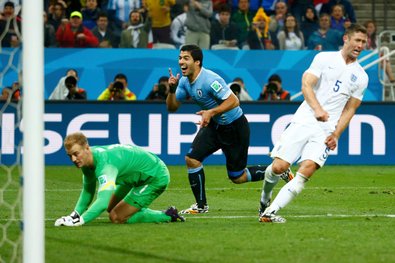
“Did Luis Suarez surprise England? Apart from killing them? It’s hardly feasible that Glen Johnson, Steven Gerrard, Jordan Henderson, Daniel Sturridge or Raheem Sterling could say they’d never seen anything like that before. They’d all played through a season at Liverpool with Suarez in which he scored 31 goals in 33 games and won just about every award anyone could invent. And never bit into more than a burger. No, Suarez wasn’t a shock. The England team knew Luis was going to be murder, insolent, and laughing in their faces. There’s no one they’d seen more likely to carry an injury into a big game and be the decider. At the end of the devastating 2-1 defeat by Uruguay, Luis went up to Steven Gerrard and gave him a hug, kind words and not so much as a nibble. They’re chums, you see.” New Republic
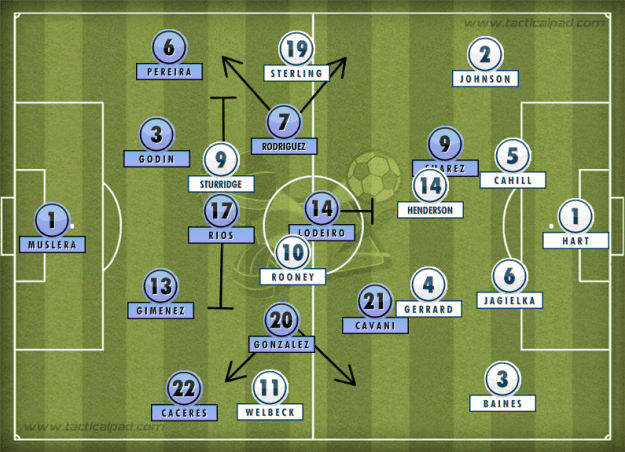
World Cup Tactical Analysis: Uruguay 2-1 England

“In a World Cup where England lacked expectations heading to the tournament, they somehow still managed to disappoint. After a lot of positivity in defeat against Italy, England were expected to carry on and impress vs Uruguay but put in a lackluster performance Uruguay on the other hand also came into the game in disappointment after defeat and were expected to do the same, but encouraged by the returning Luis Suarez. The striker struck twice to keep Uruguay’s hopes alive, all but ending that of their opponents.” Outside of the Boot
World Cup Tactical Analysis: Cameroon 0 – 4 Croatia
“With both teams losing their first group game, this was a real test for both Cameroon and Croatia, where one side would be leaving the tournament if they succumbed to yet another defeat. Croatia had a slight advantage with Eto’o being out injured; as well as the return of their main striker, Bayern Munich’s Mario Mandžukić, who missed out against Brazil due to a one match suspension which he earned all the way back in the qualifiers. The game also featured a return of Danijel Pranjić on the left flank for Croatia, and Brazilian-born Sammir playing as a starter right behind Mandžukić instead of young Mateo Kovačić. As for Cameroon, the absence of Eto’o meant Aboubakar of FC Lorient was going in as his replacement, with a few more rotations in the team tactics.” Outside of the Boot
World Cup Tactical Analysis: Colombia 2-1 Ivory Coast
“With the second round of matches underway, groups are beginning to take shape as teams fight for qualification to the knockout stages. In Brasilia, the two teams from Group C that won their opening encounters, Colombia and Ivory Coast, met to see which team would take sole control of the group. Both teams enjoyed contrasting wins in their opening games: Colombia routed Greece 3-0 while Ivory Coast had to come from behind to beat Japan 2-1. With top spot potentially at stake, both teams were determined not to concede early ground, resulting in a deadlocked first half. However, a flurry of goals in a matter of minutes set up an exciting finish.” Outside of the Boot
The Reducer: World Cup Winners and Losers
“Can I interest you in March Madness spiked with second chances? Because that’s what we’ve got on our hands. After a little more than a week of World Cup action, we’ve seen the defending champions go crashing out, the hosts wobble, new stars rise, and established stars cement their place in soccer boot ads for years to come. We’ve seen a German-born defender become an American hero, a Brazilian-born striker be partially blamed for Spain’s early exit, and Mexico’s manager turned into an anime character.” Grantland
Suárez Staggers England With Finesse and Ferocity

“Luis Suárez’s first goal on Thursday was a delicate touch of class, a deft header nodded in with precision and purpose and placement. Suárez’s second goal, however — the one that was a death blow for England — was something closer to a savage blast. The combination was vintage Suárez, a pure attacker who perfectly embodies the Uruguayan notion of garra charrua — that is, a mixture of will, fight and an unyielding desire to win in whatever way is required. On a chilly night at Arena Corinthians, Suárez showed his deliberate jab and then, at just the right moment, his haymaker.” NY Times
England’s vanquished players are left sad, speechless and bewildered
“One by one they stepped blinking into the brightly lit corridor of uncertainty, clasping their wash bags like comfort blankets. Daniel Sturridge, so effervescent and full of life in his pre-match interviews and now displaying an expression somewhere between fury and heartbreak. A red-eyed Wayne Rooney, eyes fixed forward. Jordan Henderson, exposed and overrun in midfield alongside his club team-mate Steven Gerrard, muttering that he had been ‘told not to stop’.” Guardian
At This World Cup, England Fans Get Their Disillusionment in First
“My late friend Alan Watkins, who died four years ago after writing a political column for fifty years, was a Welshman and also wrote learnedly on rugby. In 1996 he was discussing Tony Blair, then the Labour leader of the opposition, a year before he became prime minister. Every rugby fan knows the words of Carwyn James, the great Welsh coach who led the British Lions to a unique victory over New Zealand in 1971. Ahead of what was expected to be an unusually violent series, James told his players to ‘get your retaliation in first.'” New Republic

England’s Dreaming: How These Three Lions Recall the Spirit of Italia ’90
“During a break in the England-Italy match last weekend, there was a TV ad narrated by Gary Oldman. I was struck by how much he reminded me of the modern English footballer (not the first-time-on-a-world-stage ones — the ones they grow up to be). It also made me think of 1990. The 1966 World Cup was English football’s greatest moment, but the 1990 World Cup sparked one of the more stirring debates about national essentialism to take place in England that decade.” Grantland
Heart of Darkness (Lite)
“In 2009, the German director Werner Herzog published Conquest of the Useless, his account of the shooting of his movie Fitzcarraldo in Manaus, Brazil, and the surrounding Amazonian jungle. As a result, he was recently asked by FIFA to return to Manaus and referee the England vs. Italy game to be played there in June. What follows are excerpts from his diary as the game approaches.” 8by8 – Jonathan Wilson
Breaking Down Italy’s First Goal
“Was it Italy’s execution or the result of a small lapse in England’s defending? England started surprisingly well against Italy, but the first goal of the came from a perfectly executed set-piece by the Azzurri. Italy deserves more credit than England does blame. But the English did make two minor mistakes on the play.” Fusion (Video)
Kickoff
“Jonathan Wilson, from London: ‘All the new thinking is about loss. In this it resembles all the old thinking.’ That’s Robert Hass, in the opening of his great poem ‘Meditation at Lagunitas.’ The lines resonate: earlier this week, before departing for the World Cup in Brazil, the U.S. national team coach Jurgen Klinsmann, who is German, asserted, ‘We cannot win the World Cup,’ and it didn’t go down well. At least one pundit suggested that he should ‘get out of America.’” The Paris Review – Jonathan Wilson
Ireland’s best and worst World Cup moments
“The World Cup starts in less than a week and, great and all as it is, some of the shine is taken off the tournament when your own nation isn’t involved. Ireland have only been to three World Cups but managed to create enough memories to last a life time. Here’s a look at the five best and worst moments from 1990, 1994 and 2002.” backpagefootball (Video)
Jonathan Wilson’s All-time Eleven
“The editor of The Blizzard football magazine and author of multiple books about football including, Behind the Curtain, Inverting the Pyramid and Anatomy of England.” Club Med – Jonathan Wilson
2014 Fifa World Cup draw: Guide to Group D

“Gary Lineker’s verdict… Style & formation: As qualifying went on, coach Oscar Tabarez settled on a pragmatic 4-4-2. The industrious Edinson Cavani leads the line, with Luis Suarez given licence to roam. Tabarez, however, is not afraid to switch formations, doing so in away matches and during the Confederations Cup to counteract the opposition, including playing 3-5-2 and 4-3-3. Expect him to vary it up in Brazil.” BBC: Uruguay – England – Costa Rica – Italy
On A Six Pence – football art and readers’ offer!

The Arsenal.
“Here at PNIG, we love football and we love art. As you’ve seen with my piece on Pirlo, my hook-up with the great people at The Illustrated Game, and my recent piece on World Cup photographer Ryu Voelkel, the beatuiful game really can be the beautiful game in the hands of some people.” Put Niels In Goal
England’s performance at Italia 90 World Cup is venerated too much
“Perhaps, given England’s perceived lack of success, it’s only natural that we should hark always back to 1990, that we should be forever trying to recapture what made that tournament so compelling. Yet it is a little odd. It doesn’t take much of an examination of England’s World Cup record to see how fine the margins sometimes are. In the last eight World Cups, England have reached the last eight (in 1982, the second phase comprised four three-team groups; so for the purposes of this stat I’ve counted the teams who finished second in those groups as losing quarter-finalists) on five occasions. Put like that, England’s World Cup record doesn’t sound too bad – in fact, only Brazil and (West) Germany can beat it.” Guardian – Jonathan Wilson
World Cup 2014: England Squad Selector – pick your 23 then compare with our choices
“Ever wanted to be Roy Hodgson? It’s a common condition. His is a life of easy charm, muted bookishness and lovely warm coats. But there’s one unenviable task looming for the England manager ahead of Fifa World Cup 2014 in Brazil, and that’s picking 23 men to make up a squad capable of avoiding humiliation. With Hodgson set to announce his provisional list of players on Monday May 12, we’ve cast the net wide for potential England squad members, from the players who are on the plane barring a late metatarsal injury (Wayne Rooney, Steven Gerrard, Joe Hart), the youngsters who may or may not have done enough to impress (Luke Shaw, Ross Barkley) and the longshots (Rio Ferdinand, John Terry, ideally both at once).” Telegraph – Henry Winter
Tough times for punk football
“For advocates of supporter-ownership, the current standings in League Two will make pretty grim reading. Two of the division’s fan owned clubs, Exeter City and Wycombe Wanderers are in the very heart of the fight to avoid relegation to the Conference, while another two, AFC Wimbledon and Portsmouth have had dismal seasons.” backpagefootball
New league season, same old problems?
“While most football fans from Ireland adopt an illustrious English side to support, their own national league serves as little more than a sideshow. Growing up in Ireland I was never given the choice, so to speak, to support an Irish club as my ‘first team’. Like most Irish football fans, I support Liverpool. Strong cultural and historical links between Liverpool and Ireland make the connection, alongside the fact Liverpool were immensely successful for over 30 years straight, quite easy.” backpagefootball
England renew continent’s oldest football rivalry with visit of Denmark
“England’s friendly against Denmark on Wednesday is not just the much-discussed final audition for players hopeful of forcing their way into Roy Hodgson’s squad for the World Cup, but also another episode in the oldest rivalry in international football – other than those between teams from Britain and Ireland. It was never, it must be admitted, a particularly ferocious rivalry, but England (representing Great Britain) did beat Denmark in the finals of both the 1908 and 1912 Olympics, while no continental European nation took football as seriously as Denmark did in the years up to the first world war.” Guardian – Jonathan Wilson
World Cup 2014: England Squad Selector – pick your 23 then compare with our choices
“Ever wanted to be Roy Hodgson? It’s a common condition. His is a life of easy charm, muted bookishness and lovely warm coats. But there’s one unenviable task looming for the England manager ahead of the World Cup in Brazil, and that’s picking 23 men to make up a squad capable of avoiding humiliation. … You can select your 23 using our interactive graphic, share and compare it with your buddies across social media, then see how it stands up in comparison with five of our World Cup experts. Henry Winter, Michael Owen, Paul Hayward, Alan Hansen and Alan Smith picked their 23 in December ahead of the finals draw. Who knows, perhaps Theo Walcott will still make it to Brazil?” Telegraph – Henry Winter
The Most Righteous Team in England

“Niall Couper is UK spokesman for Amnesty International. If you follow the news, you’ll understand that means he’s a busy man. You’ll also understand why I, having never met him, was nervous about emailing to ask if he’d like a chat about football. He replied within three minutes: ‘Friday?’ I shouldn’t have been surprised. Niall Couper is a Wimbledon fan, and Wimbledon fans are always happy to talk football. In fact, it is their enthusiasm for the game that has made Wimbledon possibly the finest football club in the world.” Roads and Kingdoms
Bale steps into Ronaldo’s spotlight
“From Gareth Bale’s off-field persona, you wouldn’t expect him to be a superstar. He’s shy, retiring, quiet and modest and, although his commercial activities have increased significantly to reflect his development into one of Europe’s most exciting players, he’s generally keen to evade the spotlight. In pure footballing terms, however, Bale is highly egotistical. Not in a rude, arrogant, spoilt-brat manner but in terms of his playing style. Many expected Bale to become a rampaging left-back, including the manager who made him a regular at Tottenham, Harry Redknapp.” ESPN – Michael Cox (Video)
QPR, Giggling, Mind Games and Greenford
“Researching the sporting history of a local area can be a frustrating and frequently painful experience. Perhaps worst of all is that persistent nagging voice that questions the relevance of the research itself. “What’s the point?” a little voice whispers, ‘Who actually cares?’ It probably doesn’t help when your area of interest is an untrendy town (Greenford), in an unremarkable area (Ealing) in a now defunct county (Middlesex). To confound it all, like a moth to a light bulb I’ve recently found myself inextricably drawn to a particular part of sporting Greenford, Birkbeck College sports ground, the former playing fields of the University of London’s Birkbeck College.” In Bed With Maradona (Video)
Verbal violence and the plight of the sane fan
“At some point, probably during the early 1960s, the nasty side of football was born and promptly garrotted its parents with the chain of its first birthday bike. And while we may not see much traditional hooliganism in the football of 2014, the hate lives proud and strong in the songs sung in stadiums across the country, making life tricky for anyone who thinks the term ‘meathead’ is not a compliment.” Backpage Football
Putting the big bucks to better use
“There are some interesting firsts in Irish media history, one of them is the first live field sports broadcast in Europe on the national radio station, 2RN as it was then, which covered a hurling match between Galway and Kilkenny. This was not without controversy though; the GAA worried that live broadcast of the game could affect attendance and insisted that the coverage of the game start only after a post kick-off delay. This was not unique to the GAA; in Britain such was the concern that radio or TV coverage could affect the all-important revenue generating gate receipts that for decades conservative forces in the FA and club ownership fought against the regular live broadcast of matches or even of extended highlight packages.” Backpage Football
It’s a squad thing – Part 1

G Nev exhorts his boys.
“In the first of two posts, Jonny Sharples picks his favourite squads, from the nearly men to the gloriously overachieving. Managers are often heard discussing the importance of having a squad: the depth of it, the balance of it, the blend of it. If you get the right mix of players and you could challenge for, and sometimes win, trophies; get it wrong and you could see fall outs within the squad and trouble on the pitch. Sometimes, though, the squad that a manager brings together can just been really fun or really interesting. It can capture your imagination and strike a chord with you for nothing more than being exciting or having a somewhat cult feel. I decided to pick five of my favourite squads that, for whatever reason, have stuck in my head throughout the years. Each squad is selected on the basis of a particular season or tournament that they were brought together, reflecting the temporary nature of players being teammates one minute and opponents the next…” Put Niels In Goal – Part 1
Infographic: The Boys in Brazil | England at the World Cup
“The stage is set for the greatest show on earth and the ball is rolling. The countdown has begun for the grand World Cup in Brazil next year, as the beautiful game goes to its spiritual home. Of course, it’s inevitable that the competition would attract interest, but a few old men in suits hogged all the World Cup attention this week. The draw for the competition was released, and the customary search for the group of death ends with Group D. Italy, Uruguay and Costa Rica find themselves pitted alongside England.” Outside of the Boot
Haringey Borough FC vs Greenhouse – a visit, a match, and a conversation
“I’ve been living in the London Borough of Haringey for over four years now. Though I’ve been writing about football for only the last few months, my interest in and passion for the game has obviously been around for a lot longer. It is, therefore, with something bordering shame that I have to admit that my visit this Tuesday to Haringey Borough Football Club was my first ever. It will not be my last.” Put Niels In Goal
England 3-6 Hungary: 60 years on from the game that stunned a nation

“Hungary’s 6-3 victory at Wembley 60 years ago resonates like no other in the history of English football. It wasn’t just that this was a first home defeat to non-British or Irish opposition, the magnitude of the scoreline or the brilliance of the Hungarian display: it was the sense of shock. Over the course of one game – one hour even, given Hungary pretty much eased off in the final third – the complacency and the insularity of the English game were exposed. After 25 November 1953, none of the old certainties were certain any more.” Guardian – Jonathan Wilson
England v Hungary 60 years on: What lessons have been learned?
“You can normally count on a Scotsman to cut to the chase when it comes to English football’s failings. After all, they have been pointing them out ever since 11 Englishmen went north on 30 November, 1872, for the first ever international match. That game ended 0-0, but the Scots would win nine of the first 13 matches between the teams, and 27 of the first 50. England would trail in the head-to-head series until 1983. Losing to more skilful opponents from a country called Scotland was not that shocking for most of English football’s history.” BBC
Jimmy Hogan: The Englishman who inspired the Magical Magyars
“You might not expect the ‘Magical Magyars’ of 1953 and former Manchester United managers Ron Atkinson and Tommy Docherty to have much in common, but they were actually all inspired by the same remarkable man. His name was Jimmy Hogan and, although he played, managed and coached on these shores, he is an Englishman better known – and far more celebrated – in mainland Europe.” BBC
Chile making mark as a Bielsa team after win over England
“Alexis Sanchez trod in the footsteps of Marcelo Salas with his two goals to beat England at Wembley on Friday night. Salas scored his Wembley goals – also a 2-0 win – in a warm-up game for France 98, a tournament at which he once more gave evidence of his quality and where Chile had their moments. They made it out of their group but they did not win a single game, going down to Brazil in the second round after three consecutive draws. The current Chile side under Jorge Sampaoli are capable of better things, and not just because the 2014 World Cup is on their home continent.” BBC
English football should learn from Southampton
“It took just 15 minutes of Southampton’s 4-1 victory over Hull before the inevitable chants started from the Northam Stand, the loudest section of St Mary’s. ‘En-ger-land, En-ger-land, Eng-er-land’ was the first. ‘Come on England!’ swiftly followed. This wasn’t, of course, a message of support for the national side as a whole ahead of England’s upcoming friendlies against Chile and Germany. It was something of a boast: for the first time since the mid-1980s, three Southampton players have been selected the England squad in Adam Lallana, Jay Rodriguez and Rickie Lambert.” ESPN – Michael Cox
Barrilete Cosmico: Malvinas, Maradona, Argentina and England
“The scoreline is familiar, as is the fateful date, but surely the title for this article should be ‘The Hand of God’? Everyone knows that this was the game when England’s brave Three Lions and the hapless officials were slyly deceived by the diminutive Argentine, and thus any retrospective of the game must take this key moment as its starting point? Or perhaps not…the moment we always hark back to, with a characteristic tone of moral indignation, is remembered quite differently outside England. The Quarter Final game may occupy a similar space in the Argentine collective memory in terms of its significance, but the epithet that is more commonly used in the Southern Cone, invoking the Uruguayan commentator’s interest in cosmology, refers predictably to the ‘other’ moment of otherworldly intervention that day.” In Bed With Maradona
Racism remains a problem in football, but Roy Hodgson was not guilty of it
“No show without Punch as they say. Or, in this instance, without Piara (‘Pipsqueak?’) Powar. He is, grandiosely, the Executive Director of something called Racism in Europe and on the utter non-event of Roy Hodgson’s harmless monkey in the spaceship analogy at Wembley, he opined ‘Hodgson used a very silly term within a diverse term environment. He should know better.’ Pomposity incarnate. But if this body is truly of European dimensions, what you wonder has it been doing about the shameful award to racist Russia of the 2018 World Cup. The country where that talented if somewhat eccentric forward Peter Odemwingie was forced out by the bigoted racist fans of Lokomotiv Moscow, who celebrated his departure for West Bromwich with a repugnant banner?” World Soccer
World Cup qualifiers: Romelu Lukaku sends Belgium to Brazil

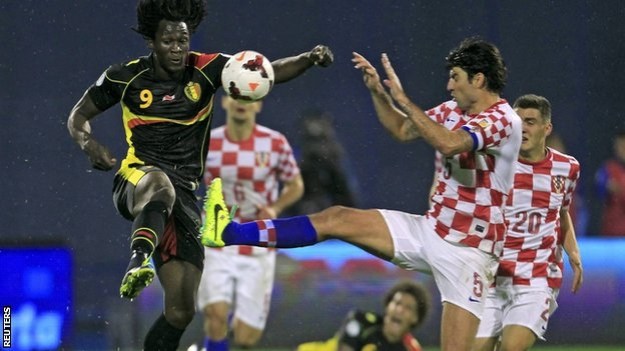
“Romelu Lukaku scored twice as Belgium beat Croatia 2-1 to secure their place at the 2014 World Cup in Brazil. Striker Lukaku, on loan at Everton from Premier League rivals Chelsea, scored twice in the first half, with Niko Kranjcar grabbing a late consolation. Belgium were joined by Germany and Switzerland in qualifying for next year’s tournament. Germany defeated the Republic of Ireland 3-0, while Switzerland won 2-1 in Albania.” BBC
The biggest problems facing World Cup contenders
“The fascinating thing about international football is that managers must cope with a very definite group of players. Whereas at club level, weaknesses can be solved by signing new players, at international level it’s not unusual for a top-class side to completely lack quality in one particular position. Sometimes, this forces managers to formulate innovative new tactical ideas to compensate for that weakness – but often, it simply means the side has a weak link. With eight months to go until the World Cup, here’s a look at six big international sides who have an obvious problem position.” ESPN – Michael Cox
England expects … quite wrongly

“In 2009 the sports economist Stefan Szymanski and I published a book about football and data called Why England Lose. Going into the World Cup of 2010, people kept asking us: ‘Aren’t you worried about your title? What if England win?’ We weren’t very worried, and predictably, England lost. Later we changed the title anyway, because it turned out (amazingly) that English people wouldn’t buy a book called Why England Lose. Still, our original title remains pertinent. England enter their last qualifying matches against Montenegro and Poland on October 11 and 15 very uncertain to qualify for next year’s World Cup. It’s time to explain, once and for all, why England lose.” <a href=”http://www.ft.com/intl/cms/s/2/8683a198-2bc4-11e3-a1b7-00144feab7de.html#axzz2hFhItdi7FT – Simon Kuper
England need consistency and chemistry to elevate their game
“The use of well-worn football cliches can be frustrating, but the cliches themselves are generally easy to understand — which, of course, is why they remain so frequently used by fans and pundits alike. It can be confusing, however, when two accepted cliches completely contradict one another. This is particularly problematic when considering a player’s true level of ability. On one hand, we’re told that ‘Form is temporary, class is permanent.’ On the other, ‘You’re only as good as your last game.’ So how are we supposed to view Esteban Cambiasso, for example? Superb throughout the past decade, yet wretched during Inter’s 3-0 weekend defeat at home to Roma — if we follow both cliches, Cambiasso is simultaneously ‘class’ and ‘not very good’.” ESPN – Michael Cox
Mel Machin and AFC Bournemouth’s Original Great Escape
“The adventures of the Championship season have been mixed for AFC Bournemouth so far but the difficulties and crises of the past remain fresh in the memory. Since the early 1990s the story of the club has been one of promotions, relegations, takeovers and more than one instance of near financial oblivion. Many of the supporters who were at the rebuilt stadium at King’s Park for the first home game of this season will also have been at the town’s Winter Gardens theatre throwing notes into buckets in an effort to save their club during the 1996/97 season. The Cherries became a community club – Europe’s first, so it was said – but their problems were far from over. Similarly, they were hardly just beginning. By the time Tony Pulis left Dean Court in 1994 after two seasons in the job after replacing Harry Redknapp, Bournemouth were in the third tier and set for a troublesome season. After losing their first seven matches and scoring just four goals before eventually drawing against Chester City, they turned to a former Manchester City manager with a promotion in his scrapbook alongside a famous brush with Alex Ferguson in 1989.” In Bed With Maradona