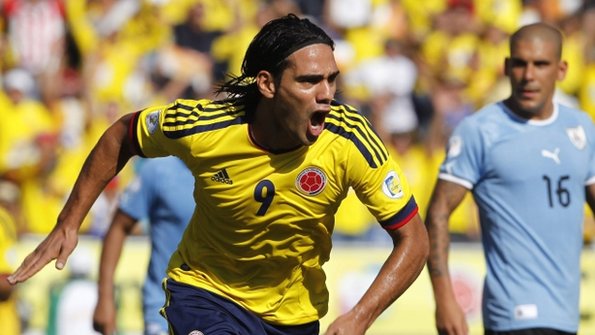
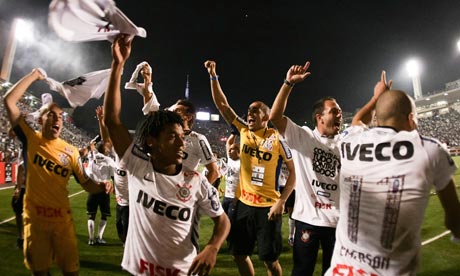
“A gap has opened up as South America’s World Cup qualification campaign reaches the halfway stage. Victories on Friday for Argentina, Colombia and Ecuador mean that three teams have pulled away from the pack. But the round had another winner, who did not even take the field on Friday. It was sixth-placed Venezuela’s turn to take a rest, and their position improved while they sat and watched as Uruguay and Chile, the teams above them, both lost. Three rounds ago Chile were first and Uruguay were second. Now they seem to be in free-fall. On Friday all they managed to accomplish was further damage to their goal difference – and things could get still worse for them in Tuesday’s 10th round.” BBC – Tim Vickery
Tag Archives: Brazil
Oscar – a midfielder in the full sense of the word

“Little more than a month into the season, new signing Oscar is already a Stamford Bridge sensation. I must confess that I took a bit longer to be won over by him – before making up for lost time by coming to the conclusion that he could be the most important player Brazilian football has produced in a while. I was at one of his very first matches for Internacional, a 3-0 defeat to Fluminense in the Maracana stadium in August 2010. He was brought on after 35 minutes, made a mess of everything he tried and was himself replaced after 57. It hardly matched the hype that was already surrounding him.” BBC – Tim Vickery
Higher hopes for South America’s World Cup players

“World Cup qualification in Europe has a few good games along with plenty of mismatches. In South America, meanwhile, every game in the long campaign is resonant with rivalry and relevance. The best development in the history of the continent’s national teams was the birth of the Copa America in 1916 and its frequent, at times annual, staging in the early years. It did much to spread interest in the game and raise standards.” BBC – Tim Vickery
Two Brazilian cities, two games, halfway to the 2014 World Cup

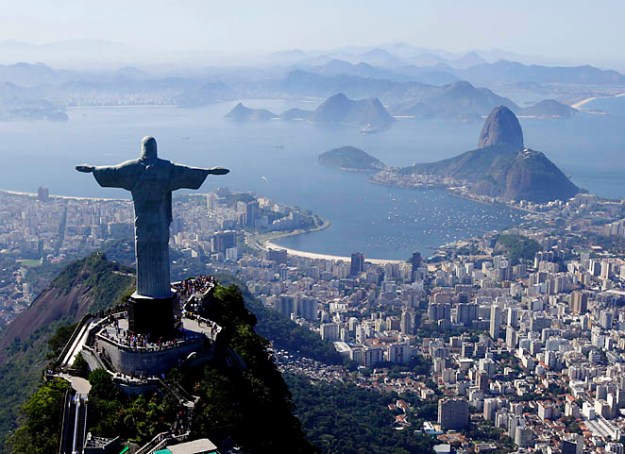
“On the belvedere atop Corcovado mountain, tourists crowd the railings for a God’s-eye view of the world’s most beautiful cityscape. Standing under one Rio icon, the open-armed statue of Christ the Redeemer, they aim their phone cameras at another: Pão de Açúcar (Sugarloaf Mountain), the granite outcropping that resembles a giant cat crouching at the edge of Guanabara Bay. Off to the left, though, is a Rio landmark of equal significance, at least to futebol fans: Maracanã, the largest stadium in Brazil and the site of the 2014 World Cup final.” SI
Beaten Uruguay have no time to sulk

“In the context of a league campaign, a resounding win or a heavy defeat never ends at the final whistle. More important than the points won or lost can be the team’s reaction. Can it rally in the face of adversity, or guard against excessive euphoria? This is especially true in South America’s marathon 2014 Fifa World Cup qualifiers, when two rounds are played together, and a team can play at one end of the continent on Friday and the other the following Tuesday.” BBC – Tim Vickery
This Is A Red and Brack Nation
“Over an hour before kick-off and the stadium was already awash with flags, banners and fireworks as it rocked to the drums and chants of the Torcidas. I was in Rio for the game known as the Fla-Flu, the derby between Flamengo and Fluminese. While not as big as Vasco vs Flamengo, the excellently named derby of the millions, the Fla-Flu is a game of historical significance. And the pre-match atmosphere was certainly living up to the hype as the two sets of fans took in turns to explode into action.” In Bed With Maradona
The Short Happy Life of Adilson Batista

“A man at peace, Adilson Batista, manager of Serie A strugglers Atlético Goianiense, yawned, stretched, and leaned back in his chair. He knew had made the right choice. It hadn`t been easy to turn down the offer to go back to Cruzeiro, a far bigger club than Atlético, and he would never forget those glorious nights in 2009, when he had taken the team from Belo Horizonte to the Libertadores final against Estudiantes. They had called him one of the brightest young coaches in Brazil back then. But he had a responsibility to Atlético. He`d only arrived in April, and it would be wrong to leave the club in the lurch just a few weeks later. He wanted to see the project through to the end.” World Soccer
Uruguay have cause for World Cup concern

“World Cup qualification resumes in South America this Friday, with a question mark hanging over the team which have been the continent’s form side over the past two years. Might the London Olympics mark an unwelcome turning point for Uruguay? On the face of it there should be no cause for alarm. World Cup semi-finalists in 2010, Copa America champions last year, Uruguay’s senior side have gone 18 games without defeat. They have made a solid start to the 2014 qualifiers. Leaders Chile sit out Friday’s round, where a win for Uruguay would take them to the top of the table.” BBC – Tim Vickery
Sabella meshes Argentina’s abundance of attacking talent
“It is possible to have too much of a good thing. Lionel Messi, Sergio Aguero, Gonzalo Higuain, Carlos Tevez, Angel Di Maria, Javier Pastore, Ezequiel Lavezzi … no other nation comes even remotely close to Argentina in terms of attacking and creative talent. The problem has been trying to fit as many of them as possible into the same squad. It did for Diego Maradona and it did for Sergio Batista.” SI – Jonathan Wilson
Trouble atop the table, hope at the bottom
“With Euro 2012 followed by the season’s big kickoff and the excitement of the transfer window, only now is Europe turning its attention to the need to qualify for the next World Cup. South America, meanwhile, is in a very different situation. Sights are already firmly trained on winning a place in Brazil 2014. The continent’s marathon qualification tournament is a third of the way through. This Friday, action will get under way in the second year of a three-year campaign. So far the soccer has lived up to its billing as the most competitive World Cup qualifiers on the planet.” ESPN
Neymar must leave comfort zone to fulfil promise
“On Wednesday Neymar helped Brazil to a morale-boosting 3-0 win away to Sweden. The next evening he was back in action on the other side of the Atlantic, in Florianopolis in the south of Brazil, where he played the starring role as Santos came from behind to seal a 3-1 victory against Figueirense.” BBC – Tim Vickery
Sócrater the Liberator

“When the news broke in September last year that Sócrates, the legendary Brazilian midfielder, had been rushed to hospital for an emergency operation, I feared the worst. O Doutor had been a committed fan of alcohol and cigarettes for many years, I assumed his illness was related to his lifestyle choices. It appeared at first that he might be able to shake his sickness off, like he had so many opposing players. This time it was one attacker too many for him. Sócrates lived life by his own rules, and when the rules didn’t suit him he changed them. He was a marvellous footballer and always politically engaged, something he continued after retiring from playing. Indeed it is his involvement in the ‘Corinthians Democracy’ that particularly drew me to read about his life.” In Bed With Maradona
Brazil fail to learn defensive lessons
“A dream realised, a quest for gold finally successful and a new name added to the roll of honour. We just didn’t expect it to be Mexico. Brazilian football cannot yet call itself all-conquering since the Olympic Games have again caused them pain and with it ravaged their credentials at the 2014 World Cup they will host.” ESPN
How Olympic football affects the World Cup
“Olympic football may not be the main event of the Olympic Games but those teams taking part have an excellent opportunity to try things out as they prepare for the next World Cup. This has rarely been clearer than at Old Trafford on Sunday, when 2014 hosts Brazil were confronted with a problem they will surely meet time and time again in two years’ time. Opponents Belarus put 10 men behind the ball and looked to frustrate them, forcing them to pass sideways, hoping that Brazilian frustration would lead to error and then launching the counter-attack.” BBC – Tim Vickery
Italy 3-2 Brazil, 1982: the day naivety, not football itself, died
“It’s 30 years ago this month that, according to Zico, football died. On 5 July 1982, in the Estadi de Sarrià in Barcelona, Tele Santana’s majestic Brazil lost to Italy and were eliminated from the World Cup. With them went the nostalgic form of Brazilian football, the fluid attacking style that had won them three World Cups between 1958 and 1970.” Guardian – Jonathan Wilson
The messy history of Olympic football has robbed it of a coherent narrative

“Part of the allure of the World Cup is that, despite changes to format, entrants, moments in early history when certain European countries refused to send teams to South America one year and vice versa the next, the tournament has managed to maintain a linear quality stemming from a basic competitive consistency. One can trace, for example, the narrative thread from Brazil’s 2002 World Cup win back to its lacklustre turn in 1994 when Baggio missed, through to its peak in 1970 when Pele hosted the Jules Rimet trophy, all the way to 1950 when Ghiggia scored Uruguay’s winning goal in the 79th minute leaving the Maracana in deathly silence. There are recurring heroes and villains, classic semifinals, great teams that never won (the Netherlands, Hungary), touchstone moments that changed the direction of the sport. Even the most casual soccer person will be able to recount in a reasonably dependable chronology.” The Score
Can Uruguay roll back the years at London 2012?
“The Paris Olympics of 1924 are best remembered in Britain for providing the backdrop to ‘Chariots of Fire.’ But for all the heroism of Messrs Liddell and Abrahams, something happened there with far greater consequences – the birth of modern football. No one knew much about Uruguay as they sailed their way across the Atlantic to take part in the football tournament. But they strolled to the gold medal, and did it with a balletic, artistic style of play which captivated spectators and set off a fever for the game. Four years later, to prove it was no fluke, Uruguay won the gold medal at the Amsterdam Olympics. Argentina came across as well, and they took the silver.” BBC – Tim Vickery
Strange things happen at a football Olympics – Simon Kuper
“In 1996, the Nigerian football team arrived at the Atlanta Olympics in their usual financial chaos. They stayed first in a college dormitory, later in a cheap motel. Most days they slept late, and then went for brunch at a Chinese restaurant. Their Dutch coach, Jo Bonfrere (known by Nigerian custom as ‘Bonfrere Jo’) paid for the meals out of his own pocket. On the field the Nigerians attacked frantically and won gold – the first African nation ever to do so in the football Olympics. Nwankwo Kanu, their ‘Lucky Skipper’, said of his last-gasp equaliser in the semi-final against Brazil (after Nigeria had been 3-1 down): ‘That goal was the most beautiful moment of my life.’” MIO Stadium
Olympic Football – The Real Thing?
“BBC football commentator Jonathan Pearce got through last Friday evening without once name-checking his current love…Cristiano bloody Ronaldo. He also avoided one word you would have thought key to his commentary on a football match between Great Britain and Brazil. Britain. In an age where succinct branding is so important (and Google “Bill Hicks advertising marketing” for my “view” on such things), “Team GB” is about as much detail as the modern sports fan is deemed capable of understanding. So Stuart Pearce’s hastily-flung together team of B-list England stars and most of the best of the Welsh were “Team GB” for the night. Maybe if they had the ball long enough to force Pearce to use two descriptions…” twohundredpercent
Continental shift: why the Olympics mean so much to South America
“It is fair to say that, historically, South America has not made a huge impact on the Olympics. While it is true Brazil is working hard to broaden its sporting base, of the 20 gold medals the country has won, over half have come in the last four Games. Argentina has picked up 17 golds, but its glory days are long gone. In the late 1940s and early 1950s, the Peron government invested heavily in a wide range of sports and leading athletes were closely identified with the regime, but all that ended when Peron was deposed in 1955. Since then, Argentina has claimed just four gold medals – two of them in the last two football tournaments.” World Soccer – Tim Vickery
Can Brazil rekindle their magic?
“Spain’s Euro 2012 triumph – their third consecutive international title – has prompted many to reach for comparisons with Brazilian sides of old in the quest to answer the bar-room question: Which is the world’s best-ever international team? Spain’s Euro 2012 triumph – their third consecutive international title – has prompted many to reach for comparisons with Brazilian sides of old in the quest to answer the bar-room question: Which is the world’s best-ever international team? Fun stuff, but given the difficulties of comparing teams from different eras, it may be more worthwhile to peer in the other direction, looking forward rather than backward when making Brazil/Spain comparisons. The specific question is this: What impact might the success of Spain have on future Brazil sides?” ESPN – Tim Vickery
A Soccer Prodigy, at Home in Brazil
“There is a Brazilian saying that the soccer prodigy Neymar and his family often laugh about. The phrase — calça de veludo ou bunda de fora — comes up frequently: when Neymar reminisces about his beginnings in street games in São Vicente, for example, or when someone asks, again, ‘Are you really better than Messi?’ Always, the family returns to calça de veludo ou bunda de fora. And then they all giggle.” NY Times
South Americans ready to stop Spanish stroll
“Spain’s win at Euro 2012 – their third consecutive major tournament win – has sparked off all kinds of comparisons in the bar room debate over the best international team of all time. Of course, such conversations have a strong subjective component, but it is hard to formulate arguments against the facts – and a fourth consecutive trophy will surely tip the balance in Spain’s favour. But title number four looks set to be the hardest of the lot. It entails doing what no European team has ever done – winning the World Cup on South American soil when the world come to Brazil in 2014.” BBC – Tim Vickery
Brazilian football: when silence isn’t golden
“Sonically speaking, Avenida Conde da Boa Vista in Recife is a typical Brazilian urban drag. Swarms of unsilenced motorbikes buzz back and forth, battalions of buses grind through the gears, and cheesy local pop blasts out from clothes and shoe stores. Endless verbal churn rattles back and forth between the shoppers and the coconut water sellers and the snack peddlers. Brazil’s big cities, it’s fair to say, are not always places to wander as lonely, or as peacefully, as a cloud.” World Soccer
Corinthians finally break their duck as Emerson sees off Boca Juniors

“By the end, Boca Juniors had been so comprehensively beaten that, as the South American football expert Rupert Fryer joked, they could not even raise themselves for the traditional post-Copa Libertadores final punch-up. Corinthians won 2-0 after a 1-1 draw in the first leg but the gulf between the sides was so vast, the chances of a comeback so slight, that it may as well have been quadruple that. And so, in their centenary year, seven months after the death of Sócrates, the most iconic player in their history, Corinthians won the Copa Libertadores for the first time. No more will there be cracks about ‘the 100-year-old virgin’.” Guardian – Jonathan Wilson
Corinthian values
“The 2012 Copa Libertadores final ended up being fought out between two of South America’s biggest clubs. Boca Juniors, one of the competition’s most successful sides, who have six titles and are only one behind all-time record holders Independiente, and Corinthians, a club that despite their grand stature were hoping to win their first ever Copa. After a hard-fought couple of legs, it was Corinthians who came out on top, to become the 23rd different club to win the trophy.” ESPN
Spain success built on clear football identity
“With a goal scrambled in from a set piece, Brazil beat Spain 1-0 in the final of the 2003 Under-17 World Cup in Finland. Spain, though, played most of the football. ‘We were the Brazilians today,’ said their coach Juan Santiesteban, after his team of little ball-players had lost out to opponents who carried much more physical presence. The overriding objective of youth football is to groom players for the senior side. Nearly a decade on, then, it is clear who really won the game. Not one of the Brazil team has played a serious competitive international. Cesc Fabregas and David Silva, meanwhile, have gone on to better things, combining on Sunday to put Spain on the way to a third consecutive major tournament win.” BBC – Tim Vickery
The greatest football team: Spain 2012 vs. Brazil 1970?
“After becoming the first team to defend the European Championships, adding a second continental title to the World Cup won in 2010, many observers have been quick to label Spain the greatest team in the history of international football. An emphatic 4-0 thrashing of Italy, the biggest margin of victory ever seen in a world or European final, continued a remarkable run which has seen Spain not concede a goal in a knockout match since the great Zinedine Zidane found the back of their net for France at the 2006 World Cup.” CNN
Making History In the Copa Libertadores Final

Independiente with the 1975 Copa Libertadores trophy
“This year’s Copa Libertadores final, between Boca Juniors and Corinthians, is a truly heavyweight clash. On and off the pitch, the two combatants are giants of South American football. They are both current national champions and hold 28 league titles and four national cup titles between them. They are the most popular clubs in their respective megacities, beloved for their working-class roots, and count their supporters in the tens of millions.” In Bed With Maradona
Corinthians close in on Libertadores dream
“Some 20 years ago, Corinthians director Luis Paulo Rosenberg made a promise to himself. He said, ‘[When we win the Copa Libertadores] I want to buy a bottle of cachaca (the local moonshine), drink it all myself and sleep in the gutter, drunk.’ He has never been closer to buying that bottle. In the 53rd version of the South America’s Champions League, the Brazilian giants have made it through to the final at last. They are two games away from lifting the trophy – the final is played on a home and away basis with the first match on 27 June and the return leg on 4 July.” BBC – Tim Vickery
Lionel Messi hat-trick leads Argentina to 4-3 win over Brazil
“The summer friendly has become a familiar genre for American fans, but this felt different. For one thing, Brazil and Argentina are perhaps the only teams in the world able to draw more than 80,000 people in the same time slot as Germany-Portugal — a European Championship game that actually matters. For another, it provided another chance to compare Neymar and Lionel Messi, excellent players in their own right and proxies in the cold war between Pele and Diego Maradona.” Guardian
4-4-2 G4M3 TH3ORY 4-3-2-1 4-2-2-2 3-4-1-2
“Brazil finds itself in an awkward position. After a desperately disappointing quarterfinal exit in the 2011 Copa América, the Seleçao has three years to put it right with only the Olympic Games this year and the Confederations Cup next in the way of ‘proper’ matches. (Even then, the Olympic Games allow only three players over the age of 23, and the quality of opposition in the Confederations Cup is questionable, as the major nations seem unsure of the tournament’s importance.) Other teams may complain about qualifiers, but they do at least offer an opportunity for competitive games.” Howler – Jonathan Wilson
Euro 2012 – a World Cup without Brazil?
“A Rio newspaper on Sunday asserted that the European Championship is a World Cup without Brazil and Argentina. It is an expression used on both sides of the Atlantic – but that does not make it fair. European teams have disputed the last two World Cup finals but the continent also provides some of the dullest teams in the tournament. The phrase is unfair on Africa and Asia, where South Korea have made a consistent contribution to recent World Cups. If they needed home advantage to reach the semi-finals in 2002, then so did England in 1966 and France in 1998 to register their only wins.” BBC – Tim Vickery
U.S. Men’s National Team: Baby Steps to the Elevator
“Most of the time, when a ‘promising,’ ‘up-and-coming,’ ‘dangerous’ team is developing into an elite power, its progress resembles the climb of an elevator. The floor and the ceiling rise at the same pace. The team gets better when playing at its best, but it also gets reliably better when playing at its worst. Wins that once seemed crazy to think about (say, the Thunder rolling the Lakers) start to feel routine; losses that once seemed fairly normal (say, Manchester City hacking up a game to Everton) start to feel inexplicable and devastating. That’s part of what getting good is: raising expectations at both ends of the spectrum, as well as all the points in between.” Grantland – Brian Phillips
End of the road for Ronaldinho’s Flamengo
“While Europe’s Champions League is down to the last four, the South American equivalent, the Copa Libertadores, is whittling down its field to the 16 teams who will go into the knockout phase. Twelve places have so far been filled, with some high drama along the way. For a few sweet seconds, for example, Flamengo of Rio thought they had saved themselves from elimination.” BBC – Tim Vickery
Santos continue to punch above their weight
“If the Titanic was too big to sink, then Santos FC would be too small to shake the world – flawed logic on both counts. On 14 April, 1912 – the very day the Titanic hit an iceberg which caused it to sink – Santos were founded, beginning their rise to become one of the most remarkable clubs in football history. Santos represent a relatively small city, with a population of a little more than 400,000, which grew to prominence as the port through which much of Brazil’s coffee was exported. An hour’s climb away is the metropolis of Sao Paulo, South America’s biggest city, with more than 11 million inhabitants.” BBC – Tim Vickery
That They May Face the Rising Sun
“André Alves Leso and Guilherme Vinicius Jovanelli Moreira, in all likelihood, had never met Jefferson Firmino da Silva. But the three had more than a little in common. All were young, working class Brazilians. All were members of a torcida organizaa group, André and Guilherme of Mancha Alvi Verde (Palmeiras), Jefferson of Inferno Coral (Santa Cruz). And all now can be added to Brazil’s staggeringly long list of murder victims.” World Soccer
Benfica’s Brazilian import-export connection
“If they were unable to do it in front of their own fans, can Benfica manage to beat Chelsea at Stamford Bridge this Wednesday? Some might make the point that they were hardly at home last week. The Lisbon giants kicked off without a single Portuguese player – and with an extraordinary complement of nine South Americans in their starting line-up, plus another on the bench (alongside a Brazilian-born Spaniard), and one more ruled out by injury. And that is not even the half of it. Benfica have a further 17 South American players out on loan with other teams.” BBC – Tim Vickery
Brazil’s championship needs a licence to thrill
“Before Ian Fleming made his name writing the James Bond books, he was eclipsed by older brother Peter, a derring-do adventurer of the type Michael Palin might have been born to satirise. Peter Fleming was part of an eccentric expedition into the Brazilian jungle in the early 1930s, which he wrote about in a book best remembered for its stand out line. ‘Sao Paulo,’ he mused, ‘is like Reading, only much further away’ – an observation which does, of course, depend on one’s starting point, but which contains an excellent piece of insight.” BBC – Tim Vickery
Neymar a match for Messi on Day of the Goal

“A Brazilian journalist this week came up with the thoroughly sensible idea that 7 March henceforth be commemorated as world football’s Day of the Goal. It was not only the date on which Lionel Messi chalked up his five for Barcelona in the Champions League; in the South American equivalent, the Copa Libertadores, Neymar of Santos also added a magnificent hat-trick of his own.” BBC – Tim Vickery
Can Lionel Messi become an Argentina hero?
“Argentina will be hoping Lionel Messi is finally starting to transform his stunning club form with Barcelona to the international arena following his magnificent hat-trick in the 3-1 win against Switzerland. The hints were there late last year, in the second half of the World Cup qualifier away to Colombia, and now the Switzerland game has surely consolidated the Messi-Sergio Aguero link-up at the heart of the Argentine attack. The pair have had a natural rapport for years, built up when they roomed together during the 2005 World Youth Cup, and now that understanding is clearly visible on the pitch through their pacy, dazzling exchanges.” BBC – Tim Vickery
Can Brazil rely on David Luiz?
“The World Cup can be a cruel thing. No matter how well the team is doing in the competition, it need not take a bad game, or even a bad half, for them to be eliminated. A bad few minutes can be enough – as Brazil know very well. Brazil’s team in the last World Cup in South Africa may not have been to everyone’s taste, but results were excellent in the two years leading up to the tournament, and at half-time in the quarter-final against Netherlands few would have bet against them. Yet, in a matter of minutes, a 1-0 lead evaporated into a 2-1 deficit, and they were back on the plane home.” ESPN – Tim Vickery
The importance of potent partnerships

“Of the many images football has left in my mind, one of the most intriguing comes from a pre-match warm up more than 15 years ago. Flamengo were about to play Internacional in the Brazilian Championship. Reunited for the first time since winning the World Cup just over two years earlier, Romario and Bebeto were exchanging passes. Bebeto was sleek and somehow vulnerable, like a cheetah. Romario was stocky and merciless, a perfect hyena. The two made natural hunting partners. It is inconceivable that Brazil would have won USA 94 without them.” BBC – Tim Vickery
Copa Libertadores Week One Round-up
“All the results from week one of the 2012 Copa Libertadores. Velez Sarsfield secured a comfortable win in the tournament opener as they overcame Defensor Sporting 3-0 in Uruguay. After going up just before the break through David Ramirez there was no doubt they would see the game out. Mauro Obolo and Seba Dominguez, with a scorching free kick, added the other goals.” Purple Patch
Copa Libertadores a cradle of talent
“This year’s major international tournament, the European Championship, was first disputed in 1960 – which makes it a mere youngster in comparison with the South American version, the Copa America, held as far back as 1916. But in terms of club competitions, rather than national teams, the seniority is reversed. The competition now known as the Champions League, originally the European Cup, first kicked off in 1955. The South American equivalent, the Copa Libertadores, only came to life five years later – and was a conscious attempt to emulate the European competition, so that the champions of football’s two traditional continents could fight it out for the world title. Why the discrepancy? It is not too hard to explain.” ESPN – Tim Vickery
Diplomat Bielsa goes on the attack

Marcelo Bielsa
“If he needs help in his captaincy dilemma then perhaps Fabio Capello could take a leaf out of the book of Marcelo Bielsa. Currently with Athletic Bilbao after spells in charge of the national teams of Chile and his native Argentina, Bielsa believes that the role of the captain is to represent the squad – and on that basis he usually lets the players vote to determine who should lead them out. But that is where Bielsa’s democracy ends. In the late 90s when he first took the Argentine job there were some early problems – hardly a surprise given the unorthodox nature of his trademark 3-3-1-3 system.” BBC – Tim Vickery
South American superstars wind down on home soil
“I have often mentioned the single greatest pleasure of covering South American football -spotting a future superstar on the way up, spying on the early steps of someone with the talent to become a household name all over the world. Another pleasure comes from following some of those big names at the end of their playing days, when they come back from Europe to wind down their careers. One of the fascinating aspects here is that they can fit into so many different categories.” BBC – Tim Vickery
Insecure coaches set a cynical tone
“When Pepe, Real Madrid’s Brazil-born defender, steps on the hand of Barcelona’s Lionel Messi, the blame is not his alone. A coach has three main tasks. He selects the team, prepares the strategy – and he also sets the emotional tone for the work. An uptight coach usually produces an uptight team. When the opposition is Barcelona, Real Madrid boss Jose Mourinho appears to get carried away with the importance of the occasion, with some personal questions and with his own frustration at losing so often.” BBC – Tim Vickery
Jose Pekerman takes Colombia back to the future
“Pep Guardiola as coach of Argentina’s national team? It was an idea floated recently by Argentine FA boss Julio Grondona, but as nothing more than a pipedream. It is very, very hard to imagine Argentina having a foreign coach. Same with Brazil. The idea was debated briefly in the Brazilian press just over a decade ago. But that was in exceptional times, when the national team were in danger of not qualifying for the 2002 World Cup.” BBC – Tim Vickery
5 Brazilians Your Club Should Sign (Who Aren’t Neymar, Ganso Or Lucas)
“The buying and selling of Brazilian footballing talent has undergone a sea change in the last couple of years. While European currencies totter, the local economy booms, tempting the youngsters (Neymar, Ganso, Lucas, Damião) to tarry a while longer, and plenty of elder statesmen (including Ronaldinho, Luis Fabiano, Adriano and Fred) to spend more than just their retirements back home. A boatload of just-shy-of-Balzaquiano*, mid-level talent has also traipsed back across the Atlantic, boosting the Brasileirão’s quality quotient further.” Sabotage Times
Vargas and Neymar battle for player of the year accolade
“In the last competitive game of the South American season, Eduardo Vargas scored a goal that made sure Universidad de Chile won the domestic title, and also highlighted why Napoli are taking him across the Atlantic. Vargas broke from the halfway line. Cobreloa defender Sebastian Roco, worried about his pace, kept backing off. Vargas’ control of the ball at pace was so good that he was able to do two things.” BBC – Tim Vickery
El Bielsa De Los Pobres

“In the presence of more illustrious South American nations – Brazil’s financial strength allowing clubs to compete with their European counterparts, Argentina’s continued production of the world’s most sought after forwards and Uruguay’s successful national team, reaching the World Cup semi-final and winning the Copa America in the last 18 months with a population similar to Wales – Chilean football is silently flourishing. Or it was, until Universidad de Chile, known as La U, decided to attract attention to the west coast of South America by creating history and breaking records, all while playing some of the most exciting football in world football.” In Bed With Maradoma
The Angel With Bow Legs
“A serial adulterer, a volatile character, an incurable alcoholic and yet undoubtedly one of the most extraordinary entertainers the game is ever likely to see. The controversial, colourful and captivating life of a man many consider to be the forgotten hero of Brazilian Football: Garrincha. On 20th January 1983 at the age of just 49 – a mere 21 years after he was hailed as the greatest footballer on the planet – A Alegria do Povo (The Joy of the People) passed away in Rio de Janeiro penniless and unable to conquer the demon that had blighted his life: alcohol. This is the extraordinary story of an idol who, against all the odds, reached the dazzling heights of success but whose excesses led to a spectacular downfall.” In Bed With Maradona
2011: A tumultuous year for Brazilian football

“After a year of mixed fortunes in Brazilian football, what needs to change? In a year that was believed to herald a new dominance of Brazilian club football with higher quality players, partially from repatriated imports, and ever-growing revenue, one can perhaps feel a little disappointed at the outcome and sense a change in direction is needed.” Purple Patch
La U accomplishments unforgettable despite defeat
“It is finally over. After 36 games, the unbeaten run of Universidad de Chile came to an end last Thursday when they went down 2-1 to Santiago rivals Universidad Catolica (an interesting side themselves – look out for right-back Stefano Magnasco and left-footed striker Kevin Harbottle). The long awaited defeat of ‘La U’ (the previous one was in July) came in bizarre circumstances. At 1-1 and with the game in stoppage time, they looked in total control – until the usually excellent midfielder Marcelo Diaz misplaced a pass out of defence and Catolica’s Jose Luis Villanueva fired in a cross shot to win the game.” BBC – Tim Vickery
What Brazil can learn from Barcelona

“In 1924, Uruguay arrived as unknowns at the Olympic football tournament in Paris, took everyone apart on the way to winning the gold medal and changed football forever. The enthusiasm they set off led to the birth of the World Cup six years later. And like so many significant events in football, it was not just because they won – it was because of the way they did it. Contemporary accounts raved about them. Influential journalist Gabriel Hanot praised their ‘marvellous virtuosity in receiving the ball, controlling it and using it,’ and drew attention to their ‘beautiful football, elegant but at the same time varied, rapid, powerful, effective.” BBC – Tim Vickery
Universidad de Chile take the 2011 Copa Sudamericana crown in style

“The club of the moment? Universidad de Chile: sweeping up trophies in their domestic league, unbeaten in 35 games, and this week crowned Copa Sudamericana champions, their first ever continental title. More interesting than their success has been their style of play. Coming 18 months after Marcelo Bielsa took Chile to the World Cup having played dynamic, quick football with heavy pressing, usually in a 3-3-1-3 formation, his fellow Argentine Jorge Sampaoli is doing something similar.” Zonal Marking
Copa Sudamericana champions face uphill struggle to hold onto key players
“The best team in South America face an uphill struggle to hold onto their prize assets. With a crushing 4-0 aggregate victory over the formidable LDU Quito, Universidad de Chile secured their first ever continental title. The comprehensive victory ensures La U can be counted as one of the best teams on the continent. With Copa Libertadores football secured for 2012, they now face the task of holding on to their key players and push on to become one of the greatest teams in the recent history of South American club football.” Purple Patch
Paraguay’s hooligan problem is getting out of control
“Six games in 2011, four in just over a month, have been suspended in Paraguay due to crowd violence. The latest suspension came on last weekend’s crunch game between league leaders Libertad and title chasers Cerro Porteño, two points behind with three games to play. With Cerro Porteño leading one-nil at half time the players and officials came out ready for what was set to be a thrilling and potentially season-defining 45 minutes of football. But before the second half could begin a flare thrown from the Cerro Porteño end struck the linesman who had to leave the stadium in an ambulance.” World Soccer
Universidad de Chile target Barca showdown
“Crunch time is approaching for this year’s two outstanding South American clubs.
Over the next few days both Santos of Brazil and Universidad de Chile are seeking to scale new heights. The Chileans, ‘la U’ for short, extended their unbeaten run to 34 games on Sunday, brushing aside Union Espanola to book their place in the semi-finals of the local championship. This, though, is hardly the priority. They already have 14 Chilean titles to their name, including the first of the two played this year.” BBC – Tim Vickery
Brazilian football needs to take the opposition seriously
“I flew back to Brazil from London on the day that the group phase of the Champions League kicked off. I well recall that the talk in England at the time was that the entire group stage was dull and predictable. It was almost too easy for the Premier League sides. But that is not the way things have turned out.” BBC – Tim Vickery
World Cup 2014 – a scheduling headache
“‘It’s been a big task and long work,’ said Fifa secretary-general Jerome Valcke last week when the calendar of the 2014 World Cup was presented. “We had 57 versions of this match schedule and finally nine on which we have been working. We took into account the medical aspects, logistics, travel and accommodation.” Staging a World Cup in a country the size of a continent is not easy, and Brazil in June/July offers a specific challenge – winter bites hard in the south and barely touches the north.” BBC – Tim Vickery
Bad start for new Argentina coach
“Last Tuesday when Venezuela beat Argentina in the second round of South America’s World Cup qualifiers it was historic, but hardly surprising. Venezuela have been making dramatic strides, had home advantage and were taking on an especially vulnerable Argentina side – whose 4-1 win at home to Chile the previous Friday may have disguised the fact.” BBC – Tim Vickery
Latin America’s power struggle
“Just a few rounds gone and, of the nine teams in contention, only two have yet to win a game. The other seven already have one success to their name, but nobody has two. The figures don’t just show it, they shout it: World Cup qualification in South America is more competitive than anywhere else on the planet.” ESPN – Tim Vickery
Goals galore in South American World Cup qualifiers
“It’s the same teams, three months apart, coming up with a totally different spectacle. Back in July the Copa America in Argentina was always enthralling, but its fascination was frequently the grim, attritional kind, with defences holding the upper hand. Now in October, the first round of South America’s marathon World Cup qualification campaign produced four open games – at times absurdly so – and 15 goals. Much of this can be explained by the differing demands of tournament and league football.” BBC – Tim Vickery
Ecuador and Venezuela set sights on 2014 World Cup
“As recently as two decades ago, when Ecuador met Venezuela in World Cup qualification it was about as significant as when Liechtenstein take on the Faroe Islands. Not any longer. This Friday, the two South American countries face each other in the opening round of the continent’s Fifa 2014 World Cup qualifiers – with both entitled to believe that they are taking the first step on the road to the finals in Brazil.” BBC – Tim Vickery
Bora Bahia

“The constant beating of drums, the colour, the dancing, the screaming, the singing, the joy on people’s faces; it’s all around me. Bora Bahia! Campeão Carioca! (come on Bahia, Champions of Rio) screams the guy behind me. But I’m not in Rio, I’m in Salvador in North Eastern Brazil. On the pitch, Rio side Fluminense are being put to the sword and in the stands the carnival atmosphere is in full swing. Full time score: Esporte Clube de Bahia 3 Fluminense 0.” In Bed With Maradona
Brazil in mood for World Cup hurry up
“No doubt about the highlight of last week’s friendly international 0-0 draw between Argentina and Brazil – the moment in the second half when Brazil striker Leandro Damiao produced his speciality ‘lambreta’ dribble. Cutting in from the right he ran over the ball, and then flicked it with his right foot against his left, in such a way that it did not just loop over his bewildered marker, but also fell on an ideal trajectory for him to continue his run and meet it with a lobbed volley, probably an intended cross, that looped off the far post.” BBC – Tim Vickery
Leandro Damiao: Superstar Under the Radar

Leandro Damiao
“Brazil have made a habit of producing a fine profusion of strikers in the past. Tostão, Pele and Rivelinho all graced that 1970 World Cup in a team which some have dubbed the greatest squad in the history of the game. Eight years prior, it was Garrincha and Vavá who stole the show with their fine movement and keen eye for goal that led Brazil to their second title. Fast forward to the modern era and the 2002 tournament which focused on the “Three R’s” of Ronaldo, Rivaldo and Ronaldinho, the trio working in perfect tandem that eventually landed their fifth World Championship in South Korea and Japan.” In Bed With Maradona
Allure of European football still remains
“A year ago, I spoke to Brazilian midfielder Sandro a few minutes after he had made his debut for Tottenham. I caught up with him again a few days ago as, recovering from injury, he watched his international team-mates train for last Monday’s international against Ghana at Craven Cottage in London.” BBC – Tim Vickery
A worrying crush at Ghana v Brazil
“Last night Fulham’s Craven Cottage stadium hosted the international friendly between Ghana and Brazil. As friendlies go, this was a particularly enticing prospect, with the likes of Ronaldinho and Neymar on show to people who perhaps haven’t had chance to see them play live before. Not to mention chance for London’s sizable Ghanaian community to see the Black Stars in action against the most famous international team in the world.” Narrow the Angle