Category Archives: World Cup

Video of the Week Extra: The English Premier League 1992/93 Season Review

“During the summer of 1992, the First Division of the Football League became the Premier League. The first season of the Premier League was played out against a backdrop of building sites as clubs sought to bring themselves into line with the Taylor Report, and it was a season that – and this seems extraordinary to say now – saw Manchester United instated as the English champions for the first time in twenty-six years. We would come to see over the coming years just how much this season would become a page turning in the history of the game in England. Our most sincere thanks go to the original uploader.” twohundredpercent

The Damned Utd: A Review


“I approached my reading of David Peace’s The Damned Utd with a mixture of excitement and trepidation. Widely regarded as one of the most creative novels ever composed on the subject of football, I was excited to get to grips with the book and yet fearful of being disappointed having seen the film version starring Michael Sheen (released three years after the publication of the book in 2009) and been largely impressed.” The Equaliser

We’re Coming To Win It

“If you want to cheer for a plucky underdog at this year’s Copa America then Paraguay are your team. Their small population of 6,000,000 (or 6,000 if you believe their most famous female export Larissa Riquelme)*, relatively small land mass in South American terms, and lack of funds (only Bolivia have a smaller GDP per head) will make them perennial underdogs. But this year they can also be considered dark horses, even though their opening game against Ecuador on July 3rd will be their first competitive outing since they were narrowly beaten by Spain in the World Cup quarter-finals. That was the furthest they had ever reached on the world’s biggest stage and it was the third time in their last three World Cup knockout games they were defeated by a team that went on to the final (2002 Germany, 1998 France). Here I assess the reasons why Paraguay are more than just spirited minnows.” In Bed With Maradona

Scattershot Politics: Sport and Its Serpentine Political Meanings


Andres Escobar
“Over the past fifteen to twenty years, historians have increasingly emphasized the role of sports as both a driver and reflection of society. The recent Bill Simmons-inspired and ESPN-produced 30 for 30 documentary series tackled a number of difficult subjects via sport. In “The Two Escobars“, directors Jeff and Michael Zimbalist travelled through 1980s Columbia, following the lives of Pablo (international drug dealer/murder/local philanthropist) and Andres Escobar (captain of Columbia’s 1994 World Cup team murdered in a nightclub alteration several months later). The two unrelated protagonists encapsulated the travails of late 20th century Columbia. Drug money filtered into the nation’s soccer infrastructure, boosting its competitive success but also adding layers of complexity and violence to a nation already struggling with decades of conflict.” CultFootball

Five great soccer quotes from a few literary giants


“Admit it: You’re fascinated by all the chaos and allegations embroiling FIFA these past few days. So are we. Who knows what to believe, but it’s hard to argue with the theater of it all. At some point, we read a poignant quote from legendary French philosopher writer Albert Camus (right), who before writing The Stranger and other classics was a goalkeeper for the youth team of Racing Universitaire Algerios (RUA).” Kicking & Screening Soccer Film Festival

Mundialito 1981


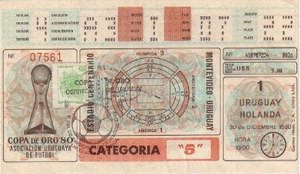
“On Wednesday Holland play Uruguay in Montevideo, which is not the first visit for the Dutch team. In 1980-81 they went to play in the Mundialito to celebrate 50 years of World Cup football. All winners were invited, but England, without a winterbreak, declined and Holland were asked instead as the shining lights of European football during the seventies.” Total Football NL

1970s Month: Death In the Afternoon

“Lazio won their first league title – Scudetto – in 1974, a team led by Tommaso Maestrelli beat Juventus to the title by just two points. On the pitch they played a high paced, attacking style that has seen certain members of the squad remembered as all-time legends. However, off the pitch they were an unruly bunch of prickly characters who failed to observe any sort of social standards.” The Equaliser

Fourteen: #1

“This is the first part of a David Peace-style fictionalisation of the 1974 World Cup Final, its specific focus being the Dutch squad of Rinus Michels and Johan Cruyff. I’m not entirely sure where I’m going this – I started it while sitting in a coffee shop to pass the time and just kept writing – but I’ll publish it in several parts and see it through to its conclusion regardless. If the prose seems clunky then that’ll be because I very rarely turn my hand to fiction, but it’s been fun to write and so this is the first instalment of what may be several to follow.” The Equaliser

1970s Month: The Match That Never Was


Chilean political prisoners in 1973
“The history of football is a fascinatingly diverse path. The manner in which it spread across the globe in a rapid, uncompromising fashion led to it becoming increasingly entangled in the social and political issues that were prevalent at any given time. Through such periods clubs and players were granted different connotations as they became associated with varying aspects of society, politics and religion.” The Equaliser

History of World Football in 100 Games – Part 7

“In its early years the FA Cup led a nomadic life. From the first final of 1872 between the Wanderers and the Royal Engineers until 1893 the climax of the tournament was hosted at the Oval. However, Surrey Cricket Club, the owners of the Oval refused permission for the ground to be used as the venue of the 1893 Cup final for fear of damage to the cricket squares.” Ademir to Zizinho

1970s Month: The Most Beautiful Goal

“It started deep inside the Brazilian half, the Seleção playing at walking pace, the orb in their thrall. The sun beats down on Mexico City’ s Azteca Stadium; the grass cowers from the incandescent barrage but Brazil’s golden shirts seem gloriously imbued with sunlight. Time moves slowly. The seconds that tick by are incidental.” The Equaliser

It’s just not fair… Jose Mourinho, the 1973 European Cup Winners Cup Final and why football needs its sense of injustice

“On Thursday evening, as I sat clad in shorts basking in the warm spring sunshine and savouring a tipple in the company of good people, I began to shuffle nervously as conversation quickly turned to the previous nights activities at the Santiago Bernabeu. The reason for my sudden anxiousness was not down to any strong affiliation with Real Madrid, nor was it down to any kind of discomfort brought about by the searing heat (18 degrees – I’m British), but rather because I knew exactly what was coming. To be more specific, I knew exactly what was coming from one particular corner of the table.”
Five in Midfield

1960s Month: God’s Footballer


“Football and religion have always been intertwined; from teams such as Manchester City and Everton being formed as church teams to the likes of Gavin Peacock entering the church in their post-football careers. Indeed, many believe that football is a new religion, with star players being treated as deities and their importance within society being debated long into the night. One player, however, had doubts as to its significance.” The Equaliser

Part One: Introduction, Aims and Context


“The first part of four in the serialisation of my dissertation ‘To what extent can Real Madrid CF and FC Barcelona be considered to have been political institutions in Spain during the twentieth century?’, this instalment introduces the topic at hand and provides academic and historical context to the subject.” The Equaliser – Part One: Introduction, Aims and Context, Part Two: The Political Life of FC Barcelona, Part Three: Real Madrid, Franco and the Socio Model, Part Four: Conclusions

The New York Cosmos Want to Take the Field Again

“As a theme for a downtown party, a salute to late-’70s American professional soccer sounds a little on the you’ve-got-to-be-kidding side. But anyone who walked into Openhouse Gallery in NoLIta one rainy night in mid-February would have seen a young crowd in a huge room celebrating the New York Cosmos, the long-defunct team that briefly turned the world’s most popular sport into a glamorous New York fad.” NYT

1960s Month: Kansas City Spurs, Glory and Oblivion

“The year was 1969. Only one year earlier, professional soccer had finally arrived in Kansas City, under dubious circumstances. The National Professional Soccer League had merged with the North American Soccer League, forcing the then Chicago Spurs into a bind – they could either dissolve to make way for the newly minted Chicago Mustangs, or move. And move they did.” The Equaliser

The Greatest Footballer in the World


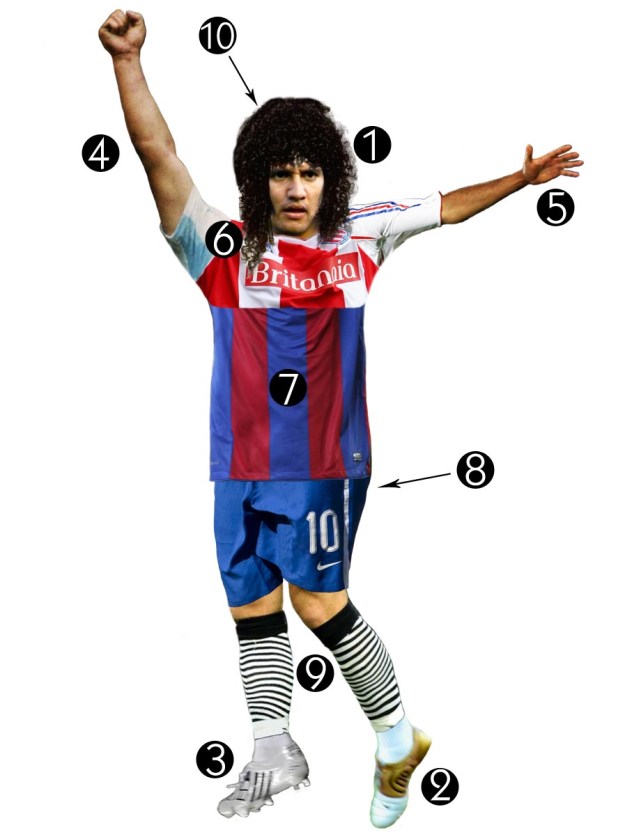
“The reason I can attach a title as vitriol-inspiring and inaccurate as the one above is because no such person can exist, by any standard. Pele? Zidane? Maradona? Cruyff? What about Clint Dempsey (kidding…sort of)? The debate rages, without any hope of ever coming to a consensus. So instead of casting my lot with the rest of despairing humanity, I’m sloughing off the bounds of biology and physics and building my own footballer, Mary Shelley style. Selecting eleven factors that I believe to be the most important when building a great player, I set to work in a virtual Gothic mansion, shrouded in storm clouds and ringing with echoes of my own maniacal laughter.” The Other 87

1960s Month: The Nomad’s Curse

“It is high noon in Vienna, May of 1990. Benfica is scheduled to play the great Milan side of Baresi, Rijkaard, Gullit, van Basten and Sacchi the following day for the European Cup. A man kneels beside a gravestone and murmurs a few words with a light, weeping voice. He stands and leaves with a glance that combines both anguish and love. The name on the gravestone is that of Béla Guttmann. The weeping man goes by the name of Eusébio da Silva Ferreira.” The Equaliser

1960s Month: La Grande Inter

“When Inter Milan ended a 45-year wait to lift the European Cup at the Santiago Bernabéu in May 2010, their 2-0 victory over Bayern Munich was the culmination of a run which had been fundamentally based on organisation. José Mourinho, famed for his man-management and pragmatic tactics, had moulded a team in his own image: determined, ruthless and adaptable.” The Equaliser

Rinaldi Reminisces: Milan Inter


“It is one of the most iconic snapshots of the Italian game. Inter’s Marco Materazzi leans on the shoulder of Milan’s Manuel Rui Costa as the pair of them gaze in disbelief or bemusement at what is unfolding before their eyes. Fireworks rain down upon the pitch of the San Siro in a scene more reminiscent of Dante’s Inferno than a Champions League encounter.” Serie A Weekly

It’s 1960s Month on The Equaliser

“The ‘Decade by Decade’ series continues in April with a look at football in the 1960s. A decade which produced immense technological advancements, the rapidly globalising sport reflected the optimism of the age with a period now characterised by lovably roguish players and some of the most entertaining football Europe has ever seen.” The Equaliser

1950s Month: Post-War Football and the Creation of the Teenager

“There’s one at every club. Intricate hair, intricate tattoos, ‘obvious’ girlfriends. Strops, tabloid scandals and growing pains. Football has always been a good home to teenagers; a mode of communication for the shy, and a goldmine to those so inclined. Forget the present day for a second, though, and cast your mind back to the decade that gave birth to the phenomenon. The world had never seen a ‘teen-ager’ until the 1950s. Nor had it seen modern football as we know it.” The Equaliser

1950s Month: One Flew Over the Cuckoo’s Nest

“In 1954, football came home. Sort of. The selection of Switzerland as the venue for the fifth World Cup finals had less to do with practicality and more to do with the Swiss-based FIFA’s 50th anniversary celebrations. Yet in many ways it was fitting that the land of the cuckoo clock provided the setting for the most barking mad World Cup in history.” The Equaliser

1950s Month: The Tragedy of Munich

“Still the snow fell. The date was 6th February 1958 and British European Airways Flight 609 taxied on the icy tarmac of Munich airport as it prepared for its third attempt at take-off. On board were 44 passengers, many of whom were members of the Manchester United squad returning home after facing Red Star Belgrade in the European Cup the previous evening.” The Equaliser

Gelukkige Verjaardag Ruud Krol!

“Ruud Krol, one of the original Dutch masters, was born in Amsterdam on this day in 1949. So: Gelukkige Verjaardag Ruud Krol! Krol was part of the great Dutch generation of the 1970s: he played on the great Ajax side that was managed by Rinus Michels and led on the field by Johan Cruijff, Johan Neeskens, Piet Keizer and Krol. Together they famously won three consecutive UEFA European Cups (the precursor to today’s Champions League), and in doing so introduced totaalvoetbal to the world.” Cult Football

On Monarchies and Captains, John Terry and the Meaning of Armbands


“John Terry, a man you may know from Bridgegate and Tour-for-moneygate, is now back in the limelight in the latest episode of England Captaingate. England manager Fabio Capello has reinstated his former captain as England’s new temporary-permanent captain, replacing the injured Rio Ferdinand in what can only be described as a Capello-esque manner. The decision, like all of Capello’s now trademark decisions, has been everything but straight-forward and has sparked heated debates about the merits of Terry’s reappointment as captain. But does it matter who sports the elastic armband for England? Probably not.” Nutmeg Radio

1950s Month: ‘O Rei’ and the Defiance of Understanding

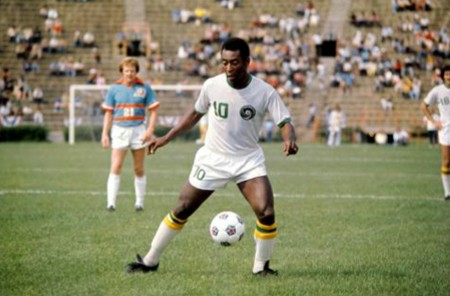
“In September Brian Phillips, founder and editor of the glorious Run of Play, wrote one of the greatest sporting essays I have ever read. Never mind the ‘blogosphere’, this made even some of Brian Glanville and Hugh McIlvanney’s efforts look tame. I really mean that. It was entitled ‘Pelé as a Comedian’ and dealt with the sheer aesthetic poetry of the great Brazilian, the disbelieving laughter his transcendent genius brings to our lips. Pelé, Brian argued, is a comedian, a man who creates chaos out of peace and thrills us by restoring that peace with dizzying ease.” The Equaliser

1950s Month: Tripping the light fantastic

“If I was to ask which British team have had the greatest impact on the formative years of European competition, who would you say? Hibernian, the first British team to play in a continental tournament? Tottenham, the first British winners of a European trophy? Perhaps Celtic, whose Lisbon Lions of ’67 defeated Helenio Herrera’s Internazionale?” The Equaliser

1950s Month: Fever, Calcio and the Danish

“As I was dealing with a near-death experience recently (the doc later, somewhat laconically, described it as a case of tonsillitis, but what does he know about disease?), oddly enough, my life didn’t flash before my eyes as you’d expect it to. Maybe my life up until now has simply been too dull to be worth a re-run? Maybe I wasn’t really dying – who knows? The fact of the matter is that the feature film in the Last Chance to See (Anything) Cinema had nothing to do with myself but a whole lot to do with a country in an epoch so foreign to us 21st century boys (and girls) that it might as well have been a long time ago, in a galaxy far, far away…” The Equaliser

The origin of pragmatism in soccer


“For around three decades after the foundation of the Football League in 1888, the game remained unchanged. Teams played with two backs, three halves and five forwards, and soccer was all about getting the ball out to the winger so he could cross for the center forward. Pattern-weaving — working the ball in neat triangles between midfield and attack – was seen as the ideal and soccer was largely formulaic.” SI

1950s Month: The Mighty Magyars


“It would be impossible to write a collection of articles on the subject of football in the 1950s without paying homage to the Mighty Magyars. One of the greatest teams to have ever graced the game, for the best part of six years Gusztáv Sebes’ Hungary thrilled audiences across Europe with their innovative and unique style, going down in history as one of the finest sporting collectives there has ever been.” The Equaliser

It’s 1950s month on The Equaliser
“The ‘Decade by Decade’ series continues in March with a look at football in the 1950s. With the game back on its feet after the Second World War, this was a decade which saw the game begin to flourish once again, World Cups resuming and a series of rich footballing narratives being played out against the backdrop of an unprecedented global economic boom and yet growing Cold War paranoia.” The Equaliser

1940s Month: Zamora, Franco and Atletíco Aviación


“The Second World War caused severe disruption to formalised footballing competition throughout Europe, but Spain was left relatively untouched as it recovered from Civil War and remained neutral and non-belligerent under the leadership of General Francisco Franco. While the majority of the continent’s leagues were suspended during the conflict, La Liga ploughed on during the 1940s and produced some fascinating narratives, not least of which was the success of Atletíco Aviación.” The Equaliser

1940s Month: While Europe burned

“On Saturday 2 September, 1939, the day after Nazi Germany’s invasion of Poland, Britain woke up to a full Football League programme. Blackpool went top of Division One with three wins from three after defeating Wolves 2-1 at Bloomfield Road, Sheffield United and Arsenal were one point behind, both also undefeated. Luton Town headed up Division Two, while Accrington Stanley and Reading led Division Three North and South respectively.” The Equaliser

1940s Month: Football and the Norwegian resistance

“The late 1930s and early 1940s had seen the political landscape of Europe dramatically altered. Having swept to power in Germany, Adolf Hitler’s Nazi Party had undertaken an aggressive military campaign which had precipitated the invasion and annexation of Austria, Czechoslovakia, Poland, Norway, Belgium, Holland, France, Romania, Denmark and the Baltic States by the summer of 1940.” The Equaliser

GOALS – “My Favourite Goal”


“Giggs – Man Utd vs Arsenal – 1999. ‘Instinct is action taken in pursuance of a purpose, but without conscious perception of what the purpose is’. Instinct can sometimes be a wonderful thing. In the professional era, sportsmen and women spend years finely tuning their skills and meticulously practicing for different scenarios. But sport, like life itself, never quite goes by the script.” Ghost Goal

Real must look to the future to topple Barca


“They say there are things in life money can’t buy. Love, happiness, health and it now seems we can add the La Liga title to this list. Real Madrid now sit 7 points behind fierce rivals Barcelona in the league. A points tally which is increased to 8 when you take into account the head to head with the 5-0 dubbing they encountered at the Camp Nou. But perhaps because of that game and Barcelona’s current unstoppable form, psychologically it may feel like 18 points.” The Oval Log

El Tel, Archigol and Los Ingleses
“So strong has Barcelona’s production and promotion of young talent been over the last few years, it is easy to forget that the club has traditionally had a more multinational feel to it. Of the team that started the 5-0 demolition of Real Madrid in November, eight were Spaniards and the same number graduates of the famous La Masia academy.” The Equaliser

1940s Month: Bob Jackson’s Pompey

“Portsmouth Football Club may have recently slipped from the upper echelons of the English game, a victim of boardroom incompetency and relegated to The Championship saddled with serious financial difficulties, but it was not long ago that they were basking in the glory of an FA Cup triumph under the stewardship of Harry Redknapp.” The Equaliser

The forgotten story of … Danish Dynamite, the Denmark side of the mid-80s

“Winning is for losers. Many of life’s more interesting stories focus on those who didn’t quite make it; who didn’t get the girl or the job or the epiphany or even the Jules Rimet trophy. Johan Cruyff said his Holland side of the 70s were immortalised by their failure to win the World Cup and, when World Soccer invited a group of experts to select the greatest teams of all time a couple of years ago, three of the top five sides won nothing: Hungary 1953, Holland 1974 and Brazil 1982. Lying 16th on the list – above any side from Argentina, Spain, Germany, Liverpool, Manchester United or Internazionale – was the Danish team of the mid-80s.” Guardian

Luis Suarez. The Architect of Football

“On 6 December of last year, FIFA and France Football announced the three finalists for the 2010 FIFA Ballon d´Or award. The result was a triumph for Spanish football, with all three coming from FC Barcelona. While the Catalan press rejoiced, the Madrid press also had a reason to celebrate. Although one of the candidates was Argentinean, the other two were Spanish. With Spain having just won the World Cup, the smart money appeared to be on either Andrés Iniesta or Xavi Hernández with the latter of the two a particular favourite. Although Iniesta scored the goal that won the World Cup, Xavi was the player who made Spain tick with his range and accuracy of passing. In Spain, it’s common to give players nicknames. If Casillas is the saint and Torres is the child then what is Xavi? A fitting name would be the architect that is if it weren’t already taken.” In Bed With Maradona

It’s 1940s month on The Equaliser

“The ‘Decade by Decade’ series continues in February with a look at football in the 1940s. Interrupted by the Second World War, the decade was in many ways a disjointed and transitional one for the game. After the seismic advances of the 1930s, conflict disrupted football’s progress during the first half of the 40s, but that did not prevent a series of fascinating stories coming to pass.” The Equaliser

1930s Month: Pentland’s Lions of Bilbao

“Athletic Bilbao, the club which has come to popularly represent Basque identity in the sporting world, was founded in 1898 and quickly established itself as one of the strongest teams in Spain. Ten Copa del Rey titles were won in the first twenty-five years of the club’s existence, but it was during the 1930s – following the establishment of the national league in 1928 – that Athletic enjoyed its greatest run of success.” The Equaliser