Category Archives: Uruguay

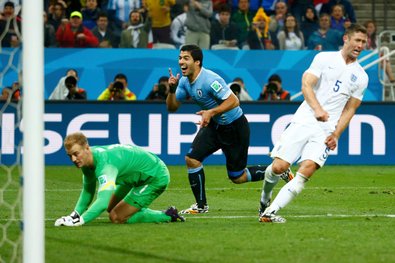
Suárez Staggers England With Finesse and Ferocity

englandcup1-sfSpan
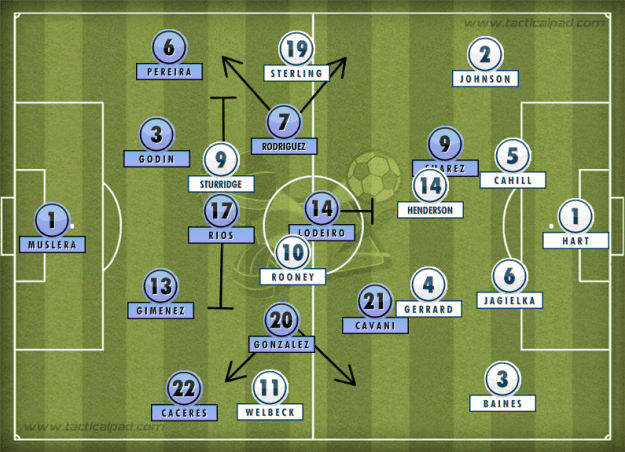
“Luis Suárez’s first goal on Thursday was a delicate touch of class, a deft header nodded in with precision and purpose and placement. Suárez’s second goal, however — the one that was a death blow for England — was something closer to a savage blast. The combination was vintage Suárez, a pure attacker who perfectly embodies the Uruguayan notion of garra charrua — that is, a mixture of will, fight and an unyielding desire to win in whatever way is required. On a chilly night at Arena Corinthians, Suárez showed his deliberate jab and then, at just the right moment, his haymaker.” NY Times

England’s vanquished players are left sad, speechless and bewildered
“One by one they stepped blinking into the brightly lit corridor of uncertainty, clasping their wash bags like comfort blankets. Daniel Sturridge, so effervescent and full of life in his pre-match interviews and now displaying an expression somewhere between fury and heartbreak. A red-eyed Wayne Rooney, eyes fixed forward. Jordan Henderson, exposed and overrun in midfield alongside his club team-mate Steven Gerrard, muttering that he had been ‘told not to stop’.” Guardian

At This World Cup, England Fans Get Their Disillusionment in First
“My late friend Alan Watkins, who died four years ago after writing a political column for fifty years, was a Welshman and also wrote learnedly on rugby. In 1996 he was discussing Tony Blair, then the Labour leader of the opposition, a year before he became prime minister. Every rugby fan knows the words of Carwyn James, the great Welsh coach who led the British Lions to a unique victory over New Zealand in 1971. Ahead of what was expected to be an unusually violent series, James told his players to ‘get your retaliation in first.'” New Republic

Restored Footage from the First World Cup: Uruguay, 1930

“The 19th FIFA World Cup is now underway in Brazil, and that gives us an excuse to revisit the first World Cup, played in July, 1930 in Uruguay. Only 13 teams participated in the tournament, and all matches were played in Montevideo, Uruguay’s capital. In the semi-finals, the United States lost to Argentina, 6-1. Uruguay crushed Yugoslavia by the same score. In the end, Uruguay, the favorites all along, triumphed over Argentina (4-2) before a home crowd of 93,000, to become the winner of the inaugural FIFA World Cup.” Open Culture (Video)

World Cup Tactical Analysis: Uruguay 1-3 Costa Rica

“After a successful 2010 World Cup, expectations were high for Uruguay. But those that haven’t followed Oscar Tabarez’ men should know that the South Americans struggled in qualifying while retaining an almost identical squad from four years back. Their opponents, Costa Rica, were being over-looked by most in the highest ranked World Cup group. But while viewers can be forgiven for this, Uruguay were guilty of almost ‘expecting’ a victory rather than earning it.” Outside of the Boot

A Few Words on Uruguay’s (Very Tight) Shirts
“I was the only person in my local café watching Uruguay vs. Costa Rica, the first game in Group D. I knew there would be more interest for England vs. Italy. Egyptian love for Latin American teams extends mostly to Brazil and Argentina.” New Republic

A Nation Teased by a Stale Promise of Supremac
“Few in Uruguay will have heard of the English man of letters Cyril Connolly. Yet his most famous phrase — ‘Whom the gods wish to destroy they first call promising’ — would not be lost on a country used to auspicious starts. The seeds of Uruguayan exceptionalism were sown early. After the country hosted and won the inaugural World Cup, in 1930, the president of the Uruguayan Football Association gave a moving speech in which he stated his expectation that the country take its place as the first among all nations.” NY Times

Costa Rica vs. Uruguay Highlights (Video)

Tomgram: Eduardo Galeano, The World Cup and the Corporatization of Soccer

sclzzzzzzz_
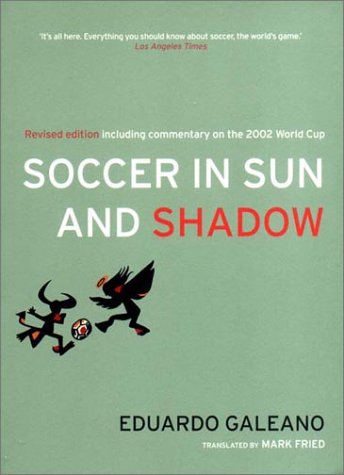
“There is a tiny universe of editors of Eduardo Galeano. I was once one of them. Carl Bromley of Nation Books is so today. For an editor, working with such an author is an experience glorious beyond describing. Think of it as to ordinary editing what ‘the beautiful game’ (soccer), World Cup variety, is to sports. With the latest round of that contest imminent, I thought the perfect teaser for TomDispatch readers would be a selection from Galeano’s classic book, Soccer in Sun and Shadow, and Galeano’s splendid literary agent Susan Bergholz agreed immediately. So, one editor to another, I asked Carl, as a literary gent and a Brit with a yen for soccer (who will be cheering for Italy), to do the TomDispatch introduction. Let me give all of you the TomDispatch Guarantee: buy Galeano’s book before the World Cup begins and you may not be able to look up long enough to catch the games! Remember, he’s just been called ‘the Pele of soccer writers’ in the Guardian.” TomDispatch

amazon: Soccer in Sun and Shadow by Eduardo Galeano

Eduardo Galeano: ‘My great fear is that we are all suffering from amnesia’

d6996b1310149d488ea49ae3992ed04
“Most mornings it’s the same. At the breakfast table Uruguayan-born author, Eduardo Galeano, 72, and his wife, Helena Villagra, discuss their dreams from the night before. ‘Mine are always stupid,’ says Galeano. ‘Usually I don’t remember them and when I do, they are about silly things like missing planes and bureaucratic troubles. But my wife has these beautiful dreams.’ One night she dreamt they were at an airport where all the passengers were carrying the pillows they had slept on the night before. Before they could board officials would run their pillows into a machine that would extract the dreams from the night before and make sure there was nothing subversive in them. When she told him he was embarrassed about the banality of his own. ‘It’s shaming, really.’ There is not much magical about Galeano’s realism. But there is nothing shaming in it either. This septuagenarian journalist turned author has become the poet laureate of the anti-globalisation movement by adding a laconic, poetic voice to non-fiction.” Guardian

Colombia and Uruguay give way to youth

“It looks as if centre-back Dante will get a game when Brazil take on Panama in Tuesday’s warm-up match. Captain Thiago Silva is carrying a knock, and is likely to be rested. Otherwise, the team picks itself. All week, coach Luiz Felipe Scolari has been training with the same lineup that won the Confederations Cup. In subsequent friendlies, Scolari has looked at variations here and there, and tested out reserve players. But that same starting eleven has been in his mind for a year now.” ESPN – Tim Vickery

Before Pelé there was Andrade

“Colette, the ‘Grand Dame of French literature’, lived with fame and scandal throughout her life. The novelist and performer caused a riot at the Moulin Rouge in 1907 when she simulated sex with another woman on stage. She seduced her stepson when he was 16, telling him: ‘It’s time you became a man.’ She had three husbands, two messy divorces and a string of lovers, both male and female. In 1924, when Paris hosted the Olympic Games, Colette met, and was captivated by, one of its participants: José Leandro Andrade. Their upbringings could not have been more different: Andrade was a Uruguayan footballer who had slept on a dirt floor in his childhood and spent little time at school. But Colette was not the only famous Frenchwoman smitten by Andrade.” Guardian

Key Battles: How to Defend

PBSOCCER_2
“How can defenders like Spain’s Sergio Ramos even hope to shut out the world-class strikers they’ll see in Brazil? It all starts at training camp with a clear strategy and a willing body double. Heading into the World Cup, most of the focus has been on the tournament’s large group of elite goal scorers: Ronaldo, Messi, Neymar, Suarez. All told, 14 goal mongers expected at this year’s Cup scored at least eight times in qualifying — and that doesn’t include the best from Brazil, which qualified automatically as host. But history shows it’s the team with the stingiest defense that hoists the trophy. Of the past five champions, all but one had the best goals-against average among the quarterfinalists. (Brazil was second to runner-up Germany in 2002.)” ESPN

2014 Fifa World Cup draw: Guide to Group D

Argentina Uruguay Soccer WCup
“Gary Lineker’s verdict… Style & formation: As qualifying went on, coach Oscar Tabarez settled on a pragmatic 4-4-2. The industrious Edinson Cavani leads the line, with Luis Suarez given licence to roam. Tabarez, however, is not afraid to switch formations, doing so in away matches and during the Confederations Cup to counteract the opposition, including playing 3-5-2 and 4-3-3. Expect him to vary it up in Brazil.” BBC: Uruguay – England – Costa Rica – Italy

The problem with the Copa America Centenario

soc_g_lionel-messi_mb_576x324
“The oldest continental competition in the world, the Copa America, was first played in 1916. Four countries participated — one of them was Chile, who have still never won it. The others were Argentina, Brazil and Uruguay, who between them have gone on to accumulate nine World Cup wins. The seeds for such triumphs were planted in the early years of the Copa America — played almost annually until the Great Depression.” ESPN – Tim Vickery

Domestic league turbulence won’t affect Uruguay at World Cup

nacionalfanviolence_576x324
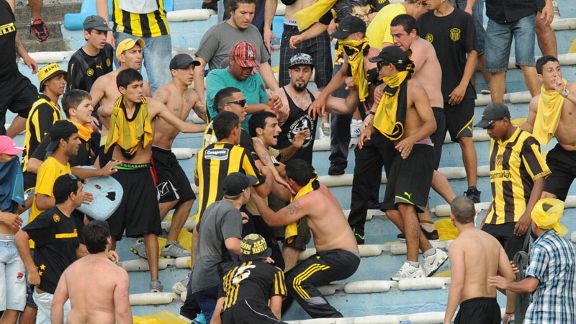
“The directors of Uruguay’s FA resigned earlier this week, and a scare story was doing the rounds suggesting that this would result in the country’s national team being kicked out of the World Cup. There was never the slightest chance of this happening. The false justification for the fear was FIFA’s hard line against government interference in football administration. But this is not what had transpired in this case. The Uruguayan government had taken measures on a subject 100 percent within its proper jurisdiction — policing policy.” ESPN – Tim Vickery (Video)

World Cup 2014: Uruguay fans are realistic but their side’s never-say-die spirit could see them spring surprise

“With a population of under 3.5 million, Uruguay’s two successful campaigns mean they have overachieved like no other nation in the history of the World Cup. Continental championships demonstrate that those two World Cups are no fluke; though squeezed between two giants in Argentina and Brazil, Uruguay have been champions of South America 15 times (including at present), more than any other side. Where does this overachievement come from? The influence of history mustn’t be underestimated. Uruguayans are proud of what they managed early in the international game’s history, and that pride leads to high standards for youngsters coming through today.” Telegraph

2014 Fifa World Cup: Gary Lineker’s guide to the eight seeds

world_cup_hosts_map_624_v4
“England have been drawn in Group D for the 2014 World Cup, meaning they will face seeded team Uruguay as well as Italy and Costa Rica. Hosts Brazil are in Group A, reigning world and European champions Spain are in Group B and three-time champions Germany are in Group G. Match of the Day presenter Gary Lineker, speaking before the draw was made, takes a closer look at the eight seeded national teams…” BBC

El Fantasma helps bitter rivals unite

“The ghost of 1950 is back to haunt Brazil. With Uruguay snapping up the last place in the 2014 World Cup, the possibility opens up of history repeating itself – of Brazil organising the party only for its tiny southern neighbour to walk off with the prize. In the final game of the 1950 tournament host Brazil needed just a draw to become world champion for the first time. It seemed to have a hand and a half on the trophy when it took the lead early in the second half but Uruguay hit back, silencing a huge crowd in the newly-built Maracana stadium to win 2-1.” The World Game -Tim Vickery (Video)

South American sides to show World Cup credentials

“Over the next few days South America’s World Cup sides will present their case for the defence. The continent’s sides made a strong showing in South Africa 2010; all five made it out of the group phase, four reached the quarter-finals and Uruguay (who had finished fifth in qualifying) made it into the semis. Naturally, good things are expected next year when the World Cup finally returns to South America. But on the evidence of the 2014 qualifiers, there could be a problem. A common theme of the campaign was teams tended to be better in attack than defence.” BBC

Uruguay’s band of brothers closes in on the World Cup

Jordan v Uruguay
“When he took the field for the playoff against Jordan, goalkeeper Martin Silva became the 28th player Uruguay have used in their World Cup qualification campaign. All of the other South American teams used more. Uruguay coach Oscar Washington Tabarez is fiercely loyal to his group of players, many of whom have been together since the 2007 Copa America. But sticking with the same players does not necessarily mean sticking with the same strategy. Uruguay can switch formations — from a back three to a back four, for example — and change approaches, sometimes with the same starting lineup.” ESPN – Tim Vickery

Jordan panic after Maxi Pereira goal sets up emphatic Uruguay victory
“Passion, desire and unity, it turns out, can carry you only so far. This was the biggest game in Jordan’s football history, but they were undone by a Uruguay side who remained admirably unfazed by a raucous crowd and had the quality to take the chances that came their way. This was a comfortable victory and next week’s second leg should be no more than a formality at which Uruguay will book their place at the World Cup, where they will be one of the eight seeds.” Guardian – Jonathan Wilson (Video)

Uruguay makes South American statement in demolishing Jordan
“It was a good 10 minutes after the final whistle had blown that Uruguay’s players, having celebrated in front of their fans, finally left the pitch. They were applauded off by the few thousand Jordanian fans who had remained, a sporting gesture but one that seemed rather to sum up the gulf between the sides. Before the game, a number of Jordan’s fans had insisted that Kalil Baniateyah and Ahmed Ibrahim would outshine Luis Suarez and Edinson Cavani, but the sense had been that mainly they were excited to have players of that stature playing in their country.” <a href=”http://sportsillustrated.cnn.com/soccer/news/20131113/jonathan-wilson-uruguay-jordan-playoff/#ixzz2kkJuHvxjSI

Oscar Tabarez More Important Than Luis Suarez and Edinson Cavani for Uruguay

“AMMAN, JORDAN–Oscar Washington Tabarez is beginning to look his age now. Four years ago, at the World Cup, with his neat navy blazers and striped ties, the carefully parted steel-grey hair and the benignly intelligent eyes, he looked like the precinct chief in a host of 70s and 80s cop shows. Now, with his limp ever more pronounced, and the skin of his face a little softer than it was, he has become the retired veteran the mavericks on the street go to when they need some friendly but unsparing advice. He remains one of the most thoughtful and astute coaches in the world game.” bleacher report – Jonathan Wilson

Uruguay: World Champions

“The Uruguay national football team has undoubtedly had a rough year. After a promising start to qualifying for the next World Cup, a run of negative results put the team’s chances in jeopardy. Uruguay ultimately advanced to a two-game playoff against Jordan for a spot in Brazil in 2014. Their 5th place finish in CONMEBOL qualification derived from a paltry 2-1-5 away record, including a 4-1 loss to lowly Bolivia, and an additional 3 home draws to weaker opposition such as Paraguay and Venezuela. Finishing below a talented Colombia team and a young upstart Chile was somewhat disappointing, but losing the last automatic qualification spot to Ecuador was shocking after Uruguay finished in 4th place in the 2010 World Cup in South Africa.” Soccer Politics

World Cup Qualifying: Standings and scenarios for Tuesday’s games

edin-dzeko-bosnia-herzegovina-world-cup-qualifying
“World Cup dreams will be realized, dashed or deferred on Tuesday as qualifying continues around the globe. On the home front, the U.S. booked passage to Brazil last month and then clinched first place in CONCACAF’s Hexagonal with Friday’s 2-0 win over Jamaica. The only thing left to play for on Tuesday night in Panama is a seed next summer. Unfortunately for Jurgen Klinsmann and Co., chances are slim. The top seven sides in next month’s FIFA ranking (beside Brazil) will be anointed. According to ESPN statistican Paul Carr, the U.S. would have to defeat Panama while the Netherlands loses at Turkey, Switzerland loses to Slovenia, Poland ties or beats England, Ecuador ties or beats Chile and Uruguay misses out on qualifying altogether. Here’s a summary of what’s at stake elsewhere. Ties in group play are broken by goal differential in all games, goals scored in all games and then assorted head-to-head criteria.” SI

World Cup 2014: Ecuador and Uruguay’s growing rivalry

IMAGEN-5380767-2
“England’s bid to reach Brazil next year could be heading towards yet another crunch game with Poland at Wembley next Tuesday, a tie which is rich in World Cup qualifying history. On the other side of the Atlantic, a contest is building up a similar pedigree. Ecuador v Uruguay in Quito, is a story whose latest chapter will be written on Friday. It is a clash with an agreeable contrast; the first kings of the global game visiting a team which, 25 years ago, were merely making up the numbers. Indeed, it was a win over Uruguay in the 1989 Copa America which first hinted that Ecuador might be on their way towards better things. Eight years later I could hardly believe my eyes as Ecuador took Uruguay apart with a 4-0 win in World Cup qualification.” BBC – Tim Vickery

Five things we learned from South American qualifiers

“… 1 — ARGENTINA KNOW WHAT THEY ARE DOING. The first team from the continent to book their place in Brazil, Argentina’s qualification might seem predictable enough – but it looked anything but in the early stages of the campaign, when coach Alejandro Sabella’s side lost to Venezuela and drew at home to Bolivia. Since then, though, the side have made enormous progress. They are not perfect.” ESPN – Tim Vickery

Under-fire Uruguay rising to the challenge

“South America’s World Cup qualification campaign has featured 35 wins for the home side — and just 11 for the away. It is a statistic that puts the value of Uruguay’s last two results in stark context. The Sky Blues had a disastrous 2012-13, suffering four consecutive heavy away defeats and making it difficult for them even to finish fifth and claim the playoff slot. But Uruguay are seldom more dangerous than when they have their backs to the wall. They have since won away from home against their two rivals for fifth place — beating Venezuela 1-0 in June, and then winning 2-1 at Peru last Friday.” ESPN – Tim Vickery

Brazil 2-1 Uruguay: Brazil through to the final after substitutes help increase the pressure

“Brazil weren’t on top form, but Paulinho’s late header sends them through to the final. Luiz Felipe Scolari brought back Paulinho after injury kept the Tottenham target out of the victory over Italy – so Hernanes dropped to the bench. Having changed his entire side for the win over Tahiti, Oscar Tabarez reverted to the side that defeated Nigeria. This was a disappointing match in technical sense, with none of the attacking players sparkling, although it was interesting in tactical sense.” Zonal Marking

Brazil reaches Confed Cup final
“Brazil’s players wept with joy inside the stadium, and Brazilian protesters were sprayed with tear gas outside it as the country’s national football team reached the Confederations Cup final despite another wave of mass demonstrations on the streets. Brazil beat neighbors Uruguay 2-1 with an 86th minute header from Paulinho in a performance that failed to reach the commanding heights of earlier games. As thousands of anti-government protesters clashed with police nearby, inside the Mineirao Stadiujm, Brazil’s footballers reached Sunday’s final in Rio de Janeiro with a patchy display.” ESPN (Video)

Uruguay 2-1 Nigeria: Tabarez switches to a back three, then to a back four, then to a back five

“Diego Forlan hit the winner on his 100th international appearance, as Uruguay unconvincingly defeated Nigeria. After a terrible performance against Spain, Oscar Tabarez brought back Diego Forlan into his starting XI, completely changed his midfield duo, and switched to a back three. Stephen Keshi swapped his two central attackers – Ideye Brown replaced Anthony Ujah, and John Ogu came in for Sunday Mba. Uruguay were a little fortunate to win this one – over the course of the game they hardly outplayed Nigeria, although they unquestionably had more quality in the final third.” Zonal Marking

Spain 2-1 Uruguay: Del Bosque changes his midfield structure, Uruguay are disorganised

“Spain’s level of dominance should have resulted in a much more emphatic victory. Xabi Alonso is unavailable for the Confederations Cup because of injury, and in his absence Vicente del Bosque changed the structure of his side, using Sergio Busquets as the sole holder, moving Xavi Hernandez into the role he plays at Barcelona, and introducing Cesc Fabregas as a number ten who could drive forward at the opposition defence. Roberto Soldado played upfront. Oscar Tabarez left Diego Forlan on the bench, with Edinson Cavani and Luis Suarez upfront. Gaston Ramirez and Cristian Rodriguez were the attacking midfielders, with Walter Gargano in the middle. Spain’s possession dominance was astonishing in the first period, as Uruguay struggled to get out of their own half.” Zonal Marking

Spain see off Uruguay in Confederations Cup

“Goals from Pedro and Roberto Soldado helped Spain to a 2-1 victory over Uruguay in the Confederations Cup in Recife on Sunday and reinforced their position as tournament favourites. Luis Suárez scored a late consolation for Uruguay but the European champions dominated the game from start to finish and could easily have won by more.” Guardian

Confederations Cup 2013: Spain remain team to beat in Brazil

heroa
“Despite some resistance from the Republic of Ireland at the Yankee Stadium, they outgunned Giovanni Trapattoni’s men 2-0 in their last game before the Confederations Cup campaign gets under way in Brazil this weekend. On Sunday, the world and European champions play their first group game against Uruguay, as La Roja begin their bid to bring yet another international trophy back to Madrid.” BBC

Uruguay’s fighting spirit comes to the fore
“Uruguay turning up for a tournament on Brazilian soil is enough to send a shudder down the local spine. The other day Pele was remembering the World Cup final of 1950, and his father in tears as the sky blues came from behind to shock the host in Rio’s newly built Maracana stadium. Now Uruguay is back once more, this time for the 2013 FIFA Confederations Cup.” The World Gane – Tim Vickery

Confederations Cup 2013: Spain team profile
“… Whether in a 4-3-3, 4-2-3-1 or 4-6-0 formation, the modern-day Spanish side, with a little help from their free-flowing Barcelona contingent, have ripped up the formation book – even winning tournaments with the false number nine/strikerless line-up. Barcelona’s Victor Valdes is expected to start the tournament as Spain’s number one goalkeeper in the major change from Euro 2012, with Iker Casillas missing out.” BBC

Face of World Cup host Brazil? Look no further than Neymar
“When the World Cup hopes and dreams of arguably the world’s most successful footballing country rest on your skinny shoulders, you’re going to need all the help you can get. It is not known what great works of literature Neymar chose when packing his suitcases for Barcelona, but he could have done worse than to seek solace in a little Shakespeare. Dank and drizzly though it can sometimes be, Santos’ Vila Belmiro stadium, our hero’s erstwhile home, is a long way from the gloomy battlements of Hamlet’s Elsinore. Nevertheless, there are more than a few parallels between the life and times of Brazil’s current idol and Shakespeare’s classic paean to troubled young manhood.” SI

Confed Cup Preview: 5 storylines to watch
“The Confederations Cup (June 15-30) is the ritual eight-team dry run designed to give the World Cup hosts the chance to iron out any kinks in their stadia and transport systems a year before the big show begins. The tournament pitches the hosts, reigning World Cup holders and six confederation champions (with Italy qualifying as Euro runners-up to World Cup holders Spain) into battle.” ESPN (Video)

A rare Confederations Cup – all the teams, for once, want to win it
“Tournaments are like birthdays: they are as significant as you want them to be. To many the Confederations Cup is a meaningless intrusion on the football calendar, a rinky-dink competition that proves nothing more than Fifa’s greed. After all, the World Cup already exists to establish the best team on the planet so what, other than money and attention-seeking, is the point of a mini-tournament between the leading teams from each continent?” Guardian

Starting anew: Deeper Spain lacks strong XI
“While club football’s evolution from a ‘team game’ into a ‘squad game’ has been widely acknowledged the past two decades, the situation at the international level remains uncertain. After all, major international tournaments are decided during the course of four weeks, rather than eight months. Whereas the speed and intensity of modern football ensures club managers frequently rotate their squad to prevent burnout in the spring, international managers often squeeze every last drop out of their regular starting XI.” ESPN – Michael Cox

Uruguay 1-1 Paraguay: Tabarez ditches his double pivot, then makes more attacking moves

int_130323_INET_WCQ_Uruguay_Paraguay
“Reigning South American champions Uruguay recorded their third consecutive 1-1 home draw – their participation in Brazil remains in the balance. Oscar Tabarez fielded a familiar core to this side – Edinson Cavani was only on the bench, with Diego Forlan behind Luis Suarez upfront, the combination that won Uruguay the Copa America final against Paraguay in 2011. The major news was in the centre of midfield, where Tabarez played Nicolas Lodeiro rather than a second defensive midfielder. Uruguyan-born Gerard Pelusso selected a cautious 4-4-2 formation for bottom-placed Paraguay, having experimented with 4-3-3 earlier in the qualification process. Oscar Cardozo and Nelson Valdez were together upfront, while Ricard Ortiz pushed forward to the left of midfield. This game started slowly before gradually developing into something quite interesting – mainly because of Tabarez’s constant chances.” Zonal Marking

In Ecuador, a Thriving Game and Prospects Galore

diaz-blog480
“It has been a difficult couple of weeks for teams named Barcelona in continental competition. Last Wednesday the Spanish version dropped a 2-0 decision to Milan in the Champions League. On Feb. 12 the Ecuadorean namesake — Barcelona Sporting Club — was denied three points in its Copa Libertadores opener when Nacional’s Álvaro Recoba set up Iván Alonso for a late equalizer in Montevideo, Uruguay. That Alonso’s goal came in the third minute of second-half stoppage time was not the worst part. Throughout the night there was a feeling Barcelona was not only going up against the Uruguayan champion, but the Chilean referee, Enrique Osses, as well.” NY Times (Video)

Never a dull moment in Bolivian football

“Firstly, let me set the scene. It’s my first game from the Bolivian LFPB (Liga del Fútbol Profesional Boliviano) with Universitario de Sucre facing Oriente Petrolero, two teams languishing in the mid-table region of the Apertura half of the competition. Going in to the game, Oriente Petrolero had drawn a mind-boggling 8 of their 11 games, and had only lost once. Universitario were just a point better off but were playing at the Estadio Olímpico Patria, where they had a fine record. Football tends, more often than not, to follow certain formulae and basic principles. Being a Bolivian football newcomer (save for a few games in the Copa Sudamericana and a harrowing experience with Aurora in the Libertadores), I applied these principles to the game and assumed it would be a turgid, boring, low quality draw. Despite my inexperience with Bolivian football, I’ve commentated on scores of South American games from Brazil, Argentina, Uruguay, Paraguay, Peru – well, you get the picture.” World Soccer

Chile Boss Bichi Borghi Felling The Heat

“‘Fuera Borghi’ (Borghi out) was the message scrawled onto Chile’s Juan Pinto Durán training complex in Macul after the 3-1 defeat to Ecuador in the World Cup qualifier. Accompanied by ‘Vergüenza nacional’ (national shame) and ‘Ladrones’ (thieves), the message was clear: changes needed to be made as Borghi’s reputation had hit an all-time low amongst fans. The messages appeared after that defeat to Ecuador and before the game against Argentina. La Roja went out against Argentina like a team possessed; hunting down the ball when they didn’t have it and rampant when they did. They moved the ball, down the wings, at electrifying speed, bombarding the Argentina rearguard with crosses.” South American Football

Uruguay still struggling to get best out of Edinson Cavani

“In the past couple of years, Uruguay have been South America’s best side. At the 2010 World Cup, they advanced further than any other CONMEBOL nation, then triumphed at last year’s Copa America. The man behind their success is Oscar Tabarez. A veteran coach who won the Copa Libertadores as long ago as 1987 and started his first spell as Uruguay coach a year later, Tabarez is a wise tactician, both methodical and ruthless with his starting selections and strategy.” ESPN – Michael Cox

Argentina 3-0 Uruguay: Messi the main man

“Argentina dominated the entire match, but took an hour to get the breakthrough. Alejandro Sabella kept a similar side to the XI that drew in Peru last month, with a couple of Manchester City players replacing a couple of recent Napoli players – Pablo Zabaleta replaced Hugo Campagnaro and Sergio Aguero returned in place of Ezequiel Lavezzi. Oscar Tabarez was without Diego Perez, Alvaro Pereira and Gaston Ramirez, so in came Walter Gargano, Martin Caceres and Alvaro Gonzales. Argentina were superior in every department – although particularly in the final third, thanks to the fluidity, movement and clever combinations of the attackers.” Zonal Marking

Uruguay still struggling to get best out of Edinson Cavani

“In the past couple of years, Uruguay have been South America’s best side. At the 2010 World Cup, they advanced further than any other CONMEBOL nation, then triumphed at last year’s Copa America. The man behind their success is Oscar Tabarez. A veteran coach who won the Copa Libertadores as long ago as 1987 and started his first spell as Uruguay coach a year later, Tabarez is a wise tactician, both methodical and ruthless with his starting selections and strategy.” ESPN – Michael Cox

Venezuela profit without kicking a ball

“A gap has opened up as South America’s World Cup qualification campaign reaches the halfway stage. Victories on Friday for Argentina, Colombia and Ecuador mean that three teams have pulled away from the pack. But the round had another winner, who did not even take the field on Friday. It was sixth-placed Venezuela’s turn to take a rest, and their position improved while they sat and watched as Uruguay and Chile, the teams above them, both lost. Three rounds ago Chile were first and Uruguay were second. Now they seem to be in free-fall. On Friday all they managed to accomplish was further damage to their goal difference – and things could get still worse for them in Tuesday’s 10th round.” BBC – Tim Vickery

Everton reverses trend with superb start to Premier League season

“Everton goes into this weekend in third place in the Premier League (ahead of West Bromwich Albion on goal difference!) and playing some of the nicest soccer around. Does David Moyes not know it is still only September? It’s been five years since his side had 10 points from the opening five games, with Everton renowned for split seasons that start badly and end well since at least 2005-06, when the Toffees lost the first three European fixtures and the domestic ties that followed them. It took an injury-time winner from Tim Cahill against Sunderland (and against the run of play) on New Year’s Eve to turn a tide that threatened to carry the club to the second tier.” SI

Higher hopes for South America’s World Cup players


“World Cup qualification in Europe has a few good games along with plenty of mismatches. In South America, meanwhile, every game in the long campaign is resonant with rivalry and relevance. The best development in the history of the continent’s national teams was the birth of the Copa America in 1916 and its frequent, at times annual, staging in the early years. It did much to spread interest in the game and raise standards.” BBC – Tim Vickery

Beaten Uruguay have no time to sulk


“In the context of a league campaign, a resounding win or a heavy defeat never ends at the final whistle. More important than the points won or lost can be the team’s reaction. Can it rally in the face of adversity, or guard against excessive euphoria? This is especially true in South America’s marathon 2014 Fifa World Cup qualifiers, when two rounds are played together, and a team can play at one end of the continent on Friday and the other the following Tuesday.” BBC – Tim Vickery

Uruguay have cause for World Cup concern


“World Cup qualification resumes in South America this Friday, with a question mark hanging over the team which have been the continent’s form side over the past two years. Might the London Olympics mark an unwelcome turning point for Uruguay? On the face of it there should be no cause for alarm. World Cup semi-finalists in 2010, Copa America champions last year, Uruguay’s senior side have gone 18 games without defeat. They have made a solid start to the 2014 qualifiers. Leaders Chile sit out Friday’s round, where a win for Uruguay would take them to the top of the table.” BBC – Tim Vickery

Sabella meshes Argentina’s abundance of attacking talent
“It is possible to have too much of a good thing. Lionel Messi, Sergio Aguero, Gonzalo Higuain, Carlos Tevez, Angel Di Maria, Javier Pastore, Ezequiel Lavezzi … no other nation comes even remotely close to Argentina in terms of attacking and creative talent. The problem has been trying to fit as many of them as possible into the same squad. It did for Diego Maradona and it did for Sergio Batista.” SI – Jonathan Wilson

Trouble atop the table, hope at the bottom
“With Euro 2012 followed by the season’s big kickoff and the excitement of the transfer window, only now is Europe turning its attention to the need to qualify for the next World Cup. South America, meanwhile, is in a very different situation. Sights are already firmly trained on winning a place in Brazil 2014. The continent’s marathon qualification tournament is a third of the way through. This Friday, action will get under way in the second year of a three-year campaign. So far the soccer has lived up to its billing as the most competitive World Cup qualifiers on the planet.” ESPN

The messy history of Olympic football has robbed it of a coherent narrative


“Part of the allure of the World Cup is that, despite changes to format, entrants, moments in early history when certain European countries refused to send teams to South America one year and vice versa the next, the tournament has managed to maintain a linear quality stemming from a basic competitive consistency. One can trace, for example, the narrative thread from Brazil’s 2002 World Cup win back to its lacklustre turn in 1994 when Baggio missed, through to its peak in 1970 when Pele hosted the Jules Rimet trophy, all the way to 1950 when Ghiggia scored Uruguay’s winning goal in the 79th minute leaving the Maracana in deathly silence. There are recurring heroes and villains, classic semifinals, great teams that never won (the Netherlands, Hungary), touchstone moments that changed the direction of the sport. Even the most casual soccer person will be able to recount in a reasonably dependable chronology.” The Score

Can Uruguay roll back the years at London 2012?
“The Paris Olympics of 1924 are best remembered in Britain for providing the backdrop to ‘Chariots of Fire.’ But for all the heroism of Messrs Liddell and Abrahams, something happened there with far greater consequences – the birth of modern football. No one knew much about Uruguay as they sailed their way across the Atlantic to take part in the football tournament. But they strolled to the gold medal, and did it with a balletic, artistic style of play which captivated spectators and set off a fever for the game. Four years later, to prove it was no fluke, Uruguay won the gold medal at the Amsterdam Olympics. Argentina came across as well, and they took the silver.” BBC – Tim Vickery

Strange things happen at a football Olympics – Simon Kuper
“In 1996, the Nigerian football team arrived at the Atlanta Olympics in their usual financial chaos. They stayed first in a college dormitory, later in a cheap motel. Most days they slept late, and then went for brunch at a Chinese restaurant. Their Dutch coach, Jo Bonfrere (known by Nigerian custom as ‘Bonfrere Jo’) paid for the meals out of his own pocket. On the field the Nigerians attacked frantically and won gold – the first African nation ever to do so in the football Olympics. Nwankwo Kanu, their ‘Lucky Skipper’, said of his last-gasp equaliser in the semi-final against Brazil (after Nigeria had been 3-1 down): ‘That goal was the most beautiful moment of my life.’” MIO Stadium

Olympic Football – The Real Thing?
“BBC football commentator Jonathan Pearce got through last Friday evening without once name-checking his current love…Cristiano bloody Ronaldo. He also avoided one word you would have thought key to his commentary on a football match between Great Britain and Brazil. Britain. In an age where succinct branding is so important (and Google “Bill Hicks advertising marketing” for my “view” on such things), “Team GB” is about as much detail as the modern sports fan is deemed capable of understanding. So Stuart Pearce’s hastily-flung together team of B-list England stars and most of the best of the Welsh were “Team GB” for the night. Maybe if they had the ball long enough to force Pearce to use two descriptions…” twohundredpercent

Juan Alberto Schiafffino and the Demise of Uruguay


“Juan Alberto Schiaffino is now 51, and it’s 34 years since he was given the opening to launch a career which brought him fame as the world’s most expensive footballer. Today Schiaffino lives on the outskirts of Montevideo, his native city, in a spacious villa out towards the airport. ‘I’m not rich,’ he’ll tell you. ‘But I’m not poor either.’ Maybe that’s because he’s stayed out of football for most of the 15 years since he retired, after closing a glorious career with two years as a utility player at Roma in Italy. His steady determination to keep football at arm’s length may also have something to do with the fact that his looks still belie his years.” In Bed With Maradoda

Continental shift: why the Olympics mean so much to South America

“It is fair to say that, historically, South America has not made a huge impact on the Olympics. While it is true Brazil is working hard to broaden its sporting base, of the 20 gold medals the country has won, over half have come in the last four Games. Argentina has picked up 17 golds, but its glory days are long gone. In the late 1940s and early 1950s, the Peron government invested heavily in a wide range of sports and leading athletes were closely identified with the regime, but all that ended when Peron was deposed in 1955. Since then, Argentina has claimed just four gold medals – two of them in the last two football tournaments.” World Soccer – Tim Vickery

South Americans ready to stop Spanish stroll

“Spain’s win at Euro 2012 – their third consecutive major tournament win – has sparked off all kinds of comparisons in the bar room debate over the best international team of all time. Of course, such conversations have a strong subjective component, but it is hard to formulate arguments against the facts – and a fourth consecutive trophy will surely tip the balance in Spain’s favour. But title number four looks set to be the hardest of the lot. It entails doing what no European team has ever done – winning the World Cup on South American soil when the world come to Brazil in 2014.” BBC – Tim Vickery

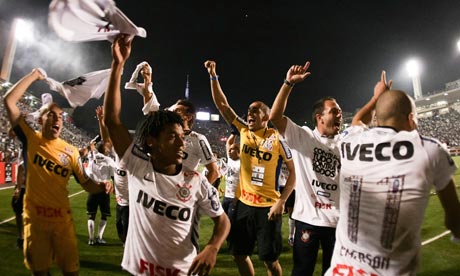
Corinthians finally break their duck as Emerson sees off Boca Juniors


“By the end, Boca Juniors had been so comprehensively beaten that, as the South American football expert Rupert Fryer joked, they could not even raise themselves for the traditional post-Copa Libertadores final punch-up. Corinthians won 2-0 after a 1-1 draw in the first leg but the gulf between the sides was so vast, the chances of a comeback so slight, that it may as well have been quadruple that. And so, in their centenary year, seven months after the death of Sócrates, the most iconic player in their history, Corinthians won the Copa Libertadores for the first time. No more will there be cracks about ‘the 100-year-old virgin’.” Guardian – Jonathan Wilson

Corinthian values
“The 2012 Copa Libertadores final ended up being fought out between two of South America’s biggest clubs. Boca Juniors, one of the competition’s most successful sides, who have six titles and are only one behind all-time record holders Independiente, and Corinthians, a club that despite their grand stature were hoping to win their first ever Copa. After a hard-fought couple of legs, it was Corinthians who came out on top, to become the 23rd different club to win the trophy.” ESPN

Making History In the Copa Libertadores Final


Independiente with the 1975 Copa Libertadores trophy
“This year’s Copa Libertadores final, between Boca Juniors and Corinthians, is a truly heavyweight clash. On and off the pitch, the two combatants are giants of South American football. They are both current national champions and hold 28 league titles and four national cup titles between them. They are the most popular clubs in their respective megacities, beloved for their working-class roots, and count their supporters in the tens of millions.” In Bed With Maradona

Corinthians close in on Libertadores dream
“Some 20 years ago, Corinthians director Luis Paulo Rosenberg made a promise to himself. He said, ‘[When we win the Copa Libertadores] I want to buy a bottle of cachaca (the local moonshine), drink it all myself and sleep in the gutter, drunk.’ He has never been closer to buying that bottle. In the 53rd version of the South America’s Champions League, the Brazilian giants have made it through to the final at last. They are two games away from lifting the trophy – the final is played on a home and away basis with the first match on 27 June and the return leg on 4 July.” BBC – Tim Vickery

Lionel Messi hat-trick leads Argentina to 4-3 win over Brazil

“The summer friendly has become a familiar genre for American fans, but this felt different. For one thing, Brazil and Argentina are perhaps the only teams in the world able to draw more than 80,000 people in the same time slot as Germany-Portugal — a European Championship game that actually matters. For another, it provided another chance to compare Neymar and Lionel Messi, excellent players in their own right and proxies in the cold war between Pele and Diego Maradona.” Guardian

4-4-2 G4M3 TH3ORY 4-3-2-1 4-2-2-2 3-4-1-2
“Brazil finds itself in an awkward position. After a desperately disappointing quarterfinal exit in the 2011 Copa América, the Seleçao has three years to put it right with only the Olympic Games this year and the Confederations Cup next in the way of ‘proper’ matches. (Even then, the Olympic Games allow only three players over the age of 23, and the quality of opposition in the Confederations Cup is questionable, as the major nations seem unsure of the tournament’s importance.) Other teams may complain about qualifiers, but they do at least offer an opportunity for competitive games.” Howler – Jonathan Wilson

Euro 2012 – a World Cup without Brazil?

“A Rio newspaper on Sunday asserted that the European Championship is a World Cup without Brazil and Argentina. It is an expression used on both sides of the Atlantic – but that does not make it fair. European teams have disputed the last two World Cup finals but the continent also provides some of the dullest teams in the tournament. The phrase is unfair on Africa and Asia, where South Korea have made a consistent contribution to recent World Cups. If they needed home advantage to reach the semi-finals in 2002, then so did England in 1966 and France in 1998 to register their only wins.” BBC – Tim Vickery

End of the road for Ronaldinho’s Flamengo

“While Europe’s Champions League is down to the last four, the South American equivalent, the Copa Libertadores, is whittling down its field to the 16 teams who will go into the knockout phase. Twelve places have so far been filled, with some high drama along the way. For a few sweet seconds, for example, Flamengo of Rio thought they had saved themselves from elimination.” BBC – Tim Vickery

Benfica’s Brazilian import-export connection

“If they were unable to do it in front of their own fans, can Benfica manage to beat Chelsea at Stamford Bridge this Wednesday? Some might make the point that they were hardly at home last week. The Lisbon giants kicked off without a single Portuguese player – and with an extraordinary complement of nine South Americans in their starting line-up, plus another on the bench (alongside a Brazilian-born Spaniard), and one more ruled out by injury. And that is not even the half of it. Benfica have a further 17 South American players out on loan with other teams.” BBC – Tim Vickery

Can Brazil rely on David Luiz?

“The World Cup can be a cruel thing. No matter how well the team is doing in the competition, it need not take a bad game, or even a bad half, for them to be eliminated. A bad few minutes can be enough – as Brazil know very well. Brazil’s team in the last World Cup in South Africa may not have been to everyone’s taste, but results were excellent in the two years leading up to the tournament, and at half-time in the quarter-final against Netherlands few would have bet against them. Yet, in a matter of minutes, a 1-0 lead evaporated into a 2-1 deficit, and they were back on the plane home.” ESPN – Tim Vickery

Copa Libertadores Week One Round-up

“All the results from week one of the 2012 Copa Libertadores. Velez Sarsfield secured a comfortable win in the tournament opener as they overcame Defensor Sporting 3-0 in Uruguay. After going up just before the break through David Ramirez there was no doubt they would see the game out. Mauro Obolo and Seba Dominguez, with a scorching free kick, added the other goals.” Purple Patch

Copa Libertadores a cradle of talent

“This year’s major international tournament, the European Championship, was first disputed in 1960 – which makes it a mere youngster in comparison with the South American version, the Copa America, held as far back as 1916. But in terms of club competitions, rather than national teams, the seniority is reversed. The competition now known as the Champions League, originally the European Cup, first kicked off in 1955. The South American equivalent, the Copa Libertadores, only came to life five years later – and was a conscious attempt to emulate the European competition, so that the champions of football’s two traditional continents could fight it out for the world title. Why the discrepancy? It is not too hard to explain.” ESPN – Tim Vickery

Jose Pekerman takes Colombia back to the future

“Pep Guardiola as coach of Argentina’s national team? It was an idea floated recently by Argentine FA boss Julio Grondona, but as nothing more than a pipedream. It is very, very hard to imagine Argentina having a foreign coach. Same with Brazil. The idea was debated briefly in the Brazilian press just over a decade ago. But that was in exceptional times, when the national team were in danger of not qualifying for the 2002 World Cup.” BBC – Tim Vickery

Vargas and Neymar battle for player of the year accolade

“In the last competitive game of the South American season, Eduardo Vargas scored a goal that made sure Universidad de Chile won the domestic title, and also highlighted why Napoli are taking him across the Atlantic. Vargas broke from the halfway line. Cobreloa defender Sebastian Roco, worried about his pace, kept backing off. Vargas’ control of the ball at pace was so good that he was able to do two things.” BBC – Tim Vickery

El Bielsa De Los Pobres


“In the presence of more illustrious South American nations – Brazil’s financial strength allowing clubs to compete with their European counterparts, Argentina’s continued production of the world’s most sought after forwards and Uruguay’s successful national team, reaching the World Cup semi-final and winning the Copa America in the last 18 months with a population similar to Wales – Chilean football is silently flourishing. Or it was, until Universidad de Chile, known as La U, decided to attract attention to the west coast of South America by creating history and breaking records, all while playing some of the most exciting football in world football.” In Bed With Maradoma

La U accomplishments unforgettable despite defeat

“It is finally over. After 36 games, the unbeaten run of Universidad de Chile came to an end last Thursday when they went down 2-1 to Santiago rivals Universidad Catolica (an interesting side themselves – look out for right-back Stefano Magnasco and left-footed striker Kevin Harbottle). The long awaited defeat of ‘La U’ (the previous one was in July) came in bizarre circumstances. At 1-1 and with the game in stoppage time, they looked in total control – until the usually excellent midfielder Marcelo Diaz misplaced a pass out of defence and Catolica’s Jose Luis Villanueva fired in a cross shot to win the game.” BBC – Tim Vickery

Universidad de Chile take the 2011 Copa Sudamericana crown in style


“The club of the moment? Universidad de Chile: sweeping up trophies in their domestic league, unbeaten in 35 games, and this week crowned Copa Sudamericana champions, their first ever continental title. More interesting than their success has been their style of play. Coming 18 months after Marcelo Bielsa took Chile to the World Cup having played dynamic, quick football with heavy pressing, usually in a 3-3-1-3 formation, his fellow Argentine Jorge Sampaoli is doing something similar.” Zonal Marking

Copa Sudamericana champions face uphill struggle to hold onto key players
“The best team in South America face an uphill struggle to hold onto their prize assets. With a crushing 4-0 aggregate victory over the formidable LDU Quito, Universidad de Chile secured their first ever continental title. The comprehensive victory ensures La U can be counted as one of the best teams on the continent. With Copa Libertadores football secured for 2012, they now face the task of holding on to their key players and push on to become one of the greatest teams in the recent history of South American club football.” Purple Patch

Paraguay’s hooligan problem is getting out of control
“Six games in 2011, four in just over a month, have been suspended in Paraguay due to crowd violence. The latest suspension came on last weekend’s crunch game between league leaders Libertad and title chasers Cerro Porteño, two points behind with three games to play. With Cerro Porteño leading one-nil at half time the players and officials came out ready for what was set to be a thrilling and potentially season-defining 45 minutes of football. But before the second half could begin a flare thrown from the Cerro Porteño end struck the linesman who had to leave the stadium in an ambulance.” World Soccer

Suarez skill complements Uruguay teamwork


Luis Suárez
“There was a little run and a cracking left-foot shot from outside the area. There were two headers, one classic, the other bundled in after sound reading of the situation. And to complete the set there was a drilled, first-time, right-footed cross shot. Luis Suarez showed the full range of his astonishing talent last Friday, scoring all the goals in Uruguay’s 4-0 World Cup qualifier win over Chile. It was breathtaking stuff.” BBC – Tim Vickery

World Cup qualifying 2014: Argentina 1 – 1 Bolivia: match highlights
“Argentina’s qualifying campaign for the 2014 World Cup hit another bump in the road on Friday afternoon where, in the glorious Monumental sunshine, Bolivia took the lead and eventually held the hosts to a 1-1 draw in the third round of qualifiers. Marcelo Martins opened the scoring in the 56th minute, only for Argentina – who dominated without overly impressing – to equalise through Ezequiel Lavezzi just seconds after he’d taken to the pitch. In the first half, Gonzalo Higuaín saw an early opener disallowed due to a foul… on Lionel Messi in the buildup. You can see the highlights (in HD if you’re so minded) right here.” Hasta El Gol Siempre (Video)

Argentina rallies to draw Bolivia 1-1 in qualifier

“Argentina’s poor start in South American World Cup qualifying continued on Friday with substitute Ezequiel Lavezzi scoring in the 60th minute to salvage a disappointing 1-1 draw against Bolivia. Marcelo Martins put Bolivia ahead in the 56th, capitalizing on an error by Argentina defender Martin Demichelis. Lavezzi equalized four minutes later with his first touch after coming on for Ricardo Alvarez.” SI

Suarez scores four as Uruguay crush Chile 4-0
“Uruguay striker Luis Suarez scored all four goals as the Copa America holders crushed Chile 4-0 on Friday to stay top of the South American 2014 World Cup qualifying group. Suarez scored twice in each half, his goals spanning a 30-minute period in which Uruguay devastated Chile, who went into the match following coach Claudio Borghi’s dismissal of five of his players for indiscipline in midweek.” SI