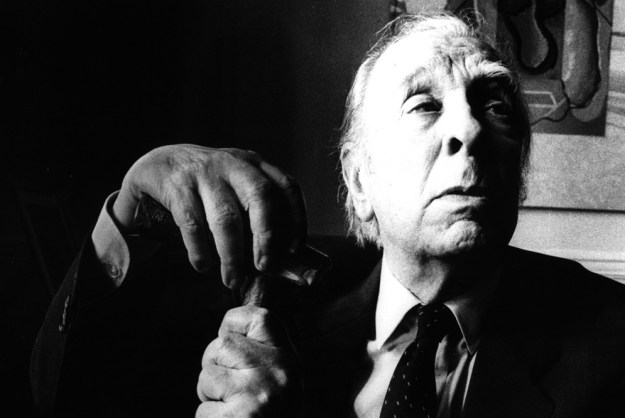
“‘Soccer is popular,’ Jorge Luis Borges observed, ‘because stupidity is popular.’ At first glance, the Argentine writer’s animus toward ‘the beautiful game’ seems to reflect the attitude of today’s typical soccer hater, whose lazy gibes have almost become a refrain by now: Soccer is boring. There are too many tie scores. I can’t stand the fake injuries. And it’s true: Borges did call soccer ‘aesthetically ugly.’ He did say, ‘Soccer is one of England’s biggest crimes.’ And apparently, he even scheduled one of his lectures so that it would intentionally conflict with Argentina’s first game of the 1978 World Cup. But Borges’ distaste for the sport stemmed from something far more troubling than aesthetics.” New Republic
Category Archives: Argentina
Restored Footage from the First World Cup: Uruguay, 1930
“The 19th FIFA World Cup is now underway in Brazil, and that gives us an excuse to revisit the first World Cup, played in July, 1930 in Uruguay. Only 13 teams participated in the tournament, and all matches were played in Montevideo, Uruguay’s capital. In the semi-finals, the United States lost to Argentina, 6-1. Uruguay crushed Yugoslavia by the same score. In the end, Uruguay, the favorites all along, triumphed over Argentina (4-2) before a home crowd of 93,000, to become the winner of the inaugural FIFA World Cup.” Open Culture (Video)
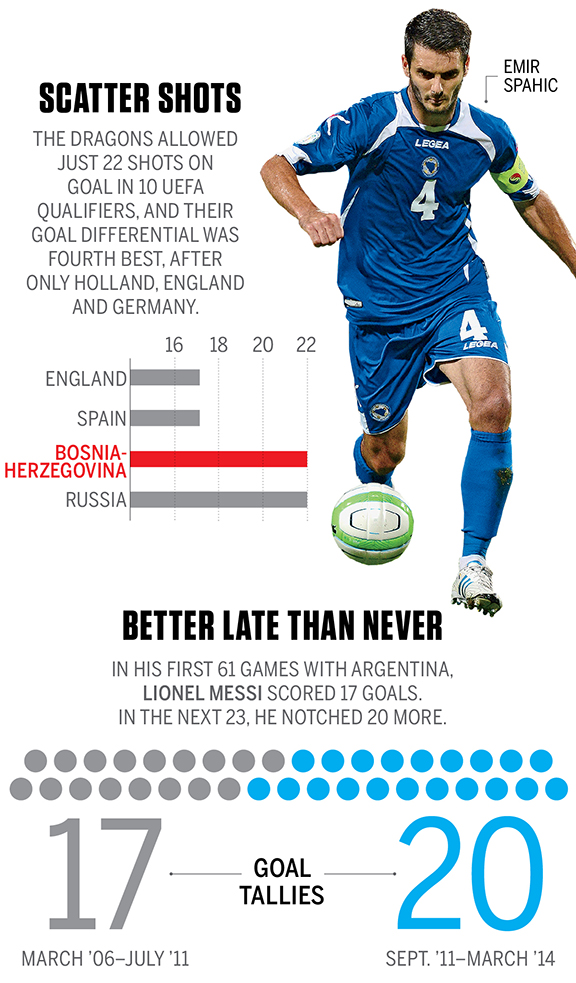
Lionel Messi relishes switch to 4-3-3, deals dagger to Bosnia-Herzegovina
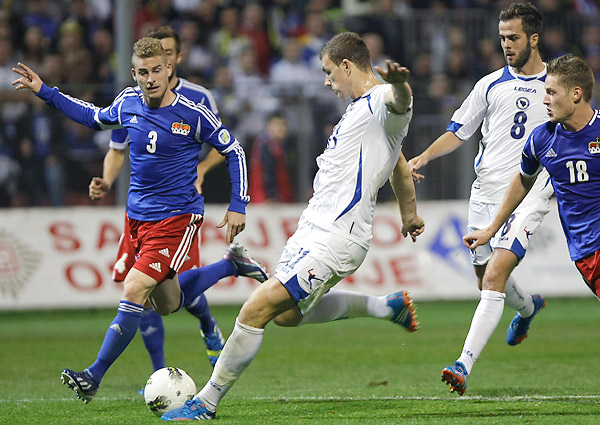
“It was a win but far from a convincing one. For much of the 62 minutes between Argentina’s first goal and its second, Bosnia was the better side but it was undone first by a moment of ill-fortune and then by a scintillating goal from Lionel Messi. In the estimation of Alejandro Sabella, the Argentina coach, this was a 6/10 performance with plenty of room for improvement. Messi had had an awkward night. He didn’t play badly as such, but too often he was crowded out, too often forced deep by Bosnia’s pressing.” SI – Jonathan Wilson
World Cup 2014: Lionel Messi shines after tactical change

“On the eve of the Argentina-Bosnia game, a Brazilian newspaper came up with a cruel statistic. In one World Cup game, Neymar had scored more World Cup goals than Lionel Messi had managed in his entire career. The Brazilian was leading by two to one. The little wizard has now levelled the score, and did it in style in his first ever game in Rio’s iconic Maracana stadium. His strike, which turned out to be the winner in Argentina’s 2-1 victory over Bosnia, is the moment a packed crowd will guard in their memories of Sunday’s game. It was Messi at his best, cutting in with the ball tied to his left foot, exchanging quick passes with Gonzalo Higuain and curling a shot in off the post. Without a slight deflection off a Bosnian defender the ball would probably have gone just wide, but few would complain – apart from Bosnians, and some Brazilians.” BBC
Lionel Messi lights up World Cup with stunning strike in Group F victory as Argentina triumph against Bosnia
“Messi at Maracana: what an event. This was part-homage to one of the game’s greats and part-launch of Argentina’s World Cup campaign. The two themes were inevitably intertwined as Lionel Messi embarked on his mission, using his phenomenal footballing capabilities to try to guide his country to victory in these finals that are already being hailed as one of the finest ever. The tone of the tournament has been on attacking and here it was Messi’s turn. He was short of his highest standards, short of the brilliance that has defined his Barcelona career but he still created Argentina’s first and then scored their second, giving the feeling of a special cameo being performed in front of an audience of 74,738, the majority enrapt by his work. It was astonishing to think that this was only his second ever World Cup goal in nine games.” Telegraph – Henry Winter
World Cup Tactical Analysis: Argentina 2-1 Bosnia
“In a game that was expected to be Argentina’s announcement of intent in this World Cup, the favorites met stern opposition in the form of Bosnia and Herzegovina. And though Argentina certainly did the business by walking away with the 3 points, it may have been Bosnia and Herzegovina who perhaps made the bigger statement.” Outside of the Boot
Argentina vs. Bosnia in GIFs
“Messi strikes in Argentina’s opener at the Maracanã. What else could a fan ask for? Argentina and Lionel Messi in Brazil’s greatest stadium, the Marcanã in Rio. Will Argentina be there on July 13? Maybe, maybe not, but it would start today for Argentina against talented World Cup first-timers Bosnia. Let’s look at our favorite GIFs.” Fusion (Video)
World Cup 2014: group stage, day 4. Switzerland 2-1 Ecuador. France 3-0 Honduras. Argentina 2-1 Bosnia.
“… Argentina 2-1 Bosnia. Alejandro Sabella made the competition’s biggest tactical error so far with his use of a 3-5-2, but he had the intelligence to correct it at half-time. Argentina shape. This match was basically all about Argentina’s formation. Throughout qualification they had one of the most settled sides and formations around, and while they sometimes played a 3-5-2 / 5-3-2 system, this was only away from home, often when playing at altitude. It was a highly defensive plan B. It was very strange, then, that Sabella decided to use that system in Argentina’s opening game.” Zonal Marking
While the World Watched
![]()
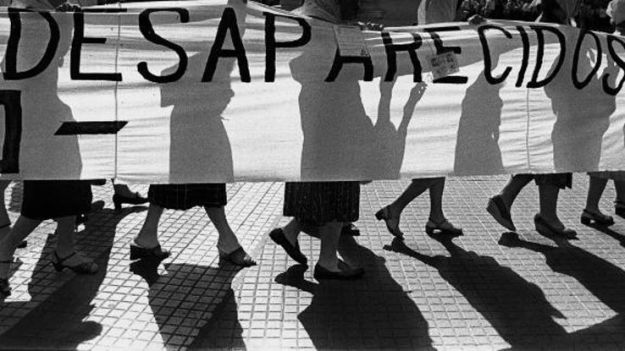
1978 World Cup and the simultaneous political strife …
“INSIDE A BUENOS AIRES restaurant named El Cuartito, sky-blue paint covers the walls, along with photographs and banners from important athletes and teams. In the center of the largest wall is a shrine to Diego Maradona, the star of the 1986 World Cup. That title is so important that Maradona, a recovering drug addict, still basks comfortably in a nation’s warming love and goodwill. People celebrate the ’86 title with vivid street art murals, and with photos and signed jerseys and posters in nearly every place of business, including El Cuartito. The restaurant celebrates civic heroes, which is why one particular omission is jarring. Argentina has won two World Cups, the famous one in 1986 and the other just eight years before, in 1978, when Argentina played host. That team is barely honored at all inside El Cuartito. In the back corner of the main room, as far away from the door as you can get, hang two team photos. That’s it.” ESPN
2014 World Cup Roundtable: Planet Futbol’s prediction panel
“The 2014 World Cup kicks off Thursday, when Brazil and Croatia open the highly anticipated competition in Sao Paulo. Every World Cup is met with excitement and intrigue, but there’s something extra special about the 2014 edition. Perhaps it’s the host and its tradition of excellence. Perhaps it’s the loaded tournament field. Or perhaps it’s that transcendent stars like Lionel Messi and Cristiano Ronaldo are in their primes at the most ideal time. Regardless, there is quite the chapter of international soccer that is on the cusp of being written. Our reporters on the ground in Brazil — Grant Wahl, Brian Straus, Jonathan Wilson and James Young — and our contributors throughout the tournament — Liviu Bird and Ben Lyttleton — offer their picks as the world’s spotlight gets firmly planted on Brazil for the next month.” SI
The Burden of Being Messi
“In much of Argentina, where Lionel Messi lived until he was 13, native speakers replace the ‘y’ sound with a ‘sh’ sound. Yo, the personal pronoun for ‘I,’ becomes ‘sho,’ and calle, which other Spanish speakers would pronounce ‘ka-yay,’ becomes ‘ka-shey.’ The sound gives Argentine Spanish a slurry softness that resembles aspects of the Portuguese spoken in Brazil. More important to this story, that ‘sh,’ and the fact that Messi has retained it all his life, has at times been the sole lifeline between the greatest soccer player in the world and the country he plays for.” NY Times
World Cup 2014: Rio horror show or a samba sensation?
“Last time the World Cup was held in Brazil, in 1950, it was designed as the propaganda centre-piece of Getúlio Vargas’s Estado Novo, the concrete sweep of the Maracanã, a modernist wonder that would be reflected in Oscar Niemeyer’s designs for the new capital, Brasília. Football, though, can be delightfully unpredictable and rather than consecrating the new Brazilian state, the World Cup offered a national disaster – ‘our Hiroshima’, as the playwright Nelson Rodrigues tastelessly put it – as Brazil, needing only a draw in the final game to seal the title, were beaten by Uruguay.” Guardian – Jonathan Wilson
Brazil will not be perfect but there should be much to savour over the coming weeks
“Inspired by the idea of covering the 2014 World Cup, Danish journalist Mikkel Jensen studied Portuguese and based himself in Brazil to observe the build up to the big kick off on June 12. But in the middle of April he went back home, proclaiming that ‘the dream has become a nightmare.’ He had come to the conclusion that the tournament was doing nothing to help the ordinary Brazilian – indeed, he felt that in some cases it was even making things worse, and he no longer wanted to be part of it.” World Soccer – Tim Vickery
2014 Fifa World Cup: Guide to Argentina’s Group F

“Style & formation: Argentina often fielded a bold 4-3-3 formation in qualifying, although a more conservative 5-3-2 was deployed for tricky away fixtures. The former system allows Lionel Messi to play as a classic number 10 behind two strikers – typically Manchester City’s Sergio Aguero and Napoli’s Gonzalo Higuain – who stretch play. But with Angel Di Maria deployed as part of a midfield three, the formation offers little defensive protection.” BBC – Argentina, Bosnia-Hercegovina, Iran, Nigeria
World Cup 2014 Tactics: How will Argentina set-up at the 2014 FIFA World Cup?
“The two-time winners topped the South American qualification for the 2014 FIFA World Cup and, as ever, will go into the tournament as one of the favourites. An Albiceleste victory on Brazilian soil would be the perfect way to rub salt into the wounds of the hosts and Alejandro Sabella’s men will be desperate to repeat the feats of ’78 and ’86.” Outside of the Boot
Portrait Serial Winner Luis Suarez Soccer Most Beautiful Player
“BEFORE GETTING TO the alleged mob hit or the mystery of the missing referee, there should be an explanation about how this quest began. An assigned profile of Luis Suarez led to a stack of things to read about his past. Whether it was a tabloid calling him Cannibal! or The New York Times calling him Luis Alberto Suarez Diaz, the portrait is of a cheat and a lunatic. If someone breathes on him near the goal, he falls down like he’s been knifed. He has bitten an opponent. Twice. And, back in his childhood in Uruguay, there’s an oft-reported incident that serves as explanation, or maybe proof, that he is, in fact, batshit crazy. When Suarez was 15, overcome with anger, he headbutted a referee and received a red card in a youth match, making the man’s nose bleed ‘like a cow,’ as a witness said.” ESPN (Video)
Key Battles: How to Defend

“How can defenders like Spain’s Sergio Ramos even hope to shut out the world-class strikers they’ll see in Brazil? It all starts at training camp with a clear strategy and a willing body double. Heading into the World Cup, most of the focus has been on the tournament’s large group of elite goal scorers: Ronaldo, Messi, Neymar, Suarez. All told, 14 goal mongers expected at this year’s Cup scored at least eight times in qualifying — and that doesn’t include the best from Brazil, which qualified automatically as host. But history shows it’s the team with the stingiest defense that hoists the trophy. Of the past five champions, all but one had the best goals-against average among the quarterfinalists. (Brazil was second to runner-up Germany in 2002.)” ESPN
UFWC World Cup Classics: Argentina vs Netherlands, 1978
“The Netherlands had beaten Italy 2-1 to reach their second consecutive World Cup final, and to deprive the Italians of the UFWC title. Dutch defender Ernie Brandts had scored for both sides in that game, with Arie Haan getting the winner. The Oranje were looking impressive despite the fact that they were without star man Johan Cruyff, who had stayed at home to consider his priorities following an alleged kidnap attempt on his family. The hugely experienced Dutch team still featured the likes of Jonny Rep, Johan Neeskens, big keeper Jan Jongbloed, and troublesome twins Willy and Rene Van der Kerkhof.” UFWC
World Cup Watch: Mario Balotelli, Sergio Aguero, Louis van Gaal
“The World Cup is only 37 days away, with the opening match between host nation Brazil and Croatia taking place in Sao Paulo on 12 June. BBC Sport, with the help of European football expert Andy Brassell, is taking a weekly look at happenings from across the world of football and what impact they could have on the tournament in the summer.” BBC
The problem with the Copa America Centenario

“The oldest continental competition in the world, the Copa America, was first played in 1916. Four countries participated — one of them was Chile, who have still never won it. The others were Argentina, Brazil and Uruguay, who between them have gone on to accumulate nine World Cup wins. The seeds for such triumphs were planted in the early years of the Copa America — played almost annually until the Great Depression.” ESPN – Tim Vickery
San Lorenzo look to divine alignment to help break Copa Libertadores duck

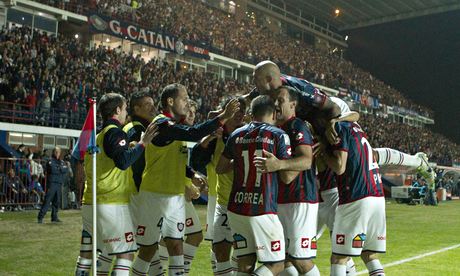
“These are unexpectedly heady times for San Lorenzo. They are the Argentinian champions, and Wednesday night’s 1-0 over Grêmio in the first leg of their last-16 tie took them a step closer to winning the Copa Libertadores for the first time. There’s a long way to go yet, but this is a ferociously competitive side blessed with an exceptional young forward in Ángel Correa and, moreover, they are playing with a self-belief that defies rational explanation.” Guardian – Jonathan Wilson
Argentina’s 10 Best Home-Based Talents Bound for Europe

Natacha Pisarenko
“Argentina has a reputation as a footballing giant for a good reason. With the possible exception of Brazil, no other country exports so many wonderful talents across the world, giving leagues from Spain to Sweden and Italy to Israel a South American flavour. As the Torneo Final reaches its closing stages, many of the latest generation of youngsters are already being watched attentively by European scouts, hopeful of finding the next Messi or Kun Aguero. But who are the top young players currently playing in the Primera Division?” Bleacher Report
Brazil 2014 – Messi’s crowning glory?
“When Lionel Messi received the honour of a fourth successive Ballon d’Or in January 2013 the record books had been rewritten. The Argentinian forward had surpassed Michel Platini’s haul of three successive FIFA World Player of the Year awards with Juventus and cemented his place as one of footballs all time greats at a mere 25 years of age.” backpagefootball
Argentina fret over form of Lionel Messi and fitness of Fernando Gago

“Football is always, ultimately, about compromise. Everything had been looking rosy for Argentina, who had qualified for the World Cup – for once – with games to spare and the sense of a cohesive team coming together, but then the injuries began. When the draw is made, the World Cup exists in a world of perfect possibility and you imagine every player at peak form and fitness, but it is never like that, and the job of a manager is always to balance the idea with what is possible.” Guardian – Jonathan Wilson
Lionel Messi’s Argentina better for Carlos Tevez absence
“In a last-gasp attempt to get the stocky Juventus striker on the plane to Brazil, an Argentine musician has written a tango for Carlos Tevez. Daniel Ursini is using the medium of music to send a message to national team coach Alejandro Sabella, once an elegant midfielder for Leeds and Sheffield United. Entitled ‘Sabella, you’ve forgotten Carlitos’ the song’s melancholy tones accuse the coach of having taken the wrong path. ‘You can’t be so stupid as to leave out one of Argentina’s most popular players,’ argues Ursini. A year ago, Ursini wrote a song to mark the birthday of Lionel Messi, and separate songs for the two stars may well have been a wise move because it could boil down to a choice between one or the other in the Argentina national team. And that is not a particularly difficult decision to take.” BBC – Tim Vickery
Chile tactics will ask a lot of the Socceroos
“In the final of the 2004 Copa America in Peru, Argentina dominated an experimental Brazil side. With three minutes to go La Albiceleste went 2-1 up. Surely the title was won. But with the last kick of the game, Brazil scored the equaliser. Argentina blundered into the penalty shootout with the air of men who had been blinded by the light, and Brazil kept its nerve to lift the trophy.” The World Game – Tim Vickery (Video)
World Cup 2014: Man Utd’s Valencia key to Ecuador in Brazil

“With his ability to fill in at right-back as well as his more customary position higher up the flank, Luis Antonio Valencia is an extremely useful member of the Manchester United squad. For Ecuador, though, he is much more than that. A year ago national team coach Reinaldo Rueda referred to him as ‘the main reference point for Ecuadorian football, as a result of everything he has achieved’. A British readership might be unaware how special it is for Ecuador to have one of their own playing at one of the world’s major clubs, and in action in the closing stages of the Champions League. Less than 30 years ago Ecuador was a Latin American Luxembourg in footballing terms.” BBC – Tim Vickery
Episode 137: Colón still lead the way, Independiente in meltdown & previewing Boca v River
“The hundred-and-thirty-seventh episode of Hand Of Pod sees Sam, Peter and Andrés joined by German Dan to discuss an interesting weekend of matches, at the end of which Colón were still top of the Torneo Final pile, and looking increasingly likely to avoid relegation, points deduction or no points deduction. There were surprising results on Saturday and more predictable ones on Sunday, which concluded with a dire goalless draw between Quilmes and Boca Juniors. Boca’s next match is of course at home to their arch rivals River Plate, so as ever we dedicate a chunk of this week’s pod to previewing the superclásico; will River get their first win in La Bombonera in a decade? Can Boca lift their game? We also discuss Dan’s side Argentinos Juniors, and what’s gone wrong for them, and Peter tries to give us a quick lowdown of what mentalness is happening at Independiente this week. All this and more awaits…” Hand Of Pod
World Cup path clear for Brazil v Argentina final
“The Rio samba schools steered well clear of the 2014 World Cup when they selected their themes for Carnaval. The winner based its parade on the idea of speed, with pride of place for Ayrton Senna. Another school paid tribute to Zico, and finished fifth. But no one wanted to touch the coming World Cup. One school in the Sao Paulo parade took the plunge – one from the Itaquera district, where the new stadium is being built. They were relegated. Even the weather turned against their parade, which celebrated the fact that the World Cup kicks off in their neighbourhood. They had to strut their stuff in heavy rain and a hailstorm. There are signs of protest fatigue, but it is obvious that the 2014 World Cup has a public relations problem with the Brazilian people, upset at how much it is costing and how little it is giving back.” BBC – Tim Vickery
Unlike Simeone’s Atletico, Seedorf’s AC Milan still searching for identity
“The most fascinating aspect of Atletico Madrid is how the club resembles its coach, Diego Simeone. The Argentine was a hugely talented central midfielder, winning titles in both Spain and Italy, while becoming the first Argentine to collect over 100 caps for his national side — only Roberto Ayala and Javier Zanetti, two of his contemporaries, have beaten his tally. Simeone could pass astutely, he scored more goals than expected, he was superb in the air and he was highly mobile.” ESPN – Michael Cox (Video)
We Went There: A 72-Hour Whirlwind Tour of European Football
“Stuttgart’s Mercedes-Benz Arena used to be called the Gottlieb-Daimler Stadion, which used to be called Neckarstadion, which used to be called Century Stadium, which was first called the Adolf-Hitler-Kampfbahn when it was built in 1935. And it was in the shadows of this stadium that I was handed a VIP card — with ‘Einttritt frei!’ on it — for a strip club called Macabu Four Roses. I don’t know if it was because we didn’t speak German and therefore couldn’t say ‘no,’ but people kept trying to hand us stuff. Our hands were full of beers and bratwurst — we’re tourists, all right? — but that didn’t stop the women from Commerzbank from coming over, multiple times, and handing us schedules for the World Cup. And it didn’t stop the older woman in the German-flag smoking jacket from slipping us a card for the only-€84.95 Germany Jacket, which she casually suggested we buy as an ‘alternative jersey’.” Grantland
Carlos Tevez should be at his peak, but is destined for World Cup despair
“A vineyard near Mendoza, June 2011. The manager had just learned I was a journalist covering the Copa América and was determined to find out why I thought Argentina were underperforming – which is to say, she was determined to tell me why she thought they were underperforming. I suggested there was a superabundance of attacking talent, that maybe Carlos Tevez and Lionel Messi couldn’t usefully play together. ‘Then we must drop Messi,’ she said.” Guardian -Jonathan Wilson
River Plate v Boca Juniors: Argentina’s ultimate rivalry
“Summer is a hellish time to be in Buenos Aires. First, because the temperatures are enough to wilt even the strongest constitution – I type this whilst sitting in the living room in my pants, with the air conditioning on, and thanks to the 40 degrees Celsius outside, I’m still sweating. But for the football fan, there’s a more prosaic reason: from mid-December until early February, the Argentine league shuts down, and with clubs relocating to coastal resorts or holiday towns far from the capital to undergo ‘pre-season’ (I use inverted commas because technically, we’re actually halfway through the season), there’s no competitive football to enjoy.” World Soccer
Ricardo Bochini’s long wait to become Argentina’s legend of la pausa

“With five minutes of the 1986 World Cup semi-final remaining and Argentina leading Belgium 2-0, Ricardo Bochini came on for Jorge Burruchaga. He was 32, and had been omitted from the squads in both 1978 and 1982. This time, though, Diego Maradona had demanded that he be picked. Those five minutes plus stoppage time would be the only World Cup football Bochini ever played. As he trotted on, Maradona ran over and shook his hand. ‘Maestro,’ he said, ‘we’ve been waiting for you’.” Guardian – Jonathan Wilson
World Cup 2014: Lionel Messi and Sergio Aguero can shine in Brazil

“Federico Insua is one of those number 10 playmakers that Argentine football produces in such quantity. With a nice left foot and a good range of passing he is an interesting player, although at 34 his best days are now behind him. He was not quite good enough to impose himself on the European game – he had disappointing seasons in Spain, Germany and Turkey – but he has been a strong club player in Argentina, where he currently turns out for Velez Sarsfield.” BBC – Tim Vickery
Monumental Rivalry
“Summer is a hellish time to be in Buenos Aires. First, because the temperatures are enough to wilt even the strongest constitution – I type this whilst sitting in the living room in my pants, with the air conditioning on, and thanks to the 40 degrees Celsius outside, I’m still sweating. But for the football fan, there’s a more prosaic reason: from mid-December until early February, the Argentine league shuts down, and with clubs relocating to coastal resorts or holiday towns far from the capital to undergo ‘pre-season’ (I use inverted commas because technically, we’re actually halfway through the season), there’s no competitive football to enjoy. Still, this is Argentina. And so it is that, amongst the phalanx of meaningless kickabouts involving the likes of Argentinos Juniors against a Uruguayan second division side playing two halves of 35 minutes each way in front of a crowd of ten people, we also have some equally meaningless – but far more famous – fixtures. Saturday night will bring the first of three (three!) pre-season friendlies between River Plate and Boca Juniors.” In Bed With Maradona
Juan Iturbe: Scout Report | The special ‘Juan’ from South America
“It’s taken a little longer than expected, but Juan Iturbe is finally starting to realise his enormous potential that led him to being dubbed ‘the new Lionel Messi’ only a few years ago. Of course, when any big talent emerges from Argentina, they are instantly dubbed and hyped up to be the next Maradona or the next Riquelme.” Outside of the Boot
The Suárez Conundrum
“I first made it to Montevideo shortly after Richard ‘Chengue’ Morales scored the winning goal against Australia in a World Cup playoff in 2001. Ragged horses and carts danced through the streets like Lipizzaner stallions. Children begging on the streets got extra portions of Pollo Milanese from diners leaving fine restaurants. Beautiful girls shared their grappamiel. And posters of Chengue, a bare-chested Afro-Uruguayan, waving La Celeste (the iconic sky blue Uruguay shirt) were in every shop window. It was a poor, but proud city. On my second visit in 2007, I saw the remarkable progress of the country under newly elected President Tabaré Vázquez. Under Vázquez all social and economic indices were up. He was the first member of the left wing Frente Amplio to be elected President. Poverty levels plummeted, child hunger was greatly reduced, smoking in public places was banned and Uruguay confronted the crimes committed in the military dictatorship years of 1973 to 1985.” Road and Kingdoms
Super Sunday in South America, with five titles up for grabs

“South America staged its Super Sunday at the weekend – five domestic titles were up for grabs. In Argentina the fixture computer had played its part. Four teams still had a chance of glory, and they faced each other in a dramatic double header. Two draws meant that San Lorenzo, with the Pope’s blessing and an interesting crop of youngsters, came out on top. There was even more drama in Uruguay, where three teams went into the last day with a chance. Favourites were traditional giants Nacional, with a relatively straightforward home game against little Fenix. They took the lead, and with rivals River Plate losing they seemed well on course.” BBC – Tim Vickery
Heat is on for all but Argentina
“And so after the trip way out west to Cuiaba to take on Chile, it’s the frozen wastes of the south for Ange Postecoglou’s Socceroos. Winter can bite a little bit in the cities of Porto Alegre and Curitiba, where Australia will face Netherlands and Spain respectively. Whoever wins Group B is then in for something of a shock – up to Fortaleza in the north east for a second round match, which is due to kick off at 1pm local time. It will probably be hot enough to fry. A Brazilian first division game would never get going at such a time. A few days ago I was on a TV show with Tite, who has just stepped down from a hugely successful spell in charge of Corinthians – and who could well be the next Brazil coach, once the 2014 circus has packed up and left town.” The World Game – Tim Vickery
Argentina all set for epic four-way tussle in final-day title cliffhanger
“Whatever else is wrong with domestic football in Argentina – and it is a lot – it does have the huge advantage of being extremely competitive. Going into the final weekend (although a number of teams are already finished) of the Torneo Inicial, the top four are separated by two points – and are playing each other.” Guardian – Jonathan Wilson
2014 Fifa World Cup: Gary Lineker’s guide to the eight seeds

“England have been drawn in Group D for the 2014 World Cup, meaning they will face seeded team Uruguay as well as Italy and Costa Rica. Hosts Brazil are in Group A, reigning world and European champions Spain are in Group B and three-time champions Germany are in Group G. Match of the Day presenter Gary Lineker, speaking before the draw was made, takes a closer look at the eight seeded national teams…” BBC
South American sides to show World Cup credentials
“Over the next few days South America’s World Cup sides will present their case for the defence. The continent’s sides made a strong showing in South Africa 2010; all five made it out of the group phase, four reached the quarter-finals and Uruguay (who had finished fifth in qualifying) made it into the semis. Naturally, good things are expected next year when the World Cup finally returns to South America. But on the evidence of the 2014 qualifiers, there could be a problem. A common theme of the campaign was teams tended to be better in attack than defence.” BBC
The more things change, the more they stay the same
“Washington ‘Pulpo; Etchamendi never quite got the fame his quick wit and sharp tongue deserved. His top lip warmed by a pencil moustache, he was a portly figure, and no mean manager either. He spent much of his career in his native Uruguay with clubs like Defensor Sporting and Liverpool before taking charge of Nacional and leading the Montevideo side to three league titles and, in 1971, their first ever Copa Libertadores.” ESPN
Why a South American experiment could be a boost to Europe

“How can the prestige and profile of the Europa League be raised? A second cup competition always has the problem of being in the shadow of the first, like a consolation prize for those who have missed out on the main event. There is, though, a relatively simple means of improving things; use the prestige of the leading cup competition to help pull along the second. The winners of the 2014-15 Europa League will automatically qualify for the Champions League, giving clubs a powerful incentive to take the competition seriously and field their strongest sides.” BBC – Tim Vickery
Barrilete Cosmico: Malvinas, Maradona, Argentina and England
“The scoreline is familiar, as is the fateful date, but surely the title for this article should be ‘The Hand of God’? Everyone knows that this was the game when England’s brave Three Lions and the hapless officials were slyly deceived by the diminutive Argentine, and thus any retrospective of the game must take this key moment as its starting point? Or perhaps not…the moment we always hark back to, with a characteristic tone of moral indignation, is remembered quite differently outside England. The Quarter Final game may occupy a similar space in the Argentine collective memory in terms of its significance, but the epithet that is more commonly used in the Southern Cone, invoking the Uruguayan commentator’s interest in cosmology, refers predictably to the ‘other’ moment of otherworldly intervention that day.” In Bed With Maradona
World Cup Qualifying: Standings and scenarios for Tuesday’s games

“World Cup dreams will be realized, dashed or deferred on Tuesday as qualifying continues around the globe. On the home front, the U.S. booked passage to Brazil last month and then clinched first place in CONCACAF’s Hexagonal with Friday’s 2-0 win over Jamaica. The only thing left to play for on Tuesday night in Panama is a seed next summer. Unfortunately for Jurgen Klinsmann and Co., chances are slim. The top seven sides in next month’s FIFA ranking (beside Brazil) will be anointed. According to ESPN statistican Paul Carr, the U.S. would have to defeat Panama while the Netherlands loses at Turkey, Switzerland loses to Slovenia, Poland ties or beats England, Ecuador ties or beats Chile and Uruguay misses out on qualifying altogether. Here’s a summary of what’s at stake elsewhere. Ties in group play are broken by goal differential in all games, goals scored in all games and then assorted head-to-head criteria.” SI
Manuel Pellegrini & Mauricio Pochettino buck a coaching trend
“For more than an hour in last Wednesday’s Champions League matches, up and down the continent, every goal had been scored by players from either Argentina or Brazil – an extraordinary example of South America’s contribution to European club football. In comparison to the impressive feats of the players, surprisingly little of that contribution has come from coaches. There have been a few South American success stories on the other side of the Atlantic – Brazil’s Otto Gloria and Chile’s Fernando Riera spring to mind. But opportunities have been limited – hence the general surprise when Argentina’s Gerardo Martino was rushed into the Barcelona job, an appointment which suggests a desire to keep Lionel Messi content.” BBC – Tim Vickery
Tactical Analysis: Is Arsenal’s alleged need for a defensive midfielder exaggerated?
““They won’t go far. They needed a player in the middle of the park with grit, determination, someone who can get stuck in.” Sound familiar? Arsenal fans like myself have been subjected to such warnings from rival supporters. Sceptics who have been eager to assert that while the purchase of Ozil was admirable, what Arsenal really required was some “steel” in the midfield. It has even been suggested that instead of going all out to capture the “the best Number 10 in the world”, Manchester United new boy Maroune Fellaini was the player that Arsenal should have gone all out to buy. Surely he would have added much needed bite and steel to what appears to be a lightweight midfield.” Think Football
Five things we learned from South American qualifiers
“… 1 — ARGENTINA KNOW WHAT THEY ARE DOING. The first team from the continent to book their place in Brazil, Argentina’s qualification might seem predictable enough – but it looked anything but in the early stages of the campaign, when coach Alejandro Sabella’s side lost to Venezuela and drew at home to Bolivia. Since then, though, the side have made enormous progress. They are not perfect.” ESPN – Tim Vickery
Under-fire Uruguay rising to the challenge
“South America’s World Cup qualification campaign has featured 35 wins for the home side — and just 11 for the away. It is a statistic that puts the value of Uruguay’s last two results in stark context. The Sky Blues had a disastrous 2012-13, suffering four consecutive heavy away defeats and making it difficult for them even to finish fifth and claim the playoff slot. But Uruguay are seldom more dangerous than when they have their backs to the wall. They have since won away from home against their two rivals for fifth place — beating Venezuela 1-0 in June, and then winning 2-1 at Peru last Friday.” ESPN – Tim Vickery
Javier Mascherano must keep his cool for Argentina to thrive in Brazil
“The start of the Spanish campaign could hardly have been more gentle for Javier Mascherano, watching from the other half as his Barcelona team-mates ran in seven goals against Levante. But come the end of the season he is likely to be right in the thick of the battle with a crucial role to play. The spotlight inevitably settles on Lionel Messi in Argentina’s quest to win next year’s World Cup. But last week’s friendly win in Italy reinforced the view that, in his own very different way, Mascherano is every bit as important to his team’s chances. The stereotype is of Mascherano the warrior, the little enforcer who stomps through matches at the limit of emotional intensity.” BBC
New man, new strategies
“In a world in which the rich are getting even richer and success seems increasingly the preserve of a select handful of clubs, this season’s Premier League promises a rare openness, with the big three of Manchester United, Manchester City and Chelsea all changing manager. It is an instability that could just open the door for Arsenal, Tottenham Hotspur and, with a couple more signings, perhaps Liverpool.” World Soccer – Jonathan Wilson
Barcelona coach Gerardo Martino’s ideology shaped by Old Boys’ network

“For three days nobody saw Marcelo Bielsa. He was in his room at the Conquistador Hotel in Santa Fe but he had not emerged since arriving, chewed up by the 6-0 home defeat Newell’s Old Boys had suffered against San Lorenzo in the Copa Libertadores earlier that week. His project, his great plan, was falling apart and El Loco was suffering a crisis of faith. Newell’s had won the Apertura championship in 1990-91, playing brilliant, vibrant football but, exhausted, they had stuttered badly in the Clausura championship and were even worse in the Apertura in 1991-92.” Guardian – Jonathan Wilson (Video)
Martino planning for Messi and Neymar
“Gerardo ‘Tata’ Martino said he will have failed in his role as new Barcelona coach if he is unable to get Lionel Messi and recently signed Brazilian star Neymar to play to the best of their ability in his starting lineup. Martino, speaking at a news conference to announce his arrival at the Camp Nou on a two-year contract, has the task of accommodating two of world football’s biggest stars next season — one of them from his hometown of Rosario, Argentina. But he is certain that Neymar, who arrived this summer on a five-year deal, and four-time Ballon d’Or winner Messi will complement each other perfectly on a Barca team that he believes can go on winning for many years to come.” ESPN
Top 10 Young Football Managers
“Football, over the last couple of seasons, has been witnessing a ‘change of guard’. Players who we adored in their prime have retired, managers that headed some of the greatest sides in history have resigned. All this has given rise to the next generation of football personnel ranging from talented young footballers to talented young tacticians. In this piece we will be focusing on the Top 10 Young Football Managers, that could be at the helm of some of the biggest clubs in World Football, in the not-so-distant future.” Outside of the Boot – Part 1, Outside of the Boot – Part 2
Messi returns in Argentina draw
“Argentina stayed top of the South American World Cup qualifying table after being held to a goalless draw by Colombia in a match which saw both sides reduced to 10 men. With Barcelona star Lionel Messi on the bench, Alejandro Sabella’s team were aiming to move one step closer to Brazil 2014, but neither side could make a breakthrough and the key talking point came when Gonzalo Higuain and Cristian Zapata were dismissed in the first half.” ESPN (Video)
Room for improvement
“Of all the great football rivalries, my favourite is the one between the national teams of Brazil and Argentina. There is nothing to get in the way – no real military history between the two countries, as is the case with the Netherlands and Germany, for example, of England and Germany, and even England and Argentina. When Brazil meets Argentina the rivalry is one of pure football, a battle for supremacy on the pitch between two neighbours vying to be considered the number one nation of the global game.” The World Game – Tim Vickery
The Saints get their Pope
“Crowds thronging Saint Peter’s Square on Wednesday to welcome the new Pope knew that, quite apart from the fact his predecessor is still alive, they were witnessing an historic event. Francisco I (as he’s known on his home continent) is the first Latin American to become leader of the world’s Catholics, and also the first Jesuit. Of course, everyone who had their Papal fact-checking priorities right had only one question on their minds; which football team does this Argentine Pope support?” ESPN
Chelsea 2-1 Arsenal: Chelsea stronger in the first half, Arsenal better after the break
“Chelsea took charge with a commanding start to the game, then held on in the second half. Rafael Benitez was without Victor Moses and Jon Obi Mikel because of the Africa Cup of Nations, and David Luiz was injured. This meant Ramires and Frank Lampard was the only possible midfield duo, with three creators ahead. Fernando Torres surprisingly started upfront, rather than Demba Ba. Arsene Wenger was without wide forwards Gervinho, Alex Oxlade-Chamberlain and Lukas Podolski, as well as Mikel Arteta, so he started with the same XI that beat Swansea in the FA Cup in midweek. The game was all about the tempo of passing – Chelsea moved the ball quicker in the first half and dominated, then this suddenly dropped after half-time, allowing Arsenal back into the game.” Zonal Marking
Excursionistas

“It is the 24th of April 2000 in Argentina, and the turn of a new millennium has seen the continued upturn in fortunes of Club Atlético Excursionistas, a Primera C side who have racked up ten successive victories under director técnico Néstor Rapa. Sitting pretty at the top of the table, they have a home clash versus Club Comunicaciones at Pampa y Miñones, the 8,000 capacity ground that hides, camouflaged, in the Belgrano neighbourhood of Buenos Aires.” In Bed With Maradona
In Argentina, Martino follows line of Bielsa disciples to success

Gerardo Martino
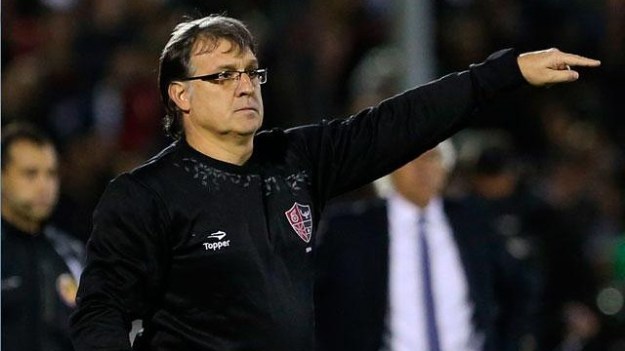
“He has a fluffy demi-mullet. He wears big, slightly academic glasses (although without a cord). He paces the technical area nervously during games (although without ensuring each perambulation takes 13 steps). Even without watching his side play, it’s not hard to work out who Gerardo Martino’s main influence as a coach is. Given he also preaches hard-pressing, ball-retention and verticality, it’s obvious that Martino is another follower of Marcelo Bielsa.” SI – Jonathan Wilson
Never a dull moment in Bolivian football
“Firstly, let me set the scene. It’s my first game from the Bolivian LFPB (Liga del Fútbol Profesional Boliviano) with Universitario de Sucre facing Oriente Petrolero, two teams languishing in the mid-table region of the Apertura half of the competition. Going in to the game, Oriente Petrolero had drawn a mind-boggling 8 of their 11 games, and had only lost once. Universitario were just a point better off but were playing at the Estadio Olímpico Patria, where they had a fine record. Football tends, more often than not, to follow certain formulae and basic principles. Being a Bolivian football newcomer (save for a few games in the Copa Sudamericana and a harrowing experience with Aurora in the Libertadores), I applied these principles to the game and assumed it would be a turgid, boring, low quality draw. Despite my inexperience with Bolivian football, I’ve commentated on scores of South American games from Brazil, Argentina, Uruguay, Paraguay, Peru – well, you get the picture.” World Soccer
Radamel “The Tiger” Falcao emerges as a ferocious scorer
“Gonzalo Ludueña started it and now there’s no stopping it. Gonzalo was fourteen at the time. He played in the youth team at River Plate in Argentina and shared a dormitory with a handful of other players at the club’s residency. One day one of them scored twice in a game against Huracán and was awarded the Man of the Match Award, sponsored by the petrol company Esso whose adverts famously involved a prowling Tiger and whose slogan ran: Put a Tiger in Your Tank.” SI
Superclásico passion reignited as Boca Juniors and River Plate meet again

“The 2004, Observer Sports Monthly published its list of the “50 sporting things you must do before you die”. At number one was attending a ‘superclásico’, the passionate encounter between Argentina’s bitter rivals Boca Juniors and River Plate. The standard of the Argentinian league was declining even then – it has got a lot worse since – but the superclásico remains special. Sunday’s was ninth against fifth between two teams who, in all honesty, aren’t very good and yet el Monumental was packed, seething with noise and colour and passion.” Guardian – Jonathan Wilson
River Plate v Boca Juniors – where has the magic gone?
“The biggest occasion in South American domestic club football was back on Sunday when River Plate met Boca Juniors in a league match for the first time in almost 18 months. The big Buenos Aires derby is followed all over the continent for a number of reasons. One is the historic role played by Argentina in the consolidation of South American football. The British introduced the game to the South Cone. More than anyone else, the Argentines helped the spread of the game northwards. In terms of playing styles and fan culture, much of the continent takes its cue from Argentina.” BBC – Tim Vickery