“In the 1980s and ’90s, most of the sport televised in this country was in Spanish. An American writer says gracias. It wasn’t always like this, flicking to and fro from ESPN to ESPN2, to hear soccer commentary in English: Derek Rae rolling his Scottish Rs; Steve McManaman in sing-songy Scouse-speak; or the Manchester basso profundo of Efan Ekoku. Nor, for that matter, did you hear the flat American accents of Alexi Lalas, Mike Tirico, or Kasey Keller (and, thank goodness, not that in-between-the-pond affectation of Brad Friedel). No, there was a time when the only soccer in this country was broadcast in foreign languages, mainly en Español. And this wasn’t a bad thing. On the contrary: It was glorious.” Fusion
Tag Archives: World Cup 2014
World Cup 2014: Goals, drama & that bite – is Brazil the best?

“Record goals, Suarez gnaws, that James Rodriguez strike, passion, drama, colourful fashion – what a World Cup this has been. It was a tournament that started with a bang as the hosts came from behind to beat Croatia, and has since delivered fantastic entertainment almost game after game. Here, BBC Sport’s chief football writer Phil McNulty and the BBC’s much-loved and most experienced commentator John Motson consider whether this has been the best ever World Cup.” BBC
Man vs. Machine
“This can’t be happening. At around the moment when Toni Kroos fired Philipp Lahm’s cross past the diving Júlio César for Germany’s third goal against Brazil, that thought started blinking in my brain like the red light at the top of a radio tower. This can’t be real. Only a minute earlier, Miroslav Klose had made it 2-0, breaking Ronaldo’s all-time World Cup goal-scoring record in the process; two minutes later, Kroos swiped the ball from Fernandinho, played a 1-2 pass with Sami Khedira to slip past Dante in the area, and scored again. 4-0 in the 26th minute. This isn’t possible. Three minutes after that, Khedira got the ball from Mesut Özil and knocked it home from inside the edge of the area. 5-0. I’m imagining this. The Germans had scored four goals in six minutes against the most celebrated nation in soccer history, a team that hadn’t lost a competitive match on home soil since 1975. I’m asleep. After almost four weeks of obliterating expectations, the World Cup finally produced a match that obliterated belief.” Grantland – Brian Phillips
Germany wary of Lionel Messi counter threat in World Cup final
“Nobody, Toni Kroos insisted on Tuesday night, wins the World Cup after a semi-final. Jogi Löw pursued the theme: there had been no exultation in the dressing room, he insisted; there was still one game to go. The response was sensible, admirable even, and it probably is true that there is no team so likely to be capable of moving on from a historic victory as Germany but, still, wins of that nature have their dangers.” Guardian – Jonathan Wilson
How Germany Got its Game On
“Paul Breitner (1974, 1982). Spain, 1982. It was the saddest goal in a World Cup final. Paul Breitner reacted quickly to a loose ball in the Italian box, adjusted his body, and volleyed neatly into Dino Zoff’s bottom right corner. It was a goal that begged to be scored, had to be scored, but there was no joy, no sense of relief, not even hope. It wasn’t even a goal at all, really, but an anti-goal. It marked defeat, not victory. Breitner knew it. He raised his hand to acknowledge his inconsequential achievement and jogged back to the halfway line. Nobody came over to congratulate him. The West Germany vice captain looked like a schoolboy who had come up to the board and solve a problem for which there is no solution. Seven minutes before the final whistle at the Santiago Bernabéu, the time was up—for the World Cup (West Germany were 3-1 down against the Azzurri), for Breitner’s team, and for Breitner himself. …” 8 of 8
World Cup quiz: name the goal from the chalkboard diagram

1. Which World Cup goal was this? Saeed Al-Owairan (Saudi Arabia v Belgium, 1994). Diego Maradona (Argentina v England, 1986). Franz Beckenbauer (West Germany v Switzerland, 1966). Archie Gemmill (Scotland v Holland, 1978).
“Everyone loves a tactical chalkboard, don’t they? Don’t they? Oh. Well, anyway see if you can decipher the World Cup goals after looking at our funky stripped-down graphics below.” Guardian
I Love Messi, But I’m Rooting for Germany. Here’s Why You Should, Too.
“I will be rooting for Germany in Sunday’s World Cup final. Now, there’s a sentence I thought I would never write. I grew up with an intense dislike of German prowess on the football field. One of my first memories is of Harald Schumacher flying through the air, almost killing the hapless Patrick Battiston. (To this day, the Frenchman still carries a cracked vertebra and damaged teeth; Schumacher probably still carries his hateful smirk.) Four years later I saw Germany end Mexico’s World Cup dreams in Monterrey through a relentless display of intimidation. They then proceeded to eliminate my beloved French again. Oh, how I hated them, with their canine names: Rummenigge, Littbarski, Briegel, Augenthaler. Yes: almost 30 years ago, when I celebrated Argentina’s triumph in the Azteca as if it were my own, it would have been unfathomable that I, one day, would root for Germany.” New Republic
World Cup Tactical Analysis | Netherlands 0-0 Argentina ( 2-4 pens ) : Netherlands’ discipline and Argentina’s narrow midfield
“After the ridiculously one-sided affair in the first semi-final, the second was always going to be a tight game. After seeing hosts Brazil blown away by Germany, both sides were set-up to primarily not concede. Something that they were successful in not only for the course of the 90′ but through extra time as well. Argentina was labelled as a lot of people’s favourites but are yet to convincingly stamp their authority on the tournament as front-runners. It is a strange accusation to level at the finalists of the tournament and yet there it is. They’ve relied on individual ability on multiple occasions in this tournament and will do so once again this Sunday. While the Dutch too have been beholden to Arjen Robben’s exploits to a certain degree, their progression has been characterized by multiple rabbits being pulled out of the hat by Van Gaal and his staff.” Outside of the Boot
Let’s Get Metaphysical
“Argentina and the Netherlands played yesterday’s second semifinal. That’s as much as should be said about the match, which forced us to appreciate what this World Cup has been, while remembering what it could have been. Throughout 120 minutes of football, there was first, last, and above all an air of safety that had been refreshingly absent from most of the games thus far—and with that absence came gifts of goals and good play. But yesterday, there was so much at stake: safe passage to a World Cup final. Since both teams are middling, professional, and graced by the presence of once-in-a-lifetime, left-footed talents, they took no risks—no playing the ball patiently through the midfield, no attempts at a tactical surprise. It was a game of chicken, and a penalty kick shoot-out was the inevitable collision.” The Paris Review
Humiliation, Honor, and Brazil

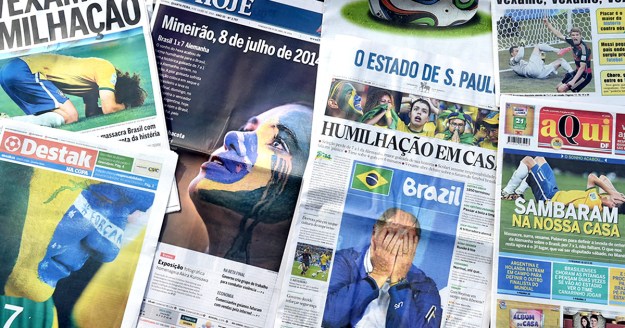
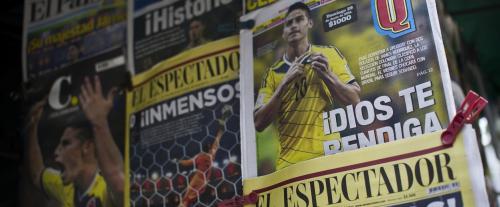
‘The morning after Brazil’s shocking, numbing 7-1 loss to Germany in the World Cup (which the commentators on ESPN have been instructed to call, robotically, the FIFA World Cup), my soccer-loving son mordantly read out English translations of the Brazilian headlines, which he had found online. All were brokenhearted—“FIASCO,” “AN EMBARRASSMENT FOR ETERNITY,” “EMBARRASSMENT DOES NOT EVEN BEGIN TO DESCRIBE IT,” and “WE CAN’T JOKE ABOUT IT: WE’RE TOO ASHAMED”—but the key word, over and over, was humiliation: “ULTIMATE HUMILIATION,” “HUMILIATING,” “FELIPE MISSES AND BRAZIL IS HUMILIATED,” “FROM DREAM TO HUMILIATION,” on and on like that.’ New Yorker
World Cup 2014: Brazil’s Neymar makes wheelchair claim
“Brazil’s Neymar broke down in tears as he claimed the challenge that ended his World Cup came close to paralysing him. The Barcelona forward, 22, fractured a vertebra in his spine when he was kneed in the back by Colombia’s Juan Zuniga during Brazil’s 2-1 quarter-final win. ‘I thank God for helping me, because if that blow had been a few inches lower I would have risked being paralysed,’ said Neymar.” BBC
Most Memorable World Cup Moments
“The World Cup final between Germany and Argentina will take place on Sunday at 4 P.M. By now, many of us have watched an absurd amount of soccer, at the expense of work, family, and good sense. A few weeks ago, unwilling to break away from a close match, I resorted to streaming it on my iPhone while slaloming through a crowded train station, something I wouldn’t recommend.” New Yorker (Video)
Whether Wretched or Inspired, Title Match Often Provides a Jolt
“Apart from Germany, the Champagne fizz has suddenly gone flat at a World Cup that was being hailed earlier as the best in recent memory. Goals that seemed to pour from a spigot have now slowed to intermittent drips. The Netherlands once led the tournament with 12 goals, but it has not scored since the Round of 16. In Wednesday’s semifinal loss on penalty kicks to Argentina, the Dutch produced one shot on target. It was the lowest number for the Netherlands in a World Cup match since record keeping began in 1966, according to the Opta statistical service.” NY Times (Video)
25 of the best World Cup photos ever – in pictures
“Our sports picture editor, Jonny Weeks, has trawled the archives to pick out some of the best World Cup images ever taken. From the iconic shot of Diego Maradona taking on six Belgium players in 1982 – the real story of which can be read here – to the moment John Aldridge went berserk on the touchline at USA ’94, the shots range from the eye-catching to the unorthodox, the unforgettable to the bizarre. Beneath each image is a short explanation of why it made the cut.” Guardian
Brazil’s nightmare gets worse: Argentina to play for World Cup title

“A bad week for Brazil just got worse. There’s not much that could make the humiliation of Tuesday’s 7-1 defeat to Germany feel even grimmer, but Argentina winning the World Cup at the Maracana would be unbearable. The holiest of the holies has already been defiled once, by Uruguay in 1950, but that would be nothing to the desecration of seeing Lionel Messi and his side celebrating there on Sunday. Whether that’s likely is another matter. Argentina will go into the final as the underdog, and understandably so, given the respective performances in the semifinals, but it will not capitulate against Germany as Brazil did. This may be a limited side, but it is one with great character and spirit, a cold-eyed willingness to get the job done.” SI – Jonathan Wilson
Argentina 0-0 Netherlands: Argentina through on penalties
“Sergio Romero was the hero after an extremely uneventful 120 minutes. Alejandro Sabella brought back Marcos Rojo after suspension, while Enzo Perez deputised for the injured Angel di Maria. Louis van Gaal was able to bring back Nigel de Jong after injury, meaning Daley Blind moved across to wing-back in place of Memphis Depay. There was obviously great tension here, but not much happened – of the 62 games at this World Cup so far, this game featured the lowest shot rate, and the lowest percentage of touches in the opposition third.” Zonal Marking
After Long Stalemate, Argentina Breaks Through in Shootout
“Regulation and extra time brought 120 minutes of scoreless exasperation in a World Cup semifinal on Wednesday that was by turns tense, cautious, clumsy, gripping and stubbornly unyielding. There was little space to move, few chances to score. Sometimes the match was as dreary as the misty evening chill. If it possessed any beauty, it was not in gracefulness but in stark, struggling exertion. And finally, when grind and strain and labor could not bring a resolution, whimsy and caprice did. Argentina defeated the Netherlands by 4-2 on penalty kicks and advanced to Sunday’s final against Germany.” NY Times
Netherlands 0 Argentina 0 (Argentina win 4-2 on penalties)
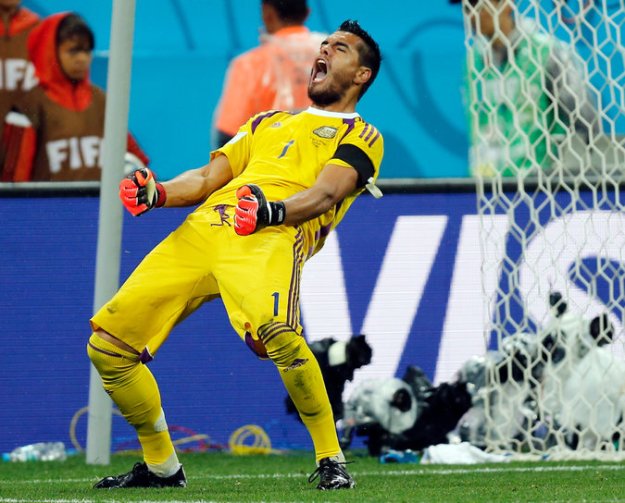
“Argentina will meet Germany in Sunday’s World Cup final at the Maracana after winning a penalty shootout to eliminate the Netherlands.After 120 tedious and goalless minutes that were in stark contrast to the spectacular shock of the first semi-final between Brazil and the Germans, Argentina prevailed and a repeat of the 1986 and 1990 finals – when they played West Germany – will be played out in Rio. Goalkeeper Sergio Romero was the hero with penalty saves from Ron Vlaar and Wesley Sneijder, while opposite number Jasper Cillessen was unable to repeat the feats of his deputy, Tim Krul, in the quarter-final win against Costa Rica.” BBC
World Cup Pass & Move: Semi-Charmed Lives
“Two semifinal matches, one penalty shootout, one plain old one-sided shootout. As the World Cup draws to a close, we look at some of the characters who made the semifinal round so wonderful, weird, glorious, ponderous, and heartbreaking.” Grantland
Argentines Sing of Brazil’s Humiliation, Loudly and in Rio
“As the Brazil team has come spectacularly undone in the World Cup, the pain for the host country has been compounded by the prospect that its hated rival, Argentina, could still lift the championship trophy on Sunday in Rio de Janeiro’s fabled Estádio do Maracanã, after Argentina won a tense semifinal against the Netherlands in a penalty shootout on Wednesday afternoon. The tens of thousands of Argentine fans who have invaded Brazil to cheer for their team, and taunt their hosts, brought with them a song that predicts not just triumph for Argentina, but deep humiliation for Brazil. And the players themselves have joined the choir.” NY Times (Video)
29 Minutes That Shook Brazil
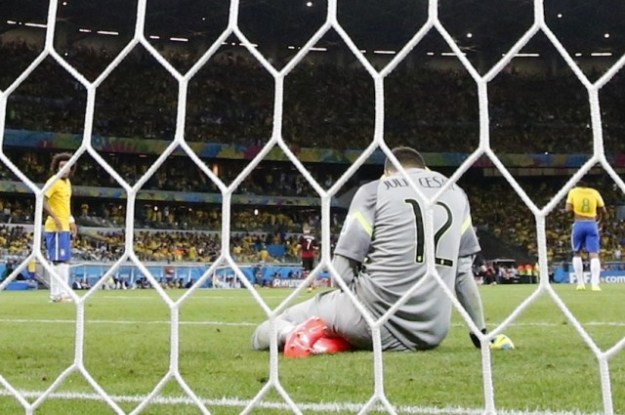
“It started, innocently enough, in the 11th minute. Thomas Müller, Germany’s top scorer at this World Cup, slyly slid around the back of Brazil’s defense. When the ball arrived from a corner kick, he blasted it home. The Brazilian fans who made up most of the crowd of 58,000 went quiet for a moment. But then, unbowed, they resumed their defiant chants. In Ceilândia, some 450 miles north of the Estádio Mineirão, a housecleaner shrugged. ‘After the first goal, our reaction was not too much of a shock because Germany is a strong competitor,’ said the housecleaner, Neide Moura de Brito do Nascimento, who was watching on TV with her family. ‘We already expected one or two goals from them.’ Nothing else about Tuesday afternoon followed anyone’s expectations. From that modest beginning, this country went on to witness something never seen before in World Cup soccer: Germany scored five goals — more than many teams scored in the entire tournament — in the first 29 minutes of a World Cup semifinal on the way to a 7-1 victory. Those 29 minutes will be scrutinized for generations in Brazil, poked and prodded and dissected the way Brazil’s dreaded defeat to Uruguay in the 1950 World Cup final has been.” NY Times (Video)
No More Tears

This “Jesus Wept” photo became a meme in the aftermath of Brazil’s defeat yesterday.
“O Lachryma Cristi, what has happened to our weepy Brazilians? Since day one of this tournament, it seems, they have been in tears. As the technical director Carlos Alberto Parreira reported, ‘They cry during the national anthem, they cry at the end of extra-time, they cry before and after the penalties.’ The sports psychologist Regina Brandão was rushed in, but failed to stem the flow; then it was the Pressure! The Pressure! A nation’s hopes, et cetera, et cetera. And now this 7-1 pasting, the iconic gone-viral boy in the crowd, glasses pushed up, fingers pressed to eyes, sobbing into his Coca-Cola cup; and somewhere else not too far off, the pretty girl with tears streaming down her cheeks, rivulets slowly obliterating the Brazilian flags she had painted there.” The Paris Review – Jonathan Wilson
Why Brazil Lost
“Most people are terrible singers, and yet football crowds are good at picking out a tune. Crowds are often flat on the high notes and tend to rush the tempo, but generally the combination of thousands of wrongs adds up to one big right. The Brazilian national anthem last night was different. All around the Mineirão people stood and roared it so loud that their eyes bulged. The words resounded with startling clarity but much too loudly for any music to be heard. Down on the field David Luiz and Júlio César were holding aloft the shirt of Neymar like a holy relic. The camera picked out a woman holding a placard that read, “Don’t worry—Neymar’s soul is here!” It was as though Neymar had died and was looking down at his former teammates from heaven, rather than watching them on television. The collective emotional frenzy of the scene was awe-inspiring.” Slate (Video)
The World Cup Beyond the Stadiums
“The matches of the FIFA World Cup have played out before crowds in stadiums—some barely finished—throughout Brazil, but the passions of the tournament can, at times, be most acutely felt far from the stands. Here, David Alan Harvey captures scenes from the favelas of Rio de Janeiro to Copacabana Beach.” New Yorker (Photo)
Why Brazil Crumbled
“Peeling back the layers of expectation. The weight of…a team. ‘A player plays for more than himself.’ That’s a common maxim echoed throughout dressing rooms across the globe. Players are also expected to play for teammates, families, communities, countries, continents, gods, and local bodega store owners probably. Every player on a World Cup team has shouldered a cross-section of these burdens on top of self-imposed expectations and demanding, perpetually looming coaching staffs armed with lots of professional badges. And the better the player, the more that weight is amplified. If a player is that good, he can become a meal ticket for all involved. All of that weight can rest on a selection of moments and touches. A final touch ending up in a net or in the lap of a cerveza-guzzling spectator can be the difference between being heralded in tribute videos or becoming an internet sensation for all the wrong reasons. This is the burden of performance, the burden of play.” Fusion
World Cup Tactical Analysis | Brazil 1–7 Germany: Germany run riot to trounce Brazil
“While Brazilians still talk about 1950 with disappointment and horror, what transpired at the Belo Horizonte will bring nightmares to the South Americans for years to come. Aman Sardana analyses what happened, and what went wrong. The enormous pressure, the inflamed anticipation, one nation’s obsession and hysteria amassed on the shoulders of a fervent and useful but ultimately imperfect team. They snapped under the stress, no doubt, but there was more to this than just pressure, or flawed tactics and team choice, or incompetent positional play, or a first-rate German squad filled with incisive passers and composed finishers. It was all of those things, and yet more. A first-half goal barrage saw Die Mannschaft 5-0 up, Miroslav Klose procured his record-breaking 16th strike at the finals and the cruelty prolonged into the second period with Schürrle coming off the bench and bagging a brace. Mesut Özil missed a one-on-one to make it 8-0, moments before Oscar netted a consolatory hit in the final minute of the first semifinal of World Cup 2014. But as it was, in 30 obscene first-half minutes, the Brazilian dream was over. Outside of the Boot
World Cup Players to Know: Argentina Goalkeeper Sergio Romero
“In the John Hughes high school class version of Argentina’s national team, Lionel Messi is the quiet, smiling genius who wins over all the teachers through his sheer brilliance. Ángel di María plays the fragile cello prodigy, performing out there in the wings of the gymnasium before cutting in with his jaw-dropping skill. Sergio Agüero is a legend in his own time for getting it on with the principal’s daughter, in this case Giannina Maradona, child of Diego, to whom the Manchester City forward was married for four years before splitting off and getting called a wimp. (Mr. Hand of God himself needs better writers.) As for Sergio Romero, well, Sergio Romero would no doubt like to remain unseen in the corner.” Grantland (Video)
Thirty-One Nil
“No sport generates extremes of passion like football. And for football, there’s no bigger stage than the World Cup finals, every four years. The road to Brazil 2014 started in 2011 with hundreds of qualifying games in every corner of the world. For teams, players and fans, the games represent national identity, sometimes against backdrops of war, riots and revolution. ‘Thirty-One Nil’, a new book by British author James Montague, chronicles these extremes of hope, joy and despair — sometimes very personal, sometimes felt by entire nations. … Nick Wrenn, editor-in-chief, CNN” CNN
amazon: Thirty-One Nil: On the Road With Football’s Outsiders: A World Cup Odyssey by James Montague
Thirty One Nil: A Book About The Ones We Won’t See in Brazil: Book Review
O Jogo Bonito
“A little more than halfway through Brazil’s horrible, galling victory over Colombia last Friday, I began to wonder what type of foul might actually persuade the Spanish referee Carlos Velasco Carballo to issue a yellow card: A studs-up, two-footed, kung-fu fly-kick to the chest, like the one launched by Eric Cantona against a fan in the stands back in 1995? Any one of the number of egregious fouls, including punches to the head, committed by Italy against Chile, and then by Chile on Italy, in the infamous Battle of Santiago in World Cup 1962? Maybe multiple Suárez-type bites by a hyena pack of players on a prostrate Colombian felled by a scything tackle might have done the trick.” The Paris Review – Jonathan Wilson
Germany 7-1 Brazil: Germany record a historic thrashing, winning the game in 30 minutes

“In one of the most incredible matches in World Cup history, this ridiculous scoreline was an entirely fair reflection of Germany’s dominance. Jogi Low named an unchanged side from the XI that had narrowly defeated France in the quarter-final. Luiz Felipe Scolari was without the suspended Thiago Silva, and the injured Neymar. Dante was the obvious replacement at the back, while tricky winger Bernard was a surprise choice to replace Neymar, with Oscar moving inside to become the number ten. Luiz Gustavo returned after suspension, with Paulinho dropping out. Incredibly, this game was finished after half an hour – it was 5-0, and Brazil were simply trying to avoid further embarrassment.” Zonal Marking
Brazil 1 Germany 7
“Brazil’s World Cup dreams ended in humiliating and brutal fashion as Germany inflicted their heaviest defeat in the first semi-final in Belo Horizonte. A thunderous occasion that began with Brazil riding a tidal wave of emotion was reduced to a nightmare as Germany were 5-0 up inside 29 remarkable minutes in front of a disbelieving Estadio Mineirao crowd. Brazil’s players mourned the absence of the injured Neymar before kick-off, but captain Thiago Silva was an even bigger loss. The result was their first competitive home defeat in 39 years, and the end of their hopes of making it to the World Cup final at the iconic Maracana on Sunday.” BBC
Germany Scored Three Goals in 76 Seconds and Four Goals in Four Minutes
“Everyone, including Slate, has noted that Germany scored five goals in an 18-minute span on Tuesday. That figure, though, understates what the Germans accomplished. For a good portion of that 18 minutes, the ball wasn’t in play because it was sitting in the back of the net and Die Mannschaft was celebrating. The ESPN broadcast made it hard to determine how fast Germany had scored in actual game time, as the copious goal replays were always butting in to the on-field action. In order to get an accurate count, I rewatched the first half using ESPN’s ‘tactical cam’ replay, which shows the game from above and affords a clear view of each goal and the precise moment when play subsequently resumed.” Slate (Video)
Goal, Goal, Goal, Goal, Goal, Goal, Goal, and Brazil’s Day Goes Dark
“The fireworks began at dawn. All around this city, loud pops and bangs rang out as men and women and children, so many dressed in yellow, set off flares and beeped car horns. It was supposed to be a magical day. The Brazilian national soccer team, playing at home, was one game away from a World Cup final. No one could have guessed the tears would come before halftime. No one could have imagined there would be flags burning in the streets before dinner. Certainly no one could have envisioned that any Brazilian fans, watching their team play a semifinal in a celebrated stadium, would ever consider leaving long before full time.” NY Times
Let the Recriminations Begin in Brazil, and Let Them Begin with Scolari
“Then Brazil lost a relative squeaker to France in the finals of the 1998 World Cup, the country’s congress held intensive investigations and hauled some of its most storied athletes before a panel of preening politicians. Conspiracy theories swirled that cast blame in all directions—one widely held notion attributed the defeat to the machinations of Nike. The questions were irrational but give some hint of the mindset of a defeated Brazil and foreshadow the ugly recriminations that will follow this ugly defeat.” New Republic
Nation in Despair
“… Everyone knew it would be difficult for Brazil without the injured star Neymar and the suspended captain, Thiago Silva, but nobody imagined this feeble capitulation — four goals surrendered to Germany in six minutes during a 7-1 rout in a World Cup semifinal. Early on, Brazil’s players bickered, lost their cool, then lost their fight. The country of the beautiful game was left to face a grotesque humiliation. Luiz Felipe Scolari, the coach, flung his hands in disgust amid the flurry of early German goals. Marcelo, a defender, put his hands to his face in embarrassment and disbelief. A boy and a woman cried in the grandstand beneath their glasses, appearing stunned and overcome on camera.” NY Times (Video)

Is Arjen Robben a Jerk, or Does He Just Suffer From Jerk Face Syndrome?
“Name: Arjen Robben Home country: Netherlands Known for: Cutting inside and shooting with his left foot, diving, apologizing for diving, diving after apologizing for diving, promising not to dive again, diving after promising not to dive again, inspiring memes, Jerk Face. Why he might be a jerk: He looks like a pretty big jerk. The main manifestation of this jerkiness is the way his entire body explodes in apparent death throes every time he’s touched or nearly touched in the penalty area. His theatrics at the 2014 World Cup have set off this year’s version of the perennial hand-wringing over diving and whether it ruins soccer.” Slate (Video)
Neymar’s Injury Sidelines Effort to End World Cup Racism
“After an episode in Peru earlier this year in which Peruvian soccer fans subjected a Brazilian player to racial abuse by imitating the sounds of monkeys, President Dilma Rousseff of Brazil swiftly pledged a ‘World Cup against racism,’ declaring, ‘Sports should be no place for prejudice.’ Yet when Brazil’s top player, Neymar, broke a vertebra when he was kneed in the back during a match on Friday by a Colombian player, the torrent of racist insults against the Colombian, Juan Camilo Zúñiga, showed how far the host of the World Cup remains from achieving that goal.” NY Times
An Argentine Army Grows in Brazil
“As the Albiceleste goes deeper into the tournament, its fan base gets bigger, louder, and even more unbearable to Brazilians. Until recently, the biggest fan mobilization in Brazilian soccer history arguably came on September 5, 1976, when 70,000 Corinthians fans travelled the 300 miles from São Paulo to the Maracanã in Rio de Janeiro to see their team beat Fluminense in the Brazilian championship playoffs. Twenty-eight years after the Invasão Corintiano, another fan invasion is making headlines in Brazil. There were an estimated 20,000 Argentinian fans at the Maracanã in Rio de Janeiro for Alejandro Sabella’s team’s opening game against Bosnia and Herzegovina, including 50 or so ticketless gatecrashers who jumped over a wall into the stadium. The number had swelled to 30,000 when Messi and co. reached Belo Horizonte for their second game against Iran, and 70,000 hermanos, as Brazilians call their neighbors,swarmed across the border into Rio Grande do Sul for Argentina’s final group stage game against Nigeria.” Fusion
Spain ’82: My First World Cup
“The first World Cup I remember was Spain ’82. I was eleven and in my fifth year of primary school and living at the Holy Child Teacher Training College, in Ikot Ekpene, in southern Nigeria, where my mother taught home economics. This is about an hour from my village. It was two years since I watched Nigeria’s Green Eagles (as they were called then) defeat Algeria to lift the African Cup of Nations for the first time, in 1980. I remember the three goals against the Desert Foxes, or Les Fennecs, by Segun (Mathematical) Odegbami and Muda Lawal and the celebrations that swept through the land. The image of our captain, Christian (Chairman) Chukwu, lifting the cup after the game was something to behold.” New Yorker
Neymar’s cultural significance to Brazil transcends soccer, World Cup

“Tweets of sympathy and support from Brazilian president Dilma Rousseff to Kobe Bryant and everyone in between, including super models (Gisele Bundchen), Olympic sprinters (Usain Bolt), footballers (Ronaldo and Lionel Messi) and soap opera stars (too many to mention). Hours of TV coverage devoted to detailed analysis of spinal columns and estimated back injury recovery times. More hours of TV coverage dedicated to discussion of whether Colombian defender Juan Camilo Zuniga’s crushing, knee-raised challenge was premeditated or not (the debate oscillating between ‘a normal part of soccer’ and ‘a cowardly assault’). FIFA Fan Fests all over the country, filled with supporters who minutes before had been wildly celebrating Brazil’s 2-1 World Cup quarterfinal win over Colombia, falling still and silent. On Friday evening, Brazil turned its lonely eyes to Neymar da Silva Santos Junior.” SI
How have Germany tactically set-up so far in the World Cup?
“With the recent domination of German football at club level, Germany were marked as favorites in this World Cup. With a highly talented squad, Low was expected to recreate the incisive and dominant football that Germany were known for. Questions have loomed about where Lahm would start for Germany, how they could deal with the scarcity of out an out strikers and the soft spots in the wider areas of defense. Big things are expected from this German squad and here is how they have lined up so far in this tournament.” Outside of the Boot
How have Brazil tactically set-up so far in the World Cup?
“Prior to the start of this tournament, followers of the Selecao were well aware of the tactics Luiz Felipe Scolari will employ for the side. Though the squad seemed weak, it didn’t surprise many that impressive performances from some Brazilians didn’t earn them a spot in the squad as pragmatic Scolari stuck to his tried & tested team. This piece on Brazil’s tactical set-up prior to the start of the tournament was spot on. This was the case for any Brazilian supporter, as the formation & system was well known before the first ball was kicked, and there has been little change.” Outside of the Boot
Germany Must Out-Invent Brutish Brazil: A Bizarre-But-True Semifinal Preview
“Germany and Brazil are the two most successful teams in World Cup history, so it’s funny to think that they have only met once before in the tournament. That was in the 2002 final, when Brazil claimed its fifth trophy and Ronaldo topped the all-time goal-scoring charts. It was also, incidentally, the day a certain Philipp Lahm, then 18 years old, and Bastian Schweinsteiger, 17, made it to the German youth championship final for Bayern Munich. Sitting on the bus back to Bavaria, Lahm and Schweinsteiger probably could not have imagined that 2002 would be their country’s last international tournament without them. Now, 12 years later, these twin hearts of the German team will line up on Tuesday in the semi-final against Brazil in the hopes of erasing their nation’s reputation as the eternal also rans.” New Republic
Brazil’s Only Hope to Take This World Cup: Win Ugly
“There are three contradictory narratives getting batted around about Brazil’s foul-plagued, back-breaking 2–1 quarterfinal victory over Colombia. The first, one that’s being pushed by the Brazilian press, is that Neymar was assaulted by brutish Colombian defender Juan Camilo Zúñiga, whose late-game challenge was reckless and cowardly. (Sample headlines: ‘Stabbed in the back’ and ‘Damn Colombian.’) An alternate view, one articulated by the New York Times’ Sam Borden among others, is that Brazil got what it had coming. Borden believes that Neymar’s fractured vertebra was the logical conclusion of Brazil’s decision to play a dirty game, and of referee Carlos Velasco Carballo’s refusal to keep the foul-happy Seleção in check. The third perspective, laid out by Forbes’ Bobby McMahon, is that Colombia was the team that came out fouling, that the referee didn’t do much of anything wrong, and that Neymar’s World Cup-ending injury was an unfortunate accident rather than a violent inevitability.” Slate (Video)
Every Sport (Including Baseball!) Has Its Version of the Dive
“One very sunny day on a pitch somewhere in America near sprawling farms and a single loitering country road, my college soccer team was playing a tight match. We were getting kicked so high into the air we must have looked from the distance like maroon grasshoppers leaping over some malicious kids’ boots. The referee wasn’t calling anything. And, as tends to be the case when that happens, the tackles got worse and worse. But we were all doing the American thing, playing through it, shaking everything off, or trying to play through it and shake everything off. Yet it wasn’t minutes after I said to the referee that someone was going to get hurt that our best player had his tibia and fibula snapped in two, right in front of me. I remember the sound of the bones breaking: I remember his scream and then his screams and then the silence.” New Republic
Semifinals Remain an Inner Sanctum Until Further Notice

“The World Cup, ultimately, is a highly exclusive club. To be sure, the World Cup lets in hoi polloi to give a glimmer of hope and inclusion, but the inner sanctum is usually sealed shut by the semifinals, sending home the pretenders. Not our kind. Check out the four semifinalists this time around. The outsider, the long shot, is merely a three-time finalist, respected all over the world for its Total Football, the open, offensive style that has influenced Spain, the nation; Barcelona, the club; and other appealing offensive systems. Yes, the Netherlands, destiny’s darling, is known universally as the greatest soccer nation never to win the World Cup. All over the world, the huddled masses like the United States, yearning to be significant, are asking themselves, What does it take to crash that club, to become a regular, a nation that feels at home in the semifinals? How do countries learn that self-assurance that wins dubious referee calls and takes over game-deciding shootouts?” NY Times
World Cup Pass & Move: Weekend Warriors
“This past weekend saw quite a few footballing fireworks in Brazil. There were brilliant tactical decisions, gravely important injuries, near upsets, penalty shootouts, and Mothra landed on James Rodríguez’s arm. As a way of looking back on the quarterfinals matches, six Grantland writers — Chris Ryan, Brian Phillips, netw3rk, Mike L. Goodman, Graham Parker, and Ryan O’Hanlon — wrote about six characters from the weekend action.” Grantland
World Cup Tactical Analysis : Netherlands 0–0 Costa Rica (4-3 pens) | The Dutch exploit the right side and Krul enters the fray
“The Netherlands secured a stirring victory over Costa Rica to earn a place in the semi-finals of the World Cup with a win on penalties to end the minnows’ reverie. Van Gaal picked a very offensive line-up to start the game, with an almost in-existent midfield but a resilient defence and a luscious attack. Costa Rica took a somewhat pragmatic approach for the occasion in contrast, and the two sides largely squared each other, with the Ticos frustrating their more eminent opponents for much of the game. Van Gaal then made the intrepid decision to replace Jasper Cillessen with Tim Krul ahead of the penalty shootout, and the manoeuvre paid off as the Newcastle keeper saved from Bryan Ruiz to put his side through.” Outside of the Boot
Netherlands 0-0 Costa Rica: Oranje progress after van Gaal’s late keeper switch
“The Dutch dominated but couldn’t find a way past Keylor Navas – then finally broke their penalty shoot-out curse. Louis van Gaal played a more aggressive wing-back pairing than against Mexico, with full-back Paul Verhaegh making way for winger Memphis Depay. Costa Rica manager Jorge Luis Pinto was without suspended centre-back Oscar Duarte, so Johnny Acosta came into the side. In a long, drawn out and – eventually – dramatic 120 minutes, the Dutch dominated but were disappointing in the final third.” Zonal Marking
World Cup Tactical Analysis: Brazil 2-1 Colombia | Brazil come out on top in a rough encounter
“The host team stepped up for a big quarter final clash against the form team of the tournament, Colombia on a hot night. This was touted as a clash of 2 teams that would entertain, with the likes of Neymar, Oscar, Cuadrado, and James expected to dazzle. Instead, we saw the dark side of both teams in a game that saw a lot of fouls, and eventually, a heart breaking injury for the star of the tournament, Neymar.” Outside of the Boot
World Cup Tactical Analysis : Argentina 1-0 Belgium | Argentina dominate midfield to enter the semifinals

“In the first of the two intercontinental showdowns of the quarter-finals, two time winners and favourites Argentina took on the Belgians, looking to book a place in the semi-finals of the FIFA World Cup for the first time in 24 years. The South Americans didn’t just have to face a strong Belgian team, but also a Brazilian crowd that would have loved to see their fierce neighbours falter in the quarters. With both the teams coming into the match having won all of their previous matches of the tournament, this one was certainly going to be a close call.” Outside of the Boot
Argentina 1-0 Belgium: Argentina become even more reliant on Messi
“In their fifth World Cup game, Argentina recorded their fifth one-goal victory. Alejandro Sabella was without Marcos Rojo so brought in Jose Basanta at left-back, and replaced Federico Fernandez and Fernando Gago with Martin Demichelis and Lucas Biglia. Marc Wilmots played Kevin Mirallas rather than Dries Mertens on the right flank, but otherwise the side was as expected. Belgium remain a group of individuals, while Argentina play to the strengths of one individual.” Zonal Marking
World Cup Tactical Analysis : France 0-1 Germany | France get caught out early and Germany’s high line shuts out France
“At the end of a very highly anticipated clash, Germany reached their fourth consecutive World Cup semi-final as Mats Hummels opened the scoring from a set piece in the 12th minute, scoring what turned out to be the winner. Germany looked dangerous going forward in the early phases, while France tried to exploit the space behind the high defensive line of Löw’s team. The scoreline is a perfect reflection of how close the game was, with both sides having ample opportunities to score goals. Eventually, the game fell in favour of the Germans, who just managed to take their chances on the day.” Outside of the Boot
Argentine Fans Mock Neymar’s Injury with Chant and Plastic Spine
“Argentina and Brazil have what is arguably the most intense rivalry in international soccer. The matches between the two countries, whether competitive or nominally “friendly,” are typically rough, tense affairs, with a history of nasty fouls and conspiracy theories. As is the case with most soccer “derbies,” fans also compete to come up with the most creative and insulting chants. But a group of Argentine World Cup fans have pushed the genre into new territory in a recent Youtube video.” Fusion
World Cup Brazil’s Other Beautiful Games
“It was a newsroom like any television station newsroom, unless you count the brunette receptionist wearing a crown, sash and leopard print dress and offering friendly advice on how to spice up the World Cup. ‘Beauty queens,’ Brenda Pontes, 19, said. The World Cup does have many things — consuming attention, enthralling soccer and a carnival atmosphere — but it does not have beauty queens. In the Amazon rain forest, though, there is a tournament that is equal parts soccer and beauty pageant. It is one of the largest and most unusual amateur soccer competitions in the world, and perhaps the only one with a reality show. Pontes is the reigning queen.” NY Times
A Late Entry Helps the Dutch Avert an Exit

“With a World Cup quarterfinal in the closing moments of extra time on Saturday, Louis van Gaal, the coach of the Netherlands, made a move that was as bold as it was rare. As penalty kicks loomed in a 0-0 game, he replaced his starting goalkeeper, Jasper Cillessen, with Tim Krul, who had not played in the tournament but was confident to the point of haughtiness in a 4-3 victory in the shootout. After growing frustrated against Costa Rica, which seemed mostly content to sit back, surrender possession and play for penalty kicks, the Dutch became assured and clinical. The Netherlands made all of its penalty kicks, and the 6-foot-4 Krul made two dramatic saves after appearing to try to intimidate the Costa Ricans.” NY Times
Netherlands 0 Costa Rica 0 (4-3)
“Goalkeeper Tim Krul came off the bench late in extra time and saved two penalties as the Netherlands beat Costa Rica in a shootout to set up a World Cup semi-final against Argentina. Newcastle’s Krul saved from Bryan Ruiz and Michael Umana to send the Dutch through after the game finished 0-0. Wesley Sneijder had hit the woodwork twice for the Dutch, while Robin van Persie’s shot was turned onto the bar. They face Argentina, who beat Belgium, in Sao Paulo on Wednesday in the semis.” BBC
At Home Abroad, Argentina Shuts Down Belgium
“As unlikely as it may seem given the résumés of the two nations involved, including the seven combined world championships, Argentina and Brazil had never reached the semifinals in the same World Cup until this year. With a 1-0 victory over Belgium on Saturday thanks to a goal by Gonzalo Higuaín, Argentina joined Brazil, which beat Colombia on Friday, in the final four. The possibility exists that the two teams, South American giants and bitter rivals, could face off in the final in Rio de Janeiro, which many feel would provide the most fitting conclusion to this World Cup. Argentina, the winner in 1978 and 1986, is back in the semifinals for the first time since 1990, when a rough group coming off a title relied heavily on the skills of Diego Maradona and Claudio Caniggia, who did just enough to win, before losing to Germany in a desultory final.” NY Times
Argentina 1 Belgium 0
“Argentina reached their first World Cup semi-final since finishing as runners-up in 1990 with victory over Belgium in Brasilia. Gonzalo Higuain scored the only goal at Estadio Nacional, a thunderous early strike that ended his run of six international games without a goal. But Belgium’s so-called golden generation were undone by another quicksilver Lionel Messi performance, as Argentina set up a last-four encounter with Netherlands in Sao Paulo on Wednesday.” BBC
Germany 1-0 France: Germany get the better of the midfield battle
“Mats Hummels’ early header from a Toni Kroos free-kick was the difference in a peculiarly tame, flat contest. Jogi Low made two significant tactical alterations to his side, moving Philipp Lahm to right-back, and bringing in Miroslav Klose upfront. Didier Deschamps, as expected, returned to a one-striker system with Antoine Griezman replacing Olivier Giroud, and Karim Benzema shifting upfront. Germany dominated the first half with some good midfield play, and then the second half was…almost non-existent, with France barely launching a fightback.” Zonal Marking
Brazil 2-1 Colombia: Brazil prevail in a very aggressive game
“Goals from both centre-backs put Brazil into the semi-finals. Luiz Felipe Scolari made a straight swap at right-back, with Maicon in for Daniel Alves, while Paulinho replaced the suspended Luiz Gustavo. Colombia coach Jose Pekerman surprisingly brought in Fredy Guarin in central midfield, with Abel Aguilar dropping out. The story here was the sheer physicality, aggression and brutality of the game – to be frank, not much football was played.” Zonal Marking
The Amazon’s Floating Fields

“In this floating village, there is only one way to travel. Students go to school by boat. Pentecostals go to church by boat. Taxis arrive by boat. Even the soccer field is often a boat. There are three homemade fields on land, but they are submerged now in the annual flooding of the Black River, which meets nearby with the Solimões to form the Amazon. If the wooden goal posts had nets, they would be useful this time of year only for catching fish. So young players and adults improvise. They play soccer at a community center that has a roof but no walls. They play on the dock of a restaurant. And they play on a parked ferry, a few wearing life jackets to cushion their falls on the metal deck and stay afloat while retrieving the ball from the river.” NY Times
How the World Cup Is Damaging Brazil
“Don’t believe journalists who tell you the tournament is going smoother than expected. In a normal month of June, Rio de Janeiro hosts at least 16 first-division soccer matches. São Paulo will typically see the same number. Salvador usually has around 8; ditto Recife, Fortaleza, Porto Alegre, Belo Horizonte, and Curitiba. None of these cities will host more than seven during the World Cup.” Fusion
For Bellicose Brazil, Payback Carries Heavy Price: Loss of Neymar
“A Colombian defender named Juan Camilo Zúñiga ended the World Cup for the Brazilian star striker Neymar on Friday with a nasty knee into Neymar’s back that fractured one of his vertebrae. It was an ugly play and a bad foul. It deserved, at least, a yellow card. Yet within any game, there is always a road map to every flash point. The beauty of soccer’s continuous flow is that one thing leads to another (and another and another), and that makes it possible to trace a path to a game’s most memorable moment. In a game like Friday’s, doing so makes it easier to see where things went wrong. So what happened to Neymar? How did the face of this tournament end up in a hospital? Brazilian fans will not like to hear it, but while Zúñiga was directly responsible for causing Neymar’s injury, Neymar’s teammates — specifically Fernandinho, though there were others — as well as the referee, Carlos Velasco Carballo, deserve their share of the blame, too. They did not commit the crime, but they contributed to an environment of lawlessness that led to Neymar’s being battered.” NY Times
Talent Radar: Paul Pogba shackled and Raphael Varane stutters as France bow out of World Cup
“… Paul Pogba. France’s midfield has won many an admiring glance over the course of their World Cup journey and the match-up against Germany saw the clash of the 2 arguably best central midfields. With Cabaye playing in the regista position, both Matuidi and Pogba have been responsible for providing thrust to the French attack using their physicality and embarking on their trademark driving runs. … Raphael Varane. Despite being only 21, Varane was France’s first choice centre-back leaving Koscielny and Sakho to battle it out for the other position. The Real Madrid defender had a decent game but in the end the solitary goal of the game came directly as a result of his error although credit must be given to Mats Hummels too who was excellent on the night aside from his goal.” Outside of the Boot
Soccer-inspired graffiti a mainstay of Rio de Janeiro, Brazilian landscape

“Jorges Leon Brasil is not lost. He started chauffeuring tourists and businessmen and urban adventurers all over Rio 26 years ago, when he was 18. His time-tested version of GPS is to squint his eyes in deep thought and—pop!—Ah yes, I know this place. He’s just not sure where he’s going this morning. A rest day during the World Cup has turned into a driving tour of Rio’s burgeoning graffiti scene, and I’ve asked Brasil—Junior to his passengers; he was named after his father—to be my guide in finding some soccer-inspired art. He has experience, after all. As a young boy growing up outside of Rio in the 1980s, in Vista Alegre (‘Happyville, you would say, in English’), Junior would join the local children at night during World Cup summers and literally paint the town center yellow and green, with Brazilian flags and soccer imagery celebrating his generation’s stars: Zico, Romario, Bebeto. . . It’s part of a tradition that carries on today.” SI
Brazil Takes a Painful Step Forward
“It was an enormous win for Brazil, but it came at a gigantic cost. Brazil on Friday powered to an impressive 2-1 quarterfinal victory over upstart Colombia at Estádio Castelão, setting off another round of raucous nationwide partying. But the noise and jubilation proved short-lived, as it was revealed after the game that Neymar — the country’s best player and biggest star — would miss the rest of the World Cup after injuring his back in the dying minutes of the hugely physical game. The Brazilian team has had only one goal this summer: to win the country’s sixth World Cup trophy while playing on home soil. The victory on Friday was an important step, setting up a semifinal next Tuesday against the powerful German squad.” NY Times
Odd couple pulls Brazil through
“On a day when Brazil lost star midfielder Neymar for the rest of the World Cup with a fractured vertebra, the Selecao turned to their odd couple — defenders Thiago Silva and David Luiz — to pull them through. The two leaders in the back scored goals either side of halftime to propel Brazil to a 2-1 quarterfinal victory over Colombia. Silva latched onto a Neymar’s corner kick and deflected the ball home with his knee with the game less than seven minutes old. In the 69th minute, Luiz hit a scorching 34-yard free kick past Colombia goalkeeper David Ospina. It was difficult to tell what possessed more maniacal ferocity — the shot, or his celebratory run to the near side corner flag.” ESPN
Germany Wins a Battle of the Old Guard
“As appetizers go, it was more of a dessert: a World Cup quarterfinal at Estádio do Maracanã between two European powerhouses featuring 22 starting players who play club soccer in England, Spain, France, Italy or Germany. For much of the world, it was a heavyweight fight contested in one of the sport’s greatest venues. Here, of course, it was a distinct undercard. Brazil defeated Colombia, 2-1, later Friday afternoon in a game so big it prompted the Colombian government to declare a national holiday.” NY Times
France 0 Germany 1
“Germany became the first nation to reach four consecutive World Cup semi-finals as Mats Hummels’ early header proved enough to see them past France at the Maracana. The three-time champions needed extra time to beat Algeria in the last 16 and suffered a bout of illness in midweek, but they were comfortable victors over a disappointing France in Rio de Janeiro. Hummels got the better of Raphael Varane to score what proved to be the winning goal and Germany can now prepare for a meeting with Brazil in Belo Horizonte on Tuesday after the hosts beat Colombia.” BBC
World Cup: Germany defeats France to reach semifinals
“It’s a demon buried deep within the French psyche — a demon which refuses to be exorcized. A word which brings shivers down the spine and strikes a fear into the heart of the country’s football fans. In Rio de Janeiro, the ghosts of years past haunted France again — the ‘Angstgegner’ returned. Germany, the ‘bogey team’ as it is known in France, wrote another painful chapter into Les Bleus’ World Cup history on Friday. A 1-0 victory secured Germany’s place in the semifinals for a record fourth consecutive tournament. But unlike in 1982 and 1986, when Germany defeated the French in the last four on both occasions, this was not a battle of epic proportions. There was not the drama, nor the controversy — but the end result was the same.” CNN
Who Won the World Cup of Arm-Folding?
“This year’s World Cup has featured some of the planet’s greatest athletes performing seemingly impossible physical tasks. Bicycle kicks. Spectacular goals. Mind-bending saves. Displays of endurance, determination, and balletic grace. And, of course, turning to the left and folding your arms. It turns out that’s surprisingly hard to ace on your first (and, presumably, only) try. Hundreds upon hundreds of millions of television viewers have watched players from all 32 teams botch this seemingly simple technique in the lineup presentations before each World Cup match.” Slate (Video)
The Hopes of Central America Rest on a Perpetual Underdog
“When Costa Rica played Uruguay on June 14 in its first game of the World Cup, it was not so much a case of David versus Goliath as it was David versus David. That time fortune favored the Central Americans: Against all expectations — they had never beaten Uruguay, the two-time Cup winners — the Costa Ricans won, 3-1. But if ever there were a country from which La Sele (the Costa Rican national team), which will face the Netherlands in the quarterfinals on Saturday, might learn how to punch above its weight, it would be plucky little Uruguay.” NY Times
Costa Rica’s Midfield Has Used the World Cup As a Stage For Redemption
“The Ticos no one wanted are suddenly in demand. The Costa Rican national team entered the World Cup hoping to send a message to the world. ‘That was one of our main goals here in Brazil, letting the world know about Costa Rican football,’ defender Giancarlo Gonzalez told reporters on Tuesday.” Fusion
Costa Rica’s Number One Soccer fan Is a Nun with her own TV Show
“Sister Aracelly Salazar is Costa Rica’s self-proclaimed number one soccer fan. When she is not kicking the ball around, she hosts a TV show on a religious channel to relive the national team’s best moments, with thousands tuning in every Saturday to hear her analysis.” Fusion
A Wonderful Tournament—But Just How Good Are Brazil, or the Rest?

“‘How good was that?’ Anyone who watches sport on British television will be familiar with the Question Asinine asked by interviewers after a game. In the case of this World Cup, we can say already, ‘Very good indeed.’ This is one of the best tournaments even those with long memories can recall, endlessly exciting and continually surprising, with a feast of great goals, and almost more of great goalkeeping. Apart from anything else, the epic Thibaut Courtois v Tim Howard match, aka Belgium v USA, showed that an amazing save can be as good to watch as an amazing goal.” New Republic
Stop Making Sense
“Should we talk about where we’ve just been? The group stage was one coup after another, a sequence of thrilling games that gradually dismantled the existing order of international soccer. The last two world champions died in their baths. Italy, never expected to be a real threat, went down screaming about tooth marks, collateral damage in the Luis Suárez carnival of shame. Spain, the team that spent six years enforcing stability at the top of the sport, went out almost before the tournament had even started, like the first corpse in a murder mystery: Robin van Persie, with the forehead, in the invisible wind tunnel.” Grantland – Brian Phillips
Javier Mascherano, Argentina’s Rock fusion
“Why Lionel Messi’s Barcelona teammate may hold the key to Albiceleste’s success. Lionel Messi was, quite understandably, named man of the match of Argentina’s first four games. But Javier Mascherano is having just as big an influence on the Albiceleste’s World Cup campaign. Mascherano has one of the most difficult jobs at the competition: to make coach Alejandro Sabella’s (or, according to widespread reporting, Messi’s) 4–3–3 system a success, and allow his higher-profile attacking teammates to shine. He’s no stranger to difficult tasks, having spent most of the last four seasons at center back for his club, despite being too small (5-7) and light (170 pounds) for the position. During that time he has won six trophies (including two La Liga titles and one Champions League), while also becoming one of the few “outsiders” to gain acceptance in the Camp Nou dressing room.” Fusion
Statkeepers Call the Shots, But They Can’t Agree on Them
“In the third minute of added extra time in Tuesday’s Belgium-U.S. World Cup match, Belgium’s Kevin De Bruyne took a pass in the box, dribbled to his right and hooked the ball into the left side of the net. Finally, after 31 shots, the Belgians had broken through. Or … wait. Was it 32 shots? It depends on which Twitter account you follow. ESPN’s Stats & Information Group tweeted that Belgium had scored on its 31st shot of the day. OptaJoe, the U.K. Twitter account of the soccer stats company Opta, said it was the 32nd. At the World Cup, shots are in the eye of the beholder. At least three major soccer stats companies are logging every match, and they have yet to all agree on each team’s number of shots and shots on goal. For every one of the 58 games so far, the companies can’t quite get their stories straight. Sometimes their counts have differed by as much as two or three.” fivethirtyeight
Unorthodox Bookends Leading the Germans

“It has been a hot and cold World Cup for Germany: from its bold statement match in steamy Salvador against Portugal to its botched lines and opportunities in the chill and drizzle of Porto Alegre against Algeria. Despite fluctuating form and Manager Joachim Löw’s concern about seven players with mild flu symptoms, the Germans are, as usual, in contention with the World Cup reaching its business end. The next obstacle amid national angst: Friday’s quarterfinal against resurgent France. Germany is hard to read and difficult to categorize, and its protean nature is particularly evident at the front of the attack and the back of the defense. Thomas Müller, again its leading scorer, is an unconventional, unusually versatile forward. Manuel Neuer is an unconventional, unusually versatile goalkeeper.” NY Times
The Netherlands’ Odds Rise Dramatically in Big Bank’s Fancy World Cup Predictions
“Banks are good at making money (or crashing the economy), but can they predict the outcome of the World Cup? The short answer: kind of. On May 30, Goldman Sachs released its 67-page World Cup and Economics 2014 report, that—between interviews with Franz Beckenbauer and in-depth breakdowns of every team (really, it’s a pretty good read)—includes a statistical model designed to predict the outcome of the tournament.” New Republic
Mario Yepes, Colombia’s Grand Old Man
“The 38-year-old Cafeteros captain persevered through the national team’s dry spell but now leads a new golden generation. Mario Yepes watched the 1994 World Cup like most of the rest of us, on television. He had just completed his first professional season, helping second division Cortulua gain promotion to the Colombian top flight. He was a striker then, but new manager Reynaldo Rueda had other ideas. Yepes would be converted to center back, to play as a libero. He was big, fluid, and rangy, but never fast, even before he became slow, never the brand of Colombian burner that has set this tournament alight.” Fusion