Tag Archives: Uruguay

Confederations Cup 2013: Spain remain team to beat in Brazil

heroa
“Despite some resistance from the Republic of Ireland at the Yankee Stadium, they outgunned Giovanni Trapattoni’s men 2-0 in their last game before the Confederations Cup campaign gets under way in Brazil this weekend. On Sunday, the world and European champions play their first group game against Uruguay, as La Roja begin their bid to bring yet another international trophy back to Madrid.” BBC

Uruguay’s fighting spirit comes to the fore
“Uruguay turning up for a tournament on Brazilian soil is enough to send a shudder down the local spine. The other day Pele was remembering the World Cup final of 1950, and his father in tears as the sky blues came from behind to shock the host in Rio’s newly built Maracana stadium. Now Uruguay is back once more, this time for the 2013 FIFA Confederations Cup.” The World Gane – Tim Vickery

Confederations Cup 2013: Spain team profile
“… Whether in a 4-3-3, 4-2-3-1 or 4-6-0 formation, the modern-day Spanish side, with a little help from their free-flowing Barcelona contingent, have ripped up the formation book – even winning tournaments with the false number nine/strikerless line-up. Barcelona’s Victor Valdes is expected to start the tournament as Spain’s number one goalkeeper in the major change from Euro 2012, with Iker Casillas missing out.” BBC

Face of World Cup host Brazil? Look no further than Neymar
“When the World Cup hopes and dreams of arguably the world’s most successful footballing country rest on your skinny shoulders, you’re going to need all the help you can get. It is not known what great works of literature Neymar chose when packing his suitcases for Barcelona, but he could have done worse than to seek solace in a little Shakespeare. Dank and drizzly though it can sometimes be, Santos’ Vila Belmiro stadium, our hero’s erstwhile home, is a long way from the gloomy battlements of Hamlet’s Elsinore. Nevertheless, there are more than a few parallels between the life and times of Brazil’s current idol and Shakespeare’s classic paean to troubled young manhood.” SI

Confed Cup Preview: 5 storylines to watch
“The Confederations Cup (June 15-30) is the ritual eight-team dry run designed to give the World Cup hosts the chance to iron out any kinks in their stadia and transport systems a year before the big show begins. The tournament pitches the hosts, reigning World Cup holders and six confederation champions (with Italy qualifying as Euro runners-up to World Cup holders Spain) into battle.” ESPN (Video)

A rare Confederations Cup – all the teams, for once, want to win it
“Tournaments are like birthdays: they are as significant as you want them to be. To many the Confederations Cup is a meaningless intrusion on the football calendar, a rinky-dink competition that proves nothing more than Fifa’s greed. After all, the World Cup already exists to establish the best team on the planet so what, other than money and attention-seeking, is the point of a mini-tournament between the leading teams from each continent?” Guardian

Starting anew: Deeper Spain lacks strong XI
“While club football’s evolution from a ‘team game’ into a ‘squad game’ has been widely acknowledged the past two decades, the situation at the international level remains uncertain. After all, major international tournaments are decided during the course of four weeks, rather than eight months. Whereas the speed and intensity of modern football ensures club managers frequently rotate their squad to prevent burnout in the spring, international managers often squeeze every last drop out of their regular starting XI.” ESPN – Michael Cox

Uruguay 1-1 Paraguay: Tabarez ditches his double pivot, then makes more attacking moves

int_130323_INET_WCQ_Uruguay_Paraguay
“Reigning South American champions Uruguay recorded their third consecutive 1-1 home draw – their participation in Brazil remains in the balance. Oscar Tabarez fielded a familiar core to this side – Edinson Cavani was only on the bench, with Diego Forlan behind Luis Suarez upfront, the combination that won Uruguay the Copa America final against Paraguay in 2011. The major news was in the centre of midfield, where Tabarez played Nicolas Lodeiro rather than a second defensive midfielder. Uruguyan-born Gerard Pelusso selected a cautious 4-4-2 formation for bottom-placed Paraguay, having experimented with 4-3-3 earlier in the qualification process. Oscar Cardozo and Nelson Valdez were together upfront, while Ricard Ortiz pushed forward to the left of midfield. This game started slowly before gradually developing into something quite interesting – mainly because of Tabarez’s constant chances.” Zonal Marking

In Ecuador, a Thriving Game and Prospects Galore

diaz-blog480
“It has been a difficult couple of weeks for teams named Barcelona in continental competition. Last Wednesday the Spanish version dropped a 2-0 decision to Milan in the Champions League. On Feb. 12 the Ecuadorean namesake — Barcelona Sporting Club — was denied three points in its Copa Libertadores opener when Nacional’s Álvaro Recoba set up Iván Alonso for a late equalizer in Montevideo, Uruguay. That Alonso’s goal came in the third minute of second-half stoppage time was not the worst part. Throughout the night there was a feeling Barcelona was not only going up against the Uruguayan champion, but the Chilean referee, Enrique Osses, as well.” NY Times (Video)

Never a dull moment in Bolivian football

“Firstly, let me set the scene. It’s my first game from the Bolivian LFPB (Liga del Fútbol Profesional Boliviano) with Universitario de Sucre facing Oriente Petrolero, two teams languishing in the mid-table region of the Apertura half of the competition. Going in to the game, Oriente Petrolero had drawn a mind-boggling 8 of their 11 games, and had only lost once. Universitario were just a point better off but were playing at the Estadio Olímpico Patria, where they had a fine record. Football tends, more often than not, to follow certain formulae and basic principles. Being a Bolivian football newcomer (save for a few games in the Copa Sudamericana and a harrowing experience with Aurora in the Libertadores), I applied these principles to the game and assumed it would be a turgid, boring, low quality draw. Despite my inexperience with Bolivian football, I’ve commentated on scores of South American games from Brazil, Argentina, Uruguay, Paraguay, Peru – well, you get the picture.” World Soccer

Chile Boss Bichi Borghi Felling The Heat

“‘Fuera Borghi’ (Borghi out) was the message scrawled onto Chile’s Juan Pinto Durán training complex in Macul after the 3-1 defeat to Ecuador in the World Cup qualifier. Accompanied by ‘Vergüenza nacional’ (national shame) and ‘Ladrones’ (thieves), the message was clear: changes needed to be made as Borghi’s reputation had hit an all-time low amongst fans. The messages appeared after that defeat to Ecuador and before the game against Argentina. La Roja went out against Argentina like a team possessed; hunting down the ball when they didn’t have it and rampant when they did. They moved the ball, down the wings, at electrifying speed, bombarding the Argentina rearguard with crosses.” South American Football

Uruguay still struggling to get best out of Edinson Cavani

“In the past couple of years, Uruguay have been South America’s best side. At the 2010 World Cup, they advanced further than any other CONMEBOL nation, then triumphed at last year’s Copa America. The man behind their success is Oscar Tabarez. A veteran coach who won the Copa Libertadores as long ago as 1987 and started his first spell as Uruguay coach a year later, Tabarez is a wise tactician, both methodical and ruthless with his starting selections and strategy.” ESPN – Michael Cox

Argentina 3-0 Uruguay: Messi the main man

“Argentina dominated the entire match, but took an hour to get the breakthrough. Alejandro Sabella kept a similar side to the XI that drew in Peru last month, with a couple of Manchester City players replacing a couple of recent Napoli players – Pablo Zabaleta replaced Hugo Campagnaro and Sergio Aguero returned in place of Ezequiel Lavezzi. Oscar Tabarez was without Diego Perez, Alvaro Pereira and Gaston Ramirez, so in came Walter Gargano, Martin Caceres and Alvaro Gonzales. Argentina were superior in every department – although particularly in the final third, thanks to the fluidity, movement and clever combinations of the attackers.” Zonal Marking

Uruguay still struggling to get best out of Edinson Cavani

“In the past couple of years, Uruguay have been South America’s best side. At the 2010 World Cup, they advanced further than any other CONMEBOL nation, then triumphed at last year’s Copa America. The man behind their success is Oscar Tabarez. A veteran coach who won the Copa Libertadores as long ago as 1987 and started his first spell as Uruguay coach a year later, Tabarez is a wise tactician, both methodical and ruthless with his starting selections and strategy.” ESPN – Michael Cox

Venezuela profit without kicking a ball

“A gap has opened up as South America’s World Cup qualification campaign reaches the halfway stage. Victories on Friday for Argentina, Colombia and Ecuador mean that three teams have pulled away from the pack. But the round had another winner, who did not even take the field on Friday. It was sixth-placed Venezuela’s turn to take a rest, and their position improved while they sat and watched as Uruguay and Chile, the teams above them, both lost. Three rounds ago Chile were first and Uruguay were second. Now they seem to be in free-fall. On Friday all they managed to accomplish was further damage to their goal difference – and things could get still worse for them in Tuesday’s 10th round.” BBC – Tim Vickery

Everton reverses trend with superb start to Premier League season

“Everton goes into this weekend in third place in the Premier League (ahead of West Bromwich Albion on goal difference!) and playing some of the nicest soccer around. Does David Moyes not know it is still only September? It’s been five years since his side had 10 points from the opening five games, with Everton renowned for split seasons that start badly and end well since at least 2005-06, when the Toffees lost the first three European fixtures and the domestic ties that followed them. It took an injury-time winner from Tim Cahill against Sunderland (and against the run of play) on New Year’s Eve to turn a tide that threatened to carry the club to the second tier.” SI

Higher hopes for South America’s World Cup players


“World Cup qualification in Europe has a few good games along with plenty of mismatches. In South America, meanwhile, every game in the long campaign is resonant with rivalry and relevance. The best development in the history of the continent’s national teams was the birth of the Copa America in 1916 and its frequent, at times annual, staging in the early years. It did much to spread interest in the game and raise standards.” BBC – Tim Vickery

Beaten Uruguay have no time to sulk


“In the context of a league campaign, a resounding win or a heavy defeat never ends at the final whistle. More important than the points won or lost can be the team’s reaction. Can it rally in the face of adversity, or guard against excessive euphoria? This is especially true in South America’s marathon 2014 Fifa World Cup qualifiers, when two rounds are played together, and a team can play at one end of the continent on Friday and the other the following Tuesday.” BBC – Tim Vickery

Uruguay have cause for World Cup concern


“World Cup qualification resumes in South America this Friday, with a question mark hanging over the team which have been the continent’s form side over the past two years. Might the London Olympics mark an unwelcome turning point for Uruguay? On the face of it there should be no cause for alarm. World Cup semi-finalists in 2010, Copa America champions last year, Uruguay’s senior side have gone 18 games without defeat. They have made a solid start to the 2014 qualifiers. Leaders Chile sit out Friday’s round, where a win for Uruguay would take them to the top of the table.” BBC – Tim Vickery

Sabella meshes Argentina’s abundance of attacking talent
“It is possible to have too much of a good thing. Lionel Messi, Sergio Aguero, Gonzalo Higuain, Carlos Tevez, Angel Di Maria, Javier Pastore, Ezequiel Lavezzi … no other nation comes even remotely close to Argentina in terms of attacking and creative talent. The problem has been trying to fit as many of them as possible into the same squad. It did for Diego Maradona and it did for Sergio Batista.” SI – Jonathan Wilson

Trouble atop the table, hope at the bottom
“With Euro 2012 followed by the season’s big kickoff and the excitement of the transfer window, only now is Europe turning its attention to the need to qualify for the next World Cup. South America, meanwhile, is in a very different situation. Sights are already firmly trained on winning a place in Brazil 2014. The continent’s marathon qualification tournament is a third of the way through. This Friday, action will get under way in the second year of a three-year campaign. So far the soccer has lived up to its billing as the most competitive World Cup qualifiers on the planet.” ESPN

The messy history of Olympic football has robbed it of a coherent narrative


“Part of the allure of the World Cup is that, despite changes to format, entrants, moments in early history when certain European countries refused to send teams to South America one year and vice versa the next, the tournament has managed to maintain a linear quality stemming from a basic competitive consistency. One can trace, for example, the narrative thread from Brazil’s 2002 World Cup win back to its lacklustre turn in 1994 when Baggio missed, through to its peak in 1970 when Pele hosted the Jules Rimet trophy, all the way to 1950 when Ghiggia scored Uruguay’s winning goal in the 79th minute leaving the Maracana in deathly silence. There are recurring heroes and villains, classic semifinals, great teams that never won (the Netherlands, Hungary), touchstone moments that changed the direction of the sport. Even the most casual soccer person will be able to recount in a reasonably dependable chronology.” The Score

Can Uruguay roll back the years at London 2012?
“The Paris Olympics of 1924 are best remembered in Britain for providing the backdrop to ‘Chariots of Fire.’ But for all the heroism of Messrs Liddell and Abrahams, something happened there with far greater consequences – the birth of modern football. No one knew much about Uruguay as they sailed their way across the Atlantic to take part in the football tournament. But they strolled to the gold medal, and did it with a balletic, artistic style of play which captivated spectators and set off a fever for the game. Four years later, to prove it was no fluke, Uruguay won the gold medal at the Amsterdam Olympics. Argentina came across as well, and they took the silver.” BBC – Tim Vickery

Strange things happen at a football Olympics – Simon Kuper
“In 1996, the Nigerian football team arrived at the Atlanta Olympics in their usual financial chaos. They stayed first in a college dormitory, later in a cheap motel. Most days they slept late, and then went for brunch at a Chinese restaurant. Their Dutch coach, Jo Bonfrere (known by Nigerian custom as ‘Bonfrere Jo’) paid for the meals out of his own pocket. On the field the Nigerians attacked frantically and won gold – the first African nation ever to do so in the football Olympics. Nwankwo Kanu, their ‘Lucky Skipper’, said of his last-gasp equaliser in the semi-final against Brazil (after Nigeria had been 3-1 down): ‘That goal was the most beautiful moment of my life.’” MIO Stadium

Olympic Football – The Real Thing?
“BBC football commentator Jonathan Pearce got through last Friday evening without once name-checking his current love…Cristiano bloody Ronaldo. He also avoided one word you would have thought key to his commentary on a football match between Great Britain and Brazil. Britain. In an age where succinct branding is so important (and Google “Bill Hicks advertising marketing” for my “view” on such things), “Team GB” is about as much detail as the modern sports fan is deemed capable of understanding. So Stuart Pearce’s hastily-flung together team of B-list England stars and most of the best of the Welsh were “Team GB” for the night. Maybe if they had the ball long enough to force Pearce to use two descriptions…” twohundredpercent

Juan Alberto Schiafffino and the Demise of Uruguay


“Juan Alberto Schiaffino is now 51, and it’s 34 years since he was given the opening to launch a career which brought him fame as the world’s most expensive footballer. Today Schiaffino lives on the outskirts of Montevideo, his native city, in a spacious villa out towards the airport. ‘I’m not rich,’ he’ll tell you. ‘But I’m not poor either.’ Maybe that’s because he’s stayed out of football for most of the 15 years since he retired, after closing a glorious career with two years as a utility player at Roma in Italy. His steady determination to keep football at arm’s length may also have something to do with the fact that his looks still belie his years.” In Bed With Maradoda

Continental shift: why the Olympics mean so much to South America

“It is fair to say that, historically, South America has not made a huge impact on the Olympics. While it is true Brazil is working hard to broaden its sporting base, of the 20 gold medals the country has won, over half have come in the last four Games. Argentina has picked up 17 golds, but its glory days are long gone. In the late 1940s and early 1950s, the Peron government invested heavily in a wide range of sports and leading athletes were closely identified with the regime, but all that ended when Peron was deposed in 1955. Since then, Argentina has claimed just four gold medals – two of them in the last two football tournaments.” World Soccer – Tim Vickery

South Americans ready to stop Spanish stroll

“Spain’s win at Euro 2012 – their third consecutive major tournament win – has sparked off all kinds of comparisons in the bar room debate over the best international team of all time. Of course, such conversations have a strong subjective component, but it is hard to formulate arguments against the facts – and a fourth consecutive trophy will surely tip the balance in Spain’s favour. But title number four looks set to be the hardest of the lot. It entails doing what no European team has ever done – winning the World Cup on South American soil when the world come to Brazil in 2014.” BBC – Tim Vickery

Corinthians finally break their duck as Emerson sees off Boca Juniors


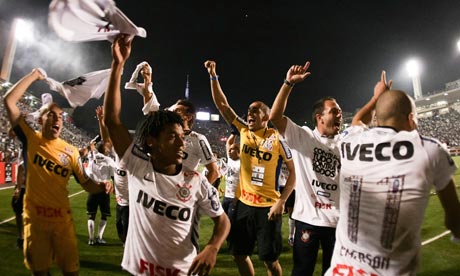
“By the end, Boca Juniors had been so comprehensively beaten that, as the South American football expert Rupert Fryer joked, they could not even raise themselves for the traditional post-Copa Libertadores final punch-up. Corinthians won 2-0 after a 1-1 draw in the first leg but the gulf between the sides was so vast, the chances of a comeback so slight, that it may as well have been quadruple that. And so, in their centenary year, seven months after the death of Sócrates, the most iconic player in their history, Corinthians won the Copa Libertadores for the first time. No more will there be cracks about ‘the 100-year-old virgin’.” Guardian – Jonathan Wilson

Corinthian values
“The 2012 Copa Libertadores final ended up being fought out between two of South America’s biggest clubs. Boca Juniors, one of the competition’s most successful sides, who have six titles and are only one behind all-time record holders Independiente, and Corinthians, a club that despite their grand stature were hoping to win their first ever Copa. After a hard-fought couple of legs, it was Corinthians who came out on top, to become the 23rd different club to win the trophy.” ESPN

Making History In the Copa Libertadores Final


Independiente with the 1975 Copa Libertadores trophy
“This year’s Copa Libertadores final, between Boca Juniors and Corinthians, is a truly heavyweight clash. On and off the pitch, the two combatants are giants of South American football. They are both current national champions and hold 28 league titles and four national cup titles between them. They are the most popular clubs in their respective megacities, beloved for their working-class roots, and count their supporters in the tens of millions.” In Bed With Maradona

Corinthians close in on Libertadores dream
“Some 20 years ago, Corinthians director Luis Paulo Rosenberg made a promise to himself. He said, ‘[When we win the Copa Libertadores] I want to buy a bottle of cachaca (the local moonshine), drink it all myself and sleep in the gutter, drunk.’ He has never been closer to buying that bottle. In the 53rd version of the South America’s Champions League, the Brazilian giants have made it through to the final at last. They are two games away from lifting the trophy – the final is played on a home and away basis with the first match on 27 June and the return leg on 4 July.” BBC – Tim Vickery

Lionel Messi hat-trick leads Argentina to 4-3 win over Brazil

“The summer friendly has become a familiar genre for American fans, but this felt different. For one thing, Brazil and Argentina are perhaps the only teams in the world able to draw more than 80,000 people in the same time slot as Germany-Portugal — a European Championship game that actually matters. For another, it provided another chance to compare Neymar and Lionel Messi, excellent players in their own right and proxies in the cold war between Pele and Diego Maradona.” Guardian

4-4-2 G4M3 TH3ORY 4-3-2-1 4-2-2-2 3-4-1-2
“Brazil finds itself in an awkward position. After a desperately disappointing quarterfinal exit in the 2011 Copa América, the Seleçao has three years to put it right with only the Olympic Games this year and the Confederations Cup next in the way of ‘proper’ matches. (Even then, the Olympic Games allow only three players over the age of 23, and the quality of opposition in the Confederations Cup is questionable, as the major nations seem unsure of the tournament’s importance.) Other teams may complain about qualifiers, but they do at least offer an opportunity for competitive games.” Howler – Jonathan Wilson

Euro 2012 – a World Cup without Brazil?

“A Rio newspaper on Sunday asserted that the European Championship is a World Cup without Brazil and Argentina. It is an expression used on both sides of the Atlantic – but that does not make it fair. European teams have disputed the last two World Cup finals but the continent also provides some of the dullest teams in the tournament. The phrase is unfair on Africa and Asia, where South Korea have made a consistent contribution to recent World Cups. If they needed home advantage to reach the semi-finals in 2002, then so did England in 1966 and France in 1998 to register their only wins.” BBC – Tim Vickery

End of the road for Ronaldinho’s Flamengo

“While Europe’s Champions League is down to the last four, the South American equivalent, the Copa Libertadores, is whittling down its field to the 16 teams who will go into the knockout phase. Twelve places have so far been filled, with some high drama along the way. For a few sweet seconds, for example, Flamengo of Rio thought they had saved themselves from elimination.” BBC – Tim Vickery

Benfica’s Brazilian import-export connection

“If they were unable to do it in front of their own fans, can Benfica manage to beat Chelsea at Stamford Bridge this Wednesday? Some might make the point that they were hardly at home last week. The Lisbon giants kicked off without a single Portuguese player – and with an extraordinary complement of nine South Americans in their starting line-up, plus another on the bench (alongside a Brazilian-born Spaniard), and one more ruled out by injury. And that is not even the half of it. Benfica have a further 17 South American players out on loan with other teams.” BBC – Tim Vickery

Can Brazil rely on David Luiz?

“The World Cup can be a cruel thing. No matter how well the team is doing in the competition, it need not take a bad game, or even a bad half, for them to be eliminated. A bad few minutes can be enough – as Brazil know very well. Brazil’s team in the last World Cup in South Africa may not have been to everyone’s taste, but results were excellent in the two years leading up to the tournament, and at half-time in the quarter-final against Netherlands few would have bet against them. Yet, in a matter of minutes, a 1-0 lead evaporated into a 2-1 deficit, and they were back on the plane home.” ESPN – Tim Vickery

Copa Libertadores Week One Round-up

“All the results from week one of the 2012 Copa Libertadores. Velez Sarsfield secured a comfortable win in the tournament opener as they overcame Defensor Sporting 3-0 in Uruguay. After going up just before the break through David Ramirez there was no doubt they would see the game out. Mauro Obolo and Seba Dominguez, with a scorching free kick, added the other goals.” Purple Patch

Copa Libertadores a cradle of talent

“This year’s major international tournament, the European Championship, was first disputed in 1960 – which makes it a mere youngster in comparison with the South American version, the Copa America, held as far back as 1916. But in terms of club competitions, rather than national teams, the seniority is reversed. The competition now known as the Champions League, originally the European Cup, first kicked off in 1955. The South American equivalent, the Copa Libertadores, only came to life five years later – and was a conscious attempt to emulate the European competition, so that the champions of football’s two traditional continents could fight it out for the world title. Why the discrepancy? It is not too hard to explain.” ESPN – Tim Vickery

Jose Pekerman takes Colombia back to the future

“Pep Guardiola as coach of Argentina’s national team? It was an idea floated recently by Argentine FA boss Julio Grondona, but as nothing more than a pipedream. It is very, very hard to imagine Argentina having a foreign coach. Same with Brazil. The idea was debated briefly in the Brazilian press just over a decade ago. But that was in exceptional times, when the national team were in danger of not qualifying for the 2002 World Cup.” BBC – Tim Vickery

Vargas and Neymar battle for player of the year accolade

“In the last competitive game of the South American season, Eduardo Vargas scored a goal that made sure Universidad de Chile won the domestic title, and also highlighted why Napoli are taking him across the Atlantic. Vargas broke from the halfway line. Cobreloa defender Sebastian Roco, worried about his pace, kept backing off. Vargas’ control of the ball at pace was so good that he was able to do two things.” BBC – Tim Vickery

El Bielsa De Los Pobres


“In the presence of more illustrious South American nations – Brazil’s financial strength allowing clubs to compete with their European counterparts, Argentina’s continued production of the world’s most sought after forwards and Uruguay’s successful national team, reaching the World Cup semi-final and winning the Copa America in the last 18 months with a population similar to Wales – Chilean football is silently flourishing. Or it was, until Universidad de Chile, known as La U, decided to attract attention to the west coast of South America by creating history and breaking records, all while playing some of the most exciting football in world football.” In Bed With Maradoma

La U accomplishments unforgettable despite defeat

“It is finally over. After 36 games, the unbeaten run of Universidad de Chile came to an end last Thursday when they went down 2-1 to Santiago rivals Universidad Catolica (an interesting side themselves – look out for right-back Stefano Magnasco and left-footed striker Kevin Harbottle). The long awaited defeat of ‘La U’ (the previous one was in July) came in bizarre circumstances. At 1-1 and with the game in stoppage time, they looked in total control – until the usually excellent midfielder Marcelo Diaz misplaced a pass out of defence and Catolica’s Jose Luis Villanueva fired in a cross shot to win the game.” BBC – Tim Vickery

Universidad de Chile take the 2011 Copa Sudamericana crown in style


“The club of the moment? Universidad de Chile: sweeping up trophies in their domestic league, unbeaten in 35 games, and this week crowned Copa Sudamericana champions, their first ever continental title. More interesting than their success has been their style of play. Coming 18 months after Marcelo Bielsa took Chile to the World Cup having played dynamic, quick football with heavy pressing, usually in a 3-3-1-3 formation, his fellow Argentine Jorge Sampaoli is doing something similar.” Zonal Marking

Copa Sudamericana champions face uphill struggle to hold onto key players
“The best team in South America face an uphill struggle to hold onto their prize assets. With a crushing 4-0 aggregate victory over the formidable LDU Quito, Universidad de Chile secured their first ever continental title. The comprehensive victory ensures La U can be counted as one of the best teams on the continent. With Copa Libertadores football secured for 2012, they now face the task of holding on to their key players and push on to become one of the greatest teams in the recent history of South American club football.” Purple Patch

Paraguay’s hooligan problem is getting out of control
“Six games in 2011, four in just over a month, have been suspended in Paraguay due to crowd violence. The latest suspension came on last weekend’s crunch game between league leaders Libertad and title chasers Cerro Porteño, two points behind with three games to play. With Cerro Porteño leading one-nil at half time the players and officials came out ready for what was set to be a thrilling and potentially season-defining 45 minutes of football. But before the second half could begin a flare thrown from the Cerro Porteño end struck the linesman who had to leave the stadium in an ambulance.” World Soccer

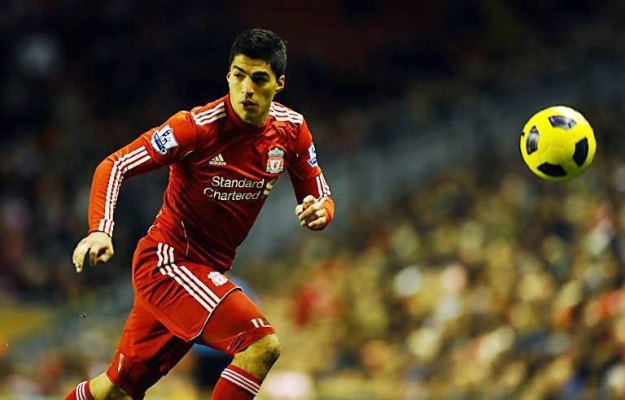
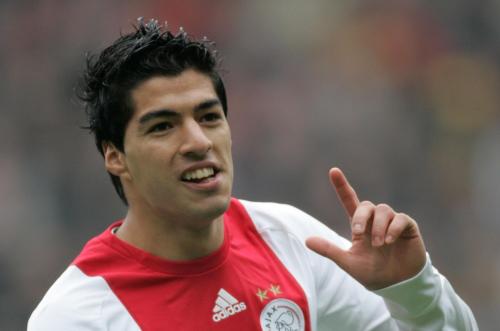
Suarez skill complements Uruguay teamwork


Luis Suárez
“There was a little run and a cracking left-foot shot from outside the area. There were two headers, one classic, the other bundled in after sound reading of the situation. And to complete the set there was a drilled, first-time, right-footed cross shot. Luis Suarez showed the full range of his astonishing talent last Friday, scoring all the goals in Uruguay’s 4-0 World Cup qualifier win over Chile. It was breathtaking stuff.” BBC – Tim Vickery

World Cup qualifying 2014: Argentina 1 – 1 Bolivia: match highlights
“Argentina’s qualifying campaign for the 2014 World Cup hit another bump in the road on Friday afternoon where, in the glorious Monumental sunshine, Bolivia took the lead and eventually held the hosts to a 1-1 draw in the third round of qualifiers. Marcelo Martins opened the scoring in the 56th minute, only for Argentina – who dominated without overly impressing – to equalise through Ezequiel Lavezzi just seconds after he’d taken to the pitch. In the first half, Gonzalo Higuaín saw an early opener disallowed due to a foul… on Lionel Messi in the buildup. You can see the highlights (in HD if you’re so minded) right here.” Hasta El Gol Siempre (Video)

Argentina rallies to draw Bolivia 1-1 in qualifier

“Argentina’s poor start in South American World Cup qualifying continued on Friday with substitute Ezequiel Lavezzi scoring in the 60th minute to salvage a disappointing 1-1 draw against Bolivia. Marcelo Martins put Bolivia ahead in the 56th, capitalizing on an error by Argentina defender Martin Demichelis. Lavezzi equalized four minutes later with his first touch after coming on for Ricardo Alvarez.” SI

Suarez scores four as Uruguay crush Chile 4-0
“Uruguay striker Luis Suarez scored all four goals as the Copa America holders crushed Chile 4-0 on Friday to stay top of the South American 2014 World Cup qualifying group. Suarez scored twice in each half, his goals spanning a 30-minute period in which Uruguay devastated Chile, who went into the match following coach Claudio Borghi’s dismissal of five of his players for indiscipline in midweek.” SI

Bad start for new Argentina coach

“Last Tuesday when Venezuela beat Argentina in the second round of South America’s World Cup qualifiers it was historic, but hardly surprising. Venezuela have been making dramatic strides, had home advantage and were taking on an especially vulnerable Argentina side – whose 4-1 win at home to Chile the previous Friday may have disguised the fact.” BBC – Tim Vickery

Latin America’s power struggle
“Just a few rounds gone and, of the nine teams in contention, only two have yet to win a game. The other seven already have one success to their name, but nobody has two. The figures don’t just show it, they shout it: World Cup qualification in South America is more competitive than anywhere else on the planet.” ESPN – Tim Vickery

Goals galore in South American World Cup qualifiers

“It’s the same teams, three months apart, coming up with a totally different spectacle. Back in July the Copa America in Argentina was always enthralling, but its fascination was frequently the grim, attritional kind, with defences holding the upper hand. Now in October, the first round of South America’s marathon World Cup qualification campaign produced four open games – at times absurdly so – and 15 goals. Much of this can be explained by the differing demands of tournament and league football.” BBC – Tim Vickery

Tough qualifying period ahead for South American sides

“While Uruguay’s players were still celebrating their recent Copa America victory, their coach Oscar Washington Tabarez, with typical wisdom, was guarding against complacency. ‘Winning the Copa doesn’t give us any guarantees in terms of the World Cup qualifiers,’ he said. ‘They are much more competitive than this tournament.’ On Friday, in their first outing since the triumph in Argentina, it took Uruguay just 13 seconds to realise that the Copa belongs to the past.” BBC – Tim Vickery

Batista must have thought he was safe as houses

“Just before the Copa America he signed a contract to be Argentina boss in the coming set of World Cup qualifiers. Argentina had not sacked a coach in decades – either they had resigned or had reached the end of their contract. Why would it be any different now? On his record over the past year, Sergio Batista is unfortunate to have been ousted – with former Leeds and Sheffield United midfielder Alejandro Sabella lined up to replace him.” BBC – Tim Vickery

Venezuela’s Loudest Cheerleader

“The ubiquitous nature of Twitter in celebrity circles ensures that us less exalted types are always kept up to date on their thoughts whenever an event of significance is occurring and it was no different at this year’s Copa America. But amongst all the usual Latin American ex-players, silicone enhanced models and other two-bob celebrities, the most compelling account to follow was that of Venezuelan president Hugo Chavez (@chavezcandanga).” In Bed With Maradona

ZM’s Copa America Best XI


“The outstanding performers from July’s Copa America tournament in Argentina.” Zonal Marking

Uruguay’s momentum, Paraguay’s bumpy road, more Copa America
“Going into the Copa America, we posed questions about the campaigns of the 10 South American sides. Now that the 43rd Copa America is history, we look back to find out if the tournament came up with the answers. (Listed from winners down to the teams eliminated in the group phase) SI – Tim Vickery

Uruguay light the way


“In the end, it was only a slightly surprising result. The 2011 Copa America might not have gone the way of holders Brazil or hosts and favourites Argentina, but Uruguay were probably the next in line to win it. Sunday afternoon’s 3-0 win over Paraguay was the result most expected after the semi-finals, and sees the Celeste lift their 15th Copa, pulling clear of Argentina, who they’d previously been level with on 14 tournament wins.” ESPN

Future bright for Copa kings Uruguay
“The record 15th Copa America triumph came with a fair dose of suffering – the only way Uruguay know how. They drew both their first two games. Then they mounted a heroic rearguard action in the quarter final against hosts Argentina, where they had a man sent off in the first half. But in the end it was conclusive. And so was the message from Buenos Aires after the 3-0 win over Paraguay in the final – last year’s run to the World Cup semi finals was no fluke. Uruguay are back.” BBC – Tim Vickery

Uruguay 3-0 Paraguay: Tabarez gets things right
“Uruguay won their record 15th Copa America with an excellent, controlled performance. Oscar Tabarez likes to spring a surprise with players and formations, but it was his expected XI for this match, in the 4-4-1-1 system that can reasonably be described as his first choice shape throughout this tournament. Gerardo Martino’s side was less predictable – he made four changes from the semi-final win over Venezuela, but kept roughly the same system – a narrow 4-4-2 / 4-5-1 with Pablo Zeballos making forward runs from a wide-left position, although Nelson Valdez sometimes switched positions with him. Uruguay were better all over the pitch – they were more secure at the back, more potent upfront, and most crucially, they won the midfield battle.” Zonal Marking

Uruguay’s Copa América triumph ushers in another golden age
“This has been a tournament that has persistently defied expectations, but not in the final. Uruguay were comfortable winners over Paraguay, collecting a 15th Copa América title and so, on Argentinian soil, moving past Argentina to become the most successful team in the tournament’s history.” Guardian – Jonathan Wilson

Suarez pays tribute to team-mates
“Luis Suarez was named Player of the Tournament after helping Uruguay to a 3-0 victory over Paraguay but paid credit to his team-mates for the success. Suarez scored the opening goal and set up Diego Forlan for the third to round off a hugely impressive tournament as Uruguay cruised to victory.” ESPN

Paraguay 0-0 Venezuela (AET): Paraguay win on penalties – again

“Paraguay are, amazingly, through to the Copa America final having drawn all five games in the competition so far. As he did for the Spain game in last summer’s World Cup, Gerardo Martino made numerous changes to his side, partly because of Antolin Alcaraz’s suspension, which meant a big reshuffle at the back. Nestor Ortigoza returned to the midfield.” Zonal Marking

Paraguay 0-0 Venezuela
“Paraguay rode its luck through another penalty shootout to beat Venezuela on Wednesday and set up a Copa America final against Uruguay. Paraguay, which has not won any of its five matches in the tournament, booked its place in the final following a goalless draw and a 5-3 victory on penalties. The only miss in the shootout came when Justo Villar stopped Franklin Lucena’s shot. Dario Veron held his nerve to net the final spot kick and set up Sunday’s final against Uruguay, which beat Peru 2-0 in the other semifinal on Tuesday.” ESPN

Uruguay 2-0 Peru: Tabarez changes formation again to take Uruguay to the final
“Luis Suarez scored two second half goals in a confident Uruguayan performance. Oscar Tabarez was without Diego Perez, so Napoli’s Walter Gargano took his place. Sebastien Coates returned at centre-back. Sergio Markarian brought in Giancarlo Carmona for Renzo Revorendo, and Yoshimar Yotun for William Chiroque. With both sides contesting the quarter-finals as underdogs and both used to playing reactive football in this competition, much of the game was something of a stalemate, with neither side committing enough players into attack to overload the opposition.” Zonal Marking

Uruguay Reach Copa America Final


“The 2011 Copa América has been a tournament full of shocks, everyone would agree. None of the three pre-tournament favourites won their groups, none of the group winners made it through to the semis, and both the hosts and the holders (who were among those favourites first mentioned) went out in the quarter-finals. When the curtain is raised on the final in River Plate’s Estadio Monumental on Sunday afternoon, though, there will be one sight that’s familiar from past tournaments, though.” In Bed With Maradona

Uruguay 2, Peru 0

“Luis Suarez scored in the 53rd and 58th minutes to lead Uruguay past Peru 2-0 on Tuesday and into the Copa America final. Uruguay, which reached the semifinals of last year’s World Cup, will be looking for a record-15th Copa America title in Sunday’s final against either Paraguay or Venezuela, which meet in the other semifinal Wednesday in Mendoza. The final will be played Sunday in Buenos Aires.” ESPN

Uruguay storm into final
“Uruguay are the first team through to the Copa America final after they recorded a convincing 2-0 victory over Peru in La Plata, Argentina. Luis Suarez netted a second-half brace in the semi-final.” ESPN

Uruguay’s international rise
“On July 7, 2010, Uruguayan fans were waking up having seen their side fall to Netherlands in the semi-finals of the World Cup in South Africa a day earlier. Now one of the favourites to pick up the Copa America, Oscar Tabarez’s Uruguay are bringing back memories of their glory days, which began in 1924 and ran until their World Cup win of 1930 on home soil.” ESPN

Brazil 0-0 Paraguay: Brazil fail to score in 120 minutes – then miss all their penalties too

“Paraguay are through to the semi-finals of the Copa America, having drawn all four games so far. Gerardo Martino took the surprising decision of dropping Nestor Ortigoza, bringing in Victor Cacares in the centre of midfield. Roque Santa Cruz dropped out, with Nelson Valdez making his first start of the tournament.” Zonal Marking

Venezuela 2-1 Chile: Borghi’s changes put Chile on top, but set-piece vulnerability proves fatal
“Venezuela are through to the semi-finals after two goals from dead ball situations. Cesar Farias’ defence and midfield were as expected – the only decision to make was upfront, where Miku played just off Giancarlo Maldonaldo, in a fairly basic 4-4-2. Claudio Borghi was without Jean Beausejour, so Arturo Vidal moved out to the left and Carlos Carmona came into the centre of the pitch. Chile were poor in the first half, then excellent in the second. Venezuela were never particularly inventive, but retained a threat from set-pieces – and that was enough for them to win the game.” Zonal Marking

Uruguay 1-1 Argentina (AET): Uruguay progress after disciplined defending and superb penalties
“The hosts are out of the Copa America after an engaging 1-1 draw. Oscar Tabarez kept faith with the same narrow 4-4-1-1 system as against Mexico, although there was one change – Martin Cacares came in for Cristian Rodriguez, with Alvaro Pereira moving forward to the left of midfield. Sergio Batista named an unchanged XI in broadly the same system as in Argentina’s final group game against Costa Rica. The game started frantically and then slowed down but remained enjoyable – the two red cards opened up the game, but didn’t produce any more goals.” Zonal Marking

Peru 2-0 Colombia (AET): Colombia waste chances and Peru exploit goalkeeping mistakes
“Carlos Lobaton and Juan Vargas scored thumping extra time goals to put Peru into the semis. Hernan Gomez named his expected side, in a 4-3-3 formation. Sergio Markarian also named 4-3-3, though his side featured many changes from the final group stage game against Chile, when various players were rested. Colombia had the better chances, but Peru were always in the game and largely defended well.” Zonal Marking

Brazil pay the penalty


“Eight-time Copa America winners Brazil were left stunned and eliminated as they failed to convert a single penalty in their shootout against Paraguay, losing it 2-0. The Brazilians created the better chances throughout the 120 minutes, but were unable to make the breakthrough as both sides remained scoreless to send the quarter-final in La Plata to penalties.” ESPN

Paraguay 0, Brazil 0
“Paraguay advanced to the Copa America semifinals on Sunday by defeating defending champion Brazil 2-0 in a penalty shootout after the score was level at 0-0 following extra time. Paraguay goalkeeper Justo Villar stopped Thiago Silva’s shot and Elano, Andre Santos and Fred also missed for Brazil, which was eliminated from the South American competition a day after host Argentina lost to Uruguay.” ESPN

Argentina and Brazil lead the fall of the Copa América giants
“The giants woke up, but only to be felled. When Argentina and Brazil scored seven goals between them in their third group games at the Copa América, it seemed they were slowly rousing themselves for the march to a meeting in the final that the organisers had done everything in their power to make inevitable. In their quarter-finals, though, the problems of the opening games returned. Both struggled to make domination of possession count, both lost on penalties, and both will look on a barely credible semi-final line-up and wonder why on earth they are not there.” Guardian – Jonathan Wilson

Brazil coach defends ‘historical incompetence’ after Copa América exit
“The Brazilian daily paper O Globo may have branded it an act of “historical incompetence” but the Brazil squad and coaching staff have defended their exit from the Copa América. The five-time world champions were beaten on penalties by Paraguay after a shoot-out in which they failed to hit the target with all four spot kicks. But despite the failure the coach, Mano Menezes, has pleaded that the public look on the bright side.” Guardian

Fickle Copa America quarterfinals yield surprising remaining quartet
“The full moon shone bright and white over San Juan, its domination of the chill sky seeming a symbol of the lunacy that took over the Copa America this weekend. The tournament — perhaps any tournament — has never known a series of quarterfinals like it, as the three group-winners and the hosts all crashed out. The machinations of the schedulers, who had done everything in their power to ensure a third successive Brazil-Argentina final, are left looking a little silly.” SI – Jonathan Wilson

Inspirational Markarian leads Peru to semi-finals
“At the time of writing there is the chance that Venezuela might make it two, but at the moment there is the certainty that one of the Copa America semi-finalists will be a team who missed out on last year’s World Cup – and who missed out by the widest possible margin. Peru finished bottom of the table in South America’s 2010 qualifiers. They lost all nine away games, conceding 26 goals in the process.” BBC – Tim Vickery

Venezuela 2, Chile 1
“Venezuela reached the Copa America semifinals for the first time as Oswaldo Vizcarrondo and Gabriel Cichero scored either side of halftime to beat Chile 2-1 on Sunday. Humberto Suazo equalized briefly for Chile in the second half. Venezuela is unbeaten in four games at the Copa America and has been the surprise team in a surprising tournament.” ESPN

Uruguay 1, Argentina 1
“Uruguay advanced to the semifinals of the Copa America with a penalty shootout victory over hosts Argentina on Saturday, with Carlos Tevez having his spotkick saved by goalkeeper Fernando Muslera in the decider. The game ended 1-1 after regulation time and there was no addition to that scoreline in extra time. The final tally in the shootout was 5-4 to Uruguay.” ESPN

Argentina dumped out
“In the biggest upset of the 2011 Copa America thus far, Uruguay have defeated tournament hosts Argentina on penalties in their quarter-final in Santa Fe. The match itself ended 1-1 as Argentina dominated large portions of the contest, but Uruguay showed their steel to win the shootout 5-4 and eliminate the favourites. Carlos Tevez, the figure at the centre of much transfer debate, had his spot-kick saved by Fernando Muslera while Uruguay converted all of their penalties in clinical fashion.” ESPN

Peru 2, Colombia 0
“Peru reached the Copa America semifinals for the first time since 1997 by defeating Colombia 2-0 in extra time on Saturday. Carlos Augusto Lobaton fired a powerful shot from just inside the penalty area in the 101st minute and fellow midfielder Juan Manuel Vargas sealed the victory with a shot from near the penalty spot in the 111th.” ESPN
Sergio Batista and the Sharpening of Long Knives


Sergio Batista
“We’re one week into the Copa América, and if nothing else it’s proven correct those who made pre-tournament predictions that it would be the most closely-fought Copa in a long time. For the first time ever, both Argentina and Brazil failed to win their opening matches. It must be said that not enough credit was given to the two sides who foiled them in those games; Venezuela in the case of the holders Brazil, and Bolivia in the case of hosts Argentina.” In Bed With Maradona

Critics attack ‘disastrous’ Brazil after they scrape Paraguay draw
“Perhaps Dunga wasn’t so bad after all. He may have been pragmatic and have refused to pick the public’s favourites, but at least he won games. Brazil, after underwhelming in a 0-0 against a Venezuela team that, after Saturday’s 1-0 win over Ecuador, improbably tops Copa América’s Group B, were highly fortunate to scrape a 2-2 draw against Paraguay. Two thirds of the way through the group stage, none of the seeds have yet won a game and, amid all the grumbling about Argentina’s form, the one consolation for the hosts has been that Brazil have been even worse than they have.” Guardian

Can Argentina salvage their Copa America hopes?
“We’re one week into the Copa América, and if nothing else, it’s shown that those who predicted that this would be the most closely-fought Copa in living memory, have been proven correct. For the first time ever, both Argentina and Brazil failed to win their opening matches. It must be said that not enough credit was given to the two sides who foiled them in those games; Venezuela in the case of the holders Brazil, and Bolivia against the hosts Argentina.” World Soccer

Brazil 2-2 Paraguay: Brazil snatch the draw
“Mano Menezes ditched the “European” 4-2-3-1, went for a Dunga-style compromise system, then ended up with 4-2-2-2… He dropped Robinho from his starting line-up, favouring Jadson who played much narrower on the right, as he has done in previous friendlies. Gerardo Martino went for the 4-4-2 / 4-3-3 hybrid that he often favoured at last summer’s World Cup. Roque Santa Cruz played on the right, and made diagonal runs to a centre-forward position.” Zonal Marking

Set-pieces dominate the first week of the Copa


“For a tournament often hailed for its flair and unpredictability, the Copa America has clearly been lacking excitement. So far, the goals per game count stands at a pathetic eight, from seven matches. That gives a goals per game rate of just 1.14 – roughly half the goals per game rate of last summer’s World Cup, where the figure was 2.27. There have been three 0-0s, and only Chile have scored more than once.” Zonal Marking

Argentina 0-0 Colombia: another goalless draw
“The third 0-0 from seven Copa America games so far, as Argentina again struggled. Sergio Batista made one change from the opening day 0-0 against Bolivia. Marcos Rojo dropped out, with Pablo Zabaleta coming in on the right. Javier Zanetti moved to the left. Hernan Dario Gomez also made a single change, bringing in Carlos Sanchez for Gutavo Bolivar, a straight swap in midfield. Argentina had much of the play but failed to create enough chances to get the breakthrough, a common feature of this tournament. Colombia sat back and played on the break, and deserved their point.” Zonal Marking

Chile 2-1 Mexico: Borghi’s change in formation prompts Chile’s comeback

“Chile recovered from 1-0 down to record a 2-1 victory in an excellent contest. Claudio Borghi lined up with a 3-4-1-2 formation containing various players who are familiar from last year’s World Cup, and there were no major selection surprises. Like Costa Rica, Mexico are competing with an Olympic squad in this tournament, and assistant manager Luis Fernando Tena is in charge. He played a 3-5-2, with Giovani dos Santos just behind Rafael Marquez Lugo, not to be confused with the more established Rafael Marquez.” Zonal Marking

Copa América 2011: Chile Rely on Set-Pieces to Get Victory
“Chile embarked on their journey for a first Copa America trophy against a weakened Mexico side. With last month’s Gold Cup Mexico’s main international competition of the summer, a mostly under-22 side make up the Copa America squad for the tournament invitees. This meant that Chile, with the likes of potentially Barcelona bound Alexis Sánchez, as well as Humberto Suazo and Matías Fernández, were clear favorites. Meanwhile Giovanni dos Santos – Tottenham-loanee and spectacular goal-scorer in the Gold Cup final – the main player of note for the Mexicans.” the elastico

WWC: Erica Turns on the Style

“Sure, Copa América has Messi, Forlán, and Neymar. Yes, it will be a very interesting test for Mano Menezes. Yeah, it’s nice to see the young Brazilian and Argie talent that’s been shining in leagues around the world. And I’ll grant you that, despite lackluster performances from Brazil in its first game and Argentina in its first two, there are good reasons to expect both to put on an offensive show in this Copa America. Both Brazil and Argentina are using very offensive schemes, and both have players who can make things happen. Plus the third traditional power in South American soccer, Uruguay, has a pretty good team, the one that went farthest in the last World Cup and the one with the best player from that tournament. And we can’t forget Chile or Colômbia, both of which bring some interesting players. There are lots of reasons to watch this Copa America.” Cult Football

Opening skirmishes hint at wide-open Copa

“They may have had a little bit of help from some a less than perfect pitch in La Plata and some opening match nerves from the big two, but in holding Argentina and Brazil respectively, Bolivia and Venezuela made a powerful declaration of the current strength in depth of the South American national teams. Whoever wins the Copa America on 24 July will have to battle their way to the title but both hosts Argentina and 2014 World Cup hosts Brazil will feel they are capable of far better than they produced in their first group games.” BBC – Tim Vickery

Copa comes home

“In 1910, Argentina invited Uruguay and Chile to compete in a three-team tournament called the Copa Centenario Revolucion de Mayo. The seeds were sown for a larger continental competition and in 1916 Argentina hosted what is considered to be the inaugural South American Championship of Nations.” ESPN

A guide to the 2011 Copa America


“Think football is over for the summer? Think again. From July 1st to the 24th, the ten nations comprising the CONMEBOL Confederation of South America, plus two guest countries, will play out the 43rd Copa America in Argentina. If you’re familiar with past tournaments, then you’ll know to expect some beautiful football, some drama, some hilariously shameless cheating, and some great spectacle, both on and off the pitch. It’s a fine showcase for South American football and for my money the most entertaining and passionate football on earth.” Three Match Ban – 2011 Copa America: Part One – The Minnows, Part Two – The Outsiders, Mexico & Costa Rica, Part Three – The Under-Achievers, Colombia & Peru, Part Four – The Over-Achievers, Paraguay and Ecuador, Part Five – The Contenders, Uruguay and Chile, Part Six – The Giants, Argentina and Brazil

Sensational Cavani signifies rebirth of Uruguay as a soccer power


Edinson Cavani
“Before they used to say “You were the champions? Sure, when football didn’t even exist, but today they’re looking at us in a different light,” Edinson Cavani said in an interview in El Pais this month about the impact of Uruguay’s World Cup campaign, which saw the country reach fourth place after decades of absence from center stage.” SI

Expect Suarez to make a speedy adjustment to the Premier League


Luis Suarez
“Before Diego Forlan, Luis Suarez and company fired Uruguay into the semifinals of last year’s World Cup, many people had forgotten (or never knew) that this little South American country with a population of under 3.5 million has an extraordinary soccer tradition.” SI

Striker Suarez fits the bill for Liverpool


Luis Suarez
“The last time I saw new Liverpool signing Luis Suarez in the flesh, he was playing his biggest game so far in his native continent. It was November 2009, and Uruguay were taking on Costa Rica with the final place in South Africa 2010 at stake. As Uruguay coach Oscar Washington Tabarez reflected recently, the World Cup can be enjoyed but the qualification process has to be suffered. Uruguay certainly suffered to book their place, and despite having a 1-0 lead from the away leg, they were certainly suffering that night against Costa Rica. They dominated the game, but while the goals refused to go in, nerves were jangling, especially for Suarez.” BBC – Tim Vickery

Agony and Empire
“And so it came to pass that a helicopter carrying Fernando Torres touched down on the wreckage of several earlier helicopters only thought to have been carrying Fernando Torres, and Fernando Torres raised his serene gaze from the book about helicopters that he had been reading on his helicopter and looked inscrutably out the window, leaving the rest of us to stare at his helicopter and wonder what it all could mean.” Run of Play

What’s next for Torres & Co.?
“After a flurry of activity on Monday, the January transfer window is closed. Clubs won’t be able to wheel and deal again until the summer. In the meantime, many teams will now have to adjust to new players joining their squads or key players leaving town. Here are the five big questions facing a few clubs in the English Premier League.” ESPN

A difficult decision that Torres could not resist
“Fernando Torres: Chelsea striker. Actually seeing it in writing feels strange, and the sight of him in a blue, rather than red shirt, harder for fans to come to terms with than the fact the former Liverpool number nine switched clubs for a record breaking £50 million. Last week, the idea that we’d be referring to Torres as a former Red by the following Tuesday was simply un-imaginable for the majority of Liverpool fans – yet the feeling that he was at a club progressing much slower than he had hoped had been growing within the player for some time – and when Chelsea made a serious enquiry ahead of Liverpool’s game against Fulham, Fernando sensed that this was an opportunity that he could not resist.” Guillem Balague

Andy Carroll: Is He Worth It?.
“Yesterday marked the third time Kenny Dalglish has broken the English transfer record for a Geordie striker. On the previous two occasions it worked out pretty well. In 1987, Peter Beardsley arrived for £1.9m, and Liverpool turned into arguably the finest English club side seen to date (certainly few have bettered that red vintage). The Reds won the league that season, and in a three year spell were one win away from completing the league and cup double each time.” Tomkins Times

2011 Copa Libertadores, map of the 38 clubs in the competition.

“From BBC/football/blogs, Tim Vickery’s Blog, from 24 Jan., ‘Crunch time for Ronaldo and Corinthians‘. The map page shows the 38 clubs’ locations on the map. Flanking the map, grouped by their countries, are the clubs’ profile boxes. Each club’s profile box includes…home kit; crest; city location; stadium(s), and capacity; how the club qualified; national professional titles (with year of last title); total Copa Libertadores appearances (and how the club fared in their last Copa Liberrtadores appearance); and Copa Libertadores titles (with year of last title).” bill sports maps

South American football awards 2010


Diego Forlán
“Hello and welcome to the Fútbol Fútbol Fútbol awards for 2010. The awards focus on events in South American football, however there is room for an expatriate player of the year section to pay tribute to the best of the thousands of South American footballers plying their trade on other continents. You may find some of the awards surprising or idiosyncratic, however if you are offended by any of these selections you can either find another website to tell you exactly what you want to read or failing that you could leave your opinion on why we are wrong in the comments section below. Enjoy.” Fútbol Fútbol Fútbol

The IBWM Torneo Apertura Review
“Last weekend Estudiantes clinched the Torneo Apertura title, and as Sam Kelly reports, they were undoubtedly worthy winners.” In Bed With Maradona

Not For Glory Alone

“Two billion souls: One must begin with that. That’s how many people, or nearly so, sat or stood in view of television screens to watch twenty-two men kick a white ball around a green field on a warm July night in Berlin four years ago. The twenty-two men comprised the men’s national soccer teams of Italy and France. The occasion was the final game of the 2006 World Cup. The cagey match, as the world now knows, turned on an extraordinary event near its end when France’s captain and star, Zinedine Zidane, strode toward the Italian defender Marco Materazzi and, for reasons unknown, drove his bald pate into the taller man’s chest. The motion mimicked one he’d used a few minutes earlier to head a flighted ball inches over the Italians’ goal, coming ago nizingly close to winning the day for France. Now Zidane was expelled, his team was rattled, and a player in blue whose name few outside Umbria and Trieste recall darted inside a player in white and curled the ball inside the French goal with his left foot, cueing images, on countless flickering screens around the planet, of his countrymen celebrating Italy’s triumph in the floodlit waters of the Trevi fountain in Rome.” (Laphams Quarterly)