Tag Archives: Spain

World Cup 2018 groups: Your complete guide to the teams

“The World Cup draw is done and dusted with England drawn against Belgium, Panama and Tunisia. Here is your guide to the eight groups for the 2018 World Cup…” Telegraph

Saudi Stars Arrive in Spain, With One Eye on Russia

“VILLAREAL, Spain — After the website had crashed, but before the falcon arrived, Salem al-Dawsari was introduced by his new club. Inside the Estadio de la Cerámica, the banana-yellow-skinned home of the Spanish team Villarreal, a few dozen journalists had arrived to view Dawsari, a midfielder who had become something of a curiosity in the Spanish news media. For one, Dawsari was among the first players from Saudi Arabia to sign for a team in La Liga, Spanish soccer’s top league. But that was only part of the story. …” NY Times

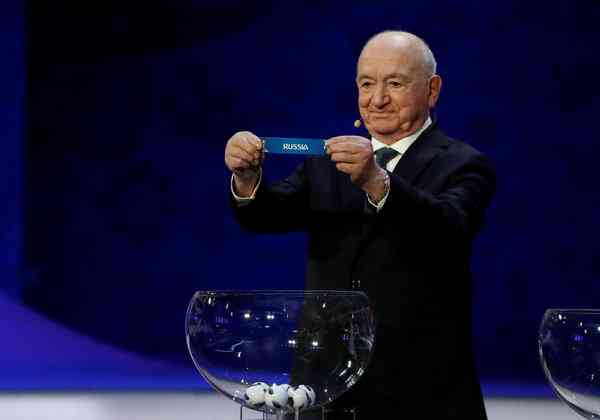
Applause at the Draw, but Will Russia Keep Cheering?


“MOSCOW — Half a million fans — by current, suspiciously optimistic, estimates — will descend on Russia next year for what Gianni Infantino, the FIFA president, has already decreed will be the ‘best’ World Cup in history. Every single fan, he has decided, will have “an amazing experience.” Billions of dollars have been spent on new, or renovated, stadiums to host the finest players in the world: Cristiano Ronaldo and Lionel Messi, Neymar and Kylian Mbappé. Russia’s president, Vladimir Putin, on Friday promised a ‘major sporting festival of friendship and fair play.’ …” NY Times, The Ringer: The Four Must-Watch Games of the 2018 World Cup Group Stages (Video), NY Times – World Cup Draw: Group-by-Group Analysis

World Cup 2018 power rankings: Germany on top among qualified 23


“Twenty-three nations have booked their places for the World Cup in Russia, with the holders and Brazil looking in good shape but we rank England in 13th place, below Iceland.” Guardian (Video)

Tactical Analysis: England 2-2 Spain | Start of a transition for both teams

“England’s international friendly against Spain on the 15th November marked Gareth Southgate’s fourth game in charge of the Three Lions and a chance for Spain to make one more step towards regaining their identity as ‘La Furia Roja’. Despite incredible depths of talent within the two camps, both teams are looking to rebuild their confidence after disappointing stints at the European Championships over the summer, but this time without the old guard.” Outside of the Boot

Uno: La Historia De Un Gol (One: The Story Of A Goal)

eba8060a106__uno_poster
“While a bloody civil war rages at home, El Salvador’s national team travels to Spain for the 1982 World Cup — one of only two World Cup tournaments the nation has ever qualified for. In their opening match, they lose to Hungary, 10-1 – still the most lopsided defeat in World Cup history. But that goal, that one goal, scored by Luis Ramirez Zapata, remains a symbol of pride and joy for the tiny nation. This is the story of that goal and its continuing legacy.” Kicking and Screening (Video)

The New Manager Effect – Five Under the Radar European Managerial Changes to watch in 2016/17

Unai-Emery-2016-17
“The conclusion of the European football season, a time for fans to sit back and reflect on the season just passed for their club. To assess and debate whether or not it was a good, bad or merely average season. The owners and board members of clubs will also spend the summer months doing exactly the same thing, however, the one crucial difference is they must make a decision whether to continue with the incumbent manager or whether to make a change. For those that choose the latter option and make a change, there is no such thing as a summer break, negotiations and interviews remain ongoing until a suitable replacement has been found. Criteria is weighed up such as past success at clubs, experience, past performances at clubs counter-balanced alongside the financial situation said individuals inherited and whether or not a new inexperienced manager could add a breath of fresh air to a football club.” Outside of the Boot

Italy dominant, special in ousting reigning Euro champion Spain

“From Italy, this was magnificent, a display of intelligence and swagger to eclipse anything seen at this tournament so far. The 2-0 victory over two-time reigning European champion Spain in the Euro 2016 round of 16 was revenge for the final four years ago, for this was a victory every bit as comprehensive as Spain’s 4-0 win in Kyiv. For Spain, meanwhile, there was confirmation that the World Cup was not a one off. The magic has gone. This is a good side, but no longer a great one.” SI – Jonathan Wilson

Euro 2016 Power Rankings: Final 16 teams in France

France's Paul Pogba (2nd L) celebrates with team mates after scoring against Portugal during their friendly soccer match at the Stade de France in Saint-Denis near Paris October 11, 2014. REUTERS/Charles Platiau (FRANCE - Tags: SPORT SOCCER) - RTR49T0J
“The dramatic end to the group stage couldn’t disguise the fact that, for the most part, this has been a slightly disappointing opening to the tournament, yielding just 1.92 goals per game and precious few games of real quality. No side won all three group games, while many of the less-fancied sides troubled their supposed betters. The suggestion is that this is a very open tournament, although there remains the possibility that one of the top sides will suddenly click into gear and surge through to success on July 10. The knockout bracket has yielded an unbalanced final 16, with powers France, Germany, Spain, Italy and England on one half, while Belgium and Portugal benefited from underperforming in the group stage by being given a more favorable rout to navigate on the road to the Stade de France.” SI – Jonathan Wilson

Six things we’ve learned from the Euro 2016 group stages

“Fears that lowly ranked sides like Albania and Northern Ireland might dilute the quality of the competition have not materialised. Cynics might say the overall quality was so low that nobody noticed anyway, but the fact is that some of the more fancied teams – the likes of the Czech Republic, Austria, Turkey, Ukraine and Rumania – couldn’t make it past these minnows. The extended format has brought plenty of colour and amazing stories like Iceland’s success to the tournament, and have helped more than make up for the lack of excitement felt elsewhere. But UEFA also got very lucky. Groups E and F were clearly at an advantage, knowing just how many points were needed to advance ahead of other third-placed teams.” red bulletin

Euro 2016 group stage grades

article-3656059-359654C400000578-931_964x417
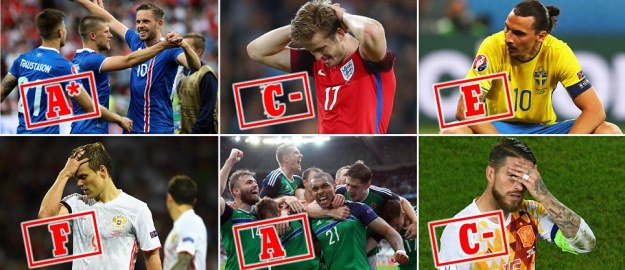
“The group stages of Euro 2016 have provided goals and controversies, outrageous skill and dreadful mistakes. With no team able to win every game, but only one side losing all three matches, the tournament has proved more competitive than anyone could have expected. After 36 matches, the action is only just hotting up, but having played three times each, we now have a decent idea about what shape the teams are in.” Daily Mail

Euro 2016: How Teams Can Advance to the Next Round

UPEURO-CUP-master768
“The group stage of Euro 2016 is well underway: From Wednesday until Saturday, all 24 teams will complete their second of three games of group play. And the minute those games are over, many serious fans will start to do math – in their heads, on cocktail napkins or even on spreadsheets – to determine what their teams must do to ensure a place in the knockout stage of the competition. It can be complicated, particularly in this expanded 24-team tournament, where four third-place teams will advance, but we’re here to help you sort through it all. This page provides a big-picture overview in real time, and as soon as teams have completed their first two games – as the teams in Group A and Group B have – we’ll publish a detailed page just for those teams, showing you all the ways they can make the Round of 16.” NY Times

The Ten Oldest Stadiums in Spain

“Before I start, I have to admit that there is a flaw in a club claiming to have the oldest stadium. It’s a bit like Trigger’s Broom (or Theseus’ Paradox if you’re that way inclined). Can something which has had all of its component parts replaced over the course of time, remain fundamentally the same? Well for the sake of this article, the answer is a resounding ‘Yes’. Quite simply here are the 10 oldest stadiums in Spain. Just a couple of criteria apply; The current stadium has to be on the site of the original ground and it must have hosted a match in any of Spain’s top three tiers. So in reverse order, in at number 10 is… ” Inside Spanish Football

Euro 2016: Are Spain over their World Cup hangover?

“Despite a solid record in qualifying of nine wins from 10 games, European champions Spain are facing several dilemmas as they prepare for the defence of their title in France next summer. Veteran coach Vicente del Bosque faces selection problems in several areas, and there is also a more general concern over La Roja’s playing style as they continue to address the lingering hangover from last summer’s World Cup finals campaign, where they made a shock group-stage exit. Going into Friday’s friendly with England, these are the main issues.” BBC

Talent Radar Young Defender Rankings: Bellerin climbs, and Gimenez makes the cut

“Judging the calibre of a young player is often a tricky task. Perceived potential has an important bearing in any consideration and is just one of the many parameters to consider when trying to quantify the ability of football’s young stars. To add a basis to what may be a leap of faith, it is useful to look back and trace the growth, or indeed lack thereof, in young players.” Outside of the Boot

Talent Radar Young Defender Rankings: Jordan Amavi, John Stones & Samuel Umtiti impress

“Judging the calibre of a young player is often a tricky task. Perceived potential has an important bearing in any consideration and is just one of the many parameters to consider when trying to quantify the ability of football’s young stars. To add a basis to what may be a leap of faith, it is useful to look back and trace the growth, or indeed lack thereof, in young players. Our Talent Radar Player Rankings, along-with our Talent Radar Team of the Weekdocuments the progress of youngsters across Europe, with those featuring in these regular pieces, eventually being recognised in our end of season Talent Radar Young Player Awards and 100 Best Young Players to Watch list. Read this document for all your queries on Talent Radar and explanation of the features under it.” Outside of the Boot

Homage to Murcia – A Season of Football Anarchy

amazon_outside_cover_image
“Whilst the book is principally about travelling around Murcia ,with the fans CAP Ciudad de Murcia, I mixed with the ultras and hinchas of Cadiz, Athletic Club, Seville and SD Eibar as well meeting many British and Irish fans who get their kicks from following the Spanish games not so glamourous clubs. I went to over 50 matches in the 2013-14 and travelled to places as diverse as Bilbao, Gibraltar, Soria, Madrid and every nook and cranny of Murcia, searching for what makes the football sub-culture of Spain tick. I also discovered some of the lesser known football pioneers that brought football to Murcia and Spain in general including the Spanish Geordie Manny Pelegin who brought football to Lorca in the 1890s.” Homage to Murcia

Book review: Homage to Murcia – A Season of Football Anarchy by Tony Higgins
“Tony Higgins, long time friend of The Football Pink, has just released his first self-published e-book, Homage to Murcia: A Season of Football Anarchy, the title largely borrowed from George Orwell’s Homage to Catalonia and chronicles Tony’s experiences of following Spanish lower league club Ciudad de Murcia, home and away, through the 2013/14 season. Immediately apparent in this book is his sense of disillusionment with modern football, something an ever-growing number of weary devotees are experiencing as corporate avarice continue its rampage across the values of the supposed game of the people.” Football Pink

On-field meddling, off-field brilliance form Pérez’s double-edged sword

“Florentino Pérez might be an idiot, at least it when comes to matters on the field, but off of the pitch, he could be a genius. Therein lies the double-edged sword that defines the Real Madrid president in his time at the helm of the world’s biggest club. In the past week ‘Uncle Flo’ has been universally panned for his impulsive firing of Carlo Ancelotti, who’s been replaced today by a far less desired Rafa Benítez. The former Valencia and Liverpool coach now has the dubious honor of being the 90th coach to serve under Pérez during the embattled president’s 12-year reign.” Fusion

Netherlands and Spain’s recent World Cup meetings have grown a rivalry

“Most football rivalries originate from geographic or political concerns, but the most intriguing are often those based purely upon football. In this respect, the 2010 and 2014 World Cup matches between the Netherlands and Spain, who meet again in Amsterdam on Tuesday night, have been significant enough to form a brand-new rivalry on the international stage. Before the 2010 final, these two countries had never previously met at a major tournament. They’d faced one another in friendlies, in qualifiers and in the Olympic Games of 1920, but there were no previous encounters to set the scene, to provide a backdrop for a chance of competitive revenge.” ESPN – Michael Cox

Watch the 8 Best Goals Scored by Premier League Managers

“Sam Allardyce | Bolton Wanderers vs. Ipswich Town. 21 April 1979. Big Sam gets accused of being many things: long ball merchant, unambitious, over indulgent at the buffet. But I can only accuse him of abandoning an excellent mustache. While playing for Bolton Wanderers, Allardyce scored this thunderbolt of a header against Ipswich Town. In the early 2000s, Allardyce’s returned to Bolton as manager and would take them back into the Premier League and the Europa League. Sadly, the mustache did not come with him.” 8 by 8 (Video)

Euro 2012: Croatia 0-1 Spain | Epitome of the Control of the Game

“At first glance, this may appear a strange game to select as representative of what is arguably the greatest international side of all time. Spain, capable at times of the most gloriously intricate football, produced a cautious and tentative display in their final group game of Euro 2012, and were only sure of qualifying at Croatia’s expense when substitute Jesus Navas netted in the 88th minute. Yet this match best epitomises what this Spanish team stood for: control of the game via possession of the ball.” Outside of the Boot

Simeone and Atlético are a perfect fit, but Cholo’s next step is on the horizon

“Long before he was introduced to hair gel, Diego Pablo Simeone was conducting an orchestra in Argentina. He was only 10 years old at the time, still in school and tasked with organizing children much older than him. But Bruno Amasino, the school’s music teacher and a ‘genius at playing the piano’ (Simeone’s words), disregarded his age. His leadership was far more important. Amasino clearly had a good eye. Thirty-four years later, the Atlético Madrid head coach is still leading, his restless patrol of Atleti’s technical area reminiscent of a highly-tuned jungle cat. Covered in black from head to toe and with that trademark gel swooping his hair back, he now appears to be auditioning for a part in a South American version of Goodfellas. On the contrary, Simeone’s too busy cementing his place as one of the elite coaches in world soccer.” Soccer Gods

Ranking the Top 10 Young Forwards so far in 2014-15: Depay & Alcacer swap positions

“Our Talent Radar Player Rankings, along-with our Talent Radar Team of the Week documents the progress of youngsters across Europe’s top six leagues, with those featuring in these regular pieces, eventually being recognised in our end of season Talent Radar Young Player Awards and 100 Best Young Players to Watch list. Read this document for all your queries on Talent Radar and explanation of the features under it.” Outside of the Boot

Tales of Spain’s Fall May Be a Bit Too Early

“Condolences to Spanish soccer, for the losses it has suffered in 2014 might be premature. The manner in which it surrendered the World Cup, followed by a loss in Slovakia in European Championship qualifying last month, brought all manner of condemnation to the national team. La Roja, it was said, was falling apart. The team was old, with its central pillars of Xavi Hernández and Xabi Alonso retiring from the national cause. And though he had a winning percentage of more than .800 since he took over in 2008, Coach Vicente del Bosque was considered past tense.” NY Times

Clyne, Callejon and Talisca get their chance at international level

England v Slovenia - EURO 2016 Qualifier
“In the aftermath of the World Cup, with national teams beginning a new, four-year cycle, there have been plenty of debutants for major nations recently. Here are three players who were hoping to earn their first caps this week and how they might influence the play of their respective national teams, should they become regulars.” ESPN – Michael Cox

Checking In on Europe’s World Cup Heavyweights: What’s New in the Old World?

“… But guess what? We’ve got another international break on our hands, so there’s no club soccer until next weekend. And since it’s the last such intermission of the year, let’s check in with your favorite European World Cup squads as they’re about to put a bow on 2014.” Grantland

The 5 best soccer mascots based on cuddliness, adorability, and influence on team success

“You would be hard-pressed to find another sport that’s had a revolution in analysis the likes of which soccer has experienced in the last few years. Where a decade ago post-match analysis began and ended with guts, determination and hustle, the modern pundit relies on an array of technical minutiae to justify their conclusions. Tactics, heat maps, possession rates, successful dribbles, aerial duels won, distribution percentages, expected goal differentials, goal impact, man-marking, zonal marking, expected goals created, inverted wingers, inverted full backs, false nines, false coaches, training methods, choice of breakfast, team selection, nominal GDPs, and even jersey tightness are just some of the tools in use to break down a team’s performance.” Fusion

A Tiny Club’s Uneasy Rise

EIBAR-slide-KUVK-jumbo
“This month, Toni Kroos and Lionel Messi played in the World Cup final in front of nearly 75,000 people at Rio de Janeiro’s Estádio do Maracanã. Soon, however, these star players will discover the challenge of playing at Ipurúa, a hillside stadium with 5,250 seats that is home to Eibar, the new kid on the block in Spanish soccer. Tiny Eibar has needed more than just victories to join La Liga, Spain’s top division, and earn the right to challenge Kroos and his Real Madrid teammates or Messi and his fellow Barcelona players. After winning promotion in late May from the second division, Eibar faced a race against the clock to raise 1.72 million euros, or $2.32 million, and meet regulations on how much capital a top-division club should have.” NY Times

Spain ’82: My First World Cup

“The first World Cup I remember was Spain ’82. I was eleven and in my fifth year of primary school and living at the Holy Child Teacher Training College, in Ikot Ekpene, in southern Nigeria, where my mother taught home economics. This is about an hour from my village. It was two years since I watched Nigeria’s Green Eagles (as they were called then) defeat Algeria to lift the African Cup of Nations for the first time, in 1980. I remember the three goals against the Desert Foxes, or Les Fennecs, by Segun (Mathematical) Odegbami and Muda Lawal and the celebrations that swept through the land. The image of our captain, Christian (Chairman) Chukwu, lifting the cup after the game was something to behold.” New Yorker

The Reducer: World Cup Winners and Losers

“Can I interest you in March Madness spiked with second chances? Because that’s what we’ve got on our hands. After a little more than a week of World Cup action, we’ve seen the defending champions go crashing out, the hosts wobble, new stars rise, and established stars cement their place in soccer boot ads for years to come. We’ve seen a German-born defender become an American hero, a Brazilian-born striker be partially blamed for Spain’s early exit, and Mexico’s manager turned into an anime character.” Grantland

World Cup 2014: group stage, day 2. NETHERLANDS 5-1 SPAIN. MEXICO 1-0 CAMEROON. CHILE 3-1 AUSTRALIA.

U47P5029T34D1F517DT20140614075759
“… A truly extraordinary game of football – Spain took the lead, but the Netherlands repeatedly breached their high defensive line and recorded a historic victory. High lines. This match was all about high defensive lines, a concept that has become a key part of both Spanish and Dutch football – the two are strongly linked, of course. At the last World Cup, barely any teams were brave with the positioning of their defensive line, instead sitting deep and allowing space in front of their defensive block. Here, the space wasn’t in midfield, where no-one had time to put their foot on the ball, but instead in behind the opposition.” Zonal Marking

The Play That Changed Holland vs. Spain

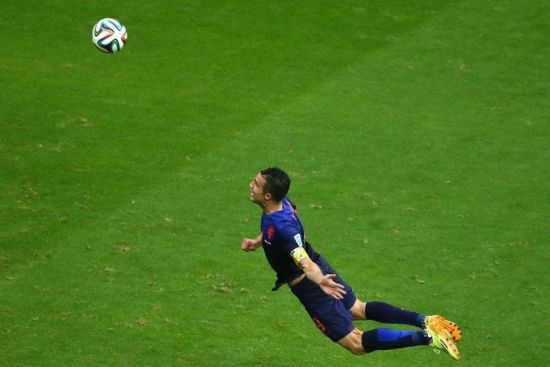
“For most of the first half of the Spain-Holland match, the defending champions had been in complete control and were up 1–0 as halftime approached. Then Robin van Persie struck in the 44th minute and turned the game upside down. … Ultimately, the first rule of defending is that you don’t let an attacker get behind you. But allowing a talented player like Van Persie to receive the ball 30 yards from goal in the middle of the field isn’t far behind. More than a tactical error, it seems that Spain’s biggest problem was Ramos’s and Pique’s execution. Notice that Pique is slightly behind the defensive line, holding Van Persie onside. If he had been in line with the rest of the defenders, RVP would have been offside. Now, it’s usually the opposite-side outside back or weak side center back who has the best view of a developing play, and so he calls the line, commanding his defensive partners in front of him to hold, step, or drop.” Fusion (Video)

Holland’s World Cup win over Spain wasn’t the return of Total Football – Louis van Gaal has created something new
” By 1661, Rembrandt had fallen on hard times. Golden Age Amsterdam was turning against the gritty, unglamorous realism of his paintings. They wanted lustre, not texture. But Rembrandt was not going to go down without a fight. And so, when he was commissioned to paint a historical scene to hang in Amsterdam Town Hall, he knew that he would be expected to produce something decorous, reverent, heroic: a bold piece full of strong colours and glorious poses, in keeping with the style of the age. The Conspiracy of Claudius Civilis, when it emerged, was none of these things. It was harsh, dimly lit, borderline disturbing. The barbarian chieftain of the title is depicted with his one blind eye not obscured in profile, but front-on, in full and queasy detail. It was one of Rembrandt’s greatest works. But it was too harrowing by far for the Amsterdam city council, who rejected it and returned it to the artist. In financial difficulties and now with a five-metre painting nobody wanted, Rembrandt was forced into the single most traumatic act that a painter can undertake.” Telegraph

Holland’s beautiful goals put the wonder back in World Cup
“Vicente del Bosque was not expecting that, and Louis van Gaal – “We had a plan but I never imagined it would work out quite so well” – was not expecting it either. Ron Vlaar, penalised for the first foul challenge after just 13 seconds, was not expecting it, and neither were the six Spain fans in replica shirts – three middle-aged couples from Valencia – who turned up a little sheepishly in a Salvador seafront restaurant on Friday evening and politely asked for a table without a view of the television. Not since the heyday of Monty Python, it appears, has anyone been quite so surprised by a Spanish inquisition.” Guardian

What If the Most Beautiful Goal of the World Cup Has Already Been Scored?
“I am sure there will be a few memorable goals during the rest of the World Cup—we’re only on day three—but the one scored by Robin van Persie of Holland against Spain to tie the game justifies the entire tournament. Those of us who wait four years for this fiesta de fútbol so that moments such as these might nourish us know full well they are few and far between. This one came early and might not be surpassed.” New Republic (Video)

Spain Was Asking for Trouble Against the Netherlands
“Spain played a high defensive line, positioning themselves well forward, near midfield. It left them vulnerable. . .” NY Times

Spain: can they keep their incredible run going?

“Spain’s current run of success is unprecedented – two European Championships, with a World Cup between. When you consider their distinctive playing style, and the way they’ve taken possession football to the extreme, they’re unquestionably one of the greatest international sides in history. They are, however, more vulnerable than in previous years. That’s because key players have declined since Euro 2012. While others have been in and out of the side, Xavi Hernandez and Andres Iniesta have been the two midfield stars consistent throughout Euro 2008, World Cup 2010 and Euro 2012. They’re the personification of Spain’s Barcelona-based tiki-taka game, and together they had their least impressive season for years. At his best, Xavi controlled matches better than any midfielder in the world, maybe better than any midfielder ever has, but now there are questions about his mobility and capacity to lead this side. Iniesta’s season at club level was disappointing, but he always delivers at international tournaments, and for the first time it is Iniesta, not Xavi, who must become Spain’s technical leader.” Zonal Marking

2014 World Cup Roundtable: Planet Futbol’s prediction panel

“The 2014 World Cup kicks off Thursday, when Brazil and Croatia open the highly anticipated competition in Sao Paulo. Every World Cup is met with excitement and intrigue, but there’s something extra special about the 2014 edition. Perhaps it’s the host and its tradition of excellence. Perhaps it’s the loaded tournament field. Or perhaps it’s that transcendent stars like Lionel Messi and Cristiano Ronaldo are in their primes at the most ideal time. Regardless, there is quite the chapter of international soccer that is on the cusp of being written. Our reporters on the ground in Brazil — Grant Wahl, Brian Straus, Jonathan Wilson and James Young — and our contributors throughout the tournament — Liviu Bird and Ben Lyttleton — offer their picks as the world’s spotlight gets firmly planted on Brazil for the next month.” SI

‘Miracle of Eibar’ – Can tiny Spanish club avoid cruel twist of fate?

“There is only one fairytale story in Spanish soccer this season, but will it have a happy ending? Forget Atletico Madrid’s first league title for 18 years, disregard its city neighbor Real concluding an exhaustive wait for ‘La Decima’ — a 10th European Champions League crown. Because this season is all about the ‘Miracle of Eibar.’ The Basque town has a population of just 27,000 and the club a budget dwarfed by almost all its rivals, yet back-to-back promotions have banked Eibar a place in the big time.” CNN

2014 Fifa World Cup draw: Guide to Group B

Sergio-Ramos-12
Sergio Ramos
“Gary Lineker’s verdict. … Style & formation: Spain’s possession game, coupled with their determination to quickly win the ball when they don’t have it, has been wearing down the opposition for over seven years. Spain typically play 4-3-3, with full-backs Jordi Alba and Alvaro Arbeloa attacking like wingers and centre backs Sergio Ramos and Gerard Pique often joining in play beyond the halfway line. Strikers only tend to enter the box at the last minute for the element of surprise.” BBC – Spain, Netherlands, Chile, Australia

Small-town Eibar to be punished for their success?

“At Ipurua, the mist rolls down the green hillside, across the roofs and right over the pitch. The town of Eibar has a population of 27,000 people and sits halfway up the valley of the River Ego in the Basque Country, northern Spain. At the top of the town, up steep streets, stands Ipurua, the picturesque home ground of Second Division club Eibar. It is surrounded by mountains to the north and south and the best view may just be the one from the two blocks of flats that tower over the stand. Not that they have to tower much to look over the short, squat side of this stadium.” ESPN

World Cup qualifiers: Romelu Lukaku sends Belgium to Brazil

lukaku_belgium
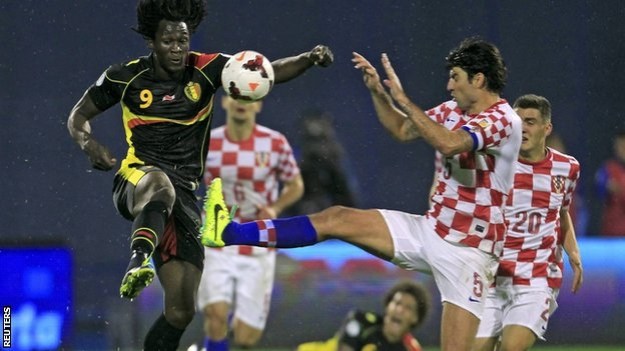
“Romelu Lukaku scored twice as Belgium beat Croatia 2-1 to secure their place at the 2014 World Cup in Brazil. Striker Lukaku, on loan at Everton from Premier League rivals Chelsea, scored twice in the first half, with Niko Kranjcar grabbing a late consolation. Belgium were joined by Germany and Switzerland in qualifying for next year’s tournament. Germany defeated the Republic of Ireland 3-0, while Switzerland won 2-1 in Albania.” BBC

The biggest problems facing World Cup contenders

“The fascinating thing about international football is that managers must cope with a very definite group of players. Whereas at club level, weaknesses can be solved by signing new players, at international level it’s not unusual for a top-class side to completely lack quality in one particular position. Sometimes, this forces managers to formulate innovative new tactical ideas to compensate for that weakness – but often, it simply means the side has a weak link. With eight months to go until the World Cup, here’s a look at six big international sides who have an obvious problem position.” ESPN – Michael Cox

Top 10 Young Football Managers

“Football, over the last couple of seasons, has been witnessing a ‘change of guard’. Players who we adored in their prime have retired, managers that headed some of the greatest sides in history have resigned. All this has given rise to the next generation of football personnel ranging from talented young footballers to talented young tacticians. In this piece we will be focusing on the Top 10 Young Football Managers, that could be at the helm of some of the biggest clubs in World Football, in the not-so-distant future.” Outside of the Boot – Part 1, Outside of the Boot – Part 2

Brazil’s Confederations outsiders face uphill battle to be included

“Brazil was obviously joyous at winning the Confederations Cup in such convincing style — but it would only be natural if there were some places where joy was somewhat confined. Those players outside the squad, for example, now face a much harder time getting back in.” ESPN – Tim Vickery (Video)

Hasn’t the Confederations Cup been great?

“Well, hasn’t it been great? From the opening minutes of that opening game when Neymar was firing home that impeccably executed volley, through the thrills and fun of the group games and semi-finals, to the final. I honestly cannot recall one bland game in over the 2 week duration of this year’s Confederations Cup. If this competition is merely Brazil’s supposed warm-up for the real deal of the 2014 World Cup, then we are in for a treat. Here are my 6 reasons why I believe the Conferedations Cup has been so flipping fantastic.” Outside of the Boot

Is the need for speed more important than tika-taka tactics?

“The Confederations Cup final between Spain and Brazil was a highly anticipated clash of two opposing brands of football. In fact, while Spain are well known for playing a possession based style of football, Luis Felipe Scolari has reshaped a traditionally flamboyant Brazilian side into a more defensive minded, counterattacking team.” Think Football

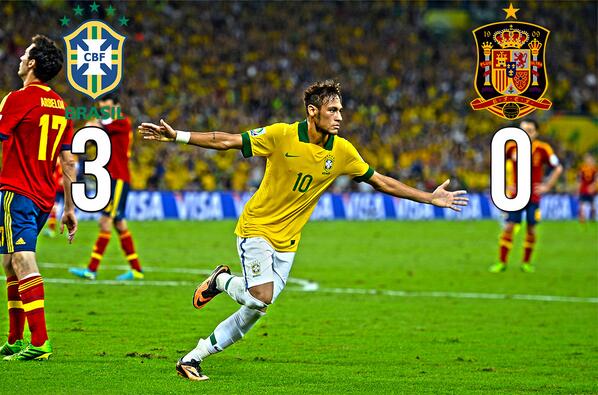
Brazil 3-0 Spain: Spain unable to cope with Brazil’s pace and power on the break

BOC8oLFCUAAAi6f
“Brazil won the Confederations Cup at the Maracana after a convincing demolition of the world champions. Luis Felipe Scolari stuck with his usual side – in five games he only deviated from this XI once, when Paulinho wasn’t 100% fit for the final group game. Vicente Del Bosque brought in Juan Mata on the left of his 4-3-3 system, but otherwise the side was unchanged. Brazil yet again started superbly – but Spain failed to mount a significant fightback.” Zonal Marking

“Brazil produced a breathtaking performance at the Maracana to overwhelm Spain and claim their third consecutive Fifa Confederations Cup. Driven on by the passion of a fiercely partisan crowd, the five-time world champions signalled their intent ahead of next summer’s World Cup by ending Spain’s 29-match competitive unbeaten record with a majestic display. Fred scored twice, but Neymar again stole the show, scoring Brazil’s second goal with a rasping left-foot shot. To compound Spain’s misery, Sergio Ramos missed a second-half penalty before Gerard Pique was sent off for bringing down Neymar as last man, with 22 minutes remaining.” BBC

Dream final a sub-plot to urban uprising (June 28)
“And so the 2013 Confederations Cup has its dream final – Brazil against Spain, the match the world has been waiting years to see. It is a clash of two philosophies. For the Brazilians, the star player (known over here as the ‘craque,’ from the English ‘crack’) tips the balance with a moment of individual inspiration. For the Spaniards the collective idea is all important – the constant passing at pace, the continuous formation of triangles, each one opening up new possibilities for a new combination, until a runner can be slipped through on goal.” The World – Tim Vickery

Brazil on the verge of greatness
“Forget history and superstition. You have to be pretty twisted to believe that because Brazil won the Confederations Cup in 1997 and 2005 and 2009 and then failed to win the big one the following year, beating Spain and lifting the trophy at the Maracana was anything but a good thing. Anyone who witnessed the performance against Spain, who felt the goose bumps from the Torcida, who saw Fred, then Neymar, then Oscar, then just about every member of the Selecao vault the pitch-side barriers and celebrate with the supporters will know just how important this was.” ESPN (Video)

Spain beats Italy on penalties

Jesús Navas Spain
“Jesus Navas scored the decisive penalty as World Cup holder Spain beat Italy 7-6 in a shootout Thursday after extra time ended 0-0, setting up a showdown with host Brazil in the Confederations Cup final. Nobody missed in the shootout until Italy defender Leonardo Bonucci shot over the bar to give Navas an attempt at the winner. The recently signed Manchester City midfielder coolly beat goalkeeper Gianluigi Buffon to end a top-class battle and send Spain to another major final.” ESPN (Video)

Scolari to mull over Hulk dilemma ahead of final
“We cannot yet declare that Luiz Felipe Scolari has turned Brazil into a successful side, and it would be unrealistic to consider them an overly entertaining one. Nevertheless, among encouraging performances and positive results, the main feature of Brazil throughout the Confederations Cup so far has been the sheer consistency of selection.” ESPN (Video)

As opponents adapt, Jordi Alba helping to give Spain a new dimension

“The beauty of this Spain team is that it keeps evolving. After technical skill and the ability to retain possession finally overcame the neurosis of past failure at Euro 2008, there came the years of control in 2010 and 2012, as World Cup and another European Championsip were collected playing safety-first keep-ball. For all the criticism of its supposed negativity in Poland and Ukraine there were signs of another Spain emerging, one that had begun to come to terms with the problem posed by an opponent that sits deep against it.” SI – Jonathan Wilson

Brave Nigeria bow out as Spain soldier on

“A courageous Nigeria team exited the Confederations Cup with their dignity very much intact despite being on the wrong end of a 3-0 scoreline against European and world champions, Spain. At the final whistle, the Super Eagles left the field as the spectators’ clear moral victors with the crowd chanting ‘Nigeria! Nigeria!’ albeit in suspiciously Brazilian accents.” ESPN (Video)

Spain 2-1 Uruguay: Del Bosque changes his midfield structure, Uruguay are disorganised

“Spain’s level of dominance should have resulted in a much more emphatic victory. Xabi Alonso is unavailable for the Confederations Cup because of injury, and in his absence Vicente del Bosque changed the structure of his side, using Sergio Busquets as the sole holder, moving Xavi Hernandez into the role he plays at Barcelona, and introducing Cesc Fabregas as a number ten who could drive forward at the opposition defence. Roberto Soldado played upfront. Oscar Tabarez left Diego Forlan on the bench, with Edinson Cavani and Luis Suarez upfront. Gaston Ramirez and Cristian Rodriguez were the attacking midfielders, with Walter Gargano in the middle. Spain’s possession dominance was astonishing in the first period, as Uruguay struggled to get out of their own half.” Zonal Marking

Spain see off Uruguay in Confederations Cup

“Goals from Pedro and Roberto Soldado helped Spain to a 2-1 victory over Uruguay in the Confederations Cup in Recife on Sunday and reinforced their position as tournament favourites. Luis Suárez scored a late consolation for Uruguay but the European champions dominated the game from start to finish and could easily have won by more.” Guardian

Confederations Cup 2013: Spain remain team to beat in Brazil

heroa
“Despite some resistance from the Republic of Ireland at the Yankee Stadium, they outgunned Giovanni Trapattoni’s men 2-0 in their last game before the Confederations Cup campaign gets under way in Brazil this weekend. On Sunday, the world and European champions play their first group game against Uruguay, as La Roja begin their bid to bring yet another international trophy back to Madrid.” BBC

Uruguay’s fighting spirit comes to the fore
“Uruguay turning up for a tournament on Brazilian soil is enough to send a shudder down the local spine. The other day Pele was remembering the World Cup final of 1950, and his father in tears as the sky blues came from behind to shock the host in Rio’s newly built Maracana stadium. Now Uruguay is back once more, this time for the 2013 FIFA Confederations Cup.” The World Gane – Tim Vickery

Confederations Cup 2013: Spain team profile
“… Whether in a 4-3-3, 4-2-3-1 or 4-6-0 formation, the modern-day Spanish side, with a little help from their free-flowing Barcelona contingent, have ripped up the formation book – even winning tournaments with the false number nine/strikerless line-up. Barcelona’s Victor Valdes is expected to start the tournament as Spain’s number one goalkeeper in the major change from Euro 2012, with Iker Casillas missing out.” BBC

Face of World Cup host Brazil? Look no further than Neymar
“When the World Cup hopes and dreams of arguably the world’s most successful footballing country rest on your skinny shoulders, you’re going to need all the help you can get. It is not known what great works of literature Neymar chose when packing his suitcases for Barcelona, but he could have done worse than to seek solace in a little Shakespeare. Dank and drizzly though it can sometimes be, Santos’ Vila Belmiro stadium, our hero’s erstwhile home, is a long way from the gloomy battlements of Hamlet’s Elsinore. Nevertheless, there are more than a few parallels between the life and times of Brazil’s current idol and Shakespeare’s classic paean to troubled young manhood.” SI

Confed Cup Preview: 5 storylines to watch
“The Confederations Cup (June 15-30) is the ritual eight-team dry run designed to give the World Cup hosts the chance to iron out any kinks in their stadia and transport systems a year before the big show begins. The tournament pitches the hosts, reigning World Cup holders and six confederation champions (with Italy qualifying as Euro runners-up to World Cup holders Spain) into battle.” ESPN (Video)

A rare Confederations Cup – all the teams, for once, want to win it
“Tournaments are like birthdays: they are as significant as you want them to be. To many the Confederations Cup is a meaningless intrusion on the football calendar, a rinky-dink competition that proves nothing more than Fifa’s greed. After all, the World Cup already exists to establish the best team on the planet so what, other than money and attention-seeking, is the point of a mini-tournament between the leading teams from each continent?” Guardian

Starting anew: Deeper Spain lacks strong XI
“While club football’s evolution from a ‘team game’ into a ‘squad game’ has been widely acknowledged the past two decades, the situation at the international level remains uncertain. After all, major international tournaments are decided during the course of four weeks, rather than eight months. Whereas the speed and intensity of modern football ensures club managers frequently rotate their squad to prevent burnout in the spring, international managers often squeeze every last drop out of their regular starting XI.” ESPN – Michael Cox
France 0-1 Spain: both sides use one wide player for ball retention and the other for direct attacks

“Spain recorded a narrow victory, and go one point clear of France at the top of Group I. Didier Deschamps used Patrice Evra rather than Gael Clichy at left-back, and the late withdrawal of Mamadou Sakho saw Laurent Koscielny start at centre-back. But the key change was higher up – from the side that defeated Georgia 3-1, Olivier Giroud was dropped, with Yohan Cabaye coming into the centre of midfield, turning a 4-4-2 into a 4-5-1 / 4-3-3.” Zonal Marking

Valdés steps up in Casillas’ absence, backstops Spain past France

” The camera kept focusing on Iker Casillas, but his replacement took center stage. High in the stands at Saint-Denis, Spain’s captain sat watching his countrymen play France, a broken finger having denied him the chance to make his 144th appearance; down on the pitch, Víctor Valdés was the man chosen in goal instead. Like Casillas, he was about to prove decisive. For some he was about to prove a discovery — at the age of 31. Spain traveled to Paris knowing that if it did not win it risked not making it to Brazil in 2014; the world champions, unable to defend their crown.” SI

Spain’s streak ends, Belgium stays hot in Euro World Cup qualifying


“It was an incredible night of drama in the European World Cup qualifiers as Spain and Germany both conceded dramatic last-minute equalizers to end winning streaks. Meanwhile Belgium continued its positive run of form, while question marks remain over the future of Ireland coach Giovanni Trapattoni. Here is a wrap of Tuesday’s European World Cup qualifiers…” SI

Spain 1-1 France: Deschamps’ formation switch results in late France dominance

“Spain failed to win for the first time in 25 qualification matches. Vicente del Bosque continued with Sergio Busquets at the back and Xabi Alonso as the sole holding player. David Silva started on the left, but went off injured after 13 minutes, replaced by Santi Cazorla. Didier Deschamps started with a single striker, Karim Benzema, flanked by Jeremy Menez and Franck Ribery. Patrice Evra came back in for Gael Clichy, and Maxime Gonalons played as the holding midfielder. Spain dominated before the break, but France were excellent for the final half hour following a clever change in formation from Deschamps, and the away side created enough goalscoring chances to feel they merited a point.” Zonal Marking

Russia, England under scrutiny as World Cup qualifying resumes


Xabi Alonso, Franck Ribery, quarterfinal match
“1. Capello faces crunch match against Portugal. It’s far too early to call it a crisis, but for all the money that Russian football has lavished on players and coaches this summer, there has been precious little return — yet. The country’s two Champions League representatives, Zenit St. Petersburg and Spartak Moscow, are both pointless after two group games (despite Zenit spending €80 million on Hulk and Axel Witsel and Spartak playing Celtic at home), and now attention turns to the national team, World Cup hosts in 2018.” SI

UEFA World Cup qualifying: Spain wins opener; England ties Ukraine

“World Cup champion Spain defeated Georgia 1-0 on an 86th-minute goal by Roberto Soldado on Tuesday, the first step by the Spaniards on their road to the 2014 World Cup. This was the 23rd consecutive victory in qualifying matches for Spain, which has three points in Group I and is tied with Georgia. Spain is attempting to win an unprecedented fourth consecutive major title after repeating as European champion this summer.” SI

The messy history of Olympic football has robbed it of a coherent narrative


“Part of the allure of the World Cup is that, despite changes to format, entrants, moments in early history when certain European countries refused to send teams to South America one year and vice versa the next, the tournament has managed to maintain a linear quality stemming from a basic competitive consistency. One can trace, for example, the narrative thread from Brazil’s 2002 World Cup win back to its lacklustre turn in 1994 when Baggio missed, through to its peak in 1970 when Pele hosted the Jules Rimet trophy, all the way to 1950 when Ghiggia scored Uruguay’s winning goal in the 79th minute leaving the Maracana in deathly silence. There are recurring heroes and villains, classic semifinals, great teams that never won (the Netherlands, Hungary), touchstone moments that changed the direction of the sport. Even the most casual soccer person will be able to recount in a reasonably dependable chronology.” The Score

Can Uruguay roll back the years at London 2012?
“The Paris Olympics of 1924 are best remembered in Britain for providing the backdrop to ‘Chariots of Fire.’ But for all the heroism of Messrs Liddell and Abrahams, something happened there with far greater consequences – the birth of modern football. No one knew much about Uruguay as they sailed their way across the Atlantic to take part in the football tournament. But they strolled to the gold medal, and did it with a balletic, artistic style of play which captivated spectators and set off a fever for the game. Four years later, to prove it was no fluke, Uruguay won the gold medal at the Amsterdam Olympics. Argentina came across as well, and they took the silver.” BBC – Tim Vickery

Strange things happen at a football Olympics – Simon Kuper
“In 1996, the Nigerian football team arrived at the Atlanta Olympics in their usual financial chaos. They stayed first in a college dormitory, later in a cheap motel. Most days they slept late, and then went for brunch at a Chinese restaurant. Their Dutch coach, Jo Bonfrere (known by Nigerian custom as ‘Bonfrere Jo’) paid for the meals out of his own pocket. On the field the Nigerians attacked frantically and won gold – the first African nation ever to do so in the football Olympics. Nwankwo Kanu, their ‘Lucky Skipper’, said of his last-gasp equaliser in the semi-final against Brazil (after Nigeria had been 3-1 down): ‘That goal was the most beautiful moment of my life.’” MIO Stadium

Olympic Football – The Real Thing?
“BBC football commentator Jonathan Pearce got through last Friday evening without once name-checking his current love…Cristiano bloody Ronaldo. He also avoided one word you would have thought key to his commentary on a football match between Great Britain and Brazil. Britain. In an age where succinct branding is so important (and Google “Bill Hicks advertising marketing” for my “view” on such things), “Team GB” is about as much detail as the modern sports fan is deemed capable of understanding. So Stuart Pearce’s hastily-flung together team of B-list England stars and most of the best of the Welsh were “Team GB” for the night. Maybe if they had the ball long enough to force Pearce to use two descriptions…” twohundredpercent

Sergio Busquets: Re-inventing the midfield pivot role

“Karthik Venkatesh (KV) lets his imagination run wild, likening Sergio Busquets to the sitcom character Barney Stinson. Oh, and he also argues why Busquets is one of this generation’s most important players. Sergio Busquets is the ultimate ‘Bro’ on the pitch. His game is so astonishingly altruistic that he can be fittingly compared to the perfect ‘wingman’ who will do his all to set you up with that girl of your wildest fantasies.” The Arsenal Column

Can Brazil rekindle their magic?

“Spain’s Euro 2012 triumph – their third consecutive international title – has prompted many to reach for comparisons with Brazilian sides of old in the quest to answer the bar-room question: Which is the world’s best-ever international team? Spain’s Euro 2012 triumph – their third consecutive international title – has prompted many to reach for comparisons with Brazilian sides of old in the quest to answer the bar-room question: Which is the world’s best-ever international team? Fun stuff, but given the difficulties of comparing teams from different eras, it may be more worthwhile to peer in the other direction, looking forward rather than backward when making Brazil/Spain comparisons. The specific question is this: What impact might the success of Spain have on future Brazil sides?” ESPN – Tim Vickery