Tag Archives: NY Times

A Tiny Club’s Uneasy Rise

EIBAR-slide-KUVK-jumbo
“This month, Toni Kroos and Lionel Messi played in the World Cup final in front of nearly 75,000 people at Rio de Janeiro’s Estádio do Maracanã. Soon, however, these star players will discover the challenge of playing at Ipurúa, a hillside stadium with 5,250 seats that is home to Eibar, the new kid on the block in Spanish soccer. Tiny Eibar has needed more than just victories to join La Liga, Spain’s top division, and earn the right to challenge Kroos and his Real Madrid teammates or Messi and his fellow Barcelona players. After winning promotion in late May from the second division, Eibar faced a race against the clock to raise 1.72 million euros, or $2.32 million, and meet regulations on how much capital a top-division club should have.” NY Times

FIFA’s Dazed and Dated Attitude

“Of all the lasting images from the 2014 World Cup, the officials who run FIFA, soccer’s governing body, should be forced to remember one, above all: Germany’s Christoph Kramer staggering around the field in the final, glassy-eyed and dazed, like a sleepwalker. It was a glaring symbol of FIFA’s misguided approach to concussions and how desperately it needs to amend its substitution rules, which now allow for only three replacements per game and dictate that once a player is out of the game, he stays out. Faced with those restrictions, coaches are hesitant to keep a player with a possible head injury from leaving the match.” NY Times

Germany 1-0 Argentina

VD-WorldCup-408x264
Germany 1-0 Argentina (AET): Gotze’s extra-time goal wins the World Cup
“Germany won their fourth World Cup after victory over Argentina in a tense but enjoyable final. Joachim Low’s team selection was compromised by the late withdrawal of Sami Khedira through injury. Christoph Kramer took his place – although he only lasted 30 minutes himself. Alejandro Sabella’s side was unchanged from the semi-final against the Netherlands. Both sides had promising moments in an even match – Argentina had the better chances before Mario Gotze’s late winner.” Zonal Marking

Germans End Long Wait: 24 Years and a Bit Extra
“For years, Brazilians had a phrase they would inevitably utter when things went wrong. ‘Imagina na Copa,’ they said after an endless traffic jam or a construction accident or an ugly rash of violence dominated the news — imagine if this happened during the World Cup. It became a foreboding warning, a pre-emptive sigh at the presumed disasters that lay ahead. Over five weeks, though, Brazil avoided any of the major catastrophes it feared. Thrilling games and entertaining soccer — as well as the national team’s own stunning collapse — generally overshadowed any logistical issues, and the tournament was seen as a global success. So it was fitting, then, that in the tournament’s final game, the Brazilians managed to dodge the ultimate on-field nightmare, too.” NY Times

Germany 1 Argentina 0 (BBC)
“Germany were crowned world champions for the fourth time as Mario Gotze’s extra-time winner beat Argentina in the 2014 World Cup final. Gotze demonstrated perfect technique and commendable calm to chest down Andre Schurrle’s pass and sweep in a left-foot finish with the prospect of a penalty shootout only seven minutes away. Argentina, with skipper Lionel Messi looking subdued despite flashes of his talent, could not respond and Germany claimed their first World Cup since they beat the same opponents in Rome 24 years ago.” BBC

Germany’s World Cup title a result of revamped development, identity
“At the final whistle, after Germany claimed a fourth World Cup by beating Argentina 1-0 in extra time, BastianSchweinsteiger collapsed to the turf, utterly spent. He had given everything, running to the point of exhaustion, the only holding midfielder in the Germany squad still standing by the end, and that only just, a stray arm from Sergio Aguero having caught him across the face leaving him with a gash on his cheek.” SI – Jonathan Wilson

The Party’s Over: A Critic’s Take on Brazil’s Dismal World Cup Legacy
“About a five minute walk from Rio de Janeiro’s historic Maracanã stadium, the site of today’s Argentina vs. Germany final (Update: Germany won, obvsly), there used to be a small community of about 700 families called Favela do Metro. The reason the city demolished the tightly-packed neighborhood is hotly disputed: Residents said it was to build a parking lot, while the city claimed it had more ambitions urbanization plans, such as a park. But at least for now, there is little left except a jumbled mess of concrete and brick.” Fusion

Germans See World Cup Win as a Symbol of Global Might
germanyvictory-videoSixteenByNine1050-v2
“Even normally quiet streets were electrified early Monday by Germany’s dramatic 1-0 win of the World Cup in extra time, a victory that symbolized, at least to fans, not just the country’s dominance of Europe, but its global prominence. Car horns and vuvuzelas honked, and fireworks and firecrackers exploded. On the Kurfuerstendamm, the gleaming street of stores and restaurants that was the symbol of West Berlin during the Cold War, cars quickly jammed traffic and fans draped themselves in the black, red and gold of the German flag.” NY Times

World Cup Pass & Move: Germany Wins It All
The World Cup came to a close on Sunday, with Germany defeating Argentina in extra time, 1-0, in Rio’s Maracanã Stadium. Here, five Grantland writers look at five important characters from the match. Be sure to check out all of our coverage of the final, and the entire month of wonderful soccer action, at our World Cup landing page. Grantland (Video)

A Final Prediction: Germany Wins a Thriller
“Like the Sex Pistols in their prime, World Cup finals rarely fail to disappoint. After all the buildup and hype, the games often turn out to be low-scoring, bad-tempered affairs. In 2010, Holland, the nation that, during the nineteen-seventies, invented “total football,” a free-flowing, attacking style of soccer that enchanted the world, disgraced itself by trying to kick the Spanish “tiki-taka” men off the park in Johannesburg, and almost succeeded. Four years earlier, during the latter stages of a tense 1-1 tie between Italy and France, Zinedine Zidane, the French midfield maestro, was sent off for headbutting an Italian player, Marco Materazzi, who had allegedly called his sister a whore. (Italy went on to win on penalties.)” New Yorker

Germany Grinds Its Way To World Cup Triumph
“Well, I got the result right. But my prediction that it would be a thrilling World Cup final turned out to be wishful thinking. Instead of thrills, we got another tense, low-scoring game, in which both teams accumulated more bookings for bad fouls (two each) than clear-cut chances. By the middle of the second half, it was evident that one goal would settle it, and, in the second period of extra time, Germany nabbed one, thanks to a great piece of finishing by the young striker Mario Götze, who had come on as a substitute.” New Yorker

Success for Brazil, Just Not on the Field
“When Mario Götze settled a crossing pass with his chest and volleyed a goal that won the World Cup, German fans roared in ecstatic release. Those from Brazil were nearly as delirious, even if it was out of relief as much as celebration. It might have seemed an odd sight, Brazilian fans celebrating another team inside their own cathedral of soccer, the Maracanã stadium. But after two demoralizing losses brought national embarrassment, solace finally came Sunday as Germany defeated Argentina, 1-0, to become the first European team to win a World Cup played in North or South America.” NY Times

In a Latino Enclave, the World Cup Puts Everything on Pause
14ROOSEVELT1web-master675
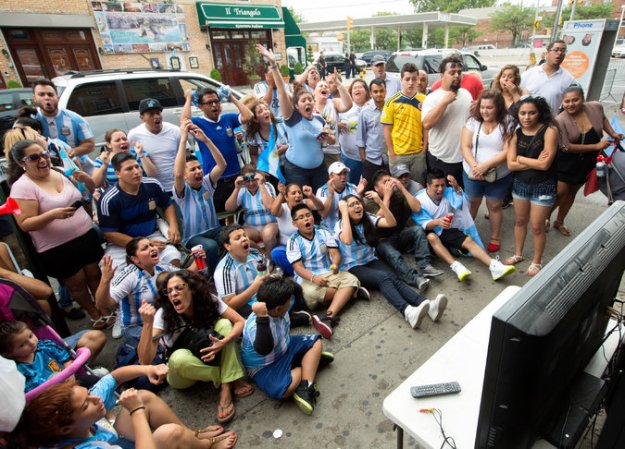
“Something unusual happened on Sunday afternoon on the streets of Jackson Heights, Queens: Quiet. As crowds gathered to watch the World Cup final around the Latin American enclave — in bars and barbershops, in electronics stores and by food trucks — the usually frenetic area beneath the elevated No. 7 train grew uncharacteristically still. Business, which spills onto the streets in the form of carts and trucks and tables, came to a halt. There was no merengue. Or cumbia. Or bachata.” NY Times

Don’t Cry for Messi, Argentina. This Germany Team Is One of the Best in Years.
“Lionel Messi seemed to recognize that he had lost the World Cup several minutes before the final whistle had blown. Moments after substitute striker Mario Götze scored a wundervolley in the game’s 113th minute to put Germany up by the decisive margin of 1–0, the Argentine legend had his last somewhat realistic chance at goal. Defender Marcos Rojo sent a high arcing cross deep into the German area and Messi came flying in for a free header from about 15 yards out. Had his shot gone in, it would have been a glorious goal. Instead, the ball fluttered harmlessly over the bar, and Messi walked away with his head down, staring desperately at the turf.” Slate (Video)

Brazilians Go Back to Real Life
Brazil suffered mightily with its national team’s 7-1 rout at the hands of Germany in the World Cup semifinals last week, but the authorities here breathed sighs of relief as the tournament came to a close on Sunday with Germany’s victory over Argentina, amid muted street protests and a display of Brazil’s ability to successfully organize sporting megaevents.” NY Times

Germany May Be the Best National Soccer Team Ever
“Germany didn’t begin the World Cup as the favorite. That honor belonged to (ahem) Brazil. But that’s a slightly deceptive measure. This was a top-heavy World Cup; not only Brazil but also Germany, Argentina and Spain would have been the front-runners in many past editions of the tournament. By the end of the World Cup, Germany left little doubt it is the best team in the world. In fact, it may be the best national soccer team ever assembled. One simple way to compare World Cup winners is by their goal differential throughout the tournament. Germany, with 18 goals scored and four allowed, comes out at a plus-14.” Five Thirty Eight
Germany’s Haunting Emptiness in Goal

“Manuel Neuer is the latest in a line of German goalkeepers regarded by many as the best in the world. German soccer fans often reminisce about the greatness of Sepp Maier and Harald Schumacher and Oliver Kahn, and if Neuer helps Germany win the World Cup final on Sunday, his place in history — even in the middle of his career — will be secure. Yet there is also a darker side to the lineage of German goalkeepers, an incident that lingers over German fans and also started Neuer along his current path.” NY Times

Brazil’s nightmare gets worse: Argentina to play for World Cup title

ARGENTINACUP-master675
“A bad week for Brazil just got worse. There’s not much that could make the humiliation of Tuesday’s 7-1 defeat to Germany feel even grimmer, but Argentina winning the World Cup at the Maracana would be unbearable. The holiest of the holies has already been defiled once, by Uruguay in 1950, but that would be nothing to the desecration of seeing Lionel Messi and his side celebrating there on Sunday. Whether that’s likely is another matter. Argentina will go into the final as the underdog, and understandably so, given the respective performances in the semifinals, but it will not capitulate against Germany as Brazil did. This may be a limited side, but it is one with great character and spirit, a cold-eyed willingness to get the job done.” SI – Jonathan Wilson

Argentina 0-0 Netherlands: Argentina through on penalties
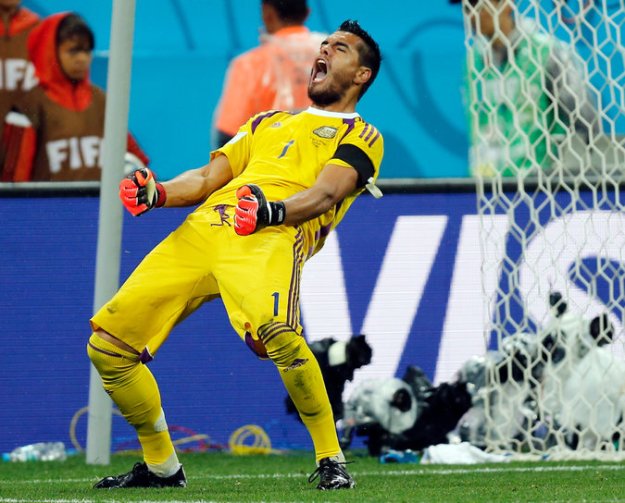
“Sergio Romero was the hero after an extremely uneventful 120 minutes. Alejandro Sabella brought back Marcos Rojo after suspension, while Enzo Perez deputised for the injured Angel di Maria. Louis van Gaal was able to bring back Nigel de Jong after injury, meaning Daley Blind moved across to wing-back in place of Memphis Depay. There was obviously great tension here, but not much happened – of the 62 games at this World Cup so far, this game featured the lowest shot rate, and the lowest percentage of touches in the opposition third.” Zonal Marking

After Long Stalemate, Argentina Breaks Through in Shootout
“Regulation and extra time brought 120 minutes of scoreless exasperation in a World Cup semifinal on Wednesday that was by turns tense, cautious, clumsy, gripping and stubbornly unyielding. There was little space to move, few chances to score. Sometimes the match was as dreary as the misty evening chill. If it possessed any beauty, it was not in gracefulness but in stark, struggling exertion. And finally, when grind and strain and labor could not bring a resolution, whimsy and caprice did. Argentina defeated the Netherlands by 4-2 on penalty kicks and advanced to Sunday’s final against Germany.” NY Times

Netherlands 0 Argentina 0 (Argentina win 4-2 on penalties)
“Argentina will meet Germany in Sunday’s World Cup final at the Maracana after winning a penalty shootout to eliminate the Netherlands.After 120 tedious and goalless minutes that were in stark contrast to the spectacular shock of the first semi-final between Brazil and the Germans, Argentina prevailed and a repeat of the 1986 and 1990 finals – when they played West Germany – will be played out in Rio. Goalkeeper Sergio Romero was the hero with penalty saves from Ron Vlaar and Wesley Sneijder, while opposite number Jasper Cillessen was unable to repeat the feats of his deputy, Tim Krul, in the quarter-final win against Costa Rica.” BBC

World Cup Pass & Move: Semi-Charmed Lives
“Two semifinal matches, one penalty shootout, one plain old one-sided shootout. As the World Cup draws to a close, we look at some of the characters who made the semifinal round so wonderful, weird, glorious, ponderous, and heartbreaking.” Grantland

Germany 7-1 Brazil: Germany record a historic thrashing, winning the game in 30 minutes

germany-humiliate-brazil-7-1-e1404868594956
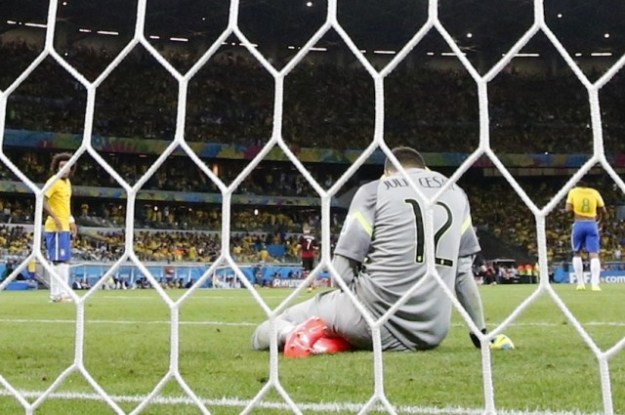
“In one of the most incredible matches in World Cup history, this ridiculous scoreline was an entirely fair reflection of Germany’s dominance. Jogi Low named an unchanged side from the XI that had narrowly defeated France in the quarter-final. Luiz Felipe Scolari was without the suspended Thiago Silva, and the injured Neymar. Dante was the obvious replacement at the back, while tricky winger Bernard was a surprise choice to replace Neymar, with Oscar moving inside to become the number ten. Luiz Gustavo returned after suspension, with Paulinho dropping out. Incredibly, this game was finished after half an hour – it was 5-0, and Brazil were simply trying to avoid further embarrassment.” Zonal Marking

Brazil 1 Germany 7
“Brazil’s World Cup dreams ended in humiliating and brutal fashion as Germany inflicted their heaviest defeat in the first semi-final in Belo Horizonte. A thunderous occasion that began with Brazil riding a tidal wave of emotion was reduced to a nightmare as Germany were 5-0 up inside 29 remarkable minutes in front of a disbelieving Estadio Mineirao crowd. Brazil’s players mourned the absence of the injured Neymar before kick-off, but captain Thiago Silva was an even bigger loss. The result was their first competitive home defeat in 39 years, and the end of their hopes of making it to the World Cup final at the iconic Maracana on Sunday.” BBC

Germany Scored Three Goals in 76 Seconds and Four Goals in Four Minutes
“Everyone, including Slate, has noted that Germany scored five goals in an 18-minute span on Tuesday. That figure, though, understates what the Germans accomplished. For a good portion of that 18 minutes, the ball wasn’t in play because it was sitting in the back of the net and Die Mannschaft was celebrating. The ESPN broadcast made it hard to determine how fast Germany had scored in actual game time, as the copious goal replays were always butting in to the on-field action. In order to get an accurate count, I rewatched the first half using ESPN’s ‘tactical cam’ replay, which shows the game from above and affords a clear view of each goal and the precise moment when play subsequently resumed.” Slate (Video)

Goal, Goal, Goal, Goal, Goal, Goal, Goal, and Brazil’s Day Goes Dark
“The fireworks began at dawn. All around this city, loud pops and bangs rang out as men and women and children, so many dressed in yellow, set off flares and beeped car horns. It was supposed to be a magical day. The Brazilian national soccer team, playing at home, was one game away from a World Cup final. No one could have guessed the tears would come before halftime. No one could have imagined there would be flags burning in the streets before dinner. Certainly no one could have envisioned that any Brazilian fans, watching their team play a semifinal in a celebrated stadium, would ever consider leaving long before full time.” NY Times

Let the Recriminations Begin in Brazil, and Let Them Begin with Scolari
“Then Brazil lost a relative squeaker to France in the finals of the 1998 World Cup, the country’s congress held intensive investigations and hauled some of its most storied athletes before a panel of preening politicians. Conspiracy theories swirled that cast blame in all directions—one widely held notion attributed the defeat to the machinations of Nike. The questions were irrational but give some hint of the mindset of a defeated Brazil and foreshadow the ugly recriminations that will follow this ugly defeat.” New Republic

Nation in Despair
“… Everyone knew it would be difficult for Brazil without the injured star Neymar and the suspended captain, Thiago Silva, but nobody imagined this feeble capitulation — four goals surrendered to Germany in six minutes during a 7-1 rout in a World Cup semifinal. Early on, Brazil’s players bickered, lost their cool, then lost their fight. The country of the beautiful game was left to face a grotesque humiliation. Luiz Felipe Scolari, the coach, flung his hands in disgust amid the flurry of early German goals. Marcelo, a defender, put his hands to his face in embarrassment and disbelief. A boy and a woman cried in the grandstand beneath their glasses, appearing stunned and overcome on camera.” NY Times (Video)

Semifinals Remain an Inner Sanctum Until Further Notice

split-master675
“The World Cup, ultimately, is a highly exclusive club. To be sure, the World Cup lets in hoi polloi to give a glimmer of hope and inclusion, but the inner sanctum is usually sealed shut by the semifinals, sending home the pretenders. Not our kind. Check out the four semifinalists this time around. The outsider, the long shot, is merely a three-time finalist, respected all over the world for its Total Football, the open, offensive style that has influenced Spain, the nation; Barcelona, the club; and other appealing offensive systems. Yes, the Netherlands, destiny’s darling, is known universally as the greatest soccer nation never to win the World Cup. All over the world, the huddled masses like the United States, yearning to be significant, are asking themselves, What does it take to crash that club, to become a regular, a nation that feels at home in the semifinals? How do countries learn that self-assurance that wins dubious referee calls and takes over game-deciding shootouts?” NY Times

World Cup Brazil’s Other Beautiful Games

“It was a newsroom like any television station newsroom, unless you count the brunette receptionist wearing a crown, sash and leopard print dress and offering friendly advice on how to spice up the World Cup. ‘Beauty queens,’ Brenda Pontes, 19, said. The World Cup does have many things — consuming attention, enthralling soccer and a carnival atmosphere — but it does not have beauty queens. In the Amazon rain forest, though, there is a tournament that is equal parts soccer and beauty pageant. It is one of the largest and most unusual amateur soccer competitions in the world, and perhaps the only one with a reality show. Pontes is the reigning queen.” NY Times

A Late Entry Helps the Dutch Avert an Exit

tim-krul
“With a World Cup quarterfinal in the closing moments of extra time on Saturday, Louis van Gaal, the coach of the Netherlands, made a move that was as bold as it was rare. As penalty kicks loomed in a 0-0 game, he replaced his starting goalkeeper, Jasper Cillessen, with Tim Krul, who had not played in the tournament but was confident to the point of haughtiness in a 4-3 victory in the shootout. After growing frustrated against Costa Rica, which seemed mostly content to sit back, surrender possession and play for penalty kicks, the Dutch became assured and clinical. The Netherlands made all of its penalty kicks, and the 6-foot-4 Krul made two dramatic saves after appearing to try to intimidate the Costa Ricans.” NY Times

Netherlands 0 Costa Rica 0 (4-3)
“Goalkeeper Tim Krul came off the bench late in extra time and saved two penalties as the Netherlands beat Costa Rica in a shootout to set up a World Cup semi-final against Argentina. Newcastle’s Krul saved from Bryan Ruiz and Michael Umana to send the Dutch through after the game finished 0-0. Wesley Sneijder had hit the woodwork twice for the Dutch, while Robin van Persie’s shot was turned onto the bar. They face Argentina, who beat Belgium, in Sao Paulo on Wednesday in the semis.” BBC

At Home Abroad, Argentina Shuts Down Belgium

“As unlikely as it may seem given the résumés of the two nations involved, including the seven combined world championships, Argentina and Brazil had never reached the semifinals in the same World Cup until this year. With a 1-0 victory over Belgium on Saturday thanks to a goal by Gonzalo Higuaín, Argentina joined Brazil, which beat Colombia on Friday, in the final four. The possibility exists that the two teams, South American giants and bitter rivals, could face off in the final in Rio de Janeiro, which many feel would provide the most fitting conclusion to this World Cup. Argentina, the winner in 1978 and 1986, is back in the semifinals for the first time since 1990, when a rough group coming off a title relied heavily on the skills of Diego Maradona and Claudio Caniggia, who did just enough to win, before losing to Germany in a desultory final.” NY Times

Argentina 1 Belgium 0
“Argentina reached their first World Cup semi-final since finishing as runners-up in 1990 with victory over Belgium in Brasilia. Gonzalo Higuain scored the only goal at Estadio Nacional, a thunderous early strike that ended his run of six international games without a goal. But Belgium’s so-called golden generation were undone by another quicksilver Lionel Messi performance, as Argentina set up a last-four encounter with Netherlands in Sao Paulo on Wednesday.” BBC

For Bellicose Brazil, Payback Carries Heavy Price: Loss of Neymar

“A Colombian defender named Juan Camilo Zúñiga ended the World Cup for the Brazilian star striker Neymar on Friday with a nasty knee into Neymar’s back that fractured one of his vertebrae. It was an ugly play and a bad foul. It deserved, at least, a yellow card. Yet within any game, there is always a road map to every flash point. The beauty of soccer’s continuous flow is that one thing leads to another (and another and another), and that makes it possible to trace a path to a game’s most memorable moment. In a game like Friday’s, doing so makes it easier to see where things went wrong. So what happened to Neymar? How did the face of this tournament end up in a hospital? Brazilian fans will not like to hear it, but while Zúñiga was directly responsible for causing Neymar’s injury, Neymar’s teammates — specifically Fernandinho, though there were others — as well as the referee, Carlos Velasco Carballo, deserve their share of the blame, too. They did not commit the crime, but they contributed to an environment of lawlessness that led to Neymar’s being battered.” NY Times

Brazil Takes a Painful Step Forward

“It was an enormous win for Brazil, but it came at a gigantic cost. Brazil on Friday powered to an impressive 2-1 quarterfinal victory over upstart Colombia at Estádio Castelão, setting off another round of raucous nationwide partying. But the noise and jubilation proved short-lived, as it was revealed after the game that Neymar — the country’s best player and biggest star — would miss the rest of the World Cup after injuring his back in the dying minutes of the hugely physical game. The Brazilian team has had only one goal this summer: to win the country’s sixth World Cup trophy while playing on home soil. The victory on Friday was an important step, setting up a semifinal next Tuesday against the powerful German squad.” NY Times

Odd couple pulls Brazil through
“On a day when Brazil lost star midfielder Neymar for the rest of the World Cup with a fractured vertebra, the Selecao turned to their odd couple — defenders Thiago Silva and David Luiz — to pull them through. The two leaders in the back scored goals either side of halftime to propel Brazil to a 2-1 quarterfinal victory over Colombia. Silva latched onto a Neymar’s corner kick and deflected the ball home with his knee with the game less than seven minutes old. In the 69th minute, Luiz hit a scorching 34-yard free kick past Colombia goalkeeper David Ospina. It was difficult to tell what possessed more maniacal ferocity — the shot, or his celebratory run to the near side corner flag.” ESPN

Germany Wins a Battle of the Old Guard

“As appetizers go, it was more of a dessert: a World Cup quarterfinal at Estádio do Maracanã between two European powerhouses featuring 22 starting players who play club soccer in England, Spain, France, Italy or Germany. For much of the world, it was a heavyweight fight contested in one of the sport’s greatest venues. Here, of course, it was a distinct undercard. Brazil defeated Colombia, 2-1, later Friday afternoon in a game so big it prompted the Colombian government to declare a national holiday.” NY Times

France 0 Germany 1
“Germany became the first nation to reach four consecutive World Cup semi-finals as Mats Hummels’ early header proved enough to see them past France at the Maracana. The three-time champions needed extra time to beat Algeria in the last 16 and suffered a bout of illness in midweek, but they were comfortable victors over a disappointing France in Rio de Janeiro. Hummels got the better of Raphael Varane to score what proved to be the winning goal and Germany can now prepare for a meeting with Brazil in Belo Horizonte on Tuesday after the hosts beat Colombia.” BBC

World Cup: Germany defeats France to reach semifinals
“It’s a demon buried deep within the French psyche — a demon which refuses to be exorcized. A word which brings shivers down the spine and strikes a fear into the heart of the country’s football fans. In Rio de Janeiro, the ghosts of years past haunted France again — the ‘Angstgegner’ returned. Germany, the ‘bogey team’ as it is known in France, wrote another painful chapter into Les Bleus’ World Cup history on Friday. A 1-0 victory secured Germany’s place in the semifinals for a record fourth consecutive tournament. But unlike in 1982 and 1986, when Germany defeated the French in the last four on both occasions, this was not a battle of epic proportions. There was not the drama, nor the controversy — but the end result was the same.” CNN

The Hopes of Central America Rest on a Perpetual Underdog

“When Costa Rica played Uruguay on June 14 in its first game of the World Cup, it was not so much a case of David versus Goliath as it was David versus David. That time fortune favored the Central Americans: Against all expectations — they had never beaten Uruguay, the two-time Cup winners — the Costa Ricans won, 3-1. But if ever there were a country from which La Sele (the Costa Rican national team), which will face the Netherlands in the quarterfinals on Saturday, might learn how to punch above its weight, it would be plucky little Uruguay.” NY Times

Costa Rica’s Midfield Has Used the World Cup As a Stage For Redemption
“The Ticos no one wanted are suddenly in demand. The Costa Rican national team entered the World Cup hoping to send a message to the world. ‘That was one of our main goals here in Brazil, letting the world know about Costa Rican football,’ defender Giancarlo Gonzalez told reporters on Tuesday.” Fusion

Costa Rica’s Number One Soccer fan Is a Nun with her own TV Show
“Sister Aracelly Salazar is Costa Rica’s self-proclaimed number one soccer fan. When she is not kicking the ball around, she hosts a TV show on a religious channel to relive the national team’s best moments, with thousands tuning in every Saturday to hear her analysis.” Fusion

World Cup From Carrying Water to Stirring a Nation

“For a man once belittled by Eric Cantona as ‘a water carrier,’ Didier Deschamps has certainly made a habit of carrying lots of trophies. French reporters like to ask Deschamps, now the French national team manager, if he was born under a ‘bonne étoile,’ a lucky star. But there is clearly much more than good karma and good timing involved at this stage of the game. He was captain of the French team that won the 1998 World Cup and the 2000 European Championship and a key player for Marseille and then Juventus when each club won the Champions League.” NY Times

Hail to the Alamo: Team U.S.A. Goes Down Fighting

APTOPIX Brazil Soccer WCup Belgium US
“In the very end—after the comeback goal from Julian Green, a nineteen-year-old World Cup débutant; after the close-range miss from Clint Dempsey that almost levelled it; after the final whistle that sent Team U.S.A. home; after the expressions of pride from Alexi Lalas in the ESPN studio on Copacabana Beach; after all the grandstanding tweets from politicians praising the U.S. team for displaying great valor—after it had all gone down, there was Tim Howard, the American stopper who had made an incredible sixteen saves to keep the United States in the game, a feat of goalkeeping prowess with no equals in World Cup history.” New Yorker

World Cup Pass & Move: The Boys of Summer
“For the last two weeks, the United States men’s national team has had your neighbor talking about 4-3-3 formations, the lady on the bus wearing a Clint Dempsey–riding-Falkor T-shirt, and has probably been the reason dozens of babies will be named John Anthony in nine months. The American players helped inspire a palpable passion around the game in this country, unlike anything we’ve felt before. And they helped make this truly extraordinary World Cup one that none of us will ever forget. With the United States’s exit from the tournament at the hands of Belgium, a few Grantland writers — Brian Phillips, Chris Ryan, Mike L. Goodman, Noah Davis, Ryan O’Hanlon, and Bill Barnwell — wanted to take the opportunity to pay tribute to the players that gave us so much this summer.” Grantland

Wild Ride by U.S. Comes to End, but Soccer Is the Winner
“It felt as if Tim Howard would never go down. As if the United States would never go down, standing there, taking shots like an undersize fighter clinging desperately to a puncher’s chance. Howard saved with his hands. His feet. His legs. His knees. At one point, Howard even had a shot bounce off the crest over his heart. Trying to figure out where soccer fits into the fabric of America is a popular topic but, for one afternoon at least, there was this unexpected truth: All around the country, from coast to coast and through the nation’s belly, sports fans of every kind were inspired by the performance of a soccer goalkeeper. In a loss. The ending was cruel, but then so is the game.” NY Times

World Cup: USA dream shattered by Belgium
“No guts no glory, or so the saying goes. But perhaps the vanquished United States soccer team can rest in the knowledge that if the World Cup was decided on guts, it would surely be lifting the trophy in Brazil. For 120 minutes of Tuesday’s ultimately unsuccessful last-16 clash with Belgium, each one of Jurgen Klinsmann’s men left everything on the field in Salvador. From the second the Americans went 2-0 down in extra time thanks to goals from Kevin De Bruyne and Romelu Lukaku, the rearguard action started. Substitute Julian Green’s goal offered the nation a lifeline and energized its fatigued players with a quarter of an hour to play. And you could almost hear the sigh of despair from New York to Nevada as late chances for Jermaine Jones and Clint Dempsey were agonizingly spurned. The final whistle signaled tumult at either end of the emotional spectrum as Belgium advanced to a quarterfinal with Argentina on Saturday and the U.S. departed. Beaten, yes, but not bowed.” CNN

A Eulogy for the Most Intoxicating USMNT of all Time
“There was a point during the end of the Belgium game, when Lukaku roofed that second goal, and we could see the end was nigh, that I stopped being stressed out, and started to just feel proud. The score didn’t matter, I told myself. This team has given every last iota of whatever nutritional substance is fueling their bodies. I will be fine with whatever happens. And then—of course—Julian Green comes on and buries a volley in the Belgian net to create the most frenzied final six minutes in US soccer history.” New Republic

Messi, as Always Expected, Rescues Argentina

master675
“Lionel Messi is often the smallest player on the field. But it is clear that he possesses his own gravitational pull. Just look at how opposing players — entire teams — drift toward him, one after another, and impulsively flinch at his every step and feint. Look at how magnetically he draws a crowd’s collective gaze, how hushed with expectation a building can become whenever he makes a run. Look at how quickly the ball zips its way back to his feet whenever his team feels the slightest bit of anxiety. Messi’s stature, already large, has grown considerably in this World Cup, and it grew somehow bigger still Tuesday as he inspired Argentina to a 1-0 victory over Switzerland at Arena Corinthians.” NY Times

The Dilemma of Broadcasts: Univision, ESPN, and the Radio
“For this bilingual World Cup enthusiast, the beginning of each game requires a decision: watch the broadcast in English on ESPN (or sometimes on ABC), or in Spanish on Univision. I thought at first that what would make me choose one over the other would be a momentary preference for the agitation and drama associated with the Spanish broadcast or the calmness and restraint of the English broadcast. But later I realized it wasn’t that simple, that my choice was governed by darker motives that had to do with memory and the radio. I realized that the difference between the two broadcasts has to do not only with the languages they use but also in their tolerances for silence.” New Republic

It’s Time for Argentines to Get Behind Their Team
“The Albiceleste won all three first round games, but that hasn’t kept its demanding supporters from complaining. From one Che to another: Shut up and enjoy the team! As Argentina readies for its second-round game against Switzerland, its fans are getting, well, tense. Is Argentina playing to its full potential? No, it is not. Is it the worst team at the World Cup? No, far from it. Yes, many of us have been frustrated by the performance of our team at this World Cup, despite its perfect record in the first round. Alejandro Sabella’s men have been static and even boring at times with neither Sergio Aguero nor Gonzalo Higuaín up to their usual standards.” Fusion

Argentine Fans Feel Right at Home
“Tens of thousands of soccer fans came from all parts of Argentina. It does not matter that there were no tickets left for the match. This seemed an irrelevance. The main thing was to have been here, and to have witnessed Argentina take on Switzerland. In a sliver of park overshadowed by the modern office buildings of downtown São Paulo, FIFA has installed large screens for those without tickets. The fans know that tickets were going for between $2,000 and $3,000. Not that there were any for sale. Those who had come from the Arena Corinthians complain that there are only buyers and no sellers. Even two hours before the match started, the Argentines appeared en masse with their flags of light blue and white. The stripped albiceleste shirts are ubiquitous; even children in strollers were wearing them. The drinking started early. One fan, while being frisked at the turnstile, shouted: ‘Today, we’re all brothers. Boca-River, it doesn’t matter.’ He was referring to the rival clubs River Plate and Boca Juniors.” NY Times

Your World Cup Ethical Questions, Answered

Was Luis Suárez’s bite of an opponent any more unethical than other forms of direct harm, such as a stomp or a professional foul in which the risk of serious injury is more likely? Or does the fact that biting is viewed as ‘uncivilized’ make it uniquely worse? JACK HIGGINS, posted on FacebookNY Times

A New York Odyssey Through World Cup Fandom

NYCUP_show-slide-1OXQ-jumbo
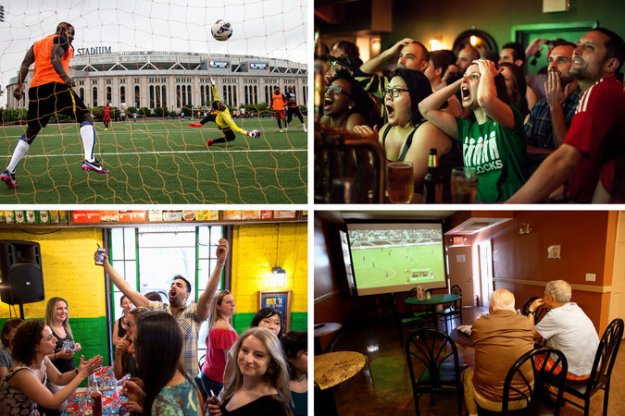
“Interest in the World Cup is surging in the United States, with record television ratings, outdoor viewing parties and midday breaks for workers to watch the United States battle its way into the second round. Here, in an extremely diverse New York City, where soccer has long been popular in some neighborhoods but is now gaining wider traction, just about every team has its fans. A random survey was attempted during the first round of the tournament. The games were on across the city. Some places were crowded and boisterous but others were, well, pretty empty. Some fans yelled together, while others commented about the games in virtual solitude. But it was hard to find a place where the games were being ignored.” NY Times

World Cup: Brazil defeats Chile on penalties

wc-0628-horizontal-gallery
“And so the carnival carries on. Brazil, the team which manages to thrill and frustrate almost simultaneously, clinched its place in the quarterfinal of the World Cup following a tension-fueled encounter with Chile. A 3-2 victory on penalties following a 1-1 draw in Belo Horizonte means Luiz Felipe Scolari’s side’s quest to win the World Cup on home soil remains alive. It will now turn its attention to a last eight contest with Colombia — a team which has thrilled so far in this tournament. While Brazil will take the plaudits, Chile should be commended for a performance which at times defied the ability of the human body to run and hustle as its players did.” CNN (Video)

Brazil 1-1 Chile: Brazil progress by the finest of margins
“Brazil won on penalties after an incredibly tense and tiring contest. Luiz Felipe Scolari selected Fernandinho following his good impact in the win over Cameroon, with Paulinho on the bench. Jorge Sampaoli brought back Arturo Vidal after he was rested for the defeat to the Netherlands. The first half was an extremely fast-paced battle of pressing, and that tired both teams for the final 75 minutes, with the quality of football declining rapidly after half-time.” Zonal Marking

World Cup 2014: Brazil Survives Shootout Against Chile
“With the pressure of an anxious nation bearing down on them with each passing minute, the Brazilian players teetered on the brink of a defeat that would have wounded a country’s soul. Brave Chile was refusing to back down, demonstrating to 57,714 howling fans at Estádio Mineirão and millions more watching at homes, restaurants and bars that the team had the nerve to stand up to the mighty host nation through 120 minutes of the most tense and exhilarating soccer seen so far at the 2014 World Cup. After 30 minutes, it looked like the most fast-paced, breathtaking game of the tournament. After 90 minutes, the teams were even, at 1-1, after Chile had controlled play through much of the second half, leaving the Brazilian fans nervous and agitated. Through 30 draining minutes of extra time — which included a thunderous Chilean shot that struck the crossbar in the 120th minute, inches from knocking Brazil out — neither team could take a lead.” NY Times

Brazil shootout hero Júlio César: I have won the country’s trust back
“Júlio César, Brazil’s hero in the penalty shootout win against Chile, reflected on the prize of a World Cup quarter-final and said he felt he had won back the country’s trust after being the scapegoat in South Africa four years ago. Júlio César saved Chile’s first two penalties and referred immediately to his mistake in the quarter-final against Holland at the last World Cup.” Guardian

The Dazzle and the Desolation of Stadiums in World Cup Host Cities

dog-jp-macur-1-master675
“NATAL, Brazil — From her crumbling house with the leaky roof, across a new highway from a new World Cup stadium, Maria Ivanilde Oliveira heard everything. Notes of the national anthems floated through the humid air into her living room, where her black vinyl couch was losing its stuffing and a metal bookshelf was secured by gnarly wire. A mix of loud cheers and moans from 40,000 soccer fans told her that a team had scored. With no job and little money, Oliveira, 62, could not afford a ticket to see one of the four games played at the $450 million Arena das Dunas, one of 12 stadiums hosting the World Cup in Brazil.” NY Times

Why You Should Root for Nigeria (or Brazil, Mexico or Ghana)

up-utilitarian--articleLarge
“Most of the world considers soccer’s quadrennial World Cup to be the most important sporting competition of all. A growing number of Americans have embraced the event, but many are only vaguely aware of it, and, aside from the United States, not so sure for whom to root. I am offering an alternative, utilitarian guide to help Americans choose a country to support. This guide can also be used if the Americans are eliminated, to help decide whom to root for among the remaining teams. The basic principle is simple, drawn from utilitarian principles: Root for the outcome that will produce the largest aggregate increase in happiness. So I came up with a simple index, calculated by a country’s passion for soccer multiplied by its average level of poverty multiplied by its population. It’s perhaps a bit crude, simply to multiply these factors by each other, but the exercise highlights some important truths about the world.” NT Times

Costa Rica Makes History at the World Cup

“Of all the surprises so far at this World Cup, perhaps none has been more unexpected than the success of Costa Rica, a country of 4.7 million and, relatively speaking, about the size of host country Brazil’s toenail. The team had been drawn into a group with three of the sport’s most storied nations: England, which is home to arguably the best soccer league in the world; Italy, which has won four World Cups, more than any country that isn’t hosting the event; and Uruguay, the team whose ghost haunts this year’s World Cup, having won the last one to be held in Brazil, in 1950. Nearly every pundit the world over had predicted that Costa Rica would function more as a punching bag than a soccer team this summer. And yet, after Tuesday’s draw with England in the final group match, Costa Rica finished in first place in the group.” Vanity Fair

Improbable Late Penalty Sends Greece to Round of 16
“Georgios Samaras scored on an added-time penalty kick to put Greece into the second round of the World Cup with a 2-1 win over Ivory Coast on Tuesday. Samaras, who was ruled to have been tripped in the area by the substitute Giovanni Sio, calmly slotted in the spot kick for a victory that put Greece through to the knockout stage as the second-place finisher in Group C. Ivory Coast would have advanced with a draw.” NY Times

A Cruel Match in an Unforgiving Jungle

1515538_470163386460476_13620178_n
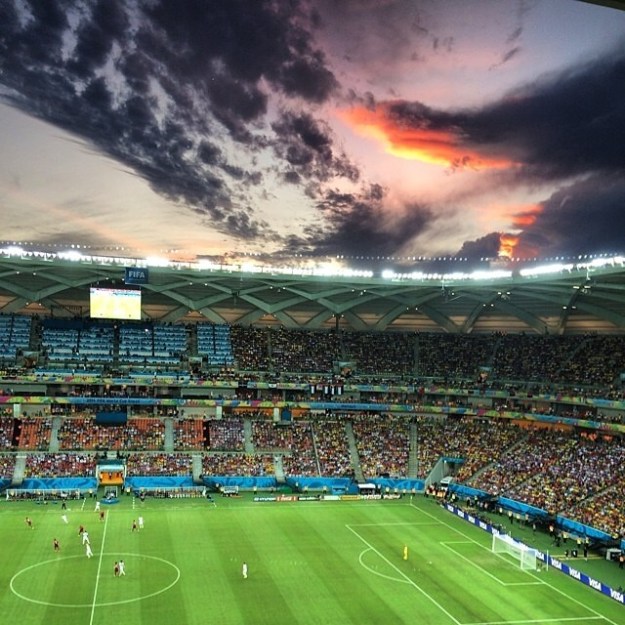
“The US team was in a stadium in the middle of a city in the middle of a jungle, getting ready to take the field to play Portugal. The sun had dropped behind the arena and it was getting darker. And hotter. Manaus was built into the Amazon. Fly in on a plane or go out on a boat and you get a sense of the enormity of the uninhabited world surrounding it. Unlike other parts of Brazil, where the natural landscape—the stunning beaches, the looming mountains—seems as much a part of the city as the buildings, Manaus is a clearing in a forest. It feels like an intrusion on nature. The jungle hangs all around city, stifling heat and huge bugs reclaiming its streets and the people living in a place they don’t belong.” 8By8

Heartbroken, but Hardly Hopeless
“Forget about that last goal. Pretend it never happened, as if that soccer ball never ricocheted off the head of a perfectly positioned Portuguese player and into the United States’ net. Do not dwell on those last 30 seconds of that game on Sunday night in the Amazon that stomped on the throat of an otherwise sublime night. Emotions are hard to temper at a time like this — when a surprising American victory seemed all but guaranteed, until that header suddenly proved that it wasn’t — but the broader picture is not at all bleak. Even after tying Portugal, 2-2, the United States remains on a trajector.” NY Times

In Time Warp of Soccer, It Ain’t Over Till … Who Knows?
“… Such situations would be unthinkable in other sports, but vagaries of time are the norm in soccer. Games do not end when a clock expires, but only when the referee decides they are over. In a world where quantities as varied as footsteps and mouse clicks can be measured with scientific precision, soccer is a land where time remains a mirage. The most recent example came in the World Cup game here Sunday night, when the United States scored to take the lead in the 81st minute of a 90-minute match only to see the advantage slip away when Portugal scored — wait for it — 14 minutes later.” NY Times

World Cup Pass & Move: I Can’t Believe That We Did Draw!

usa
“Looks like we picked the wrong week to stop sniffing glue! That was a pretty turbulent soccer match on Sunday. To try to make sense of it all, we’ve got a bunch of Grantland writers on hand to talk it out. This is a safe space! Blame Game. Bill Barnwell: When the clock struck 94:00, DeAndre Yedlin had the ball in the opposite corner of the pitch while trying to shield it from Portuguese defenders. At 94:24, the ball was up for grabs in the Portuguese half of the field. Eight seconds later, at 94:32, a bullet header from substitute Portuguese striker Silvestre Varela hit the back of the net. Given that the final whistle blew almost immediately after the ensuing kickoff, had the United States managed to hold the ball for another 10 seconds, it would have come away from Manaus with three points. It’s a bitter blow.” Grantland (Video)

USA eyes bigger picture after letting World Cup chance slip vs. Portugal
“They were 30 seconds away — half a minute from clinching a spot in the knockout stage of the 2014 World Cup after only two games, an achievement few could have expected prior to the tournament. ‘It’s the Group of Death,’ goalkeeper Tim Howard said. ‘Most people counted us out.’ They were 30 seconds away from writing a new chapter in U.S. soccer history. Never before had the U.S. men advanced beyond the first round in consecutive World Cups. Only 30 seconds separated the Americans from a seminal victory over a European power that would have opened the eyes of millions around the world and galvanized an increasingly engaged public back home. Thirty seconds proved too long.” SI (Video)

Late Shock Interrupts U.S. Party
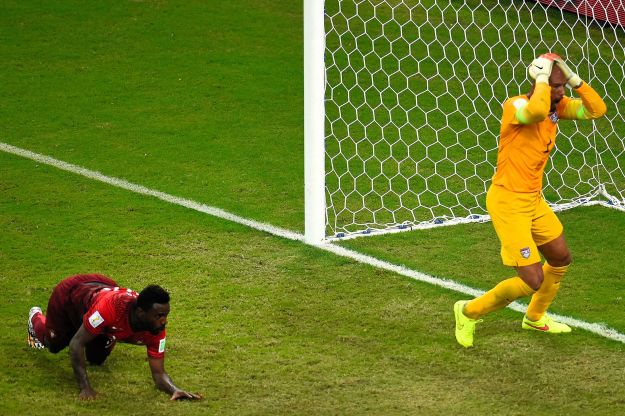
“The ball was barely past United States goalkeeper Tim Howard, and already he had put his hands to his head. On the bench, Jurgen Klinsmann spun away as if he had seen a ghost. Up the field, not far from where he lost the ball, Michael Bradley could only stare. This was what shock looked like. The Americans had advanced, hadn’t they? Hadn’t they? The celebration had been epic after Clint Dempsey, the captain, the man with the black eye and the broken nose and the swollen cheek, scored just nine minutes from the end to put the Americans in front and surely — surely — into the knockout round of the World Cup. It was bedlam. It was overwhelming. It was historic.” NY Times

World Cup Tactical Analysis | USA 2 – 2 Portugal: The Americans exploit down the right
“The two sides came into this game with contrasting opening fixtures. While the Americans were lacking expectations at the World Cup, they managed a positive result against Ghana, while the Portuguese disappointed with a 4-0 loss to Germany (though a victory was never likely). In what was the last late game of the World Cup, both teams certainly left it late. Although they shared the points, the US certainly were the more impressive side and looked deserving of all three points, while the Portuguese can count themselves extremely lucky for not having been knocked out of the tournament already.” Outside of the Boot

How the Portugal Draw Boosts the U.S.’s World Cup Advancement Odds
“The United States was seconds away from defeating Portugal on Sunday when Michael Bradley, normally one of the steadiest American players, mishandled a ball in midfield and gave Portugal a last opportunity. Silvestre Varela took advantage, scoring on a header. But the 2-2 draw was a result the U.S. might have been happy with before the match began. It improved the Americans’ odds of advancing to the knockout round of the World Cup. Those chances are up to 76 percent, according to the FiveThirtyEight forecast, an improvement from 65 percent before Sunday’s match.” fivethirtyeight

World Cup 2014: Algeria Defeats South Korea for First Cup Win in 32 Years

“First-half strikes by Islam Slimani and Rafik Halliche helped Algeria defeat South Korea, 4-2, on Sunday and become the first team from Africa to score four goals in a World Cup match. Algeria led by 3-0 at halftime and withstood a stronger South Korean performance in the second half to claim its first Cup win since 1982 and move into second place in Group H with one match left.” NY Times

World Cup Brasília, a Capital City That’s a Place Apart

“The Brazilian flag reads, “Ordem e Progresso” — “Order and Progress” — which is somewhat curious in this wonderfully jumbled and beautiful country. For an outsider who has visited the samba-infused nightclubs of Rio de Janeiro, the Amazonian jungle or São Paulo, with its ramshackle favelas and snarled traffic, order is not what springs to mind. Until you arrive in Brasília. In a country known for its flair for improvisation, Brasília stands in jarring contrast, a city so orderly, it is hard to believe it is really in Brazil.” NY Times

Talent Radar: Mario Götze improves his defensive contribution in Germany’s 2-2 World Cup draw with Ghana

“In what turned out to be a hugely attractive encounter in one of the most open and end-to-end 2014 World Cup games, Germany & Ghana played out an enthralling 2-2 draw with fast paced counter-attacking football at it’s best. The two sides had met at the previous World Cup as well with the Europeans getting the win, but this time it seemed more likely that we’d witness an African triumph until the legendary Miroslav Klose turned up and scored his record equaling 15th World Cup goal.” Outside of the Boot

An Enduring Touch Proves as Essential as Ever
“The shaky front flip was not vintage Miroslav Klose, but the critical goal that led to it was definitely a classic Klose poach. Even if he is now an injury-prone, 36-year-old substitute, playing for Germany still brings out the essential man in Klose, and less than two minutes after he trotted onto the field in Fortaleza, Brazil, he smelled a chance and pounced. The far post has been one of his happiest hunting grounds through the years, and after his teammate Benedikt Höwedes flicked on a Toni Kroos corner kick, Klose was already moving toward empty space near the goal line, a half-step and a fully formed thought ahead of the closest Ghana defender.” NY Times

World Cup 2014: Germany Ties Ghana as Miroslav Klose Ties Goals Record
“Ghana held Germany to a 2-2 tie on Saturday in Fortaleza, Brazil, although the veteran striker Miroslav Klose came on as a substitute to match the World Cup scoring record with the tying goal in a highly entertaining Group G match. Klose has 15 career World Cup goals, equaling the mark set by the former Brazil star Ronaldo. Klose scored the equalizer in the 71st minute, less than two minutes after coming on, when a corner by Toni Kroos was flicked to the far post by Benedikt Höwedes, and Klose slid in to knock the ball in.” NY Times

The Anchor on an Evolving Team

“Tim Howard did not always like what Jurgen Klinsmann was doing to Howard’s closest friends. He actually hated it. One by one, all of the veteran players on the United States national team had their moments with Klinsmann, the coach from Germany, who had made clear since the moment he was hired in 2011 that history and past performance meant nothing to him. Klinsmann dropped Carlos Bocanegra, the former captain. He benched Michael Bradley. He denigrated Clint Dempsey. With Landon Donovan, he pretty much did all three. All the while, Howard, the longtime goalkeeper, played the role of supportive teammate and steady hand.” NY Times

Deep in the Amazon, an Isolated Village Tunes In to the World Cup

“The PP Maués would not set sail for an hour, but its long and narrow decks were already crisscrossed with hammocks for an overnight trip down the Amazon. By the time it was to dock early last Monday at the regional port for which it was named, the Maués would have traveled 15 hours from the nearest World Cup stadium. A second boat would be needed to reach an even more remote indigenous village that planned to watch Brazil play Mexico last Tuesday. The village did not have electricity or cellphone signals and would rely on a diesel generator to indulge its secluded passion for soccer. While Rio de Janeiro and its famous beaches provide the touristic backdrop of the World Cup, the fevered grip of the world’s most popular sporting event can be felt even in some of the most isolated areas of the rain forest, where outsiders seldom visit.” NY Times

As Brazil Cheers, Protesters Struggle to Be Heard

“Twelve months after hundreds of thousands of protesters took to Brazil’s streets to complain of lavish public spending on stadiums for the World Cup, the tournament organizers have been relieved to see just hundreds attend scattered demonstrations as the first round of games got underway. With Brazilians loudly rallying behind their national team, the seleção — and whole cities exploding in a din of cheers and fireworks following every goal — activists concerned about social issues like poverty, corruption and police brutality have struggled to make their voices heard.” NY Times (Video)

The World’s Ball

theWorldCupBall-590x413
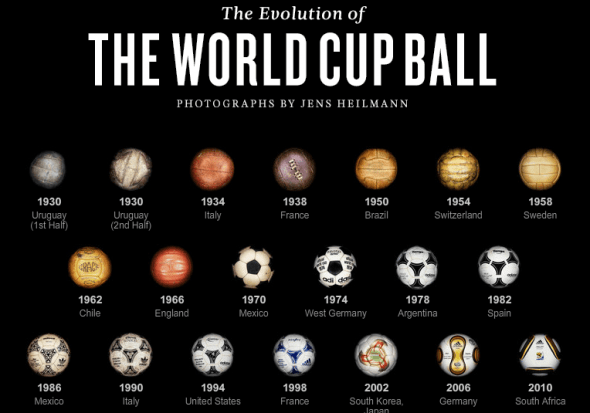
“An Imperfect Ball. Early soccer balls were hand-sewn and made of leather. They were never perfectly round, and inflating them required some skill. The laces had to be undone before an interior air bladder was filled and tied with a thread; then the laces were retied. Team captains chose a ball before each match, and every team had a preferred design, according to Peter Pesti, a collector and expert on World Cup balls. In the first World Cup, in 1930, Uruguay and Argentina could not agree on which ball to use. The first half of the match was played with a model favored by Argentina. The second half was played with Uruguay’s preferred design, the T-Model. Argentina led, 2-1, after the first half, but Uruguay recovered in the second and won, 4-2.” NY Times

Watching the World’s Game, in the World’s City

CUP-master675
“On a gloriously sunny afternoon recently, Lunasa, an East Village pub, was packed seven deep at the bar, as three TVs showed the day’s big games. Soccer games, that is, in Germany, Portugal and England. Just wait until the World Cup starts on June 12. Outside Brazil, there is no better place to experience the world’s sport than the world’s city. Passion for soccer runs deep in New York, among Ghana fans in the Bronx, who expect yet another victory over the United States team; among the Japanese faithful in a discreet Kips Bay lounge; and bursting from 900 Bosnians around Astoria preparing for their nation’s first ‘Svjetski Kup.’ There are 32 teams, in eight groups; we have chosen one nation from each group and provided a local prism to view the games through.” NY Times

Where to Watch the World Cup in New York

A Fairer World Cup Draw

“The United States has drawn one tough World Cup group, which includes Germany (currently the second-ranked team in the world), Portugal (ranked third) and Ghana (38th). (In the October rankings used for the Dec. 6 draw, Portugal was ranked 14th and Ghana 23rd.) That much is known. But here is something many fans don’t know: The difficulty of the United States’ group is not merely a byproduct of bad luck. It’s a perfectly normal outcome from the selection rules created by FIFA, soccer’s governing body.” NY Times

Inside the Fixing: How a Gang Battered Soccer’s Frail Integrity

fixing-1-master675
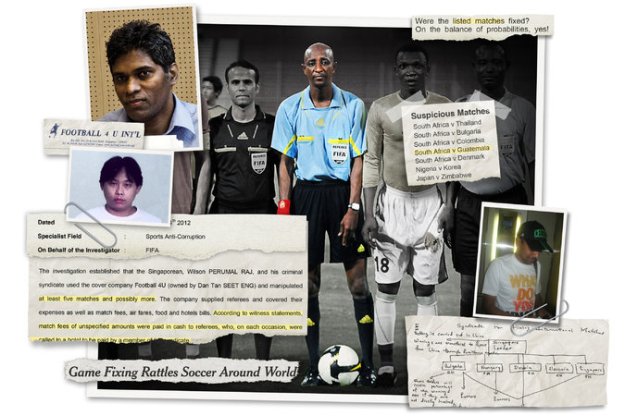
“A man arrived at the police station here in 2011 with an unusual tip. He told the police that a Singaporean man was fixing matches with the local professional soccer team. The police were incredulous. This city on the Arctic Circle is known as the hometown of Santa Claus. It boasts a theme park with reindeer, elves and jolly St. Nicks. It is also a popular destination for Asian couples looking to make love under the Northern Lights. Rovaniemi is known for many things, but not for organized crime.” NY Times – Part 1, NY Times – Part 2

Team Founded by Unhappy Fans May Buy the Club They Abandoned

“Breaking up the soccer club they loved was hard for fans of Hapoel Katamon Jerusalem. Putting it back together may prove even more difficult. But for many Katamon fans, a reunion with the club they left, Hapoel Jerusalem, has been the goal all along after they walked away from the more established Hapoel in 2007 to form Katamon, the first fan-owned club in Israel. The new team started over in the fifth division, and as it won promotion after promotion, and even as Katamon played its first emotional matches against Hapoel this season, a reunion was still the goal.” NY Times

The Beautiful Game Leads to a Beheading

“The field in Centro do Meio, Brazil, where two young men were killed after an altercation at a pick up soccer game last June. Late last week, Jeré Longman and Taylor Barnes of The New York Times relate one of the most chilling stories I have ever read in briliant, gory detail. This is a story of violence, poverty, anger and of course, soccer.” Soccer Politics

Building a World Cup Stadium in the Amazon

amazon_ss-slide-7ES7-articleLarge
“The most challenging aspect of building a World Cup soccer stadium in the middle of the Amazon is debatable. Some might say it is figuring out how to get oversize cranes and hundreds of tons of stainless steel and concrete into a city surrounded by a rain forest that stretches for about 2.1 million square miles. Others might mention the need to put most of those materials together before the rainy season floods the entire construction site. Then, of course, there are those who might point to the need to install the special chairs. Yes, the chairs. It may seem like a small concern — at least compared with the whole everything-being-flooded possibility — but one of the less obvious issues that comes with building a stadium in the jungle is what the searing equatorial sunlight here can do to plastic.” NY Times

More than a game in Brazil
“I spent August in London, which means that returning to my adopted city of Rio de Janeiro there is a ritual which I always have to go through – catching the 472 bus to Sao Januario, the stadium of Vasco da Gama. It is the best way I know of ensuring that, in mind as well as in body, I have put London in the past and am focused on events over here.” The World Game – Tim Vickery

In Ecuador, a Thriving Game and Prospects Galore

diaz-blog480
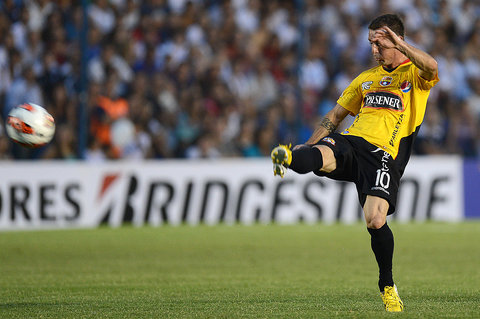
“It has been a difficult couple of weeks for teams named Barcelona in continental competition. Last Wednesday the Spanish version dropped a 2-0 decision to Milan in the Champions League. On Feb. 12 the Ecuadorean namesake — Barcelona Sporting Club — was denied three points in its Copa Libertadores opener when Nacional’s Álvaro Recoba set up Iván Alonso for a late equalizer in Montevideo, Uruguay. That Alonso’s goal came in the third minute of second-half stoppage time was not the worst part. Throughout the night there was a feeling Barcelona was not only going up against the Uruguayan champion, but the Chilean referee, Enrique Osses, as well.” NY Times (Video)

U.S.-Mexico Preview, Part 3: Predictions

“The first two installments dabbled in absolutes. In Part 1, the questions was who U.S. Coach Jurgen Klinsmann might call in for Wednesday’s friendly against Mexico at Estadio Azteca if players’ club questions were not a factor. Part 2 imposed artificial restrictions on the coach and explored what the roster might look like if Klinsmann was limited to a pool of North America-based players.” NYT

U.S.-Mexico Preview, Part 1: The A Team

“One year ago this week, in his first game as United States national team coach, Jurgen Klinsmann’s squad eked out a 1-1 draw against Mexico at Lincoln Financial Field in Philadelphia. On that night the team started poorly but seemed to draw strength from its optimistic, charismatic leader. Trailing at the half, it clawed back and got a result. All things considered, it was a good showing for both coach and team.” NYT: U.S.-Mexico Preview, Part 1: The A Team, U.S.-Mexico Preview, Part 2: The North American Solution

A Soccer Prodigy, at Home in Brazil

“There is a Brazilian saying that the soccer prodigy Neymar and his family often laugh about. The phrase — calça de veludo ou bunda de fora — comes up frequently: when Neymar reminisces about his beginnings in street games in São Vicente, for example, or when someone asks, again, ‘Are you really better than Messi?’ Always, the family returns to calça de veludo ou bunda de fora. And then they all giggle.” NY Times

12 Potential Stars for Euro 2012


Luuk de Jong
“A glance at the odds provided by European bookmakers for who will be named player of the tournament at Euro 2012 offers something of an insight into who fans are likely to be lauding when the event ends in Kiev on July 1. Cristiano Ronaldo, Franck Ribéry, Mesut Özil, Robin Van Persie, Wayne Rooney, Xavi. They are the elite of the elite, and they’re all listed.” NYT (Video)

Egyptians See Political Overtones in Deadly Soccer Riot


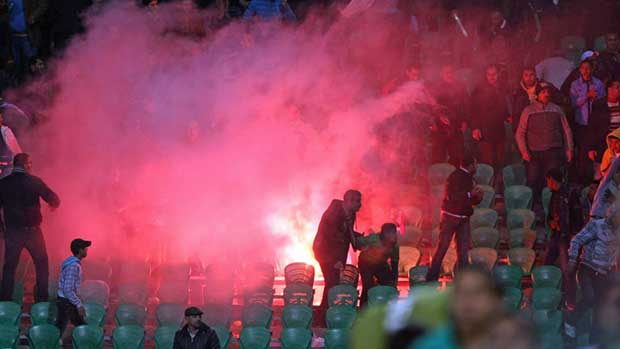
“Updated | 11:46 p.m. As my colleague David Kirkpatrick reports, Egypt’s Health Ministry said Wednesday that at least 73 soccer fans were killed, and hundreds more wounded, in clashes that erupted after a match that night in the city of Port Said. Television images of the mayhem showed that hundreds of fans of the home team, Masry, poured onto the pitch after a 3-1 victory and began chasing players from the visiting team, Ahly, which is from Cairo. There were immediate questions about the apparent lack of security at the stadium, and instant replays after the game focused not on the action on the field, but on images of police officers standing by as fans rushed past them.” NY Times (Video)

Egypt football violence: Hundreds injured in Cairo clashes
“Nearly 400 people have been injured in Cairo in fresh clashes between police and protesters angered by the deaths of 74 people on Wednesday after a football match in the city of Port Said. Thousands marched to the interior ministry, where police fired tear gas to keep them back. Earlier, the Egyptian prime minister announced the sackings of several senior officials. Funerals of some of the victims took place in Port Said.” BBC (Video)

The Ultras, the Military, and the Revolution
“The violence at Port Said last night has generated enormous commentary on twitter, and a beginning of media coverage of varying quality. One of the best summaries came last night at The Lede blog of New York Times — it’s quality largely due to the fact that it is composed of the tweets and videos generated on the ground in Egypt. You can read a good critique of a different, earlier, article by the New York Times — which like a certain number of other reports focused on the supposed ‘savagery’ of the ultras and downplayed the political context and valences of the event — here.” Soccer Politics

Egyptian Soccer Riot Kills More Than 70
“At least 73 people were killed in a brawl between rival groups of soccer fans after a match in the city of Port Said on Wednesday, the bloodiest outbreak of lawlessness since the ouster of President Hosni Mubarak one year ago.” NY Times

James Dorsey
“Anto is joined by Middle East football expert currently at the Rajaratnam School of International Studies and is the author of the Turbulent World of Middle East Soccer to discuss the stadium tragedy at Port Said this evening which resulted in at least 73 killed and up to 1,000 injuries in the hours after bloody confrontations. James provides us some background and insight into the background of the ultra movement in Egypt and how these elements have connection to the uprising in Egypt during the fall of Mubarak in the past year.” Beyond The Pitch

Manchester City Antes Up for a Seat at Soccer’s Power Table

“Now, though, Manchester City’s players take the field in pale blue jerseys that suggest possibility as expansive as the sky itself. Or the fossil fuels beneath it. In 2008, the club was bought for $330 million by Sheik Mansour bin Zayed al Nahyan, a member of the royal family of the emirate of Abu Dhabi who has fueled his team with an oil and talent pipeline.” NYT

FC Barcelona: Culminating With a Dream


“This season has seen FC Barcelona reach what must surely be the pinnacle of the quite remarkable cycle of success that this team has enjoyed since the appointment of Pep Guardiola in 2008. Playing a style of football that is as effective as it is beautiful, Barcelona have mastered both patient passing when with the ball and relentlessly energetic pressing without, their beguiling proficiency seeing them repeatedly outclass the rest of Europe.” The Equaliser – Video

Style and Stylelessness
“Some last-minute thoughts . . . Last year I wrote something about styles and stylelessness in soccer, and I’m thinking about that again as the Champions League final approaches. Everyone knows, because fifty articles a day say so, that Barcelona has a very distinctive style of play. You can name it and describe it, and you can see clearly when other sides try to imitate it. Xavi may be the perfect embodiment of the style, but it’s bigger than he is, and everyone knows it. Whenever Victor Valdés starts a Barça possession not with an aimless punt but with a sharp clean pass to Piqué or Busquets, the crowd at Camp Nou cheers. ‘Even our keeper plays the Barça way!'” Run of Play

Barcelona 3-1 Manchester United: Barcelona are European Champions
“Goals from each of Barcelona’s front three gave Pep Guardiola’s side victory at Wembley. Sir Alex Ferguson named his recent ‘big game’ XI – which meant Javier Hernandez upfront with Wayne Rooney behind, and Ryan Giggs and Michael Carrick in the centre of midfield. The biggest surprise was Dimitar Berbatov not even being on the bench. Guardiola was able to call on Eric Abidal at left-back, but not Carles Puyol at centre-back, so Javier Mascherano started in defence after all. The overall pattern was not completely different from the 2009 final. United enjoyed a good opening few minutes, but were then the poorer side for the rest of the contest.” Zonal Marking

Barcelona outclasses Man United with a performance for the ages
“Surely now the doubters have been won over: this Barcelona is one of the greatest teams there has ever been. In Pep Guardiola’s three seasons in charge Barca has twice won the Champions League, and it was denied a hat trick that would have placed it statistically alongside the Ajax and Bayern Munich sides of the seventies only by the combined might of Jose Mourinho and an Icelandic volcano.” SI – Jonathan Wilson

Lionel Messi the little master offers timely reminder of the beautiful game as Barcelona thrill
“This was the sort of spellbinding performance from Barcelona, and particularly their wonderful Argentine magician, that makes even cynics fall back in love with football. Pass and move, move and score. Bewitching. For a sport dogged by negative headlines, the club season climaxed with a celebration of the sport’s oft-hidden virtues. The spotlight turns to Fifa today, and the judgment of the Ethics Committee on recent shenanigans, but here was a reminder of what the game should be about. Not greed. Just glory. Just a love of the ball’s company, a passion for guiding it past opponents.” Telegraph – Henry Winter

Brilliant Barcelona are a high point in football’s evolution
“In the buildup to this final, the BBC debated who was the greatest of all club football sides and settled on the Real Madrid team who won the first five European Cups from 1956 to 1960. There was unanimity in favour of Puskas, Di Stéfano and Gento: white-jerseyed enemies to the people of Catalonia. Study the tapes of those Real Madrid XIs and you see skill, exuberance, thrust and machismo; a regal confidence across the team. You also register a wholly different version of football in which possession is easily surrendered and defending often laissez-faire. The greatest of all Real’s early triumphs – the 7-3 victory over Eintracht Frankfurt in 1960 – was a goal avalanche impossible to imagine in a Champions League final today.” Guardian – Paul Hayward

Prized Possession for Barcelona: Champions League Title
“LONDON — With the fans at one end of Wembley Stadium singing and dancing, and those at the other sulking and leaving, the public-address announcer made the most obvious of proclamations: Barcelona was the winner of the Champions League.” NYT

Barca vs. Man United player grades
“Reviewing the individual performances in the 2011 Champions League final (players graded on a scale of 1-10)…” SI

Barcelona 3 – 1 Manchester United
“For the second time in three years, brilliant Barcelona denied Manchester United Champions League glory with a sensational performance at Wembley. Although United could take some small consolation from the knowledge they were more effective than that 2009 letdown in Rome and even managed to level Pedro’s first-half strike through Wayne Rooney, once again the better team won. On the ground where the Catalans lifted their first European Cup, Lionel Messi also laid his personal ghost to rest, scoring his first goal for Barcelona on English soil, belting home what proved to be the winner nine minutes into the second half.” ESPN

FC Barcelona 3-1 Manchester United – Extended Fox Sports Video Highlights
Extended Fox Sports video

FC Barcelona Trophy Celebrations After Winning 2011 UEFA Champions League
Video highlights of the trophy celebration by FC Barcelona on May 28, 2011

Lionel Messi: Boy Genius


“Given a rare night on the Barcelona bench last Sunday, Lionel Messi yanked on the seat in front of him, hunched his shoulders over the chair back and kicked it with his cleats. He seemed not so much the world’s best soccer player as a restless kid in a movie theater. He is 23, with a grown-up’s income reported to exceed $43 million this year. Yet Messi still has a boy’s floppy bangs, a boy’s slight build and a boy’s nickname, the Flea. Even the ball stays on his feet like a shy child clinging to his father’s legs.” NYT

The New York Cosmos Want to Take the Field Again

“As a theme for a downtown party, a salute to late-’70s American professional soccer sounds a little on the you’ve-got-to-be-kidding side. But anyone who walked into Openhouse Gallery in NoLIta one rainy night in mid-February would have seen a young crowd in a huge room celebrating the New York Cosmos, the long-defunct team that briefly turned the world’s most popular sport into a glamorous New York fad.” NYT

A Brief History of El Clasico aka The Greatest Football Rivalry


“They called him Judas. They threw bottles, cigarettes, rubbish, and heck even a rotten pig’s head to show their disgust. The Boixos Nois, once the neo-nazi ultras of Barca, were banned from the stadium after this incident. Such was the level of hatred. This was treachery, one of ridiculous proportions. Transfer of players between these two clubs was not new, in fact 27 people had moved directions before Luis Figo did, but not one of them was in this fashion. Never before had a player who belonged to the club, one who was loved and admired by the fans for more than just his footballing skills, left so bitterly. ‘The derbi of shame’ they call it, brought out all the emotion that could ever be thrown out, by this magnificent rivalry.” The Offside

Madrid vs. Barcelona: Four Times a Soccer Classic
” A ‘clásico’ encounter between Real Madrid and F.C. Barcelona, the two biggest and most successful teams in Spanish soccer, inevitably generates high expectations. But the prospect of four such clásicos in 17 days has triggered a frenzy here that is rekindling memories of last July, when Spaniards followed with bated breath their national team’s triumphant march to its first World Cup trophy in South Africa.” NYT

Camp Nou Stadium for FC Barcelona
“FC Barcelona’s Camp Nou Stadium, one of the world’s greatest football venues, is to be extensively remodelled. The stadium, already the largest in Europe, will be enlarged to accommodate over 106,000 fans, together with extensive new facilities including hospitality and public areas.” Foster + Partners

Off the Field, a Woman Tames Brazil’s Soccer Fans

“As the gregarious Ronaldinho, one of the world’s best soccer players, emerged this month from the locker room in his black-and-red Flamengo club jersey and pulling at his trademark ponytail, fans erupted in applause. But a group of shirtless men in the seats below had their sights on someone else, turning toward a private box above and chanting.” NYT

Soccer Fans Bid Farewell to the ‘Lion of Vienna’

“Nat Lofthouse, the Lion of Vienna, will be laid to rest in Bolton, England, his hometown, on Wednesday. Thousands will line the streets, just as 23,000 inside the Bolton Wanderers’ stadium Monday night observed a silence in which you could almost hear a heartbeat. People too young to have seen Lofthouse play sobbed during the silence. It was as if he had been a grandfather to all of them — and folks who dismiss history as bunk, or who shy away from sentiment in sports or in life, had no place there.” NYT

The only coach who loves la Liga life

“A growing and probably quite unhealthy obsession with the concept of Unai Emery caused La Liga Loca to spend Monday musing whether the Valencia manager actually enjoyed his job. It certainly didn’t look like it during the 2-0 loss to Sevilla, Emery watching Mehmet Topal’s rather harsh sending-off scupper any chance of success in the Sánchez Pizjuán.” (FourFourTwo)

Musings on Madrid
“Just in case you wanted to know, Atletico Madrid’s veterans stuffed Real Madrid’s 7-0 on Friday afternoon, and Ricky Carvalho beat Diego Forlan 1-0 in the FIFA 11 (virtual) game in a Madrid hotel the same day. The scorer was Ronaldo, of course. Interestingly, in the real thing on Sunday night, Carvalho opened the scoring and Forlan failed to find the net, but the Uruguayan was at least remaining faithful to tradition. Atletico have now failed to beat their neighbours in the Madrid ‘derbi’ since the 1999-00 season, and often stand accused of not really going for it, particularly in the Bernabeu.” (ESPN)

Accounting Battle Distracts From Barcelona’s Success
“Johan Cruyff, the Dutchman who both played for and coached F.C. Barcelona, once noted that, in soccer, ‘it doesn’t matter how many goals they score, as long as you score one more.’ Winning, however, has not been the only thing that has mattered recently at Cruyff’s former club. Instead, one of Barcelona’s most successful presidents, Joan Laporta, found himself last month on the receiving end of a lawsuit initiated by his successor, Sandro Rosell, alleging unlawful accounting.” (NYT)

Champions League Chalkboards

“Beginning with this installment, the Goal blog is inaugurating a new feature that offers a statistical (courtesy of OPTA) and graphic representations of select matches from the European Champions League. At the end of each week when matches are played, the editor of zonalmarking.net, will provide analysis powered by the Total Football iPhone/iPad app, which is available at totalfootballapps.com and the iTunes App Store. Similar Chalkboards can be dissected at the Web site of the Guardian of Britain and at the zonalmarking Web site.” (NYT)

Moral Culpability and Hooliganism in European Football


“Incidents like yesterday’s fan violence at the Italy Serbia Euro qualifier in Genoa follow a similar pattern. Journalists and bloggers await the match while discussing the usual tidbits about injured players and group tables and previous encounters and betting odds, when suddenly something happens that goes beyond the meeting of two footballing nations, like fans throwing flares on the pitch while systematically destroying crowd barriers.” (A More Splendid Life)

Violent Fans Force Italy-Serbia Match to Be Suspended
“UEFA, soccer’s governing body in Europe, announced ‘it has immediately opened a full and thorough disciplinary investigation into the incidents of serious disorder witnessed at the match and the circumstances surrounding it.’ The statement, posted on the UEFA Web site, said that a report will be issued to the Control and Disciplinary Body and a meeting is set for Oct. 28. The punishments, under UEFA regulations, “range from a reprimand or fine, up to a stadium closure or ‘disqualification from competitions in progress and/or exclusion from future competitions.'” (NYT)

Serbian thugs are the toys of nationalist and neo-fascist leaders
“For the second time in three days Serbian thugs have laid waste to a European city in riots that have combined wanton and random violence with organisational talent and political backing. Yesterday in Genoa, the Scottish referee Craig Thomson had first to delay the kick-off for the Euro 2012 qualifier between Italy and Serbia by 45 minutes because of fans’ rioting, and then call the game off after seven minutes. Earlier the angry young men from Belgrade went on the rampage in the Mediterranean port and Uefa have opened a ‘full and thorough’ investigation into the incidents.” (Guardian)

U.S. Team, Drawing on the Recent Past, Looks Ahead

“Bob Bradley has a new contract and a new mission, but Bradley, the United States national team coach, is caught in a strange sort of limbo. ‘It’s a balance between the long term view, which is always focused toward the final round of qualification and then the World Cup in 2014, but also the things that happen along the way, the short-term vision,’ Bradley said ahead of the Americans’ friendly against Poland on Saturday in Chicago.” (NYT)

On the Road to Uniformity

“As the Champions League grows and grows, must it follow that domestic leagues sacrifice their native characteristics? Leave aside Spain, where Barcelona breeds its own, inimitable style, and the answer might be that we are rushing toward uniformity. The top matches in England, Germany and Italy over the weekend were all of a type. Manchester City, bankrolled by Abu Dhabi sheiks, beat Chelsea, owned by a Russian oligarch, by a solitary goal.” (NYT)

Chinese Investor Is Said to Be Bidding for English Soccer Club

“When reports began circulating last week that a Chinese investor was bidding to take over the Liverpool soccer club in the English Premier League, British tabloids quickly called him King Kenny. That little-known investor is Kenny Huang, 46, a globe-trotting sports enthusiast who has made marketing deals in China with the Cleveland Cavaliers and the Yankees, and has entered into a business partnership with Leslie Alexander, the owner of the Houston Rockets.” (NYT)