Tag Archives: Brazil

World Cup Tactical Analysis | Brazil 1–7 Germany: Germany run riot to trounce Brazil

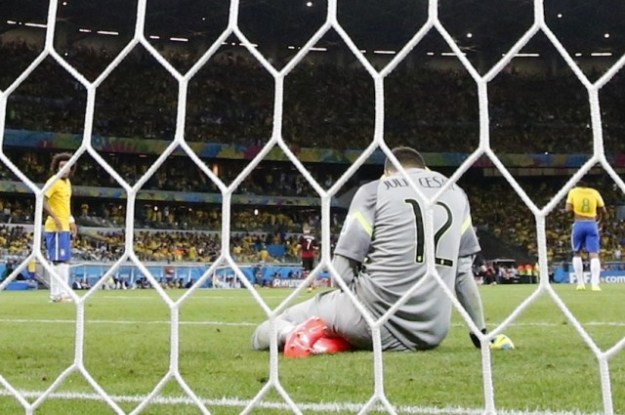
“While Brazilians still talk about 1950 with disappointment and horror, what transpired at the Belo Horizonte will bring nightmares to the South Americans for years to come. Aman Sardana analyses what happened, and what went wrong. The enormous pressure, the inflamed anticipation, one nation’s obsession and hysteria amassed on the shoulders of a fervent and useful but ultimately imperfect team. They snapped under the stress, no doubt, but there was more to this than just pressure, or flawed tactics and team choice, or incompetent positional play, or a first-rate German squad filled with incisive passers and composed finishers. It was all of those things, and yet more. A first-half goal barrage saw Die Mannschaft 5-0 up, Miroslav Klose procured his record-breaking 16th strike at the finals and the cruelty prolonged into the second period with Schürrle coming off the bench and bagging a brace. Mesut Özil missed a one-on-one to make it 8-0, moments before Oscar netted a consolatory hit in the final minute of the first semifinal of World Cup 2014. But as it was, in 30 obscene first-half minutes, the Brazilian dream was over. Outside of the Boot

Thirty-One Nil

“No sport generates extremes of passion like football. And for football, there’s no bigger stage than the World Cup finals, every four years. The road to Brazil 2014 started in 2011 with hundreds of qualifying games in every corner of the world. For teams, players and fans, the games represent national identity, sometimes against backdrops of war, riots and revolution. ‘Thirty-One Nil’, a new book by British author James Montague, chronicles these extremes of hope, joy and despair — sometimes very personal, sometimes felt by entire nations. … Nick Wrenn, editor-in-chief, CNN” CNN

amazon: Thirty-One Nil: On the Road With Football’s Outsiders: A World Cup Odyssey by James Montague

Thirty One Nil: A Book About The Ones We Won’t See in Brazil: Book Review

O Jogo Bonito

“A little more than halfway through Brazil’s horrible, galling victory over Colombia last Friday, I began to wonder what type of foul might actually persuade the Spanish referee Carlos Velasco Carballo to issue a yellow card: A studs-up, two-footed, kung-fu fly-kick to the chest, like the one launched by Eric Cantona against a fan in the stands back in 1995? Any one of the number of egregious fouls, including punches to the head, committed by Italy against Chile, and then by Chile on Italy, in the infamous Battle of Santiago in World Cup 1962? Maybe multiple Suárez-type bites by a hyena pack of players on a prostrate Colombian felled by a scything tackle might have done the trick.” The Paris Review – Jonathan Wilson

Germany 7-1 Brazil: Germany record a historic thrashing, winning the game in 30 minutes

germany-humiliate-brazil-7-1-e1404868594956
“In one of the most incredible matches in World Cup history, this ridiculous scoreline was an entirely fair reflection of Germany’s dominance. Jogi Low named an unchanged side from the XI that had narrowly defeated France in the quarter-final. Luiz Felipe Scolari was without the suspended Thiago Silva, and the injured Neymar. Dante was the obvious replacement at the back, while tricky winger Bernard was a surprise choice to replace Neymar, with Oscar moving inside to become the number ten. Luiz Gustavo returned after suspension, with Paulinho dropping out. Incredibly, this game was finished after half an hour – it was 5-0, and Brazil were simply trying to avoid further embarrassment.” Zonal Marking

Brazil 1 Germany 7
“Brazil’s World Cup dreams ended in humiliating and brutal fashion as Germany inflicted their heaviest defeat in the first semi-final in Belo Horizonte. A thunderous occasion that began with Brazil riding a tidal wave of emotion was reduced to a nightmare as Germany were 5-0 up inside 29 remarkable minutes in front of a disbelieving Estadio Mineirao crowd. Brazil’s players mourned the absence of the injured Neymar before kick-off, but captain Thiago Silva was an even bigger loss. The result was their first competitive home defeat in 39 years, and the end of their hopes of making it to the World Cup final at the iconic Maracana on Sunday.” BBC

Germany Scored Three Goals in 76 Seconds and Four Goals in Four Minutes
“Everyone, including Slate, has noted that Germany scored five goals in an 18-minute span on Tuesday. That figure, though, understates what the Germans accomplished. For a good portion of that 18 minutes, the ball wasn’t in play because it was sitting in the back of the net and Die Mannschaft was celebrating. The ESPN broadcast made it hard to determine how fast Germany had scored in actual game time, as the copious goal replays were always butting in to the on-field action. In order to get an accurate count, I rewatched the first half using ESPN’s ‘tactical cam’ replay, which shows the game from above and affords a clear view of each goal and the precise moment when play subsequently resumed.” Slate (Video)

Goal, Goal, Goal, Goal, Goal, Goal, Goal, and Brazil’s Day Goes Dark
“The fireworks began at dawn. All around this city, loud pops and bangs rang out as men and women and children, so many dressed in yellow, set off flares and beeped car horns. It was supposed to be a magical day. The Brazilian national soccer team, playing at home, was one game away from a World Cup final. No one could have guessed the tears would come before halftime. No one could have imagined there would be flags burning in the streets before dinner. Certainly no one could have envisioned that any Brazilian fans, watching their team play a semifinal in a celebrated stadium, would ever consider leaving long before full time.” NY Times

Let the Recriminations Begin in Brazil, and Let Them Begin with Scolari
“Then Brazil lost a relative squeaker to France in the finals of the 1998 World Cup, the country’s congress held intensive investigations and hauled some of its most storied athletes before a panel of preening politicians. Conspiracy theories swirled that cast blame in all directions—one widely held notion attributed the defeat to the machinations of Nike. The questions were irrational but give some hint of the mindset of a defeated Brazil and foreshadow the ugly recriminations that will follow this ugly defeat.” New Republic

Nation in Despair
“… Everyone knew it would be difficult for Brazil without the injured star Neymar and the suspended captain, Thiago Silva, but nobody imagined this feeble capitulation — four goals surrendered to Germany in six minutes during a 7-1 rout in a World Cup semifinal. Early on, Brazil’s players bickered, lost their cool, then lost their fight. The country of the beautiful game was left to face a grotesque humiliation. Luiz Felipe Scolari, the coach, flung his hands in disgust amid the flurry of early German goals. Marcelo, a defender, put his hands to his face in embarrassment and disbelief. A boy and a woman cried in the grandstand beneath their glasses, appearing stunned and overcome on camera.” NY Times (Video)
Neymar’s Injury Sidelines Effort to End World Cup Racism

“After an episode in Peru earlier this year in which Peruvian soccer fans subjected a Brazilian player to racial abuse by imitating the sounds of monkeys, President Dilma Rousseff of Brazil swiftly pledged a ‘World Cup against racism,’ declaring, ‘Sports should be no place for prejudice.’ Yet when Brazil’s top player, Neymar, broke a vertebra when he was kneed in the back during a match on Friday by a Colombian player, the torrent of racist insults against the Colombian, Juan Camilo Zúñiga, showed how far the host of the World Cup remains from achieving that goal.” NY Times

Neymar’s cultural significance to Brazil transcends soccer, World Cup

neymar1
“Tweets of sympathy and support from Brazilian president Dilma Rousseff to Kobe Bryant and everyone in between, including super models (Gisele Bundchen), Olympic sprinters (Usain Bolt), footballers (Ronaldo and Lionel Messi) and soap opera stars (too many to mention). Hours of TV coverage devoted to detailed analysis of spinal columns and estimated back injury recovery times. More hours of TV coverage dedicated to discussion of whether Colombian defender Juan Camilo Zuniga’s crushing, knee-raised challenge was premeditated or not (the debate oscillating between ‘a normal part of soccer’ and ‘a cowardly assault’). FIFA Fan Fests all over the country, filled with supporters who minutes before had been wildly celebrating Brazil’s 2-1 World Cup quarterfinal win over Colombia, falling still and silent. On Friday evening, Brazil turned its lonely eyes to Neymar da Silva Santos Junior.” SI

How have Germany tactically set-up so far in the World Cup?

“With the recent domination of German football at club level, Germany were marked as favorites in this World Cup. With a highly talented squad, Low was expected to recreate the incisive and dominant football that Germany were known for. Questions have loomed about where Lahm would start for Germany, how they could deal with the scarcity of out an out strikers and the soft spots in the wider areas of defense. Big things are expected from this German squad and here is how they have lined up so far in this tournament.” Outside of the Boot

How have Brazil tactically set-up so far in the World Cup?
“Prior to the start of this tournament, followers of the Selecao were well aware of the tactics Luiz Felipe Scolari will employ for the side. Though the squad seemed weak, it didn’t surprise many that impressive performances from some Brazilians didn’t earn them a spot in the squad as pragmatic Scolari stuck to his tried & tested team. This piece on Brazil’s tactical set-up prior to the start of the tournament was spot on. This was the case for any Brazilian supporter, as the formation & system was well known before the first ball was kicked, and there has been little change.” Outside of the Boot

Germany Must Out-Invent Brutish Brazil: A Bizarre-But-True Semifinal Preview

“Germany and Brazil are the two most successful teams in World Cup history, so it’s funny to think that they have only met once before in the tournament. That was in the 2002 final, when Brazil claimed its fifth trophy and Ronaldo topped the all-time goal-scoring charts. It was also, incidentally, the day a certain Philipp Lahm, then 18 years old, and Bastian Schweinsteiger, 17, made it to the German youth championship final for Bayern Munich. Sitting on the bus back to Bavaria, Lahm and Schweinsteiger probably could not have imagined that 2002 would be their country’s last international tournament without them. Now, 12 years later, these twin hearts of the German team will line up on Tuesday in the semi-final against Brazil in the hopes of erasing their nation’s reputation as the eternal also rans.” New Republic

Brazil’s Only Hope to Take This World Cup: Win Ugly

“There are three contradictory narratives getting batted around about Brazil’s foul-plagued, back-breaking 2–1 quarterfinal victory over Colombia. The first, one that’s being pushed by the Brazilian press, is that Neymar was assaulted by brutish Colombian defender Juan Camilo Zúñiga, whose late-game challenge was reckless and cowardly. (Sample headlines: ‘Stabbed in the back’ and ‘Damn Colombian.’) An alternate view, one articulated by the New York Times’ Sam Borden among others, is that Brazil got what it had coming. Borden believes that Neymar’s fractured vertebra was the logical conclusion of Brazil’s decision to play a dirty game, and of referee Carlos Velasco Carballo’s refusal to keep the foul-happy Seleção in check. The third perspective, laid out by Forbes’ Bobby McMahon, is that Colombia was the team that came out fouling, that the referee didn’t do much of anything wrong, and that Neymar’s World Cup-ending injury was an unfortunate accident rather than a violent inevitability.” Slate (Video)

Semifinals Remain an Inner Sanctum Until Further Notice

split-master675
“The World Cup, ultimately, is a highly exclusive club. To be sure, the World Cup lets in hoi polloi to give a glimmer of hope and inclusion, but the inner sanctum is usually sealed shut by the semifinals, sending home the pretenders. Not our kind. Check out the four semifinalists this time around. The outsider, the long shot, is merely a three-time finalist, respected all over the world for its Total Football, the open, offensive style that has influenced Spain, the nation; Barcelona, the club; and other appealing offensive systems. Yes, the Netherlands, destiny’s darling, is known universally as the greatest soccer nation never to win the World Cup. All over the world, the huddled masses like the United States, yearning to be significant, are asking themselves, What does it take to crash that club, to become a regular, a nation that feels at home in the semifinals? How do countries learn that self-assurance that wins dubious referee calls and takes over game-deciding shootouts?” NY Times

World Cup Tactical Analysis: Brazil 2-1 Colombia | Brazil come out on top in a rough encounter

“The host team stepped up for a big quarter final clash against the form team of the tournament, Colombia on a hot night. This was touted as a clash of 2 teams that would entertain, with the likes of Neymar, Oscar, Cuadrado, and James expected to dazzle. Instead, we saw the dark side of both teams in a game that saw a lot of fouls, and eventually, a heart breaking injury for the star of the tournament, Neymar.” Outside of the Boot

World Cup Brazil’s Other Beautiful Games

“It was a newsroom like any television station newsroom, unless you count the brunette receptionist wearing a crown, sash and leopard print dress and offering friendly advice on how to spice up the World Cup. ‘Beauty queens,’ Brenda Pontes, 19, said. The World Cup does have many things — consuming attention, enthralling soccer and a carnival atmosphere — but it does not have beauty queens. In the Amazon rain forest, though, there is a tournament that is equal parts soccer and beauty pageant. It is one of the largest and most unusual amateur soccer competitions in the world, and perhaps the only one with a reality show. Pontes is the reigning queen.” NY Times

Brazil 2-1 Colombia: Brazil prevail in a very aggressive game

“Goals from both centre-backs put Brazil into the semi-finals. Luiz Felipe Scolari made a straight swap at right-back, with Maicon in for Daniel Alves, while Paulinho replaced the suspended Luiz Gustavo. Colombia coach Jose Pekerman surprisingly brought in Fredy Guarin in central midfield, with Abel Aguilar dropping out. The story here was the sheer physicality, aggression and brutality of the game – to be frank, not much football was played.” Zonal Marking

The Amazon’s Floating Fields

boat2-articleLarge
“In this floating village, there is only one way to travel. Students go to school by boat. Pentecostals go to church by boat. Taxis arrive by boat. Even the soccer field is often a boat. There are three homemade fields on land, but they are submerged now in the annual flooding of the Black River, which meets nearby with the Solimões to form the Amazon. If the wooden goal posts had nets, they would be useful this time of year only for catching fish. So young players and adults improvise. They play soccer at a community center that has a roof but no walls. They play on the dock of a restaurant. And they play on a parked ferry, a few wearing life jackets to cushion their falls on the metal deck and stay afloat while retrieving the ball from the river.” NY Times

How the World Cup Is Damaging Brazil

“Don’t believe journalists who tell you the tournament is going smoother than expected. In a normal month of June, Rio de Janeiro hosts at least 16 first-division soccer matches. São Paulo will typically see the same number. Salvador usually has around 8; ditto Recife, Fortaleza, Porto Alegre, Belo Horizonte, and Curitiba. None of these cities will host more than seven during the World Cup.” Fusion

For Bellicose Brazil, Payback Carries Heavy Price: Loss of Neymar

“A Colombian defender named Juan Camilo Zúñiga ended the World Cup for the Brazilian star striker Neymar on Friday with a nasty knee into Neymar’s back that fractured one of his vertebrae. It was an ugly play and a bad foul. It deserved, at least, a yellow card. Yet within any game, there is always a road map to every flash point. The beauty of soccer’s continuous flow is that one thing leads to another (and another and another), and that makes it possible to trace a path to a game’s most memorable moment. In a game like Friday’s, doing so makes it easier to see where things went wrong. So what happened to Neymar? How did the face of this tournament end up in a hospital? Brazilian fans will not like to hear it, but while Zúñiga was directly responsible for causing Neymar’s injury, Neymar’s teammates — specifically Fernandinho, though there were others — as well as the referee, Carlos Velasco Carballo, deserve their share of the blame, too. They did not commit the crime, but they contributed to an environment of lawlessness that led to Neymar’s being battered.” NY Times

Soccer-inspired graffiti a mainstay of Rio de Janeiro, Brazilian landscape

BrpNSlUIMAEFV45.jpg large
“Jorges Leon Brasil is not lost. He started chauffeuring tourists and businessmen and urban adventurers all over Rio 26 years ago, when he was 18. His time-tested version of GPS is to squint his eyes in deep thought and—pop!—Ah yes, I know this place. He’s just not sure where he’s going this morning. A rest day during the World Cup has turned into a driving tour of Rio’s burgeoning graffiti scene, and I’ve asked Brasil—Junior to his passengers; he was named after his father—to be my guide in finding some soccer-inspired art. He has experience, after all. As a young boy growing up outside of Rio in the 1980s, in Vista Alegre (‘Happyville, you would say, in English’), Junior would join the local children at night during World Cup summers and literally paint the town center yellow and green, with Brazilian flags and soccer imagery celebrating his generation’s stars: Zico, Romario, Bebeto. . . It’s part of a tradition that carries on today.” SI

Brazil Takes a Painful Step Forward

“It was an enormous win for Brazil, but it came at a gigantic cost. Brazil on Friday powered to an impressive 2-1 quarterfinal victory over upstart Colombia at Estádio Castelão, setting off another round of raucous nationwide partying. But the noise and jubilation proved short-lived, as it was revealed after the game that Neymar — the country’s best player and biggest star — would miss the rest of the World Cup after injuring his back in the dying minutes of the hugely physical game. The Brazilian team has had only one goal this summer: to win the country’s sixth World Cup trophy while playing on home soil. The victory on Friday was an important step, setting up a semifinal next Tuesday against the powerful German squad.” NY Times

Odd couple pulls Brazil through
“On a day when Brazil lost star midfielder Neymar for the rest of the World Cup with a fractured vertebra, the Selecao turned to their odd couple — defenders Thiago Silva and David Luiz — to pull them through. The two leaders in the back scored goals either side of halftime to propel Brazil to a 2-1 quarterfinal victory over Colombia. Silva latched onto a Neymar’s corner kick and deflected the ball home with his knee with the game less than seven minutes old. In the 69th minute, Luiz hit a scorching 34-yard free kick past Colombia goalkeeper David Ospina. It was difficult to tell what possessed more maniacal ferocity — the shot, or his celebratory run to the near side corner flag.” ESPN

What’s Behind the World Cup’s Second-Round Slowdown?

“It feels like something has gone missing from Brazil in the past week. After an opening group stage that had been almost universally praised as the best-played and most entertaining World Cup in decades, the recent round of sixteen was a little more ordinary. Fouls are up and offense has slowed down, with the celebrated statistic of 2.83 scores per game in the group stage dropping by more than half a goal in the second round. Yes, it’s still the knockout stage of the World Cup, but it has sometimes felt uninspired—prosaic play clothed by the tension of high-stakes games with close final scores, extra-time finishes, and penalty shots.” New Yorker

World Cup 2014: Futsal – the game behind Brazil’s superstars

“There is a saying in Brazil that a great footballer is born here every day. A stroll along Rio’s breathtaking beaches is enough to show you why they believe that. As far as the eye can see, footballs dance in the evening air, propelled by one deft touch after another. Alongside the sun-worshippers, towel hawkers, muscle-men and bar-crawlers are boys and girls, men and women, repeating skills and drills, honing their feel for the football, hour after hour.” BBC (Video)

The Powerful Throat is giving favelas a World Cup voice in Brazil
“There’s a little football pitch up on the fifth station of the Santa Marta morro, in the Botafogo neighbourhood of Rio de Janeiro, where a group of Brazilian children who live in the favela are playing against some visiting Argentinian youths. The local kids hold a white ball, worn and battered, and they have challenged the Argentinians, saying if they win they will take their Fifa Brazuca football as the prize. The midday sun shines on the dry top of the morro, where the view of Christ the Redeemer on a nearby mountain top, and the undulating bays of Rio flanked by hills, literally stuns – can such beauty be humanly possible?” Guardian

Passion, pressure and prayers carrying Brazil on seven steps to heaven

“It was as Atlético Mineiro trailed 2-0 at half-time in the second leg of last season’s Copa Libertadores final against Olimpia of Paraguay that one of their supporters, wired on a cocktail of nerves, frustration and booze, decided to pop out for a smoke. He needed it. The Mineirão in Belo Horizonte was a maelstrom. Tears and prayers were seemingly everywhere. Another fan further down the row bawled his eyes out as he bellowed to the heavens. It was as if he were having an argument with the Big Referee upstairs. Atlético had never previously won the Libertadores. Their hated rivals, Cruzeiro, were on course to take the Brazilian league title. Atlético had to win this game.” Guardian

The Story of Resistance to FIFA’s War on Brazilian People – Video Blog

Bp83_2oCQAAC8Pi
June 13, 2014. “FIFA’s 50 billion dollar war on Brazilian people, started with the first worker oppressed, the first poor black person killed by police, the first indigenous forcefully evicted, the first teacher beaten by police, the first journalist or social activist attacked, the first protestor clubbed, the first kid in the favela murdered by state uniforms, the first sex worker raped by police, and the first child sold into sexual slavery. The World Cup is for the rich, the cops are for the poor. It started with the first home stolen, with the first rent raised, with the first law changed for FIFA’s sponsors, with the first patient left to die at the hospitals’ doors, with the first worker killed in their stadiums.” Revolution News (Video)

We Watched a World Cup Game With One of Rio’s Most Violent Drug Gangs

“The sight of young men in board shorts and flip-flops holding high-powered assault rifles is one you never get used to. A few weeks ago in one of Rio de Janeiro’s most violent favelas, half a dozen such young men were sitting on plastic chairs around a small TV set that had been brought onto the street. They drank beer and chain smoked bagulhos, fat conical joints. One guy wore a thick gold chain with two plastic baggies dangling off it, one filled with white powdered cocaine, the other crack. A couple of others, we noticed, accessorized with grenades strapped to their belts. Just a few miles away, thousands of fans from around the globe were gathering at Fan Fest on Copacabana Beach to watch the opening World Cup match between Brazil and Croatia.” Fusion (Video)

8 Books to Guide You Through the World Cup

img_20140523_234356
Golazo!: The Beautiful Game from the Aztecs to the World Cup: The Complete History of How Soccer Shaped Latin America by Andrea Campomar
“The world is divided into two groups of people: those who look forward to the World Cup every four years, and those who don’t realize they’re soccer fans until the World Cup starts. For the latter, those recent converts to the soccer religion, here is a reading list you’ll want to page through before the 2016 Summer Olympics in Brazil, so you too can become a soccer expert.” Fusion

A Definitive Reading Guide To The 2014 World Cup
“In Brilliant Orange, the English writer David Winner’s celebrated study of Dutch soccer culture, he quotes voetbal-loving artist Jeroen Henneman on the subject of the Brazilian game: ‘I was so disappointed when I went to Brazil,’ he tells Winner, describing his first trip to the country that will host this summer’s World Cup. ‘I’d thought: finally I will see the great Brazilian football! I expected to see a very ‘roomy’ football. But they play in the most boring way, on technique, only to show off… So slow! They go forward, they go back. Some do little tricks, nice little things. But it is not football.’ It is not football.” Huffingtonpost

World Cup: Brazil defeats Chile on penalties

wc-0628-horizontal-gallery
“And so the carnival carries on. Brazil, the team which manages to thrill and frustrate almost simultaneously, clinched its place in the quarterfinal of the World Cup following a tension-fueled encounter with Chile. A 3-2 victory on penalties following a 1-1 draw in Belo Horizonte means Luiz Felipe Scolari’s side’s quest to win the World Cup on home soil remains alive. It will now turn its attention to a last eight contest with Colombia — a team which has thrilled so far in this tournament. While Brazil will take the plaudits, Chile should be commended for a performance which at times defied the ability of the human body to run and hustle as its players did.” CNN (Video)

Brazil 1-1 Chile: Brazil progress by the finest of margins
“Brazil won on penalties after an incredibly tense and tiring contest. Luiz Felipe Scolari selected Fernandinho following his good impact in the win over Cameroon, with Paulinho on the bench. Jorge Sampaoli brought back Arturo Vidal after he was rested for the defeat to the Netherlands. The first half was an extremely fast-paced battle of pressing, and that tired both teams for the final 75 minutes, with the quality of football declining rapidly after half-time.” Zonal Marking

World Cup 2014: Brazil Survives Shootout Against Chile
“With the pressure of an anxious nation bearing down on them with each passing minute, the Brazilian players teetered on the brink of a defeat that would have wounded a country’s soul. Brave Chile was refusing to back down, demonstrating to 57,714 howling fans at Estádio Mineirão and millions more watching at homes, restaurants and bars that the team had the nerve to stand up to the mighty host nation through 120 minutes of the most tense and exhilarating soccer seen so far at the 2014 World Cup. After 30 minutes, it looked like the most fast-paced, breathtaking game of the tournament. After 90 minutes, the teams were even, at 1-1, after Chile had controlled play through much of the second half, leaving the Brazilian fans nervous and agitated. Through 30 draining minutes of extra time — which included a thunderous Chilean shot that struck the crossbar in the 120th minute, inches from knocking Brazil out — neither team could take a lead.” NY Times

Brazil shootout hero Júlio César: I have won the country’s trust back
“Júlio César, Brazil’s hero in the penalty shootout win against Chile, reflected on the prize of a World Cup quarter-final and said he felt he had won back the country’s trust after being the scapegoat in South Africa four years ago. Júlio César saved Chile’s first two penalties and referred immediately to his mistake in the quarter-final against Holland at the last World Cup.” Guardian

The Dazzle and the Desolation of Stadiums in World Cup Host Cities

dog-jp-macur-1-master675
“NATAL, Brazil — From her crumbling house with the leaky roof, across a new highway from a new World Cup stadium, Maria Ivanilde Oliveira heard everything. Notes of the national anthems floated through the humid air into her living room, where her black vinyl couch was losing its stuffing and a metal bookshelf was secured by gnarly wire. A mix of loud cheers and moans from 40,000 soccer fans told her that a team had scored. With no job and little money, Oliveira, 62, could not afford a ticket to see one of the four games played at the $450 million Arena das Dunas, one of 12 stadiums hosting the World Cup in Brazil.” NY Times

Were the Billions Brazil Spent on World Cup Stadiums Worth It?

“Aside from some brilliant play by Mexican goalkeeper Guillermo Ochoa that turned an expected victory for the Brazilian national team into a draw, so far the 2014 World Cup has gone well for host Brazil. The home team won its group and advanced to the Round of 16, and the widespread concerns about social unrest, street crime and stadium completion have faded as the games have largely gone off without a hitch. Of course, with a price tag estimated at $11.3 billion in public works spending alone, it will take more than just a trouble-free four-week tournament to justify Brazil’s heavy investment in hosting the World Cup.” fivethirtyeight

World Cup 2014: Might Brazil be the next victims of Chile?

chilefans
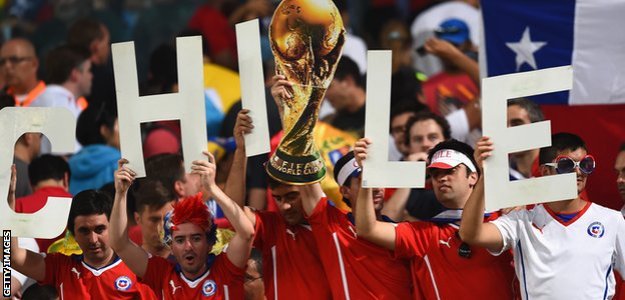
“Shortly after the World Cup draw was made in December, Brazil coach Luiz Felipe Scolari named the opposition he wished to avoid should his men reach the last 16. ‘I hope Chile don’t qualify,’ said Scolari. ‘I’d rather play any of the others. They’re a pain to play against. They’re well organised and intelligent. It’s better to face a European team.’ The 65-year-old was tempting fate and it came to pass when Chile finished second in Group B and Brazil won Group A, setting up an mouthwatering contest in Belo Horizonte on Saturday. It is the coming together of two attacking powerhouses and, while Brazil cannot contemplate defeat as they pursue a title viewed by the host nation as a birthright, Chile intend to spoil the party.” BBC

Chile will press on against Brazil
“In years to come, when the 2014 World Cup is remembered, most of the focus will fall on the knock out matches. What came before, Luis Suarez and open attacking play included, is all prelude. One fear, then, is that when the competition reaches the business end it might suddenly go cautious; as sapping conditions take their toll and the less ambitious teams seek to grind out their passage into the next round by taking the tie to a penalty shoot out. But there would seem to be little danger of caution playing much part in the first knock out match, the all South American clash in Belo Horizonte between Brazil and Chile.” ESPN – Tim Vickery

Babylon on the Beach

“There have been other parties on this beach. Not just the annual Carnival bacchanal or the New Year’s fireworks, which are massive and can run ragged (as a friend here told me, ‘you watch the fireworks and then run home so nothing bad happens to you’). Copacabana beach, the ‘billion dollar crescent’, as the New York Times called this strand fifty years ago, has hosted everyone from the Rolling Stones to Pharrell. Three million people showed up on its shore for Pope Francis last year, even more than that came for Rod Stewart a decade earlier. Five years ago, 100,000 people turned out just to celebrate the announcing of Rio as 2016 Olympic host—a party to celebrate a future party. But it’s still worth appreciating the unique wilding that is Copacabana this month during the World Cup. The Argentines are camping, the Chileans are chanting, the Costa Ricans are weeping, the Brazilians are hustling, and everywhere are the Americans, baying and bro-ing. Kiosks sell Ruffles and Lucky Strikes and Prudence condoms while sidewalk touts shove apitos and off-label FIFA tchotchkes in your face. Beach cruiser bikes weave around clusters of flagthumpers on the swirled stone promenade. A Uruguayan takes off running to the west for no apparent reason. A naval warship lingers just offshore; police helicopters buzz the beach. The atmosphere is somewhere between Spring Break and the Fall of Saigon.” Roads and Kingdoms

World Cup: The art of protest — Brazil’s graffiti artists tackle Brazil 2014

“If graffiti is the voice of the street, what better way to take a nation’s pulse than by gazing upon the walls of its inner cities?  In Brazil, like many nations, graffiti has long been a way for urban artists to decorate their neighborhoods, voice an opinion or tag prominent buildings with their signature style.  As the 2014 World Cup approached, however, many works began to take on the role of a complex social commentary.  Like the diverse spectrum of emotions and opinions surrounding the hosting of the event itself, graffiti appeared that was both aggressive and welcoming; political yet playful.  Brazilians love their football after all — as evidenced by the passion displayed inside stadia throughout the World Cup so far — but many remain appalled by the amount of money being spent to host the tournament.  We asked Cranio and Paulo Ito, two prolific graffiti artists from Sao Paulo, to explain how the sentiment of the Brazilian street has impacted their work and been transported onto walls and buildings across the vast country.  Interviews and captions by Eoghan Macguire, for CNN.” CNN

Don’t Call It Luck: The Divine Powers of the Soccer Fan

“There is a saying in this coastal city of mixed religious heritages and many creeds that goes more or less like this: If superstition decided soccer matches, all matches would end in a tie. Still, that has never kept fans here from turning to rituals, magic, prayer or just odd practices to give a helping hand to their club, or to the Brazil national soccer team, which plays Chile on Saturday in the Round of 16 at the World Cup. Whether it is wearing the same shorts for as long as the team is winning or leaving a sacrificial chicken and other offerings on a street corner to some African deity, fervent soccer fans in Salvador and beyond believe the outcome of the matches is somehow in their control.” NY Times (Video)

Group stage round-up

“A few brief points to make… 1. The three-man defence has been highly successful so far. A three-man defence has played a four-man defence (at least from the start) on ten occasions. These matches have produced eight victories for the three-man defence, and two draws. A back four is yet to beat a back three. There have been two meetings between three-man defences, Uruguay 1-0 Italy and Netherlands 2-0 Chile. …” Zonal Marking

Why You Should Root for Nigeria (or Brazil, Mexico or Ghana)

up-utilitarian--articleLarge
“Most of the world considers soccer’s quadrennial World Cup to be the most important sporting competition of all. A growing number of Americans have embraced the event, but many are only vaguely aware of it, and, aside from the United States, not so sure for whom to root. I am offering an alternative, utilitarian guide to help Americans choose a country to support. This guide can also be used if the Americans are eliminated, to help decide whom to root for among the remaining teams. The basic principle is simple, drawn from utilitarian principles: Root for the outcome that will produce the largest aggregate increase in happiness. So I came up with a simple index, calculated by a country’s passion for soccer multiplied by its average level of poverty multiplied by its population. It’s perhaps a bit crude, simply to multiply these factors by each other, but the exercise highlights some important truths about the world.” NT Times

Policing FIFA-Space

“What’s happening in the stands, where the fans meet the field? Scalpers, ticket touts, and cambistas operate freely around the Maracanã, exploiting fans desperate to get into matches. Outside the Spain vs. Chile match, an Englishman was selling three tickets for a total of $2,500—a sum that is maddeningly expensive and theoretically illegal. And this was one of dozens of such transactions happening on a newly constructed overpass that leads to the stadium before the game.” Fusion

Towards an Ethic of World Cup Fandom

“Sometime before he died, my uncle told me that in his youth, his dream had been to watch a World Cup game in person. He passed away before he could do it, so when Costa Rica qualified for the FIFA World Cup, I seized the chance to go. I contacted welcoming friends in Brazil, bought a ticket to see my team play football against England, and planned my trip. Like many fans around the world, I wanted to appreciate the beautiful game played at the highest level.” New Republic

World Cup Brasília, a Capital City That’s a Place Apart

“The Brazilian flag reads, “Ordem e Progresso” — “Order and Progress” — which is somewhat curious in this wonderfully jumbled and beautiful country. For an outsider who has visited the samba-infused nightclubs of Rio de Janeiro, the Amazonian jungle or São Paulo, with its ramshackle favelas and snarled traffic, order is not what springs to mind. Until you arrive in Brasília. In a country known for its flair for improvisation, Brasília stands in jarring contrast, a city so orderly, it is hard to believe it is really in Brazil.” NY Times

Brazilian Media Activist Arrested After Warning About Repression

“Twenty-four hours before getting arrested on Friday night, Filipe Peçanha, one of the founders of the media collective known for its edgy citizen-journalism coverage of street demonstrations in Brazil, warned of the dangers of increasing police repression and the criminalization of protests. ‘With the increasing wave of repression, we’ve seen an emptying of the streets. There’s been a criminalization of the movements,’ the founder of the Midia Ninja collective Rio de Janeiro told Fusion in an exclusive interview Thursday evening.” Fusion

Deep in the Amazon, an Isolated Village Tunes In to the World Cup

“The PP Maués would not set sail for an hour, but its long and narrow decks were already crisscrossed with hammocks for an overnight trip down the Amazon. By the time it was to dock early last Monday at the regional port for which it was named, the Maués would have traveled 15 hours from the nearest World Cup stadium. A second boat would be needed to reach an even more remote indigenous village that planned to watch Brazil play Mexico last Tuesday. The village did not have electricity or cellphone signals and would rely on a diesel generator to indulge its secluded passion for soccer. While Rio de Janeiro and its famous beaches provide the touristic backdrop of the World Cup, the fevered grip of the world’s most popular sporting event can be felt even in some of the most isolated areas of the rain forest, where outsiders seldom visit.” NY Times

Brazil united: the World Cup effect

“It seems to have been Brazil’s left-back Marcelo who came up with the idea. When the national anthem was played before a match, he told his teammates, they should keep singing after the music stopped. It would be a display of patriotism for the fans. It has become a ritual. At Brazil’s matches here, crowd and players belt out the words together a cappella. For a minute, the nation is made flesh.” FT – Simon Kuper

Train in Vain

cbe3b76b447f6e7e5bfc135878ead36d5a013f92-602x392
“The trains run every half-hour up the green slope of Corcovado, the Hunchback, through a forest whose branches scrape against the windows of the cars. They climb a mountainside where howler monkeys live, and also ocelots, and birds the color of imaginary jewels. Twenty minutes after setting out from the leafy station on the Rua Cosme Velho, they deposit tourists at the base of a long escalator, which rises to the feet of Christ the Redeemer, Cristo Redentor, the white colossus whose open arms embrace the crescent sliver of Rio de Janeiro more than 2,000 feet below. From the peak you can stand and look down on the marvelous city, a cidade maravilhosa, Rio, a bright thread curling between the mountains and the sea.” Grantland – Brian Phillips

Photos: Police on “Pacification Patrol” in a Rio Favela

“The metropolis of Rio de Janeiro, never lacking for spectacle and chaos, is presently welcoming the thousands of visitors squeezing into the city to be a part of the 2014 World Cup. Two years from now, its 6.3 million residents will have to share their city with even bigger throngs when the Olympics come to town. Already, they are feeling the strain of the put-upon host. As new facilities, retail, and accommodations pop up with each passing week, the cost of living rises along with the pace of construction. But rapid development isn’t Rio’s only stressor: To make the city presentable for international spectators, the military and police have been deployed in a program of slum clearance. In the favelas, heavily armed tactical units have engaged in pitched battles with squatters and local gangs as recently as last month.” New Republic

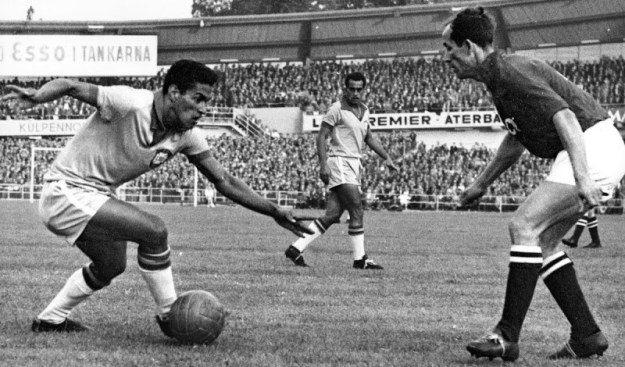
Garrincha

GARRINCHA 3
“Manuel Francisco dos Santos (28 October 1933 – 20 January 1983), known by the nickname ‘Garrincha’ (Portuguese pronunciation: [ɡaˈʁĩʃɐ], ‘little bird’), was a Brazilian footballer who played right winger and forward. He is regarded by many as the best dribbler in football history. The word garrincha itself means wren. Garrincha was also known as Mané (short for Manuel) by his friends. The combined ‘Mané Garrincha’ is common among fans in Brazil. Due to his immense popularity in Brazil, he was also called Alegria do Povo (Joy of the People) and Anjo de Pernas Tortas (Angel with Bent Legs).” Wikipedia

YouTube: Garrincha – The Genius of Dribble ( Documentary ) Part 1, Part 2

Neymar and the Disappearing Donkey

“By the time you read this, it’s possible that every single person on the planet will know who Neymar da Silva Santos Júnior is. The image above is of Neymar from five days ago. … You could come to any number of conclusions from Neymar’s remarkable transformation. For instance, you could conclude that race doesn’t exist in Brazil, which is the favourite line of a specific tribe of Brazilians – impeccable liberals all, who just happen to be upper-class, white and at the top of the heap. Or you could conclude that everyone in Brazil is indeed mixed – which is, incidentally, the second-favourite line of the selfsame tribe. Or you could wonder what happened to this boy.” Africasa Country

As Brazil Cheers, Protesters Struggle to Be Heard

“Twelve months after hundreds of thousands of protesters took to Brazil’s streets to complain of lavish public spending on stadiums for the World Cup, the tournament organizers have been relieved to see just hundreds attend scattered demonstrations as the first round of games got underway. With Brazilians loudly rallying behind their national team, the seleção — and whole cities exploding in a din of cheers and fireworks following every goal — activists concerned about social issues like poverty, corruption and police brutality have struggled to make their voices heard.” NY Times (Video)

Viagem Brazil: Prostitution, revelry and World Cup soccer own the night

“As midnight approaches on Rua do Salsa, crowds gather outside an open-air mall, the walls out front painted white and splattered with posters. The place is called Placa Jardin. It’s Friday night. Placa Jardin looks like any of the other numerous bars and clubs and restaurants in this reveler’s paradise on a cobblestone street near the beach. The lights outside alternate blue and green. Strobe lights inside flash red. Music played at maximum volume reverberates down the block. Dozens of women stand out front, clad in so many miniskirts and tube tops, lips dressed in the brightest red lipstick, feet stuffed in the tallest high heels. They spread down the street, in front of bars, clubs and cars. Some stand next to family members. Others cluster in packs of three or four. These women are prostitutes, and this is the side of the World Cup no one talks about.” SI

Scenes From Rio: Champagne Showers and Dan Gadzuric Graffiti at the World Cup

“It appears to be true, what everyone keeps saying. Last year’s massive civic unrest protesting the Brazilian government’s prodigious World Cup spending — which erupted during the Confederations Cup, and saw a million people throughout the country take to the streets — has left Rio de Janeiro working through a bit of a hangover. The pre-Cup festivities were muted: Any of these beautifully scruffy Rio streets might feature a rippling mini-flag canopy, but for every bit of street art depicting David Luiz as an ethereal sun god, there was another with hasty graffiti reading, ‘FIFA GO HOME.’ Still: No one told the seventysomething dude bombing down Copacabana beach, stunting out his limousine sunroof with a bottle of champagne, slicked-back Calipari hair, and a technicolor dreamcoat while screaming, ‘CHILE! CHILE! CHILE!’” Grantland

Out of Joint

“When I switched on last night’s World Cup opening ceremony, it first appeared that some São Paulo carnivalesque version of Macbeth was in production and Birnam wood was on its way to Dunsinane. A number of figures masquerading as trees were making their way around the field shaking their branches and twigs. But soon the trees had exotic birds for companions and then some children in white bounced on a trampoline while mechanical leaves unfolded and, of course, we were not in Scotland but a virtual rainforest, where the uncontacted tribe appeared to consist only of JLo, Pitbull, and Claudia Leitte. Luckily for them, the Amazonian jungle on display was the Disneyfied version, significantly denatured: there were no carnivorous plants in evidence or shamelessly sexual banana fronds.” The Paris Review – Jonathan Wilson

Eyesore and Landmark in On

“Rotting, crumbling, covered in graffiti, overrun by weeds, the hulking wreck of a building known as the Aldeia Maracanã would make an unsightly addition to any neighborhood. But it happens to stand next to Rio’s Maracanã Stadium, the soccer cathedral that will host some of the World Cup’s most important matches, including the final. To get to the stadium, tens of thousands of fans will have to pass the Aldeia Maracanã’s ruined walls, now unattractively shielded by a 10-foot mesh fence. If the Maracanã is the celebrated face of Brazilian soccer, the Aldeia Maracanã is the scab on its nose.” NY Times

Brazil 3-1 Croatia

n-700x393
World Cup 2014: group stage, day 1
“The World Cup opener was an exciting game, with Croatia taking an early lead and playing well throughout – Brazil were flattered by the two goal-victory. Crossing. The key feature of the match, and a rather surprising one, was the frequency of crossing. That wasn’t something we expected – Brazil usually field inverted wingers cutting inside to shoot, whereas Croatia hold the ball for long positions in central midfield. But in the first half, both sides crossed the ball regularly. One obvious cause was the format of Brazil’s attackers. Oscar is usually central, with Neymar left and Hulk right. But Scolari changed this completely, with Oscar wide-right, Hulk wide-left and Neymar playing as a support striker, effectively an inside-left. This was probably because Scolari knew Croatia lack a recognised holding midfielder, using two silky passers in that zone instead – so he knew Neymar would get plenty of space between the lines.” Zonal Marking

World Cup Tactical Analysis: Brazil 3-1 Croatia
“The curtain raiser to the grandest tournament of the year took place on the 12th of June at Sao Paulo, with the hosts and hot favourites Brazil taking on Croatia. With all the feverish build up to this game, many were expecting a Brazil romp, but things didn’t really go as planned, as Croatia coach Niko Kovac set his team up to make things very difficult for the Brazilians. Thankfully, the game didn’t suffer as a spectacle, with both teams fighting hard and playing with a great intensity to ensure a positive start to the tournament.” Outside of the Boot

Croatia seething after bitter defeat
“Hysteria — there’s no better word to describe how the morning after the night before looks in Croatia. The Vatreni lost 3-1 to Brazil in the World Cup opener despite putting on a decent performance and, for the vast majority of those who cared to express their opinion, there is no doubt whatsoever who was to blame for the defeat. Referee Yuichi Nishimura is the name’s on everyone’s lips — barely anyone opted for a rational analysis of how Croatia played, instead focusing on the Japanese’s officiating of the match. The Croatia press was incandescent with rage as each media outlet dissected the evening.” ESPN

Neymar makes his mark but like Brazil fails to convince against Croatia
“He was the first Brazilian to score (at the right end) at the World Cup, the first Brazilian to be booked in the World Cup and he also scored a decisive penalty. He trotted round in a corona of attention, always demanding the ball, taking every corner and free-kick, the demands of his country that he should win them the World Cup apparently loud in his ears. Yet this wasn’t a convincing performance, either from Neymar or Brazil.” Guardian – Jonathan Wilson

Relief for Brazil after flawed victory
“Brazil’s World Cup is one of the most ineptly organized major sporting events in history. It might yet prove to be the worst. Its inconveniences have been overshadowed only by its tragedies. Construction workers have died. Stadiums and infrastructure are incomplete. The field in Manaus, a first-order criminal folly, looks like something a beer league wouldn’t play on. The airports and streets are overwhelmed. (If you have a friend in Brazil and you want to know what he’s up to right now, he’s waiting in some kind of line.) Officials have warned visitors not to be out after midnight, that roving bands of muggers have been invading restaurants, that street violence is as inevitable as the sunshine. Long before the start of Thursday’s kickoff between Brazil and Croatia, the concessions at Arena de Sao Paulo had run out of food, the wireless had gone down and the too-few elevators weren’t working properly. Eighteen minutes after the first whistle, a large bank of lights went out.” ESPN

Soccer Morning – June 13th 1:31:13 (Video)

The Many Goal Posts of Brazil

lead_large
“The 2014 World Cup is finally underway. Soccer-loving host nation Brazil plays Croatia inside São Paulo’s Arena Corinthians Thursday afternoon. Like so many tournament story lines formed around excessive government spending on the event ($11.3 billion total), the $525 million stadium has been a source of embarrassment for Brazilian politicians and World Cup organizers. Three workers were killed building the facility. Completed six months past deadline and $150 million over budget, today’s game will be the first it hosts at full capacity.” City Lab

What Would Socrates Do?

“Brazil’s heroic midfielder from the 1980s had a political conscience that’s needed today. You have to wonder what Socrates, the legendary socially-conscious Brazilian midfielder, would have made of what is happening in Brazil. Soccer and socioeconomic issues defined his personality and his career. Were he still alive, he would no doubt be helping us contextualize the craziness of this World Cup. They don’t make Brazilian players, or athletes in general, like Socrates these days. This Seleçao team follows the lead of coach Luiz Felipe Scolari, who, when the team bus was surrounded by striking school teachers last month, dismissed the issue and said the problems of his country are not his concern. Not yet, anyway.” Fusionn

Welcome to São Paulo, Ground Zero of Protest, Foment, and Labor Strife

“The metro strike has ended in São Paulo, Brazil’s largest city, for now. Jerome Valcke, FIFA’s Secretary General in town for the FIFA Congress, says there is no Plan B to get 61,000 fans to the nearly finished Itaquerão stadium. Of course, there might be a general strike across the country on Thursday, but it’s maybe, probably just a rumor. Panic has ensued. Calm Down! Hurry up! Slow down! How do I get to the stadium?” Fusion

Brazil: organised, structured, and the favourites

“There has never been more pressure on a side to win a World Cup: the hosts are always expected to exceed expectations, but the expectation in Brazil is always to win. Following two disappointing quarter-final exits in 2006 and 2010 – and let’s not forget, Brazil started both those tournaments as favourites – another failure won’t be tolerated. In re-appointing Luiz Felipe Scolari, the World Cup-winning coach from 2002, Brazil find themselves with a fine manager capable of working, and thriving, under such great pressure. While judgement of his performance will be entirely dependent upon what happens in the next month, he’s performed an extremely good job so far.” Zonal Marking

A ‘bloodbath’ on the pitch, a riot in the streets

“The Estádio do Maracanã in Rio de Janeiro has a special, rueful place in the Brazilian psyche. It is beloved by all who have seen it, even at its rundown worst. When it came to be renovated for the first time, it was feared it was an impossible task. So much human urine had been expelled over its concrete foundations that it had made the stadium structurally unsound. It was also the venue of an event that Brazilians had never forgotten, from the last time the country hosted the tournament: the 1950 World Cup final. Those who weren’t born then have never been allowed to forget it either.” CNN – James Montague

Protests at the World Cup

sao-paulo-protests-0612-horizontal-large-gallery
A protester argues with police during the Sao Paulo demonstration on June 12. Two CNN journalists sustained minor injuries at the scene.
“A Brazilian policeman stands behind shields during clashes with protesters in Sao Paulo, Brazil, on Thursday, June 12. The buildup to the World Cup has been plagued by mass demonstrations over the estimated $11 billion cost of staging the soccer tournament. Many protesters, angered by the state of Brazil’s public services, believe the money would be better spent elsewhere.” CNN

2014 World Cup Roundtable: Planet Futbol’s prediction panel

“The 2014 World Cup kicks off Thursday, when Brazil and Croatia open the highly anticipated competition in Sao Paulo. Every World Cup is met with excitement and intrigue, but there’s something extra special about the 2014 edition. Perhaps it’s the host and its tradition of excellence. Perhaps it’s the loaded tournament field. Or perhaps it’s that transcendent stars like Lionel Messi and Cristiano Ronaldo are in their primes at the most ideal time. Regardless, there is quite the chapter of international soccer that is on the cusp of being written. Our reporters on the ground in Brazil — Grant Wahl, Brian Straus, Jonathan Wilson and James Young — and our contributors throughout the tournament — Liviu Bird and Ben Lyttleton — offer their picks as the world’s spotlight gets firmly planted on Brazil for the next month.” SI

Last Week Tonight with John Oliver (HBO): FIFA and the World Cup

“John Oliver’s excitement for the World Cup is tempered by knowing information about FIFA, the organization that produces it. John details the problems with the upcoming tournament and the staggering allegations of corruption against FIFA.” YouTube: Last Week Tonight with John Oliver (HBO): FIFA and the World Cup (Video)

The Pressure Builds on Brazil

scolari
“Just days before Brazil kicks off the World Cup against Croatia, warm-up matches and training sessions around the country reveal the two sides of Felipe Scolari and regional feelings about the team. June 3, 2014; Brazil v Panama; Goiânia, Brazil. Luiz Felipe Scolari is answering a question about Neymar. Scolari answers a lot of questions about Neymar. And about David Luiz, and Hulk, and all the other members of the Seleção. He also answers a lot of questions about pressure, and preparation, and a thousand other subjects connected with the most important, and least answerable, question: Will Brazil win its sixth World Cup this summer.” Fusion

Brazil on Edge as World Cup Exposes Rifts

“Brazil’s list of feats since ending authoritarian rule in the 1980s is as long as it is varied, including antipoverty programs pulling millions into the middle class, the democratic election of presidents who suffered indignities under the dictatorship and the surging growth of tropical agriculture to help feed the world. But instead of coming together to extol such triumphs on the global stage as the host of the World Cup, the soccer tournament starting on Thursday with teams from 32 countries, Brazil is marked by rifts, with some people genuinely excited about the event while others are simmering with resentment over its ballooning costs and a sluggish post-boom economy.” NY Times

How the UK taught Brazil’s dictators interrogation techniques

brazilarchiveprotestap
“As the world focuses on the World Cup, which opens in Brazil in less than a fortnight, many Brazilians are wrestling with painful discoveries about the military dictatorship that ruled the country from 1964 to 1985. The BBC has found evidence that the UK actively collaborated with the generals – and trained them in sophisticated interrogation techniques.” BBC (Video)