Category Archives: Brazil

Die Größte Show Der Welt

“It’s staring at me, that wallchart. It’s a little bit frayed and crumpled now since the move back from Greece and after finding its way around Jesse’s sticky fingers and teething gums. Since Sunday, I haven’t been able to summon the requisite will to complete the final vacant space. The one that states that Germany beat Argentina, one-nil, AET. It’s the finality that daunts me; the knowledge that once complete it becomes a historical artefact, no more a tantalising map of an unknown future. All those games, all those goals, all those hours. Gone forever.” Dispatches From A Football Sofa

The Ninjas in Brazil

article-2345600-1A729DDD000005DC-654_634x434
“‘Stop. Stop. Stop, stop, stop,’ Caio says. He’s seen something. We’re on a side street in Rio de Janeiro — within walking distance of Maracanã Stadium, where Argentina is taking on Bosnia-Herzegovina in the first World Cup game the city is hosting — and a protest that had been marching on, compact and peaceful for the past hour, has just splintered. The packs of Rio police officers, who had been treading silently and steadily alongside the banner-waving protesters, suddenly formed a cordon. The tear gas quickly followed, sending the protesters helter-skelter. Now I follow Caio, a member of the independent media collective Mídia Ninja, a veteran of this kind of thing, out of the scrum. ‘It’s dangerous what they decide to do,” he says of the protesters. “The street is very small. There is no strategy.’” Grantland

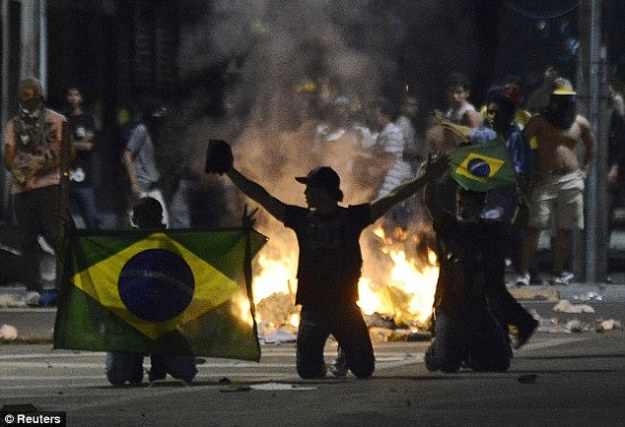
Photos: Brazilian Riot Police Squashed a Big Protest During the World Cup Finals

“It was a whirlwind of a weekend in Rio de Janeiro. The drama began on Saturday with the third-place match, which is in and of itself a depressing affair. After being on the edge of fulfilling World Cup dreams, two teams are forced to conjure up one last effort to save face. Brazil, in its case, had just suffered one of the worst defeats in World Cup history and didn’t want to compound it with another loss. The Dutch coach, meanwhile, thought everyone should hang up their boots instead of tempting fate once more. Nothing felt right about the match, so instead I decided to visit the Maracanã, the epicenter of the futebol universe, where Brazil never got to play a match as host of this World Cup.” New Republic

World Cup Expectations Rankings: Brazil’s over- and underachievers

Image, 738 × 415 pix
Cesare Prandelli
“Teams come to the World Cup with their own expectations. For some, just being there is enough, reaching the last 16 an almost impossible dream. For others, so exalted were their ambitions that even a quarterfinal feels like a disappointment. This is an attempt to grade teams according to how they did against their own expectations, looking both at results and at how well they played…” SI – Jonathan Wilson

The Two Brazils Revisited: What does the future hold after World Cup 2014?

“I first met Vitor Lira last December, when I was here on a reporting trip for an SI magazine story called The Two Brazils. The article examined the complex nature of a country that can both love soccer and engage in mass protests over the public spending and societal impact of the 2014 World Cup and the 2016 Olympics. Lira, 33, is a community leader in Santa Marta, one of Rio’s oldest favelas. Five generations of his family have lived there, and over the past two years he has organized resistance to the government’s plans for removals of Santa Marta residents as part of the sweeping changes in Rio around the World Cup and Olympics.” SI (Video)

Germany 1-0 Argentina

VD-WorldCup-408x264
Germany 1-0 Argentina (AET): Gotze’s extra-time goal wins the World Cup
“Germany won their fourth World Cup after victory over Argentina in a tense but enjoyable final. Joachim Low’s team selection was compromised by the late withdrawal of Sami Khedira through injury. Christoph Kramer took his place – although he only lasted 30 minutes himself. Alejandro Sabella’s side was unchanged from the semi-final against the Netherlands. Both sides had promising moments in an even match – Argentina had the better chances before Mario Gotze’s late winner.” Zonal Marking

Germans End Long Wait: 24 Years and a Bit Extra
“For years, Brazilians had a phrase they would inevitably utter when things went wrong. ‘Imagina na Copa,’ they said after an endless traffic jam or a construction accident or an ugly rash of violence dominated the news — imagine if this happened during the World Cup. It became a foreboding warning, a pre-emptive sigh at the presumed disasters that lay ahead. Over five weeks, though, Brazil avoided any of the major catastrophes it feared. Thrilling games and entertaining soccer — as well as the national team’s own stunning collapse — generally overshadowed any logistical issues, and the tournament was seen as a global success. So it was fitting, then, that in the tournament’s final game, the Brazilians managed to dodge the ultimate on-field nightmare, too.” NY Times

Germany 1 Argentina 0 (BBC)
“Germany were crowned world champions for the fourth time as Mario Gotze’s extra-time winner beat Argentina in the 2014 World Cup final. Gotze demonstrated perfect technique and commendable calm to chest down Andre Schurrle’s pass and sweep in a left-foot finish with the prospect of a penalty shootout only seven minutes away. Argentina, with skipper Lionel Messi looking subdued despite flashes of his talent, could not respond and Germany claimed their first World Cup since they beat the same opponents in Rome 24 years ago.” BBC

Germany’s World Cup title a result of revamped development, identity
“At the final whistle, after Germany claimed a fourth World Cup by beating Argentina 1-0 in extra time, BastianSchweinsteiger collapsed to the turf, utterly spent. He had given everything, running to the point of exhaustion, the only holding midfielder in the Germany squad still standing by the end, and that only just, a stray arm from Sergio Aguero having caught him across the face leaving him with a gash on his cheek.” SI – Jonathan Wilson

The Party’s Over: A Critic’s Take on Brazil’s Dismal World Cup Legacy
“About a five minute walk from Rio de Janeiro’s historic Maracanã stadium, the site of today’s Argentina vs. Germany final (Update: Germany won, obvsly), there used to be a small community of about 700 families called Favela do Metro. The reason the city demolished the tightly-packed neighborhood is hotly disputed: Residents said it was to build a parking lot, while the city claimed it had more ambitions urbanization plans, such as a park. But at least for now, there is little left except a jumbled mess of concrete and brick.” Fusion

Germans See World Cup Win as a Symbol of Global Might
germanyvictory-videoSixteenByNine1050-v2
“Even normally quiet streets were electrified early Monday by Germany’s dramatic 1-0 win of the World Cup in extra time, a victory that symbolized, at least to fans, not just the country’s dominance of Europe, but its global prominence. Car horns and vuvuzelas honked, and fireworks and firecrackers exploded. On the Kurfuerstendamm, the gleaming street of stores and restaurants that was the symbol of West Berlin during the Cold War, cars quickly jammed traffic and fans draped themselves in the black, red and gold of the German flag.” NY Times

World Cup Pass & Move: Germany Wins It All
The World Cup came to a close on Sunday, with Germany defeating Argentina in extra time, 1-0, in Rio’s Maracanã Stadium. Here, five Grantland writers look at five important characters from the match. Be sure to check out all of our coverage of the final, and the entire month of wonderful soccer action, at our World Cup landing page. Grantland (Video)

A Final Prediction: Germany Wins a Thriller
“Like the Sex Pistols in their prime, World Cup finals rarely fail to disappoint. After all the buildup and hype, the games often turn out to be low-scoring, bad-tempered affairs. In 2010, Holland, the nation that, during the nineteen-seventies, invented “total football,” a free-flowing, attacking style of soccer that enchanted the world, disgraced itself by trying to kick the Spanish “tiki-taka” men off the park in Johannesburg, and almost succeeded. Four years earlier, during the latter stages of a tense 1-1 tie between Italy and France, Zinedine Zidane, the French midfield maestro, was sent off for headbutting an Italian player, Marco Materazzi, who had allegedly called his sister a whore. (Italy went on to win on penalties.)” New Yorker

Germany Grinds Its Way To World Cup Triumph
“Well, I got the result right. But my prediction that it would be a thrilling World Cup final turned out to be wishful thinking. Instead of thrills, we got another tense, low-scoring game, in which both teams accumulated more bookings for bad fouls (two each) than clear-cut chances. By the middle of the second half, it was evident that one goal would settle it, and, in the second period of extra time, Germany nabbed one, thanks to a great piece of finishing by the young striker Mario Götze, who had come on as a substitute.” New Yorker

Success for Brazil, Just Not on the Field
“When Mario Götze settled a crossing pass with his chest and volleyed a goal that won the World Cup, German fans roared in ecstatic release. Those from Brazil were nearly as delirious, even if it was out of relief as much as celebration. It might have seemed an odd sight, Brazilian fans celebrating another team inside their own cathedral of soccer, the Maracanã stadium. But after two demoralizing losses brought national embarrassment, solace finally came Sunday as Germany defeated Argentina, 1-0, to become the first European team to win a World Cup played in North or South America.” NY Times

In a Latino Enclave, the World Cup Puts Everything on Pause
14ROOSEVELT1web-master675
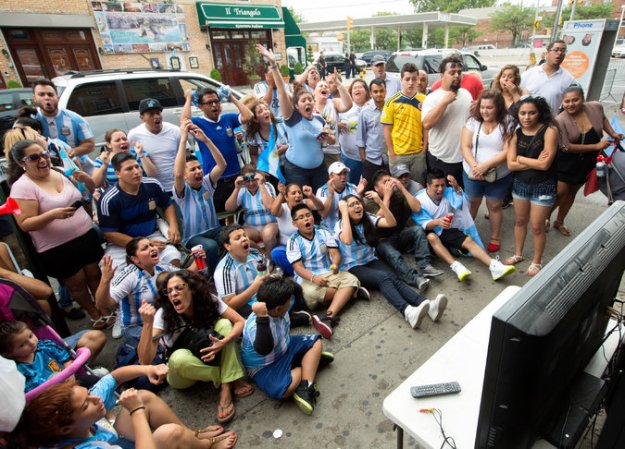
“Something unusual happened on Sunday afternoon on the streets of Jackson Heights, Queens: Quiet. As crowds gathered to watch the World Cup final around the Latin American enclave — in bars and barbershops, in electronics stores and by food trucks — the usually frenetic area beneath the elevated No. 7 train grew uncharacteristically still. Business, which spills onto the streets in the form of carts and trucks and tables, came to a halt. There was no merengue. Or cumbia. Or bachata.” NY Times

Don’t Cry for Messi, Argentina. This Germany Team Is One of the Best in Years.
“Lionel Messi seemed to recognize that he had lost the World Cup several minutes before the final whistle had blown. Moments after substitute striker Mario Götze scored a wundervolley in the game’s 113th minute to put Germany up by the decisive margin of 1–0, the Argentine legend had his last somewhat realistic chance at goal. Defender Marcos Rojo sent a high arcing cross deep into the German area and Messi came flying in for a free header from about 15 yards out. Had his shot gone in, it would have been a glorious goal. Instead, the ball fluttered harmlessly over the bar, and Messi walked away with his head down, staring desperately at the turf.” Slate (Video)

Brazilians Go Back to Real Life
Brazil suffered mightily with its national team’s 7-1 rout at the hands of Germany in the World Cup semifinals last week, but the authorities here breathed sighs of relief as the tournament came to a close on Sunday with Germany’s victory over Argentina, amid muted street protests and a display of Brazil’s ability to successfully organize sporting megaevents.” NY Times

Germany May Be the Best National Soccer Team Ever
“Germany didn’t begin the World Cup as the favorite. That honor belonged to (ahem) Brazil. But that’s a slightly deceptive measure. This was a top-heavy World Cup; not only Brazil but also Germany, Argentina and Spain would have been the front-runners in many past editions of the tournament. By the end of the World Cup, Germany left little doubt it is the best team in the world. In fact, it may be the best national soccer team ever assembled. One simple way to compare World Cup winners is by their goal differential throughout the tournament. Germany, with 18 goals scored and four allowed, comes out at a plus-14.” Five Thirty Eight

World Cup Spirits Dampened, Brazilians Show Waning Support for 4th-Place Team

“The yellow-clad fans arrived at Estádio Nacional later, more quietly and with far less face paint than usual. And no wonder: They were attending the World Cup’s third-place game, a match that newspapers around the world had called ‘a meaningless exercise,’ ‘a pointless sideshow’ and ‘the final insult.’ André Gonçalves, 48, an accountant in Brasília who was attending his fifth game in the stadium with his family, was struck by the difference in the scene outside the stadium Saturday afternoon before the Netherlands played Brazil. ‘This silence, this calm,’ he said. ‘It conveys sadness.’ André Galvão, a reporter for TV Bandeirantes, was having trouble finding the usual energy from Brazil fans.” NY Times

Pichações: The Streets Against the World Cup

gabriel-7
“As the World Cup in Brazil comes to an end without the predicted large-scale protests, there’s been a subtle but consistent message visible on the streets, as photo-journalist Gabriel Uchida has documented. ‘Pichação’ is the punk brother of graffiti. Pichadores don’t want to make art, they want to shock, to vandalize. It’s made to be ugly and agressive. In Brazil it was born in São Paulo and their main influence was the typography of punk rock and heavy metal band logos. Although it is illegal, it’s the most current cultural expression in the Brazilian streets. It’s possible to see ‘pichações’ everywhere, even at the top of the highest buildings. As it’s made to protest, recently Brazilian ‘pichações’ have found a new target: the World Cup.” World Cup 2014

The Rio the World Cup didn’t show
“There’s shit in the water. Two days after Brazil crashed out of the World Cup, on Thursday morning, one of Rio’s foremost sanitation activists, Leona Deckelbaum, came down to Copacabana Beach to work. She couldn’t help laughing. Tourists swam in the ocean across the street, and up and down the coast in both directions. In a city with a terrible sewage system even in the fancy neighborhoods and no complete sewage or water service in any of the 900-plus favelas, this is a terrible idea.” ESPN

What Will We Take From This Tournament?

“In writing on sport there is always a fine line between reading too much into what happens on the field and reading too little into it. The problem is particularly acute when it comes to the World Cup: no other sporting event creates the same torrent of hyperbole and cliché, or incites quite the same kind of grandiose pontificating. The best of sports writing and commentary manages to deal with this through a combination of grace, humor, and true emotion: something that the Men in Blazers have offered us, thankfully, on ESPN, and that has defined the wonderful writing of Brian Phillips for Grantland during the tournament.” New Republic – Laurent Dubois

What the World Cup Looks Like to a Refugee Child

boy
“I wanted to write a post predicting who will win the World Cup, but then truly, who really cares about my prediction? What do I know? I’m no pundit, not that pundits know anything anyway. Also, I’m a firm Bohrian. It was Niels who said, ‘Prediction is very difficult, especially if it’s about the future.’ Basically, a child could do just as well as me. So why not have a child do it? Not just any child, but a refugee. I had friends who work with two NGOs ask kids served by their groups some questions about the World Cup. The first organization is the World Food Programme in Beirut, which provides essential food and nutrition to over a million Syrian refugees in Lebanon. The second is Faros, an NGO in Athens, Greece, that provides individual assistance and long-term, durable solutions for unaccompanied refugee minors, mostly from Iraq and Afghanistan.” New Republic

After Soccer Loss, Dilma Rousseff Soothes Brazil With a Song

“As her country recovers from its humiliating loss to Germany in the World Cup, President Dilma Rousseff sang a samba to express Brazil’s resilience and gave no quarter to opponents who suggest that the soccer disaster may haunt her in the election this fall. ‘Soccer doesn’t mix with politics,’ Ms. Rousseff told a small group of foreign correspondents here on Friday night. ‘We’ll be discussing this defeat in Brazil for a long time to come,” she added, defending her government’s handling of the World Cup, which has unfolded without major problems. “It would have been more serious if we had lost outside the stadium than within it.'” NY Times (Video)

Soccer in Brazil, and Outside the World’s Glare

“Mauricio Lima has been in Brazil for the World Cup. Not exactly at the games, mind you, but going deep into the hearts — and jungles — where love of the game sustains and thrills (at least until the Brazilian team’s loss this week to Germany). He has ventured to a floating village where children kick improvised soccer balls along narrow docks, to a prison where inmates make balls, to an amateur tournament where teams and beauty queens compete together and to indigenous villages that are an overnight boat ride away from the nearest World Cup match.” NY Times

The Third-Place Game Is Often the Best Game

“Back in the nineteen-seventies, when Brazil still played the jogo bonito, the Dutch star Johan Cruyff was setting joyous new standards of creative attacking play, and Italy had not yet transformed soccer with the dour technique of stifling defense known as catenaccio (‘door-bolt’), the Austrian writer Peter Handke wrote a play called ‘Die Angst des Tormanns beim Elfmeter’ (‘The Goalie’s Anxiety at the Penalty Kick’). Wim Wenders followed up with a movie of the same name two years later. That title comes to mind as being extraordinarily prescient. With the exception of Germany’s spectacular 7–1 thrashing of Brazil in the first semifinal, the latter stages of the World Cup have, for many years, had a sorry tendency to be dominated by anxieties and goalies and penalty kicks.” New Yorker

World Cup 2014: Goals, drama & that bite – is Brazil the best?

best-world-cup-comp_v1_624
“Record goals, Suarez gnaws, that James Rodriguez strike, passion, drama, colourful fashion – what a World Cup this has been. It was a tournament that started with a bang as the hosts came from behind to beat Croatia, and has since delivered fantastic entertainment almost game after game. Here, BBC Sport’s chief football writer Phil McNulty and the BBC’s much-loved and most experienced commentator John Motson consider whether this has been the best ever World Cup.” BBC

Humiliation, Honor, and Brazil

brazil-newspapers-FB
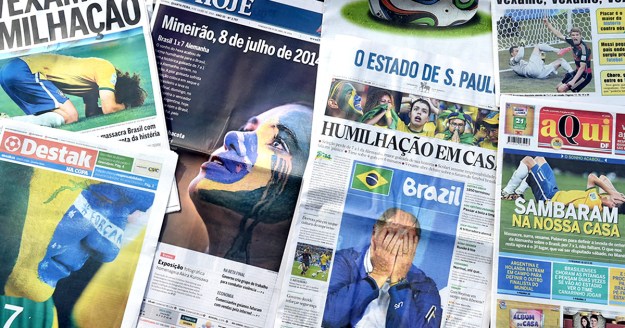
‘The morning after Brazil’s shocking, numbing 7-1 loss to Germany in the World Cup (which the commentators on ESPN have been instructed to call, robotically, the FIFA World Cup), my soccer-loving son mordantly read out English translations of the Brazilian headlines, which he had found online. All were brokenhearted—“FIASCO,” “AN EMBARRASSMENT FOR ETERNITY,” “EMBARRASSMENT DOES NOT EVEN BEGIN TO DESCRIBE IT,” and “WE CAN’T JOKE ABOUT IT: WE’RE TOO ASHAMED”—but the key word, over and over, was humiliation: “ULTIMATE HUMILIATION,” “HUMILIATING,” “FELIPE MISSES AND BRAZIL IS HUMILIATED,” “FROM DREAM TO HUMILIATION,” on and on like that.’ New Yorker

World Cup 2014: Brazil’s Neymar makes wheelchair claim

“Brazil’s Neymar broke down in tears as he claimed the challenge that ended his World Cup came close to paralysing him. The Barcelona forward, 22, fractured a vertebra in his spine when he was kneed in the back by Colombia’s Juan Zuniga during Brazil’s 2-1 quarter-final win. ‘I thank God for helping me, because if that blow had been a few inches lower I would have risked being paralysed,’ said Neymar.” BBC

YouTube: Brazil’s Neymar makes wheelchair claim

Argentines Sing of Brazil’s Humiliation, Loudly and in Rio

“As the Brazil team has come spectacularly undone in the World Cup, the pain for the host country has been compounded by the prospect that its hated rival, Argentina, could still lift the championship trophy on Sunday in Rio de Janeiro’s fabled Estádio do Maracanã, after Argentina won a tense semifinal against the Netherlands in a penalty shootout on Wednesday afternoon. The tens of thousands of Argentine fans who have invaded Brazil to cheer for their team, and taunt their hosts, brought with them a song that predicts not just triumph for Argentina, but deep humiliation for Brazil. And the players themselves have joined the choir.” NY Times (Video)

29 Minutes That Shook Brazil

“It started, innocently enough, in the 11th minute. Thomas Müller, Germany’s top scorer at this World Cup, slyly slid around the back of Brazil’s defense. When the ball arrived from a corner kick, he blasted it home. The Brazilian fans who made up most of the crowd of 58,000 went quiet for a moment. But then, unbowed, they resumed their defiant chants. In Ceilândia, some 450 miles north of the Estádio Mineirão, a housecleaner shrugged. ‘After the first goal, our reaction was not too much of a shock because Germany is a strong competitor,’ said the housecleaner, Neide Moura de Brito do Nascimento, who was watching on TV with her family. ‘We already expected one or two goals from them.’ Nothing else about Tuesday afternoon followed anyone’s expectations. From that modest beginning, this country went on to witness something never seen before in World Cup soccer: Germany scored five goals — more than many teams scored in the entire tournament — in the first 29 minutes of a World Cup semifinal on the way to a 7-1 victory. Those 29 minutes will be scrutinized for generations in Brazil, poked and prodded and dissected the way Brazil’s dreaded defeat to Uruguay in the 1950 World Cup final has been.” NY Times (Video)

No More Tears

IMG_2531
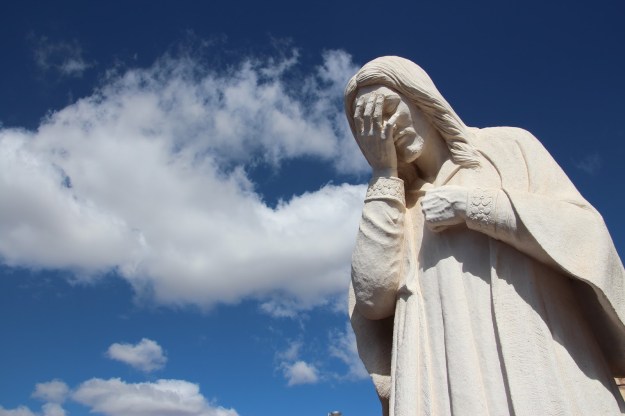
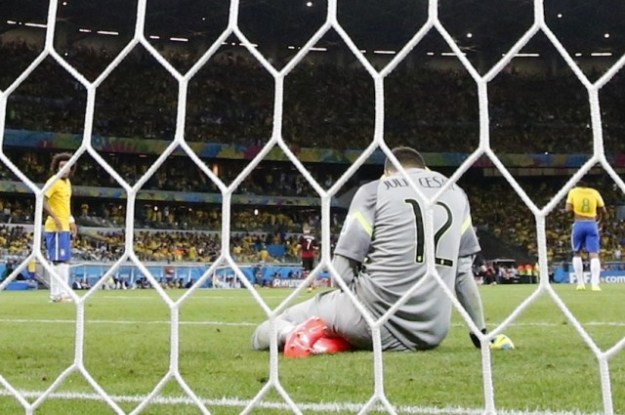
This “Jesus Wept” photo became a meme in the aftermath of Brazil’s defeat yesterday.
“O Lachryma Cristi, what has happened to our weepy Brazilians? Since day one of this tournament, it seems, they have been in tears. As the technical director Carlos Alberto Parreira reported, ‘They cry during the national anthem, they cry at the end of extra-time, they cry before and after the penalties.’ The sports psychologist Regina Brandão was rushed in, but failed to stem the flow; then it was the Pressure! The Pressure! A nation’s hopes, et cetera, et cetera. And now this 7-1 pasting, the iconic gone-viral boy in the crowd, glasses pushed up, fingers pressed to eyes, sobbing into his Coca-Cola cup; and somewhere else not too far off, the pretty girl with tears streaming down her cheeks, rivulets slowly obliterating the Brazilian flags she had painted there.” The Paris Review – Jonathan Wilson

Why Brazil Lost
“Most people are terrible singers, and yet football crowds are good at picking out a tune. Crowds are often flat on the high notes and tend to rush the tempo, but generally the combination of thousands of wrongs adds up to one big right. The Brazilian national anthem last night was different. All around the Mineirão people stood and roared it so loud that their eyes bulged. The words resounded with startling clarity but much too loudly for any music to be heard. Down on the field David Luiz and Júlio César were holding aloft the shirt of Neymar like a holy relic. The camera picked out a woman holding a placard that read, “Don’t worry—Neymar’s soul is here!” It was as though Neymar had died and was looking down at his former teammates from heaven, rather than watching them on television. The collective emotional frenzy of the scene was awe-inspiring.” Slate (Video)

The World Cup Beyond the Stadiums
“The matches of the FIFA World Cup have played out before crowds in stadiums—some barely finished—throughout Brazil, but the passions of the tournament can, at times, be most acutely felt far from the stands. Here, David Alan Harvey captures scenes from the favelas of Rio de Janeiro to Copacabana Beach.” New Yorker (Photo)

Why Brazil Crumbled
“Peeling back the layers of expectation. The weight of…a team. ‘A player plays for more than himself.’ That’s a common maxim echoed throughout dressing rooms across the globe. Players are also expected to play for teammates, families, communities, countries, continents, gods, and local bodega store owners probably. Every player on a World Cup team has shouldered a cross-section of these burdens on top of self-imposed expectations and demanding, perpetually looming coaching staffs armed with lots of professional badges. And the better the player, the more that weight is amplified. If a player is that good, he can become a meal ticket for all involved. All of that weight can rest on a selection of moments and touches. A final touch ending up in a net or in the lap of a cerveza-guzzling spectator can be the difference between being heralded in tribute videos or becoming an internet sensation for all the wrong reasons. This is the burden of performance, the burden of play.” Fusion

World Cup Tactical Analysis | Brazil 1–7 Germany: Germany run riot to trounce Brazil

“While Brazilians still talk about 1950 with disappointment and horror, what transpired at the Belo Horizonte will bring nightmares to the South Americans for years to come. Aman Sardana analyses what happened, and what went wrong. The enormous pressure, the inflamed anticipation, one nation’s obsession and hysteria amassed on the shoulders of a fervent and useful but ultimately imperfect team. They snapped under the stress, no doubt, but there was more to this than just pressure, or flawed tactics and team choice, or incompetent positional play, or a first-rate German squad filled with incisive passers and composed finishers. It was all of those things, and yet more. A first-half goal barrage saw Die Mannschaft 5-0 up, Miroslav Klose procured his record-breaking 16th strike at the finals and the cruelty prolonged into the second period with Schürrle coming off the bench and bagging a brace. Mesut Özil missed a one-on-one to make it 8-0, moments before Oscar netted a consolatory hit in the final minute of the first semifinal of World Cup 2014. But as it was, in 30 obscene first-half minutes, the Brazilian dream was over. Outside of the Boot

Thirty-One Nil

“No sport generates extremes of passion like football. And for football, there’s no bigger stage than the World Cup finals, every four years. The road to Brazil 2014 started in 2011 with hundreds of qualifying games in every corner of the world. For teams, players and fans, the games represent national identity, sometimes against backdrops of war, riots and revolution. ‘Thirty-One Nil’, a new book by British author James Montague, chronicles these extremes of hope, joy and despair — sometimes very personal, sometimes felt by entire nations. … Nick Wrenn, editor-in-chief, CNN” CNN

amazon: Thirty-One Nil: On the Road With Football’s Outsiders: A World Cup Odyssey by James Montague

Thirty One Nil: A Book About The Ones We Won’t See in Brazil: Book Review

O Jogo Bonito

“A little more than halfway through Brazil’s horrible, galling victory over Colombia last Friday, I began to wonder what type of foul might actually persuade the Spanish referee Carlos Velasco Carballo to issue a yellow card: A studs-up, two-footed, kung-fu fly-kick to the chest, like the one launched by Eric Cantona against a fan in the stands back in 1995? Any one of the number of egregious fouls, including punches to the head, committed by Italy against Chile, and then by Chile on Italy, in the infamous Battle of Santiago in World Cup 1962? Maybe multiple Suárez-type bites by a hyena pack of players on a prostrate Colombian felled by a scything tackle might have done the trick.” The Paris Review – Jonathan Wilson

Germany 7-1 Brazil: Germany record a historic thrashing, winning the game in 30 minutes

germany-humiliate-brazil-7-1-e1404868594956
“In one of the most incredible matches in World Cup history, this ridiculous scoreline was an entirely fair reflection of Germany’s dominance. Jogi Low named an unchanged side from the XI that had narrowly defeated France in the quarter-final. Luiz Felipe Scolari was without the suspended Thiago Silva, and the injured Neymar. Dante was the obvious replacement at the back, while tricky winger Bernard was a surprise choice to replace Neymar, with Oscar moving inside to become the number ten. Luiz Gustavo returned after suspension, with Paulinho dropping out. Incredibly, this game was finished after half an hour – it was 5-0, and Brazil were simply trying to avoid further embarrassment.” Zonal Marking

Brazil 1 Germany 7
“Brazil’s World Cup dreams ended in humiliating and brutal fashion as Germany inflicted their heaviest defeat in the first semi-final in Belo Horizonte. A thunderous occasion that began with Brazil riding a tidal wave of emotion was reduced to a nightmare as Germany were 5-0 up inside 29 remarkable minutes in front of a disbelieving Estadio Mineirao crowd. Brazil’s players mourned the absence of the injured Neymar before kick-off, but captain Thiago Silva was an even bigger loss. The result was their first competitive home defeat in 39 years, and the end of their hopes of making it to the World Cup final at the iconic Maracana on Sunday.” BBC

Germany Scored Three Goals in 76 Seconds and Four Goals in Four Minutes
“Everyone, including Slate, has noted that Germany scored five goals in an 18-minute span on Tuesday. That figure, though, understates what the Germans accomplished. For a good portion of that 18 minutes, the ball wasn’t in play because it was sitting in the back of the net and Die Mannschaft was celebrating. The ESPN broadcast made it hard to determine how fast Germany had scored in actual game time, as the copious goal replays were always butting in to the on-field action. In order to get an accurate count, I rewatched the first half using ESPN’s ‘tactical cam’ replay, which shows the game from above and affords a clear view of each goal and the precise moment when play subsequently resumed.” Slate (Video)

Goal, Goal, Goal, Goal, Goal, Goal, Goal, and Brazil’s Day Goes Dark
“The fireworks began at dawn. All around this city, loud pops and bangs rang out as men and women and children, so many dressed in yellow, set off flares and beeped car horns. It was supposed to be a magical day. The Brazilian national soccer team, playing at home, was one game away from a World Cup final. No one could have guessed the tears would come before halftime. No one could have imagined there would be flags burning in the streets before dinner. Certainly no one could have envisioned that any Brazilian fans, watching their team play a semifinal in a celebrated stadium, would ever consider leaving long before full time.” NY Times

Let the Recriminations Begin in Brazil, and Let Them Begin with Scolari
“Then Brazil lost a relative squeaker to France in the finals of the 1998 World Cup, the country’s congress held intensive investigations and hauled some of its most storied athletes before a panel of preening politicians. Conspiracy theories swirled that cast blame in all directions—one widely held notion attributed the defeat to the machinations of Nike. The questions were irrational but give some hint of the mindset of a defeated Brazil and foreshadow the ugly recriminations that will follow this ugly defeat.” New Republic

Nation in Despair
“… Everyone knew it would be difficult for Brazil without the injured star Neymar and the suspended captain, Thiago Silva, but nobody imagined this feeble capitulation — four goals surrendered to Germany in six minutes during a 7-1 rout in a World Cup semifinal. Early on, Brazil’s players bickered, lost their cool, then lost their fight. The country of the beautiful game was left to face a grotesque humiliation. Luiz Felipe Scolari, the coach, flung his hands in disgust amid the flurry of early German goals. Marcelo, a defender, put his hands to his face in embarrassment and disbelief. A boy and a woman cried in the grandstand beneath their glasses, appearing stunned and overcome on camera.” NY Times (Video)

Neymar’s Injury Sidelines Effort to End World Cup Racism

“After an episode in Peru earlier this year in which Peruvian soccer fans subjected a Brazilian player to racial abuse by imitating the sounds of monkeys, President Dilma Rousseff of Brazil swiftly pledged a ‘World Cup against racism,’ declaring, ‘Sports should be no place for prejudice.’ Yet when Brazil’s top player, Neymar, broke a vertebra when he was kneed in the back during a match on Friday by a Colombian player, the torrent of racist insults against the Colombian, Juan Camilo Zúñiga, showed how far the host of the World Cup remains from achieving that goal.” NY Times

Neymar’s cultural significance to Brazil transcends soccer, World Cup

neymar1
“Tweets of sympathy and support from Brazilian president Dilma Rousseff to Kobe Bryant and everyone in between, including super models (Gisele Bundchen), Olympic sprinters (Usain Bolt), footballers (Ronaldo and Lionel Messi) and soap opera stars (too many to mention). Hours of TV coverage devoted to detailed analysis of spinal columns and estimated back injury recovery times. More hours of TV coverage dedicated to discussion of whether Colombian defender Juan Camilo Zuniga’s crushing, knee-raised challenge was premeditated or not (the debate oscillating between ‘a normal part of soccer’ and ‘a cowardly assault’). FIFA Fan Fests all over the country, filled with supporters who minutes before had been wildly celebrating Brazil’s 2-1 World Cup quarterfinal win over Colombia, falling still and silent. On Friday evening, Brazil turned its lonely eyes to Neymar da Silva Santos Junior.” SI

How have Germany tactically set-up so far in the World Cup?

“With the recent domination of German football at club level, Germany were marked as favorites in this World Cup. With a highly talented squad, Low was expected to recreate the incisive and dominant football that Germany were known for. Questions have loomed about where Lahm would start for Germany, how they could deal with the scarcity of out an out strikers and the soft spots in the wider areas of defense. Big things are expected from this German squad and here is how they have lined up so far in this tournament.” Outside of the Boot

How have Brazil tactically set-up so far in the World Cup?
“Prior to the start of this tournament, followers of the Selecao were well aware of the tactics Luiz Felipe Scolari will employ for the side. Though the squad seemed weak, it didn’t surprise many that impressive performances from some Brazilians didn’t earn them a spot in the squad as pragmatic Scolari stuck to his tried & tested team. This piece on Brazil’s tactical set-up prior to the start of the tournament was spot on. This was the case for any Brazilian supporter, as the formation & system was well known before the first ball was kicked, and there has been little change.” Outside of the Boot

Germany Must Out-Invent Brutish Brazil: A Bizarre-But-True Semifinal Preview

“Germany and Brazil are the two most successful teams in World Cup history, so it’s funny to think that they have only met once before in the tournament. That was in the 2002 final, when Brazil claimed its fifth trophy and Ronaldo topped the all-time goal-scoring charts. It was also, incidentally, the day a certain Philipp Lahm, then 18 years old, and Bastian Schweinsteiger, 17, made it to the German youth championship final for Bayern Munich. Sitting on the bus back to Bavaria, Lahm and Schweinsteiger probably could not have imagined that 2002 would be their country’s last international tournament without them. Now, 12 years later, these twin hearts of the German team will line up on Tuesday in the semi-final against Brazil in the hopes of erasing their nation’s reputation as the eternal also rans.” New Republic

Brazil’s Only Hope to Take This World Cup: Win Ugly

“There are three contradictory narratives getting batted around about Brazil’s foul-plagued, back-breaking 2–1 quarterfinal victory over Colombia. The first, one that’s being pushed by the Brazilian press, is that Neymar was assaulted by brutish Colombian defender Juan Camilo Zúñiga, whose late-game challenge was reckless and cowardly. (Sample headlines: ‘Stabbed in the back’ and ‘Damn Colombian.’) An alternate view, one articulated by the New York Times’ Sam Borden among others, is that Brazil got what it had coming. Borden believes that Neymar’s fractured vertebra was the logical conclusion of Brazil’s decision to play a dirty game, and of referee Carlos Velasco Carballo’s refusal to keep the foul-happy Seleção in check. The third perspective, laid out by Forbes’ Bobby McMahon, is that Colombia was the team that came out fouling, that the referee didn’t do much of anything wrong, and that Neymar’s World Cup-ending injury was an unfortunate accident rather than a violent inevitability.” Slate (Video)

Semifinals Remain an Inner Sanctum Until Further Notice

split-master675
“The World Cup, ultimately, is a highly exclusive club. To be sure, the World Cup lets in hoi polloi to give a glimmer of hope and inclusion, but the inner sanctum is usually sealed shut by the semifinals, sending home the pretenders. Not our kind. Check out the four semifinalists this time around. The outsider, the long shot, is merely a three-time finalist, respected all over the world for its Total Football, the open, offensive style that has influenced Spain, the nation; Barcelona, the club; and other appealing offensive systems. Yes, the Netherlands, destiny’s darling, is known universally as the greatest soccer nation never to win the World Cup. All over the world, the huddled masses like the United States, yearning to be significant, are asking themselves, What does it take to crash that club, to become a regular, a nation that feels at home in the semifinals? How do countries learn that self-assurance that wins dubious referee calls and takes over game-deciding shootouts?” NY Times

World Cup Pass & Move: Weekend Warriors

“This past weekend saw quite a few footballing fireworks in Brazil. There were brilliant tactical decisions, gravely important injuries, near upsets, penalty shootouts, and Mothra landed on James Rodríguez’s arm. As a way of looking back on the quarterfinals matches, six Grantland writers — Chris Ryan, Brian Phillips, netw3rk, Mike L. Goodman, Graham Parker, and Ryan O’Hanlon wrote about six characters from the weekend action.” Grantland

World Cup Tactical Analysis: Brazil 2-1 Colombia | Brazil come out on top in a rough encounter

“The host team stepped up for a big quarter final clash against the form team of the tournament, Colombia on a hot night. This was touted as a clash of 2 teams that would entertain, with the likes of Neymar, Oscar, Cuadrado, and James expected to dazzle. Instead, we saw the dark side of both teams in a game that saw a lot of fouls, and eventually, a heart breaking injury for the star of the tournament, Neymar.” Outside of the Boot

Argentine Fans Mock Neymar’s Injury with Chant and Plastic Spine

“Argentina and Brazil have what is arguably the most intense rivalry in international soccer. The matches between the two countries, whether competitive or nominally “friendly,” are typically rough, tense affairs, with a history of nasty fouls and conspiracy theories. As is the case with most soccer “derbies,” fans also compete to come up with the most creative and insulting chants. But a group of Argentine World Cup fans have pushed the genre into new territory in a recent Youtube video.” Fusion

World Cup Brazil’s Other Beautiful Games

“It was a newsroom like any television station newsroom, unless you count the brunette receptionist wearing a crown, sash and leopard print dress and offering friendly advice on how to spice up the World Cup. ‘Beauty queens,’ Brenda Pontes, 19, said. The World Cup does have many things — consuming attention, enthralling soccer and a carnival atmosphere — but it does not have beauty queens. In the Amazon rain forest, though, there is a tournament that is equal parts soccer and beauty pageant. It is one of the largest and most unusual amateur soccer competitions in the world, and perhaps the only one with a reality show. Pontes is the reigning queen.” NY Times

Brazil 2-1 Colombia: Brazil prevail in a very aggressive game

“Goals from both centre-backs put Brazil into the semi-finals. Luiz Felipe Scolari made a straight swap at right-back, with Maicon in for Daniel Alves, while Paulinho replaced the suspended Luiz Gustavo. Colombia coach Jose Pekerman surprisingly brought in Fredy Guarin in central midfield, with Abel Aguilar dropping out. The story here was the sheer physicality, aggression and brutality of the game – to be frank, not much football was played.” Zonal Marking

The Amazon’s Floating Fields

boat2-articleLarge
“In this floating village, there is only one way to travel. Students go to school by boat. Pentecostals go to church by boat. Taxis arrive by boat. Even the soccer field is often a boat. There are three homemade fields on land, but they are submerged now in the annual flooding of the Black River, which meets nearby with the Solimões to form the Amazon. If the wooden goal posts had nets, they would be useful this time of year only for catching fish. So young players and adults improvise. They play soccer at a community center that has a roof but no walls. They play on the dock of a restaurant. And they play on a parked ferry, a few wearing life jackets to cushion their falls on the metal deck and stay afloat while retrieving the ball from the river.” NY Times

How the World Cup Is Damaging Brazil

“Don’t believe journalists who tell you the tournament is going smoother than expected. In a normal month of June, Rio de Janeiro hosts at least 16 first-division soccer matches. São Paulo will typically see the same number. Salvador usually has around 8; ditto Recife, Fortaleza, Porto Alegre, Belo Horizonte, and Curitiba. None of these cities will host more than seven during the World Cup.” Fusion

For Bellicose Brazil, Payback Carries Heavy Price: Loss of Neymar

“A Colombian defender named Juan Camilo Zúñiga ended the World Cup for the Brazilian star striker Neymar on Friday with a nasty knee into Neymar’s back that fractured one of his vertebrae. It was an ugly play and a bad foul. It deserved, at least, a yellow card. Yet within any game, there is always a road map to every flash point. The beauty of soccer’s continuous flow is that one thing leads to another (and another and another), and that makes it possible to trace a path to a game’s most memorable moment. In a game like Friday’s, doing so makes it easier to see where things went wrong. So what happened to Neymar? How did the face of this tournament end up in a hospital? Brazilian fans will not like to hear it, but while Zúñiga was directly responsible for causing Neymar’s injury, Neymar’s teammates — specifically Fernandinho, though there were others — as well as the referee, Carlos Velasco Carballo, deserve their share of the blame, too. They did not commit the crime, but they contributed to an environment of lawlessness that led to Neymar’s being battered.” NY Times

Soccer-inspired graffiti a mainstay of Rio de Janeiro, Brazilian landscape

BrpNSlUIMAEFV45.jpg large
“Jorges Leon Brasil is not lost. He started chauffeuring tourists and businessmen and urban adventurers all over Rio 26 years ago, when he was 18. His time-tested version of GPS is to squint his eyes in deep thought and—pop!—Ah yes, I know this place. He’s just not sure where he’s going this morning. A rest day during the World Cup has turned into a driving tour of Rio’s burgeoning graffiti scene, and I’ve asked Brasil—Junior to his passengers; he was named after his father—to be my guide in finding some soccer-inspired art. He has experience, after all. As a young boy growing up outside of Rio in the 1980s, in Vista Alegre (‘Happyville, you would say, in English’), Junior would join the local children at night during World Cup summers and literally paint the town center yellow and green, with Brazilian flags and soccer imagery celebrating his generation’s stars: Zico, Romario, Bebeto. . . It’s part of a tradition that carries on today.” SI

Brazil Takes a Painful Step Forward

“It was an enormous win for Brazil, but it came at a gigantic cost. Brazil on Friday powered to an impressive 2-1 quarterfinal victory over upstart Colombia at Estádio Castelão, setting off another round of raucous nationwide partying. But the noise and jubilation proved short-lived, as it was revealed after the game that Neymar — the country’s best player and biggest star — would miss the rest of the World Cup after injuring his back in the dying minutes of the hugely physical game. The Brazilian team has had only one goal this summer: to win the country’s sixth World Cup trophy while playing on home soil. The victory on Friday was an important step, setting up a semifinal next Tuesday against the powerful German squad.” NY Times

Odd couple pulls Brazil through
“On a day when Brazil lost star midfielder Neymar for the rest of the World Cup with a fractured vertebra, the Selecao turned to their odd couple — defenders Thiago Silva and David Luiz — to pull them through. The two leaders in the back scored goals either side of halftime to propel Brazil to a 2-1 quarterfinal victory over Colombia. Silva latched onto a Neymar’s corner kick and deflected the ball home with his knee with the game less than seven minutes old. In the 69th minute, Luiz hit a scorching 34-yard free kick past Colombia goalkeeper David Ospina. It was difficult to tell what possessed more maniacal ferocity — the shot, or his celebratory run to the near side corner flag.” ESPN

What’s Behind the World Cup’s Second-Round Slowdown?

“It feels like something has gone missing from Brazil in the past week. After an opening group stage that had been almost universally praised as the best-played and most entertaining World Cup in decades, the recent round of sixteen was a little more ordinary. Fouls are up and offense has slowed down, with the celebrated statistic of 2.83 scores per game in the group stage dropping by more than half a goal in the second round. Yes, it’s still the knockout stage of the World Cup, but it has sometimes felt uninspired—prosaic play clothed by the tension of high-stakes games with close final scores, extra-time finishes, and penalty shots.” New Yorker

World Cup 2014: Futsal – the game behind Brazil’s superstars

“There is a saying in Brazil that a great footballer is born here every day. A stroll along Rio’s breathtaking beaches is enough to show you why they believe that. As far as the eye can see, footballs dance in the evening air, propelled by one deft touch after another. Alongside the sun-worshippers, towel hawkers, muscle-men and bar-crawlers are boys and girls, men and women, repeating skills and drills, honing their feel for the football, hour after hour.” BBC (Video)

The Powerful Throat is giving favelas a World Cup voice in Brazil
“There’s a little football pitch up on the fifth station of the Santa Marta morro, in the Botafogo neighbourhood of Rio de Janeiro, where a group of Brazilian children who live in the favela are playing against some visiting Argentinian youths. The local kids hold a white ball, worn and battered, and they have challenged the Argentinians, saying if they win they will take their Fifa Brazuca football as the prize. The midday sun shines on the dry top of the morro, where the view of Christ the Redeemer on a nearby mountain top, and the undulating bays of Rio flanked by hills, literally stuns – can such beauty be humanly possible?” Guardian

Passion, pressure and prayers carrying Brazil on seven steps to heaven

“It was as Atlético Mineiro trailed 2-0 at half-time in the second leg of last season’s Copa Libertadores final against Olimpia of Paraguay that one of their supporters, wired on a cocktail of nerves, frustration and booze, decided to pop out for a smoke. He needed it. The Mineirão in Belo Horizonte was a maelstrom. Tears and prayers were seemingly everywhere. Another fan further down the row bawled his eyes out as he bellowed to the heavens. It was as if he were having an argument with the Big Referee upstairs. Atlético had never previously won the Libertadores. Their hated rivals, Cruzeiro, were on course to take the Brazilian league title. Atlético had to win this game.” Guardian

The Story of Resistance to FIFA’s War on Brazilian People – Video Blog

Bp83_2oCQAAC8Pi
June 13, 2014. “FIFA’s 50 billion dollar war on Brazilian people, started with the first worker oppressed, the first poor black person killed by police, the first indigenous forcefully evicted, the first teacher beaten by police, the first journalist or social activist attacked, the first protestor clubbed, the first kid in the favela murdered by state uniforms, the first sex worker raped by police, and the first child sold into sexual slavery. The World Cup is for the rich, the cops are for the poor. It started with the first home stolen, with the first rent raised, with the first law changed for FIFA’s sponsors, with the first patient left to die at the hospitals’ doors, with the first worker killed in their stadiums.” Revolution News (Video)

World Cup 2014: Who holds the balance of power in world football?

“Brazil’s World Cup has been played in the style that so many hoped for once football’s showpiece was awarded to the country regarded as the home of the game’s free spirits. The last three weeks have provided a consistent narrative of fast, attacking football and excitement – exactly as the game’s rulers would have imagined it when they handed the tournament to Brazil. Even the line-up for the last eight has a balance that brings pleasure to the purists, as four teams from the Americas are complimented by a quartet from Europe – all of them group winners.” BBC

We Watched a World Cup Game With One of Rio’s Most Violent Drug Gangs

“The sight of young men in board shorts and flip-flops holding high-powered assault rifles is one you never get used to. A few weeks ago in one of Rio de Janeiro’s most violent favelas, half a dozen such young men were sitting on plastic chairs around a small TV set that had been brought onto the street. They drank beer and chain smoked bagulhos, fat conical joints. One guy wore a thick gold chain with two plastic baggies dangling off it, one filled with white powdered cocaine, the other crack. A couple of others, we noticed, accessorized with grenades strapped to their belts. Just a few miles away, thousands of fans from around the globe were gathering at Fan Fest on Copacabana Beach to watch the opening World Cup match between Brazil and Croatia.” Fusion (Video)

8 Books to Guide You Through the World Cup

img_20140523_234356
Golazo!: The Beautiful Game from the Aztecs to the World Cup: The Complete History of How Soccer Shaped Latin America by Andrea Campomar
“The world is divided into two groups of people: those who look forward to the World Cup every four years, and those who don’t realize they’re soccer fans until the World Cup starts. For the latter, those recent converts to the soccer religion, here is a reading list you’ll want to page through before the 2016 Summer Olympics in Brazil, so you too can become a soccer expert.” Fusion

A Definitive Reading Guide To The 2014 World Cup
“In Brilliant Orange, the English writer David Winner’s celebrated study of Dutch soccer culture, he quotes voetbal-loving artist Jeroen Henneman on the subject of the Brazilian game: ‘I was so disappointed when I went to Brazil,’ he tells Winner, describing his first trip to the country that will host this summer’s World Cup. ‘I’d thought: finally I will see the great Brazilian football! I expected to see a very ‘roomy’ football. But they play in the most boring way, on technique, only to show off… So slow! They go forward, they go back. Some do little tricks, nice little things. But it is not football.’ It is not football.” Huffingtonpost

Middle Class Brazilians Watch from Afar

“The Country’s Classe C is the engine of Brazil’s Fan Culture, but You Won’t See Them in the Stadiums. Even after the sun has sunk beneath the horizon, the city of Fortaleza in the northeast of Brazil remains as warm as a steam bath. On a narrow, poorly lit street in the bairro of Mucuripe, the soft breeze coming off the Atlantic whips the hundreds of cheap yellow and green streamers hung between the cramped houses back and forth. It lifts up dust and sand too, covering the plastic tables and chairs of the Bar do Amiguinho (‘the Little Friend Bar’) in a thin layer of silt.” Fusion

World Cup: Brazil defeats Chile on penalties

wc-0628-horizontal-gallery
“And so the carnival carries on. Brazil, the team which manages to thrill and frustrate almost simultaneously, clinched its place in the quarterfinal of the World Cup following a tension-fueled encounter with Chile. A 3-2 victory on penalties following a 1-1 draw in Belo Horizonte means Luiz Felipe Scolari’s side’s quest to win the World Cup on home soil remains alive. It will now turn its attention to a last eight contest with Colombia — a team which has thrilled so far in this tournament. While Brazil will take the plaudits, Chile should be commended for a performance which at times defied the ability of the human body to run and hustle as its players did.” CNN (Video)

Brazil 1-1 Chile: Brazil progress by the finest of margins
“Brazil won on penalties after an incredibly tense and tiring contest. Luiz Felipe Scolari selected Fernandinho following his good impact in the win over Cameroon, with Paulinho on the bench. Jorge Sampaoli brought back Arturo Vidal after he was rested for the defeat to the Netherlands. The first half was an extremely fast-paced battle of pressing, and that tired both teams for the final 75 minutes, with the quality of football declining rapidly after half-time.” Zonal Marking

World Cup 2014: Brazil Survives Shootout Against Chile
“With the pressure of an anxious nation bearing down on them with each passing minute, the Brazilian players teetered on the brink of a defeat that would have wounded a country’s soul. Brave Chile was refusing to back down, demonstrating to 57,714 howling fans at Estádio Mineirão and millions more watching at homes, restaurants and bars that the team had the nerve to stand up to the mighty host nation through 120 minutes of the most tense and exhilarating soccer seen so far at the 2014 World Cup. After 30 minutes, it looked like the most fast-paced, breathtaking game of the tournament. After 90 minutes, the teams were even, at 1-1, after Chile had controlled play through much of the second half, leaving the Brazilian fans nervous and agitated. Through 30 draining minutes of extra time — which included a thunderous Chilean shot that struck the crossbar in the 120th minute, inches from knocking Brazil out — neither team could take a lead.” NY Times

Brazil shootout hero Júlio César: I have won the country’s trust back
“Júlio César, Brazil’s hero in the penalty shootout win against Chile, reflected on the prize of a World Cup quarter-final and said he felt he had won back the country’s trust after being the scapegoat in South Africa four years ago. Júlio César saved Chile’s first two penalties and referred immediately to his mistake in the quarter-final against Holland at the last World Cup.” Guardian

The Dazzle and the Desolation of Stadiums in World Cup Host Cities

dog-jp-macur-1-master675
“NATAL, Brazil — From her crumbling house with the leaky roof, across a new highway from a new World Cup stadium, Maria Ivanilde Oliveira heard everything. Notes of the national anthems floated through the humid air into her living room, where her black vinyl couch was losing its stuffing and a metal bookshelf was secured by gnarly wire. A mix of loud cheers and moans from 40,000 soccer fans told her that a team had scored. With no job and little money, Oliveira, 62, could not afford a ticket to see one of the four games played at the $450 million Arena das Dunas, one of 12 stadiums hosting the World Cup in Brazil.” NY Times

Were the Billions Brazil Spent on World Cup Stadiums Worth It?

“Aside from some brilliant play by Mexican goalkeeper Guillermo Ochoa that turned an expected victory for the Brazilian national team into a draw, so far the 2014 World Cup has gone well for host Brazil. The home team won its group and advanced to the Round of 16, and the widespread concerns about social unrest, street crime and stadium completion have faded as the games have largely gone off without a hitch. Of course, with a price tag estimated at $11.3 billion in public works spending alone, it will take more than just a trouble-free four-week tournament to justify Brazil’s heavy investment in hosting the World Cup.” fivethirtyeight

World Cup 2014: Might Brazil be the next victims of Chile?

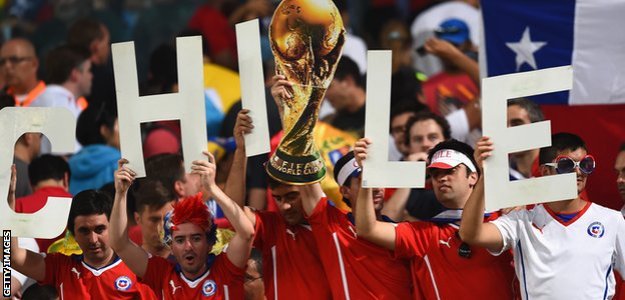
chilefans
“Shortly after the World Cup draw was made in December, Brazil coach Luiz Felipe Scolari named the opposition he wished to avoid should his men reach the last 16. ‘I hope Chile don’t qualify,’ said Scolari. ‘I’d rather play any of the others. They’re a pain to play against. They’re well organised and intelligent. It’s better to face a European team.’ The 65-year-old was tempting fate and it came to pass when Chile finished second in Group B and Brazil won Group A, setting up an mouthwatering contest in Belo Horizonte on Saturday. It is the coming together of two attacking powerhouses and, while Brazil cannot contemplate defeat as they pursue a title viewed by the host nation as a birthright, Chile intend to spoil the party.” BBC

Chile will press on against Brazil
“In years to come, when the 2014 World Cup is remembered, most of the focus will fall on the knock out matches. What came before, Luis Suarez and open attacking play included, is all prelude. One fear, then, is that when the competition reaches the business end it might suddenly go cautious; as sapping conditions take their toll and the less ambitious teams seek to grind out their passage into the next round by taking the tie to a penalty shoot out. But there would seem to be little danger of caution playing much part in the first knock out match, the all South American clash in Belo Horizonte between Brazil and Chile.” ESPN – Tim Vickery

Babylon on the Beach

“There have been other parties on this beach. Not just the annual Carnival bacchanal or the New Year’s fireworks, which are massive and can run ragged (as a friend here told me, ‘you watch the fireworks and then run home so nothing bad happens to you’). Copacabana beach, the ‘billion dollar crescent’, as the New York Times called this strand fifty years ago, has hosted everyone from the Rolling Stones to Pharrell. Three million people showed up on its shore for Pope Francis last year, even more than that came for Rod Stewart a decade earlier. Five years ago, 100,000 people turned out just to celebrate the announcing of Rio as 2016 Olympic host—a party to celebrate a future party. But it’s still worth appreciating the unique wilding that is Copacabana this month during the World Cup. The Argentines are camping, the Chileans are chanting, the Costa Ricans are weeping, the Brazilians are hustling, and everywhere are the Americans, baying and bro-ing. Kiosks sell Ruffles and Lucky Strikes and Prudence condoms while sidewalk touts shove apitos and off-label FIFA tchotchkes in your face. Beach cruiser bikes weave around clusters of flagthumpers on the swirled stone promenade. A Uruguayan takes off running to the west for no apparent reason. A naval warship lingers just offshore; police helicopters buzz the beach. The atmosphere is somewhere between Spring Break and the Fall of Saigon.” Roads and Kingdoms

Five Burning Questions for the World Cup Knockout Rounds

I am here to tell you about fire. The group stage of the 2014 World Cup was one of the most spectacular phases of a soccer tournament in recent memory. We’ve had torrential rains. We’ve had jungle heat. We’ve had moths the size of magazines. We’ve had wild upsets and crushing defeats; we’ve toppled the entire world order. We’ve seen more goals than in any major conflict since at least the French Revolution. And now — at last — this tournament is about to get serious.” Grantland

What we learned in the group stage

“Footballers are known for spouting clichés whenever possible, and when Marcelo was asked to summarise Brazil’s goalless draw against Mexico in the second round of group games, he immediately responded with a classic. ‘At the World Cup,’ he began, ‘there is no easy game.’ Bingo! There are no easy games at the World Cup, despite the fact that some teams are drawing upon the best players in the world, and others are selecting footballers plying their trade in second divisions across Europe. The World Cup sees the greatest players on the greatest stage, but sometimes also features the greatest (apparent) mismatches too. Argentina against Iran? How will the scoreboard cope?” ESPN – Michael Cox

World Cup: The art of protest — Brazil’s graffiti artists tackle Brazil 2014

“If graffiti is the voice of the street, what better way to take a nation’s pulse than by gazing upon the walls of its inner cities?  In Brazil, like many nations, graffiti has long been a way for urban artists to decorate their neighborhoods, voice an opinion or tag prominent buildings with their signature style.  As the 2014 World Cup approached, however, many works began to take on the role of a complex social commentary.  Like the diverse spectrum of emotions and opinions surrounding the hosting of the event itself, graffiti appeared that was both aggressive and welcoming; political yet playful.  Brazilians love their football after all — as evidenced by the passion displayed inside stadia throughout the World Cup so far — but many remain appalled by the amount of money being spent to host the tournament.  We asked Cranio and Paulo Ito, two prolific graffiti artists from Sao Paulo, to explain how the sentiment of the Brazilian street has impacted their work and been transported onto walls and buildings across the vast country.  Interviews and captions by Eoghan Macguire, for CNN.” CNN

Don’t Call It Luck: The Divine Powers of the Soccer Fan

“There is a saying in this coastal city of mixed religious heritages and many creeds that goes more or less like this: If superstition decided soccer matches, all matches would end in a tie. Still, that has never kept fans here from turning to rituals, magic, prayer or just odd practices to give a helping hand to their club, or to the Brazil national soccer team, which plays Chile on Saturday in the Round of 16 at the World Cup. Whether it is wearing the same shorts for as long as the team is winning or leaving a sacrificial chicken and other offerings on a street corner to some African deity, fervent soccer fans in Salvador and beyond believe the outcome of the matches is somehow in their control.” NY Times (Video)

World Cup: Do Latin Americans care more?

“… So too did world champions Spain, much-fancied Italy as well as England, who managed just one point from three games in a group that saw Costa Rica and Suarez’s Uruguay reach the last 16. Remarkably Costa Rica topped one of the tournament’s toughest groups with two impressive wins over Uruguay and Italy and a draw against England. For European observers, who perhaps don’t have the chance to watch much Latin American football, this has been a World Cup that has arguably showcased the tactical innovation and passion of the Americas.” CNN

Group stage round-up

“A few brief points to make… 1. The three-man defence has been highly successful so far. A three-man defence has played a four-man defence (at least from the start) on ten occasions. These matches have produced eight victories for the three-man defence, and two draws. A back four is yet to beat a back three. There have been two meetings between three-man defences, Uruguay 1-0 Italy and Netherlands 2-0 Chile. …” Zonal Marking

Why You Should Root for Nigeria (or Brazil, Mexico or Ghana)

up-utilitarian--articleLarge
“Most of the world considers soccer’s quadrennial World Cup to be the most important sporting competition of all. A growing number of Americans have embraced the event, but many are only vaguely aware of it, and, aside from the United States, not so sure for whom to root. I am offering an alternative, utilitarian guide to help Americans choose a country to support. This guide can also be used if the Americans are eliminated, to help decide whom to root for among the remaining teams. The basic principle is simple, drawn from utilitarian principles: Root for the outcome that will produce the largest aggregate increase in happiness. So I came up with a simple index, calculated by a country’s passion for soccer multiplied by its average level of poverty multiplied by its population. It’s perhaps a bit crude, simply to multiply these factors by each other, but the exercise highlights some important truths about the world.” NT Times

Policing FIFA-Space

“What’s happening in the stands, where the fans meet the field? Scalpers, ticket touts, and cambistas operate freely around the Maracanã, exploiting fans desperate to get into matches. Outside the Spain vs. Chile match, an Englishman was selling three tickets for a total of $2,500—a sum that is maddeningly expensive and theoretically illegal. And this was one of dozens of such transactions happening on a newly constructed overpass that leads to the stadium before the game.” Fusion