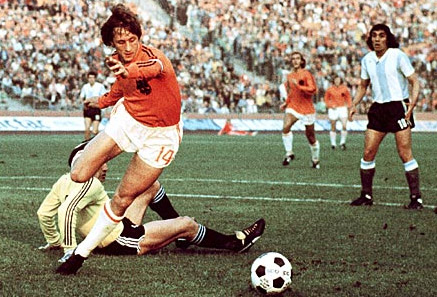
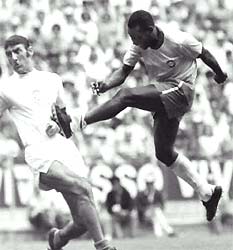
“A. A good time to score – Surprisingly, not at any time during the game. Usually just before half-time or just after half-time. Sometimes scoring a goal can be a bad thing most notably when a team scores too early – like the Dutch in the 1974 World Cup Final.” (Left Back In the Changing Room)
Category Archives: World Cup
Immigrant pride and working-class thrift

Italy
“A century ago when the Velez Sarsfield club was founded in Argentina their shirts were plain white – the cheapest they could find. Then they went with stripes of red, green and white – a tribute to the Italian origins of the club’s founders. Finally they settled on the current strip – which, with a blue V on a white background looks like something out of rugby league. This is no coincidence. The story goes that they were offered a good deal on the shirts, which a rugby club had ordered and not bothered to collect.” (BBC – Tim Vickery)
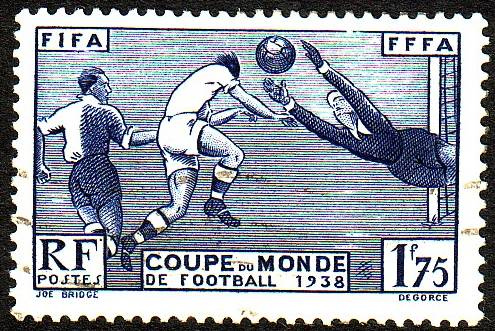
France 1938 World Cup

“01/06/38. SG612. The only stamp to be issued by any country that commemorates the 1938 World Cup.” (Footysphere Extra)
Geoff Hurst: Hat-trick hero

“Sir Geoff Hurst was an unlikely World Cup legend. He had been playing international football for little over five months when he appeared at the 1966 World Cup final. Almost exactly two years earlier, he had been playing cricket for Essex Second XI. It was only a week before the ’66 final that he made his competitive debut for his country.” (ESPN)
Good Hosts and Bad Hosts
“It’s Friday again, and that uneasy feeling rising in your belly is most likely because Friday means it’s Dotmund’s World Cup preview day here on Twohundredpercent. This week, he’s been looking at the fortunes of the host nations of the tournament. Until someone figures out how to astroturf the moon and stop the corner flags floating away, all major sporting events have to take place somewhere. And when you have somewhere, you can rest assured that someone already lives there. The host nation and the home advantage are here to stay.” (twohundredpercent)
Europe’s most dysfunctional club
“Yesterday, CSKA Sofia reappointed former Bulgarian national team coach Dimitar Penev. While playing at CSKA for 12 years, he won 90 international caps and seven league titles. He won three more championships as CSKA coach and took Bulgaria to the semi-finals of the 1994 World Cup.” (WSC)
Football At The World Cup: Part Three (1994-2006)
“We move on this evening to the final part of the history of the British television coverage of the World Cup finals, which takes us from FIFA’s revolutionary idea to hold the tournament in a non-traditional football environment to the introduction of High Definition broadcasting four years ago. On the pitch, however, the football frequently flattered to deceive and the broadcasters were left to try and make up the slack with more and more desperate marketing gimmicks. The 1990s saw television go from being a sport watched, broadly, by a hardcore into a mass commercial entertainment medium, with predictably mixed results.” (twohundredpercent)
Chile World Cup Team History

“I think the best word to describe Chile’s participation in the World Cup so far is “periodic.” The team has been to more World Cups than most nations, but has also missed out on plenty of tournaments too. Two of them thanks to one goalkeeper. Read on for the full story.” (World Cup Blog)
World Cup Gallery
“Having put a card reading ‘PRESS’ in the brim of his hat and given him some sandwiches, Dotmund will be producing some World Cup previews for this site on the next ten Fridays before the tournament kicks off in South Africa in 11 weeks time. You have been warned. Today, our resident ‘artist’ casts his ‘artistic’ eye over the official World Cup posters from down the years. You have, as I say, been warned.” (twohundredpercent)
Ferenc Puskas: Magical Magyar

Ferenc Puskas
“Like Johan Cruyff, the story of Ferenc Puskas is the story of a glorious failure. Possessing possibly the best left-foot shot in the history of football, the man known as the ‘Galloping Major’ – by virtue of his playing for army-team Honved – was the skipper of a side that were overwhelming favourites to win the World Cup.” (ESPN)
World Cup 2006 & Smilers Sheet – 6 June 2006

“The Football World Cup of 2006 will take place in Germany from 9 June to 9 July. 2006 marks the 40th anniversary of England beating Germany in the 1966 World Cup Final, and each of the 6 stamps issued by Royal Mail features one of the six national teams that have won the Cup since 1966.” (Football World Cup)
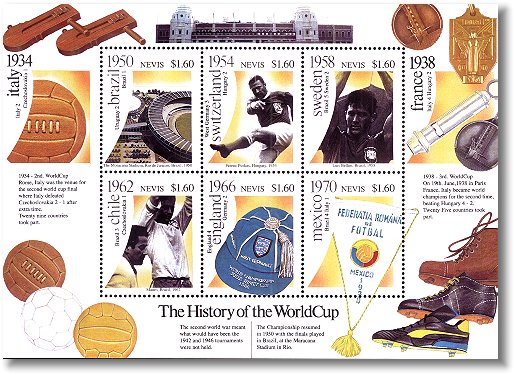
History Of The World Cup (1958)

Brazil defeats Sweden 5-2 in the World Cup. Pele;, at age 17, scores a goal in the game
“The venue of the 1958 World Cup was Sweden which infuriated the South Americans who expected it to revert back to them after Switzerland four years ago but they buried their hostility enough to be represented by Argentina, Brazil, Mexico and Paraguay. For the first and only time, all four of the British home nations qualified and we saw the first entry for the Soviet Union. People forget just how vast the Soviet Union was – once it split in 1991, the remnants formed a total of 15 different countries including Russia.” (Yanks Are Coming)
Video Of The Week: France – Black, White & Blue
“This week’s ‘Video Of The Week’ is from the ‘More Than A Game’ Series, and focusses on the history of football in France, as seen through the prism of immigration. As Jean-Marie Le Pen seemed singularly unable to grasp, much of the success that the French national football team has had has been at least partly due to to immigrant players. This documentary, which was screened in Britain as part of the ‘World Cup Stories’ series during the run up to the 2006 World Cup finals documents the history of a national team which gave the World Cup to the game and then took almost seven decades to win the competition.” (twohundredpercent)
Zonal Marking’s 20 teams of the decade – in full

“After twenty trips down memory lane, this series has finally come to an end. Below are the twenty sides chosen, in descending order, to represent the 2000s in tactical terms. Choosing the sides was a difficult task. The intention was not to choose the twenty ‘best’ sides, but to choose twenty sides who were somehow interesting tactically, or those who made a significant impact upon the game.” (Zonal Marking)
Football At The World Cup: Part Two (1982-1990)

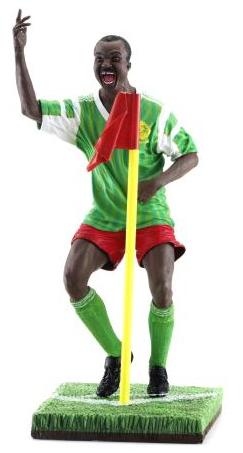
Roger Milla Cameroon 1990
“Last week, we took you from the beginning of the 1966 World Cup finals through to 1978 through the lens of the television cameras that brought the world’s biggest football tournament into our living rooms. This week we move on to the 1980s and the beginning of the gradual expansion of the tournament. The 1980s were a decade during which technological improvements that those in the television industry may have hoped for were cut short by a tournament that twice might not even have taken place, and ended with a tournament that was resplendent with bells and whistles but was let down by the appalling quality of football taking place on the pitch.” (twohundredpercent)
How the 2000s changed tactics #2: Classic Number 10s struggle

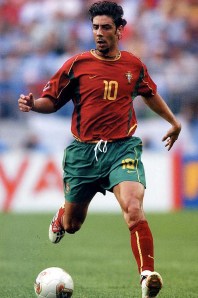
Manuel Rui Costa
“The decade started with the most attacking, open tournament in modern football, at Euro 2000. The four semi-finalists all played ‘classic’ Number 10s in the hole between the opposition defence and midfield. France, Italy, Portugal and Holland had Zinedine Zidane, Francesco Totti, Manuel Rui Costa and Dennis Bergkamp respectively – it almost seemed essential to have a player in this mould to be successful – helped by trequartista-less England and Germany’s early exits.” (Zonal Marking)
I Had Not Thought Death Had Undone So Many
“I’ve just been groping through piles of statistics and have come across a thoroughly melancholy fact, namely that there are no survivors of England’s pre-War internationals. The earliest international match for which we have a living English representative is Northern Ireland v England on 28th September 1946: Sir Tom Finney (b. 5th April 1922) scored on his war-delayed debut.” (More Than Mind Games)
The Best? Football As Never Before

“In looking at George Best Fußball wie noch nie (Football as Never Before) it would be logical to set the work next to the more widely viewed 2006 film, Zidane: A 21st Century Portrait and analyze the similarities and differences, but, in my eyes, I don’t think it would be fair to either film. There’s no doubt the Zidane edition is a direct descendant of the 1971 work by German filmaker Hellmuth Costard, with the exact same premise driving both the storyline and singular character focus. But where the two differ is outside the film itself – particularly, in the eyes of this viewer.” (Pitch Invasion)
How the 2000s changed tactics #2: Classic Number 10s struggle
“The decade started with the most attacking, open tournament in modern football, at Euro 2000. The four semi-finalists all played ‘classic’ Number 10s in the hole between the opposition defence and midfield. France, Italy, Portugal and Holland had Zinedine Zidane, Francesco Totti, Manuel Rui Costa and Dennis Bergkamp respectively – it almost seemed essential to have a player in this mould to be successful – helped by trequartista-less England and Germany’s early exits.” (Zonal Marking)
World Cup Moments: The Bittersweet Brilliance Of Totaalvoetbal, 1974.

“Total Football is such a visual spectacle it seems unjust to describe it by words. It’s football’s art – that which requires no explanation, merely open senses. Fortunately we live in the YouTube era, and as such those spectacles are only a click away. The Johan Cruijff-won Oranje penalty – all ninety seconds of it – from the 1974 final against West Germany, along with a compilation of the side’s finest moments from their bittersweet tournament…” (World Cup Blog)
Uruguayan football on the rise

“In ‘Back Home,’ his excellent account of the 1970 World Cup, Jeff Dawson does a disservice to the first kings of the global game – after 90 minutes of their quarter-final with the Soviet Union, he writes “the score is that old Uruguayan party piece, 0-0″. Just 16 years earlier, Uruguay produced a very different party piece in the 1954 World Cup in Switzerland. They beat Scotland 7-1, ended England’s campaign in with a 4-2 win in the quarter-finals, but then fell 4-2, after extra time, to the great Hungarians in the semi-final. It was the first time Uruguay had lost a World Cup match and six years later, when World Soccer magazine was launched, its inaugural edition carried a feature arguing that this was the greatest match ever played.” (BBC – Tim Vickery)
Czech Republic: 1.Liga (aka Gambrinus Liga), 2009-10 season.
“The Czech Republic’s Gambrinus Liga is the top tier of football in the country, and has been around since the late summer of 1993, which was half a year after the Czech Republic and Slovakia peacefully separated. That was two and a half years after the modern, 20th century Russian empire, also known as the Soviet Union, collapsed (hallelujah), in August 1991. Which was 20 months after the Vaclav Havel-led Czechoslovakian ‘Velvet Revolution’ occurred, in 1989, at a similar point in time as when the Berlin Wall fell (in November, 1989).” (billsportsmaps)
Video Of The Week: The Saturday Men (West Bromwich Albion 1962)
“This week’s Video Of The Week goes all the way back to 1962, and a short film called ‘The Saturday Men’. Produced as part of a shot series of films sponsored by the Ford Motor Company called ‘Look At Britain’, ‘The Saturday Men’ spends a week following West Bromwich Albion around. It follows them to training, the inner workings of the boardroom (to the extent to which the inhabitants of said room were going to be honest when there were cameras around), takes the time to meet a former player who is about to embark on a new career as a salesman and even stops in on a pre-match team talk by the club’s then manager, Archie McAuley.” (twohundredpercent)
World Cup Moments: Geoff Hurst, 1966. Did the Ball Cross the Line?

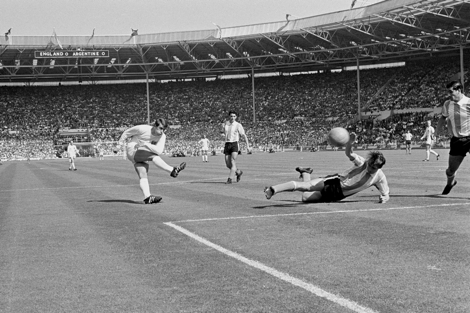
Geoff Hurst, 1966
“Can you imagine if both YouTube and blogs had existed in sixties? The events of the 1966 World Cup final would have caused internet meltdown. For those unfamiliar, here’s what happened: It was hosts England vs West Germany in the final. West Germany had equalized to make it 2-2 late in the match and take it to extra time.” (World Cup Blog)
The Joy of Six: Footballing brawls

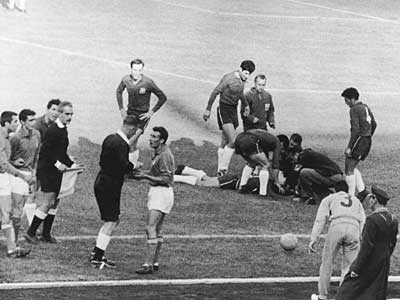
Chile 2-0 Italy, World Cup first round, 1962.
“Chile was recovering from an earthquake that had killed nearly 6,000 people, and didn’t have much money in the first place, so its countryfolk weren’t particularly disposed to tolerate the two Italian journalists who swanned into Santiago ahead of the World Cup finals, sifted through the wreckage, and sent home dispatches painting a picture of Chile’s capital as a poverty-stricken hole full of loose women.” (Guardian)
Football At The World Cup: Part One (1966-1978)

“Four years ago, we ran an article on the subject of the theme music used by British television companies for World Cup finals series. It seemed to touch a nerve at the time and today it’s back. It’s a little more complete than it was four years ago, although there are still one or two gaps and we would gratefully appreciate anybody that can help to fill these for us.” (twohundredpercent)
World Cup Moments: Philipp Lahm Kicks Off The World Cup Properly, 2006
“When discussing the history of any sport, any talk of the “greatness” is bound to be met with a quick hop in a time machine, going back into the annuls annals where myth and storytelling often displace fact and reality to the back seat. And this was necessary in a time when most could only follow sport through the words of others; words which were often embellished, contorted, polished, creating an aura which far superseded the event. Similar to the children’s game which starts with a simple sentence at one end of the room and morphs into something entirely different by the time the exercise ends.” (World Cup Blog)
World Cup Moments: Das Wunder von Bern, 1954
“It may surprise the casual fan or those new to the sport to learn that Hungary were once, bar none, the greatest team in all the lands. In fact the Aranycsapat – the Magnificent, Magical, Marvellous or Mighty Magyars – still reign as a team of such hushed majestic legend you wonder if they existed in reality at all. They were tactical revolutionaries, the brainchildren behind Brazil’s dash to prominence and much of the modern game in general, and football’s unparalleled juggernaut; within a frame of six years, they lost one solitary football game.” (World Cup Blog)
Franz Beckenbauer: Der Kaiser

“A privileged few have experienced the honour of captaining their country to World Cup glory. Just two have won the competition as player and manager. But only one man has completed the hat-trick by ‘winning’ the World Cup as an administrator as well. It is hardly surprising, then, that the great Franz Beckenbauer will always be inextricably and inescapably associated with football’s greatest competition.” (ESPN)
Sport in Modern Europe: perspectives on a comparative cultural history
“Anyone with an active interest in the history of sport will be glad for an introduction to the Sport in Modern Europe research network. It’s being led by Dr. Chris Young at the University of Cambridge assisted by Professors Alan Tomlinson of Brighton and Richard Holt at De Monfort.” (More Than Mind Games)
And so it goes and so it goes and so it goes and so it goes
“The experiment with bye-line officials in the Europa League jars somewhat. Not that it’s a bad idea per se — having someone in a position to spot offences in the maelstrom of the penalty area, which are often on the referee’s blind side, could be a good idea. You wouldn’t know that from the number of people poised to pounce on it like spoilt indoor cats who don’t realise what a proper scrap is. But then, it was endorsed by Michel Platini, so, of course, it must be hare-brained/part of a nefarious scheme to erode Britain’s sovereignty and introduce a federal Europe by the back door.” (sport is a tv show)
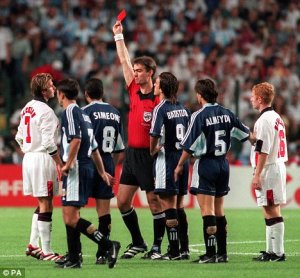
World Cup Moments: David Beckham’s Red Card vs Argentina in 1998

“Because today is David Beckham’s much talked about return to Old Trafford, it seems the perfect time to relive one of the key moments in Beckham’s career. At World Cup 1998 the man not yet known as Goldenballs was just 23 years old and competing with Darren Anderton to play right wing back for England. After scoring a trademark free kick vs Colombia in the group stage, Beckham was given the start for the Second Round knockout game vs Argentina. But then it all went a bit wrong.” (World Cup Blog)
World Cup Moments: Dennis Bergkamp’s Goal vs Argentina in 1998
“If you remember the 1998 World Cup in France, then you remember Dennis Bergkamp’s goal for the Netherlands in the quarterfinal vs Argentina. The score was 1-1 in the 89th minute, and extra time looked almost certain. Until Bergkamp produced his moment of magic.” (World Cup Blog)
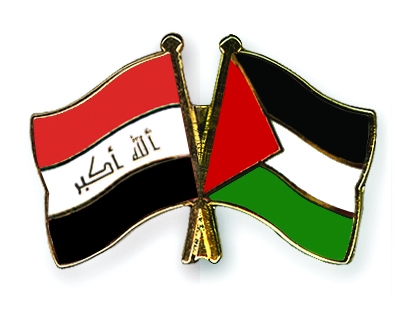
Video Of The Week: Frontline Football – Palestine vs Iraq

“This week’s Video Of The Week is another episode of the ‘Frontline Football’ series from 2006, featuring a World Cup qualifying match between Palestine and Iraq. The Palestinian national team was not officially recognised by FIFA until 1998, but their qualifying group for the 2006 World Cup saw them briefly head their AFC qualifying group after an 8-0 win against Taiwan.” (twohundredpercent)
African Soccerscapes: History, Ideas, and the 2010 World Cup

“Making an academic career out of studying soccer might sound (kind of like) fun, but it turns out to be hard work—mostly because you tend to get dissed from all sides. Here’s how Peter Alegi and Chris Bolsmann explain it in their introduction to South Africa and the Global Game, a forthcoming edited collection of scholarly essays addressing issues around the coming World Cup.” (Pitch Invasion)
The World Cup Starts Here – Just The Fourteen Weeks Early

1994 World Cup Gold
“So, there are just ninety-eight days left until the start of the 2010 World Cup finals in South Africa. As a very small number of you may be aware, this site started out as a World Cup site almost four years ago and we plan to mark the coming of our second World Cup finals with a build-up to and coverage of the tournament that will make your eyes and ears bleed with their luxuriousness. Some of you may note a slight change of tone over our coverage of the World Cup – there may be a tendency for this site to let its hair down for the World Cup and treat it with the curious mixture of mockery and reverence that it deserves.” (twohundredpercent)
Five surprising World Cup runs

Bulgaria, 1994
“Here’s the dirty little secret about the World Cup: It’s the world’s biggest sporting event, but most of the world doesn’t actually do very well at the tournament. The World Cup has been held 10 times since 1970, and just six countries account for the 20 spots in the championship games: Germany/West Germany with five, Brazil and Italy with four each, Argentina with three, and France and the Netherlands with two each.” (ESPN)
The Philosophers’ Football Match

Wikipedia – “The Philosophers’ Football Match is a Monty Python sketch depicting a football match in the Olympiastadion at the 1972 Munich Olympics between philosophers representing Greece and Germany. Starring in the sketch are Archimedes (John Cleese), Socrates (Eric Idle), Hegel (Graham Chapman), Nietzsche (Michael Palin), Marx (Terry Jones) and Kant (Terry Gilliam).”
(Wikipedia), (Philosophers Football), (Telegraph)
African Teams, But Not Coaches
“As the big countdown ticks away, less than 100 days before the World Cup, perhaps Africa’s strongest team, Ivory Coast, is still without a coach. An article in the Zimbabwean brings up the state of African football and its reliance on foreign coaches. In Cote D’Ivoire, the disgruntled Vahid Halilhodžić was unceremoniously dispensed with following an unsuccessful run at the African Cup of Nations (despite having lost only one match during his two-year tenure).” (Soccer Politics)
Some Wannabes Seize Stage in Rehearsals
“Rehearsals are not everyone’s cup of tea. The Germans and Italians, for example, seldom show up in body and soul for them. Yet this is World Cup year, and on Wednesday their people paid top dollar to see those nationals teams, and others, go through the motions. It didn’t always have the desired effect. More than 60,000 people in Algiers saw their heroes, who are going to the World Cup, succumb, 3-0, to Serbia, which is also playing in the finals.” (NYT)
Raymond Domenech continues to cling on
“Nobody can call Raymond Domenech’s tenure as France manager boring. Following yet more calls from the Stade de France faithful for him to resign during the 2-0 home defeat to Spain midweek, even French politicians are now trying to get him the sack. The discontent surrounding all parts of the national team has never really lifted since his surprise appointment in 2004. This is despite Domenech taking France to a World Cup final in 2006, which arguably they would have won had the talismanic Zinedine Zidane not got himself sent off.” (WSC)
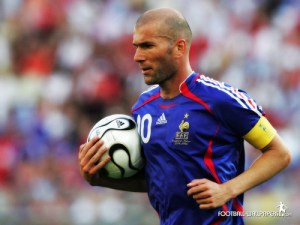
Zinedine Zidane Shows His Futsal Skills in France ‘98 vs Algeria ‘82/’86

“Relations between France and Algeria have always been a bit tricky. This isn’t the place to discuss the specifics, but there’s a whole Wikipedia page about Algeria–France relations if you want to read up. Despite said trickiness, there is one man who can claim to be loved in both countries: Zinedine Zidane.” (World Cup Blog)
Stereotyping the African: 99 Days to a Change of Imagination?

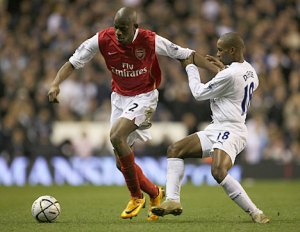
Abou Diaby
“An article by Jonathan Wilson in the Guardian today asks an interesting question for those of us who grew up in an era in which West African football was the realm of skilled artists such as Abedi Pele, George Weah, Roger Milla, and exciting teams like the ‘original’ Nigerian Super Eagles who played swashbuckling, imaginative football. In a piece that starts out by discussing Egypt’s tactical formation (very interesting as well), he goes on to ask…” (Soccer Politics)
Earthquake tragedy hits Chilean Cup preparations
“This week is the last for international friendies before the end of the season. It’s the final chance for fringe players to push their claims for a World Cup place. Chile thought they had found the perfect way to give all their players the opportunity to show their stuff with a double-header on Wednesday against Costa Rica and North Korea, one after the other. But then the country was struck by Saturday’s massive earthquake and amid the chaos and confusion the matches could clearly not go ahead.” (BBC – Tim Vickery)
The Sweeper: Chile’s Earthquake and the World Cup
“Following the devastating earthquake there this weekend, Chile unsurprisingly cancelled two international friendlies scheduled for this Wednesday as part of their World Cup preparations. Few in Chile right now will be thinking about football with more than 700 dead.” (Pitch Invasion)
The Joy of Six: matches that never were

“Pele’s Brazil against Gerd Müller’s West Germany in Mexico 1970, plus five other classic games that never took place” (Guardian)
The Best Football Tournaments, Ever…

Mario Kempes
“Since the dawn of time man has wrestled with this impossible conundrum. And following the glorious football that has generally been on display in Euro 2008 a lot of people are wondering where it stands in the pantheon of great tournaments. Coupled with this excellent Guardian blog and some terrific contributions from posters, it’s got us here at MD Towers thinking. Is it possible to assess which are the best and worst major tournaments? The simple answer is no. So here goes.” (midfielddynamo)
Video Of The Week: All The Goals Of South Korea & Japan 2002
“This week’s Video Of The Week is a little late, but it’s another cracker. All The Goals Of South Korea & Japan 2002. This one is a bit of a marathon (it weighs in at an hour and forty minutes), but it is broken up into handy ten minute segments. The 2002 World Cup was FIFA’s first joint venture between two countries, an experiment that the confederation has changed its mind about whether they will repeat about five hundred times in the eight years since.” (twohundredpercent)
The Joy of Six: Inspired substitutions
“From Arrigo Sacchi’s withdrawal of a legend to Bobby Robson’s match-winning switch, here are half a dozen inspired change… NB: the point of the Joy of Six is not to rank things, only to enjoy them. Also, this is not a piece about inspired substitute performances but inspired substitutions…” (Guardian)
1954 World Cup, held in Switzerland

World Cup 1954 in Switzerland
“The A to Z of the 1954 tournament… ” (midfielddynamo)
First XI: World Cup legends

Pelé
“Very few players become legends of the game without making an impact at the World Cup. Injuries and limited team-mates can be restrictive given the nature of the tournament, with perhaps only George Best and Alfredo Di Stefano considered among the all-time greats despite failing to appear at football’s biggest tournament, so Soccernet takes a look at the top XI players who have made their mark on the biggest stage.” (ESPN)
Why I’ll Be Cheering For Man United, Arsenal and Liverpool This Week
“Watching European football has always had an exotic element for us in Britain. In the 60s and 70s, abroad was a long way away. The world seemed much bigger and the visit of a team from Italy, Germany or Albania was like a visit from another football planet. We hadn’t heard of most of the players, we didn’t know much about the teams. How could we? They were not on TV and rarely covered in the press. Our only exposure to non-British players was at World Cups and on European nights. Hardly any played in the UK.” (EPL Talk)
A Brazil legend’s lasting legacy
“Brazilian football lost one of its all-time greats last week when Orlando Peçanha died at the age of 74. If he had to go, then maybe the forces of destiny and the gods of soccer thought it appropriate to take him on the eve of Carnaval. Perhaps they were trying to make a point, juxtaposing his loss with the start of the country’s great party. Because as revelers fill the streets from Rio to Recife, there are many who like to see Brazilian soccer as one giant Carnaval, everyone more concerned with having fun than with the result, in a fabulous land full of skilled strikers and inept defenders.” (SI – Tim Vickery)
World Cup Legends: Teófilo Cubillas (Peru)
“You may not have heard of Teófilo Cubillas, also known as ‘El Nene’ or ‘The Kid’. I was only vaguely aware of him until reading up a little (and watching a lot of YouTube) this weekend. But Teófilo Cubillas is arguably the greatest player in Peru’s history, and a player who more than made his mark at two World Cups – Mexico 1970, and Argentina 1978 – with a mix of dribbling, playmaking and long range shooting.” (World Cup Blog)
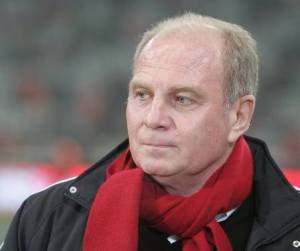
Uli Hoeness speaks his mind

“Recently in the news again for criticising FIFA’s decision to stage the forthcoming World Cup finals in South Africa, Bayern Munich president Uli Hoeness has acquired a reputation for making outspoken comments. Viewed by some as a loud-mouthed oaf, the former West Germany and Bayern midfielder is extolled by others for his championing of football’s traditional values and his distaste for some of the game’s biggest egos. Here are some of his most quotable observations…” (WSC)
England manager Fabio Capello worries over Wayne Rooney’s huge burden
“The subject was Wayne Rooney. ‘Please, rest him sometimes,’ the England manager said to his Manchester United counterpart. ‘He plays every game. I need him more fresh to play in the World Cup.’ Capello’s request carried heightened poignancy after the depressing bulletin from Chelsea earlier on Thursday about Ashley Cole’s injury.” (Telegraph – Henry Winter)
Video Of The Week: All The Goals Of The 1998 World Cup

“This week’s Video of The Week continues the World Cup theme of the last few weeks, with all the goals from the 1998 World Cup, which was, of course, held in France. The optimism that may have existed after England’s decent performance at the 1996 European Championships evaporated over the weeks of the tournament. Tabloid exclusives about the behaviour of the players, rioting in Marseille and a defeat at the hands of Romania were just the build up to a penalty shoot-out defeat at the hands of Argentina. Meanwhile, France and Brazil made the final of a tournament that was the first to feature thirty-two nations. Iran beat the United States of America in the first round but both teams went out,but Jamaica and Japan, who were both arguably beneficiaries of the expansion, brought colour to the tournament off the pitch but offered little resistance on it.” (twohundredpercent)
A Star Abroad Burns Out at Home

“Lionel Messi is probably the top sportsman in the world right now: unless you ask fans in Argentina where the soccer star was born and grew up in a town called Rosario, roughly 180 miles (290 kilometers) north-west of Buenos Aires. After helping his club, Spain’s FC Barcelona, win most of the top awards in 2009, Mr. Messi was named World Player of the Year by FIFA, world football’s governing body. He received the 2009 Ballon d’Or, given to Europe’s top player— winning the honor by the widest margin since it was first awarded in 1956. He even won the Latino Athlete of the Year 2009.” (WSJ)
World Cup Moments: When Harald Schumacher Met Patrick Battiston. In Mid-Air.
“The 1982 World Cup semifinal in Seville between France and West Germany was a stunning game of football. It finished 3-3 after extra time, and then West Germany won (as usual) on penalties. Despite those six goals, the semifinal is mostly remembered for just one thing. Germany goalkeeper Harald Schumacher’s horror foul on French defender Patrick Battiston. I say horror foul.. the ref actually gave a goal kick to West Germany. Which you’ll probably find hard to believe after watching video of the Schumacher crushing his victim below…” (World Cup Blog)
The Monday Miscellany – Africa Cup of Nations Special
“In the history of stupid decisions made by sport’s governing bodies, it is difficult to find one which compares, for sheer crassness, with that of the Confederation of African Football (CAF) to ban Togo for the next two Africa Cups of Nations. Togo, you will surely not need reminding, were attacked by terrorists in Cabinda on the eve of the tournament. Three men died and others were seriously injured. Everybody, it is safe to imagine, would have been seriously traumatized by the assault.” (Footballing World)
Egypt’s Three-peat – The Latter Stages Of The African Cup Of Nations

“The climax to Group C summed up this Cup of Nations, a curate’s egg of a tournament which ran out of good football from the second week onwards. A tournament during which the look of delight on the face of one CAF official when Algeria beat Cote D’Ivoire turned to horror when he remembered that Algeria played Egypt next. A tournament during which the players from the English Premier League, the “best” league in the world, were almost uniformally rubbish. And a tournament which ended with the unfeasibly fierce-looking Egyptian coach Hassan Shehata managing a smile at the end which made him look even more fierce. I’ll be having the nightmares for a while.” (twohundredpercent)
Africa Cup of Nations 2010: A Tournament Best Forgotten?
“The 2010 Africa Cup of Nations is over. Though I usually love the tournament, I won’t be remembering this edition fondly. For several reasons.” (World Cup Blog)
Four things I learned from the Africa Cup of Nations
“1) There is no one at the CAF fit to manage football. The choice of Angola to host the tournament in the first place was bizarre, given that it’s a quasi-Communist autocracy in the midst of a long and bloody civil war (which stipulated that, as a nation-building exercise, many of the games in this tournament would be held in the home of the hopeful secessionists). How the tournament actually panned out made the rejected bids of places like Zimbabwe and Mozambique look sweet by comparison.” (The 90th Minute)
Questions and Representations in the Year of African Soccer
“Finally, after an eventful January, I’ve got some answers to the big questions for this year of African soccer. Was Angola 2010 a success or a failure? Yes. Will the World Cup in South Africa be a success or a failure? Yes. Let me try to explain.” (Pitch Invasion)