“… England 2-3 Scotland, April 15th 1967. Wembley Stadium, London. Six years on from the roasting they received at the hands of the Auld Enemy, Scotland once again pitched up at Wembley with a strong team in this Home Championship game that doubled as a European Championship qualifier. This time, though, they were expected to struggle against ten of the English XI (Jimmy Greaves replacing Roger Hunt) that were crowned world champions on the same pitch less than a year earlier.” Football Pink
Category Archives: England
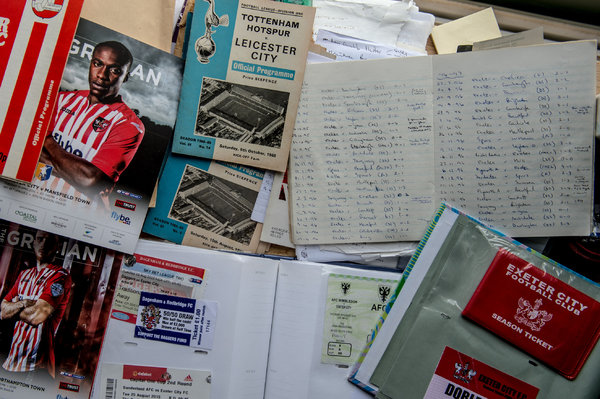
2016-17 FA Cup 1st Round – map and attendance list./+ the 3 FA Cup 1st Round first-timers (Merstham FC, Stamford AFC, Westfields FC).
“The map (click on image at the top of this post) shows all 80 clubs who have qualified for the 2016-17 FA Cup First Round Proper. Also on the map page is the 1st Round fixture list, and there is a list of the 80 clubs’ current home league average attendances. There were 736 clubs accepted into this season’s tournament. The 44 clubs from the Premier League (the 1st division) and the Football League Championship (the 2nd division) will join the competition in the 3rd Round (played in early January). The 1st Round and the 2nd Round are contested between all the clubs from the two lower leagues of the Football League (48 teams) – League One (3rd division) and League Two (4th division) – plus the 32 Non-League clubs who qualified through the preliminary and qualifying rounds (6 rounds).” Bill Sport’s Maps
Denis Kelleher: An ‘Unpredictable Irishman’
“Below the professonal ranks, Denis Kelleher was regarded as one of the finest footballers in Britain. In a remarkable life, the Irishman, capped eight times at amateur level, escaped from Nazi Germany, played for Great Britain at the Olympic Games, and became a folk hero at Barnet. Cian Manning tells his story.” Póg Mo Goal
Can Wales create more history with World Cup qualification?
“Later today, Wales will start their World Cup qualification campaign. For the Welsh faithful, it’ll be a strange feeling. No longer is history holding them back, no longer are they nearly men. Can the most successful Wales team in over half a century qualify for a World Cup? By the time the 2018 World Cup rolls along, it will be 60 years since Wales competed in their last one.” backpagefootball
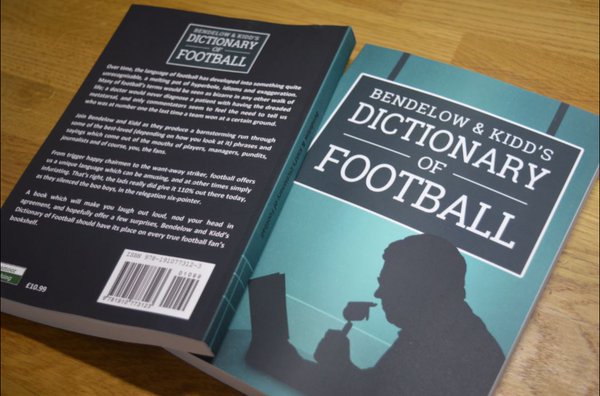
Book Review: Bendelow and Kidd’s Dictionary Of Football

“The army of terms required to talk convincingly about football has been a great source of mirth over the years. As far back as the 1970s, footballers were depicted as alternating between being ‘over the moon’ or ‘sick as a parrot’ depending on their feelings at 5 o’clock on a Saturday while Ron Atkinson let loose a whole new phalanx of phrases during his co-commentating days alongside Clive Tyldesley – to the extent that ‘crowd scene’, ‘little eyebrows’ and the daddy of them all, ‘early doors’ started to gain common currency. Ian Bendelow and Jamie Kidd are the latest to draw attention to the sheer glorious illogicality of soccer phraseology. That they are merely the latest is the one criticism one might level at their eponymous Dictionary of Football, for this exercise was carried out in pretty much identical fashion in Leigh and Woodhouse’s Football Lexicon published in the early Noughties and re-republished for as wider audience by Faber & Faber in 2004.” thetwounfortunates, amazon
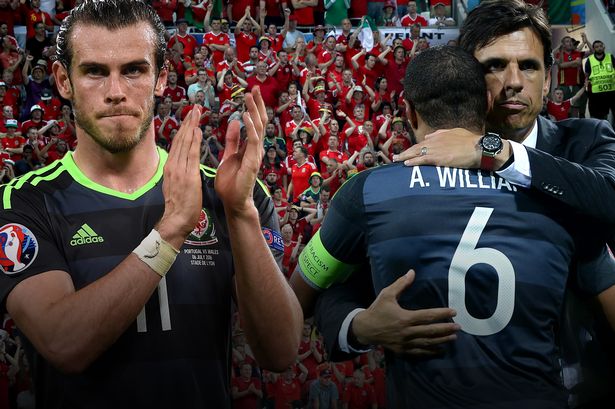
2018 World Cup qualifiers: Coleman ready for next adventure
“It is a scene every Welsh football fan will recognise: rewatching goals from Wales’ historic Euro 2016 campaign in an attempt to relive the euphoria of an unforgettable summer. The moment has passed, the rapturous celebrations fading from view, but still they cling to the memories. As does the man who masterminded it all.” BBC
The Beauty of Mediocrity
“Winning isn’t everything in football. As Evertonian and Sheffield student Alex Leonard explores, relationships with underachieving clubs are not only unexpectedly romantic but can teach you valuable life lessons too. An uncomfortable consensus of disgust led much of the Kop end to leave early. A slow grumbling stream of red and white headed for the exit. Yet despite the utterly woeful football on display, I felt compelled to stay, shivering in the bitter March evening.” Football Pink
Wales exceeded expectations at Euro 2016 – but must now deal with them

“Commiserations to Wales, whose exhilarating Euro 2016 journey came to an end at the semi-final stage in Lyon, but congratulations to all concerned for lighting up the tournament – particularly from a British point of view – and showing what is possible when a team functions as a team and takes a strong mentality and deep reserves of self-belief out on to the pitch. This is not intended as veiled criticism of England, though some may read it that way, for the Welsh and the English narratives have been inextricably entwined in France. They were drawn in the same group, and though England won the head-to-head battle – just – they lost the war by finishing second to a team with two victories.” Guardian
Euro 2016 Tactical Analysis: England 1 – Iceland 2 | Tactically disciplined Iceland kicks England out of Europe.
“When England scored its first goal, the Icelandic players must have told ‘theta reddast’ to each other. It’s a common saying in Iceland and means everything is going to be fine. In the end it was all good for the small island nation. Iceland knocked England out of Euro 2016 and forced Roy Hodgson to retire after coming back from behind and taking the lead very early in the first half. Iceland put on a well-disciplined tactical display and with a hardworking and collective approach it managed to stifle England through some good space compression in the midfield.” Outside of the Boot
England absorbs more shame, failure with Euro 2016 ouster to Iceland
“For two years Roy Hodgson has been saying that England would be at its best when it faced a side that attacked it, when it could use its ace in forward areas to play on the counterattack. We’ll never find out if that was true. No side has attacked England since Switzerland did in the second half of the Euro 2016 qualifier in Basel in September 2014, when England, playing with uncharacteristic poise, won 2-0. Perhaps this side could have challenged Germany or France (although the defending against Iceland suggests not), but we’ll never know, because it failed in what seemed the most basic of tasks, beating a nation with a population of 330,000.” SI – Jonathan Wilson
England Loses
“England has now left Europe twice in four days, with the second departure allowing this writer some small sentiment of retributive justice for the stupidity of the first. After the unmitigated and unfolding disaster of Brexit, the English national football team was defeated 2-1 by Iceland yesterday in the European Football Championship. Iceland! That’s right. With a population of around 330,000, with a fair scattering of part-time players and a coach who also works as a dentist and a goalkeeper who is also a filmmaker, Iceland defeated England, the country who first formulated the game of association football in the nineteenth century and has the richest league in the world and most of the game’s best-paid players.” NYBook
Team England, the FA and the Great EPPP Gamble

“As far as can be observed from social media, there were two responses to England being beaten by Iceland in Euro 2016. The first was blind fury, rage at overpaid footballers and incompetent coaches. The second, the more favourable one, was uncontrollable laughter prompted by the singular failure of technique, passing, shooting, crossing and, in some remarkable instances, controlling a ball. Both are equally valid but option two had the added frisson of the hilarity gleaned from seeing our Wayne tripping over footballs, the ground and his feet, on several occasions.” In Bed With Maradona
England 1 – Iceland 2

“England suffered their worst humiliation since they were knocked out of the 1950 World Cup by USA in Brazil as Iceland shocked them in the last 16 of Euro 2016. Manager Roy Hodgson resigned after the abject embarrassment of losing to a nation ranked 34th in the world – and with a population of just 330,000 – despite taking the lead through Wayne Rooney’s fourth-minute penalty. Iceland equalised within a minute as England failed to deal with a trademark long throw and Ragnar Sigurdsson bundled home from close range. England’s shameful performance was summed up by Iceland’s 18th-minute winner when goalkeeper Joe Hart was badly at fault – just as in the win over Wales – as he let Kolbeinn Sigthorsson’s shot through his hand.” BBC (Video)
Iceland’s toppling of England at Euro 2016 is a triumph for the little guys
“Takk fyrir Island. Thank you Iceland. Thank you for Gudmundur Benediktsson’s epic falsetto commentary, for bringing one-tenth of the population to France to take part in this odyssey, for making Cristiano Ronaldo uppity and reminding the rest of us of the essential valour of the little guy’s right to his aspirations, for competing so fearlessly to defeat England, for blowing our minds. Thank you for your co-manager’s other job in dentistry, your class and determination in searching for a first win at a major finals, your exemplary coaching system, your comradeship within the team, your inspired hothousing of young talent in a weather-beaten place. Thank you for showing us imaginative ways of doing things can bring extraordinary achievements.” Guardian
Euro 2016 Power Rankings: Final 16 teams in France

“The dramatic end to the group stage couldn’t disguise the fact that, for the most part, this has been a slightly disappointing opening to the tournament, yielding just 1.92 goals per game and precious few games of real quality. No side won all three group games, while many of the less-fancied sides troubled their supposed betters. The suggestion is that this is a very open tournament, although there remains the possibility that one of the top sides will suddenly click into gear and surge through to success on July 10. The knockout bracket has yielded an unbalanced final 16, with powers France, Germany, Spain, Italy and England on one half, while Belgium and Portugal benefited from underperforming in the group stage by being given a more favorable rout to navigate on the road to the Stade de France.” SI – Jonathan Wilson
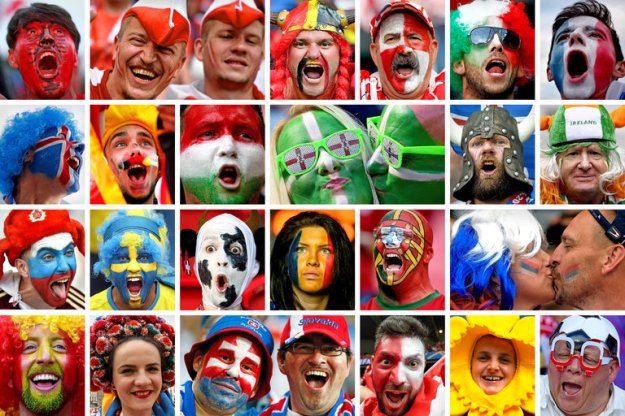
Six things we’ve learned from the Euro 2016 group stages
“Fears that lowly ranked sides like Albania and Northern Ireland might dilute the quality of the competition have not materialised. Cynics might say the overall quality was so low that nobody noticed anyway, but the fact is that some of the more fancied teams – the likes of the Czech Republic, Austria, Turkey, Ukraine and Rumania – couldn’t make it past these minnows. The extended format has brought plenty of colour and amazing stories like Iceland’s success to the tournament, and have helped more than make up for the lack of excitement felt elsewhere. But UEFA also got very lucky. Groups E and F were clearly at an advantage, knowing just how many points were needed to advance ahead of other third-placed teams.” red bulletin
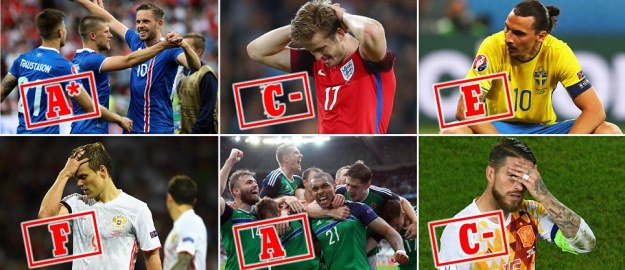
Euro 2016 group stage grades

“The group stages of Euro 2016 have provided goals and controversies, outrageous skill and dreadful mistakes. With no team able to win every game, but only one side losing all three matches, the tournament has proved more competitive than anyone could have expected. After 36 matches, the action is only just hotting up, but having played three times each, we now have a decent idea about what shape the teams are in.” Daily Mail
Euro 2016: How Teams Can Advance to the Next Round

“The group stage of Euro 2016 is well underway: From Wednesday until Saturday, all 24 teams will complete their second of three games of group play. And the minute those games are over, many serious fans will start to do math – in their heads, on cocktail napkins or even on spreadsheets – to determine what their teams must do to ensure a place in the knockout stage of the competition. It can be complicated, particularly in this expanded 24-team tournament, where four third-place teams will advance, but we’re here to help you sort through it all. This page provides a big-picture overview in real time, and as soon as teams have completed their first two games – as the teams in Group A and Group B have – we’ll publish a detailed page just for those teams, showing you all the ways they can make the Round of 16.” NY Times
Euro 2016: Russia given suspended disqualification

“The Russians have also been fined 150,000 euros (£119,000) following violent scenes at the game against England in Marseille on Saturday. The suspended disqualification and fine relate only to incidents that happened inside the stadium. There were reports of minor disturbances between rival fans in Lille on Tuesday evening. Russia play Group B rivals Slovakia in the city on Wednesday, while England fans are congregating there before Thursday’s match against Wales in the nearby town of Lens.” BBC (Video)
Is Russia exporting a new breed of football hooligan?
“Violence has been part of Russian football for many years. Clashes inside stadiums and organised fights away from them are common. But this weekend’s mass disturbances in Marseille have thrust Russian hooliganism into the international spotlight. The Russian Football Union expressed regret over the fighting and Russia’s sports minister described those involved as a disgrace. But other senior officials have praised the hooligans openly as ‘real men’. Meanwhile the fans themselves seem largely unrepentant, even proud.” BBC (Video)
Euro 2016: England and Russia fans clash in third day of violence
“Two England supporters have been seriously injured in Marseille after violent clashes with rival fans in the hours leading up to England’s opening Euro 2016 group match against Russia. Police had to resuscitate one 51-year-old fan after he was repeatedly kicked in the head on Saturday, apparently by several Russian fans, leaving him unconscious. Witnesses claimed he had also been attacked with a small axe leaving his head bleeding ‘like a tap’, although the allegation could not be immediately verified.” Guardian (Video)
Russia and England Fans Clash Repeatedly at European Championships
“Fights broke out Saturday before and soon after Russia earned a 1-1 draw against England with a stoppage-time goal in a Group B match at the European Championships in Marseille, France. Fans of the two teams rioted before the game in Marseille’s Old Port district and briefly outside the nearby Stade Vélodrome in a third straight day of violence in the city. The police fired tear gas and water cannons at the fighting fans.” NY Times (Video)
This Is England: What Euro 2016 Means for a Country on the Brink

“When Leicester City won the English Premier League in May, it was considered nothing less than a miracle. Nearly every story about the Foxes noted the 5,000-to-1 odds they were given of winning the title, and the list of likelier long-shot scenarios was as full of impossibilities as it was endless. Piers Morgan taking the reins at Arsenal, Elvis turning up alive, the discovery of the Loch Ness monster—all were deemed more probable by bookies than a Leicester championship, in most cases far more so, pushing the team’s feat into the realm of the supernatural.” New Republic (Video)
Defoe v Rashford & Wilshere v Noble: Is Hodgson’s England Euro 2016 squad right?
“Marcus Rashford instead of Jermain Defoe; Andros Townsend ahead of Theo Walcott; Jack Wilshere in, but no Mark Noble. So did Roy Hodgson get his provisional England Euro 2016 squad right? Opta statistics suggest an England squad based on data alone would have Watford’s Troy Deeney right in contention, with Bournemouth’s Steve Cook and Simon Francis competing to partner Manchester United’s Chris Smalling in the heart of defence. BBC Sport takes a look at the statistics around key England selection decisions.” BBC (Video)
Danny Is The Turnstile – Rayners Lane FC Vs Cockfosters FC, Middlesex Senior Charity Cup Semi-Final, The Tithe Farm Social Club, 21/04/16.
“I thought Rayners Lane was just a place on the far extremities of the Piccadilly line, not somewhere that unless I happened to fall asleep, and awoke post public dribbling or perhaps I was plucked from my bed by a great tornado with my small dog, and dropped on a witch with snazzy shoes, I would never have any reason to visit. As I step off the tube I realise I’m not in Finchley anymore.” Beautiful Game
Worth the Price of 92 Admissions: Entry Into a Stadium Fan Club

“The list includes ramshackle old stadiums, scented and scarred with century-old reminders of English soccer’s storied past, but also the gleaming cathedrals that testify to the Premier League’s rich new present. The City Ground (Nottingham Forest) and the County Ground (Swindon Town). Elland Road and White Hart Lane, but also Villa Park and Craven Cottage. Turf Moor and Deepdale and Ashton Gate. And when the final whistle blows at Saturday’s match between Manchester City and Stoke City, Martin Weiler, a 61-year-old soccer fan with no affiliation to either team, will leave the Etihad Stadium having seen a match in every one of them. In doing so, he also will become eligible for membership in one of soccer’s most distinctive supporters groups: the 92 Club, a small and exclusive fellowship made up of individuals who have watched a competitive league or cup match at the stadium of each of the 92 clubs in England’s top four divisions, which includes some teams from Wales.” NY Times
The history of the FA Cup trophy
“The FA Cup is, without a doubt, a huge part of English football, and the history of the FA Cup trophy itself is a rich and colourful one. First held in the 1871-72 season, the FA Cup is the oldest football competiton in the world and provides a unique opportunity for smaller teams to face the top teams. The FA Cup Final is a huge sporting event and it has an iconic trophy to match.” Football Pink
Thou shalt not make unto thee any graven image

“ANDREW BOULTON casts his sceptical gaze towards the heroism, hubris, horror and hilarity of statues in football. Spend any length of time in Nottingham’s Old Market Square and you will see what we will politely refer to as ‘sights’. Teenage skateboarders tumbling churlishly against the concrete, their drastically over-exposed underpants providing little genuine protection against pavement burns and pigeon sick. Maudlin office workers weeping quietly into jacket potatoes so enormous they could briefly be mistaken for human heads. I even once saw a man angrily thrashing a phone box with a fishing pole.” Football Pink
The limelight’s on Leicester, but what about Spurs?
“Yet another resolute display by Spurs saw them claim all three points against a solid Watford side and emerge as Leicester’s closest rivals in the race for the Premier league title. The win moves Spurs into second, ahead of Arsenal on goal difference, but still 5 points behind the leaders Leicester. The match was a testament to the in – depth strength and quality that Spurs possess as Mauricio Pochettino made four changes to the side which dispatched of Norwich in midweek.” The Incompetent Football Fan
Foreign Players Rule: Discrimination in football?
“The club versus country debate has become a major discussion in modern football, and at the heart of the debate is foreign player rules. Foreign players generally increase the standard of clubs and the league as a whole, but reduce the number of domestic players receiving first-team football, potentially decreasing the quality of the national team. The vast majority of football leagues across the world limit the amount of foreign players allowed per club, with various rules from simple restrictions on numbers of non-domestic players to the Premier League’s home grown rule. But are these rules fair on the players? Are they even legal? Using my area of expertise, Mexico, as a base, I evaluate foreign player restrictions.” Outside of the Boot
Euro 2016 power rankings: every team assessed before draw

“The Euro 2016 draw takes place in Paris on Saturday and Jonathan Wilson looks at all the teams, putting France at No1 and Romania at No24” Guardian – Jonathan Wilson
The Outsiders, Part 5: AP Campionese
“‘And this is Campione d’Italia’, she’s the Italian comune in Switzerland, you know, she’s an Italian enclave and exclave surrounded by Switzerland but still in the Province of Como, Lombardia, in the Swiss canton of Ticino’. Introducing the small town of Campione d’Italia, is much like describing a distant relative at a very large family celebration. She’s both vaguely recognisable and completely unfamiliar. She has the same plump and contented face as aunty Giulia, yet she’s definitely got the nose of grandpa Müller.” Football Pink
The Outsiders, Part 6: FC Andorra
“As countries go, there are few that can match the sheer stunning beauty of Andorra. Nestled firmly in the Pyrenees between France and Spain, Andorra is the sixth smallest nation in Europe in terms of size, its population could fit inside Barcelona’s Nou Camp stadium. It has a rich culture stretching back over a thousand years and is a constitutional monarchy with an official language of Catalan, though French and Spanish are widely spoken too.” Football Pink
The Outsiders, Part 7: The New Saints
“Around the globe, football teams that have incorporated their sponsor’s name are common place. Of course, Red Bull have taken on teams in New York, Leipzig and Salzburg, aptly named the New York Red Bulls, RB Leipzig and FC Red Bull Salzburg whilst Bayer Leverkusen in Germany have taken their founders’ name since their emergence in 1904, as did PSV Eindhoven in 1913. Hyundai have taken on two teams in South Korea, Jeonbuk and Ulsan whilst Toyota even got in on the act in Japan.” Football Pink
The Outsiders, Part 1: Berwick Rangers

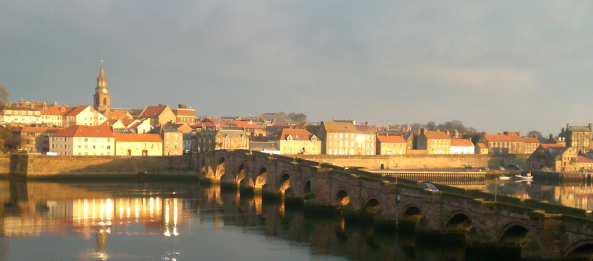
“As you approach from the south, staring wistfully out at the slate grey North Sea reflecting the equally slate grey sky over the sand dunes of Cheswick and Goswick, the quaint walled-town of Berwick-upon-Tweed – perched neatly atop the sloping banks of the famous River Tweed – slowly and neatly begins to frame this picturesque view of northernmost Northumberland. As the train lurches across the Robert Stephenson-designed Royal Border Bridge, leaving the villages of Tweedmouth and East Ord in its slipstream, one could easily be fooled into thinking you were entering another country. The shimmering, twinkling surface of the Tweed – that most renowned of salmon grounds – gives one a sense of a natural dividing line between England and Scotland. Indeed, throughout the centuries and the turbulent history between the two neighbours, it often has. However, since 1482, at the height of the Anglo-Scottish wars, Berwick has remained firmly under English control.” Football Pink
The Outsiders, Part 2: FC Büsingen
“Surrounded by the Swiss: not something you hear very often, is it? In this case, we’re not referring to a rare military skirmish (those multi-functional Army knives can be very threatening under certain circumstances), rather the tiny German enclave of Büsingen am Hochrhein which is, as inferred, totally contained within the conventional borders of Switzerland. The town has been separated from the Motherland (or should that be Fatherland?) since 1805 and the time of the Napoleonic Wars when it switched from Austrian control to that of Württemberg, which itself became a part of the German Empire a year later before eventually becoming part of the modern Bundesrepublik Land of Badem-Württemberg we see today. The ties to Germany remain unbroken despite the result of a referendum in the town after the First World War, in which the inhabitants voted to become part of Switzerland, was ignored due mainly to the Swiss being unable to offer anything substantial in return.” Football Pink
The Outsiders, Part 3: Derry City
“Derry, of all places in Britain and Ireland, seems ready made for the language of football, with a history that’s very much composed of two halves. You’ve those who see themselves as Irish on one side of the pitch, and those who see themselves as British on the other. Out of this strange, enforced marriage comes a place that’s cut from different cloth to anywhere else on both sides of the Irish Sea. Home of shirt factories and receptacle of the shared history between two islands, this is a city that has suffered, as described in Phil Coulter’s famous song ‘The Town I Love So Well.’ But, as in the poems of Seamus Heaney and the upbeat rhythms of The Undertones, the character of Derry is based on triumph over suffering, and in finding a voice and a position unique to itself.” Football Pink
The Outsiders, Part 4: FC Vaduz
“William Cook, writing in the weekly conservative magazine The Spectator, describes Liechtenstein as ‘utterly ridiculous’. It is a tax haven that has more registered companies than people, In August 2009, the British government department HM Revenue & Customs agreed with Liechtenstein to start exchanging information. It is believed that up to 5,000 British investors have roughly £3billion deposited in accounts and trusts in the country. To put the size of the country into a British context, its population is similar to Milton Keynes. You’ll find something familiar with their national anthem, it is sung to the same tune as ‘God Save The Queen’. The capital of Liechtenstein is the sleepy town of Vaduz – the home of FC Vaduz.” Football Pink
Brighton, Northampton & McBurnie – things you may have missed
“The nights are drawing in, the shops are teeming with desperate bargain-hunters and children will shortly be disappointed by the quality of their advent calendar chocolate. We are nearly entering the final month of 2015 and, while the weather cools down, the Football League action heats up. Here are some of Saturday’s best bits.” BBC
1985/86 Week: After The Apocalypse – A Video Introduction
“The sense of decay had been growing around English football for a long time, in the run-up to the start of the 1985/86 season. Attendances had been falling year on year, hooliganism had become an increasingly visible problem, and a number of different clubs had found balancing their books a greater and greater challenge. During the first five months of 1985, however, the feeling had grown that this was more than just a malaise that would be put right. Crowd violence at matches had become increasingly visible as more and more matches were televised, with such incidents as full blown riots during matches between Luton Town and Millwall in the FA Cup and between Chelsea and Sunderland in the League Cup showing levels of violence that hadn’t been seen before in English grounds.” twohundredpercent (Video)
Football Weekly: Hungary qualify for Euro 2016 as England’s friendly with France goes ahead
“The podders reflect on the Euro 2016 playoffs and the rest of the international friendlies. Plus, Raúl retires, Paul Lambert heads to Blackburn Rovers and Jimmy Floyd Hasslebaink remains in high demand. On today’s Football Weekly, AC Jimbo is joined by Jacob Steinberg, Michael Cox and John Ashdown to look back on the Euro 2016 qualifiers, with a bit of help from Jonathan Wilson, who was in Bosnia to see (or not) Ireland’s 1-1 draw with Dzecko and co in the fog, and then in Budapest to witness Hungary qualifying for their first major tournament in 30 years, and is now en route to Slovenia. Because that’s the sort of thing he does.” Guardian – Michael Cox, Jonathan Wilson, etc. (Video)
Dele Alli scores stunner as England beat France at Wembley
“Dele Alli enjoyed a stunning full debut as England beat France 2-0 on a night of tears, compassion and defiance at Wembley. The 19-year-old Tottenham midfielder found the top corner with a stunning 24-yard strike and played a key role in Wayne Rooney’s second-half volley. England’s ninth straight Wembley victory was an impressive one that came against a star-studded France side. But the real winner here at Wembley was football. Just four days after 129 people died in the Paris terror attacks, the France team and their English counterparts, as well as the home and away fans inside this famous stadium, stood shoulder to shoulder to send a defiant message to the terrorists who wreaked havoc in the French capital.” ESPN
Euro 2016 play-offs: How the ties stand – and who is through
“The 2016 European Championship play-offs are over halfway through, with Hungary becoming the 21st team to qualify for France. The Republic of Ireland and Sweden are among the six teams competing for the final three spots. How do the ties stand?” BBC
Euro 2016: Are Spain over their World Cup hangover?
“Despite a solid record in qualifying of nine wins from 10 games, European champions Spain are facing several dilemmas as they prepare for the defence of their title in France next summer. Veteran coach Vicente del Bosque faces selection problems in several areas, and there is also a more general concern over La Roja’s playing style as they continue to address the lingering hangover from last summer’s World Cup finals campaign, where they made a shock group-stage exit. Going into Friday’s friendly with England, these are the main issues.” BBC
Talent Radar Young Defender Rankings: Bellerin climbs, and Gimenez makes the cut
“Judging the calibre of a young player is often a tricky task. Perceived potential has an important bearing in any consideration and is just one of the many parameters to consider when trying to quantify the ability of football’s young stars. To add a basis to what may be a leap of faith, it is useful to look back and trace the growth, or indeed lack thereof, in young players.” Outside of the Boot
Euro 2016: Qualifiers for the tournament in France

“The group stage of qualification for Euro 2016 is over and the make-up of next summer’s tournament is taking shape. There will be 24 teams competing in the finals. France were assured of a place as hosts, and a further 19 countries have qualified automatically – 18 by finishing either first or second in their group and one more as the highest third-placed finisher. There will also be four play-off ties to determine the final four teams competing in France – and we now know who will be competing in those ties.” BBC
The peaceful invasion that London feared – England vs. Germany, 1935
“The mid-1930s was a time of growing fear in Europe, indeed the world. Germany, in particular, was a major concern for the rest of the continent. In 1935, a number of events pointed the way towards the conflict that was World War Two. This was the year that the German air force, the Luftwaffe, was formed. A few days later, Adolf Hitler ignored the Versailles Treaty and announced that Germany would re-arm. And in September, the Nuremberg Laws, an anti-semitic doctrine that made it illegal for Jews and non-Jews to have any form of relationship, came into effect. The rest of the world was scared of Germany and its intentions.” Football Pink
The top ten fan owned clubs in English football
“An enticing concept has been quietly incubating within English football in recent years: supporter ownership of clubs. While it may be the norm in places such as Germany and Argentina for football fans to own their club, it’s still a fairly alien idea in the United Kingdom and most of the Commonwealth. The allure is obvious: football fans and club owners often disagree about how clubs should operate. Wealthy owners – often with minimal connection to the club’s community – tend to prioritise the pursuit of profit, and take financial risks that can destabilise or endanger clubs. Football fans, however, view their club as a community asset rather than as a business, and desire to be treated loyally as valued club members instead of as replaceable customers.” backpagefootball – Part 1 (Video), Part 2 (Video)
Graft, grit and Northern beauty
“Sir Alex Ferguson, Kenny Dalglish, Jock Stein, Sir Matt Busby, Bob Paisley, Bill Shankly, Brian Clough, Howard Kendall, Don Revie, Sir Bobby Robson: it’s a long and impressive list, but far from an exhaustive one. The common thread that links them to one another? Yes, they are all British, but more specifically, they’re all from either the North East of England or Scotland. So what, I hear you mutter. … It’s my assertion that, as they did not inherit, at birth, the specific qualities and traits needed to stand out in the cutthroat world of football but must possess them in order to break into that sphere in the first place, then it must be their upbringing and the environment of their formative years that defined them. So, it is to the North East of England and Scotland that we must look for those ingredients that shaped the young men who would eventually become legends.” Foofball Pink
What has happened to England’s international support?
“Back in the 90s, when Britpop ruled the country, there was a charge of fantastic patriotism. Optimism was placed in a youthful, hopeful Tony Blair, my beloved Liverpool were embarking on a bout of abstinence-based detox of all things silver and support for England’s national team was riding the wave of an Italia 90 based revival. This often took ‘swarms’ (cough, cough) of Brits halfway across the world to watch their national team beat Macedonia, only to trek back again, and straight into work the next day. People, it was safe to say, were loving watching England.” backpagefootball
Phoenix from the flames: How do you resurrect a football club?

Bradford Park Avenue in action during a Division Three North match against Wrexham in 1955
“The lower reaches of English football are littered with clubs reborn from the ashes of previous incarnations. Maidstone, Bradford Park Avenue, Scarborough, Halifax, Chester, Darlington and Rushden & Diamonds are among those to have risen, phoenix-like, from the flames of their earlier demise. Hereford – responsible for one of the great FA Cup giant-killing acts, but wound up last December – are the latest former Football League club to begin the journey back from oblivion. Five months after they set alarm bells ringing – literally – when they were handed the keys to their ground, Hereford return home to Edgar Street on Saturday with a pre-season friendly against celebrated fan-owned non-league outfit FC United of Manchester.” BBC (Video)
Missing Lions: The true cost of English football’s class divide

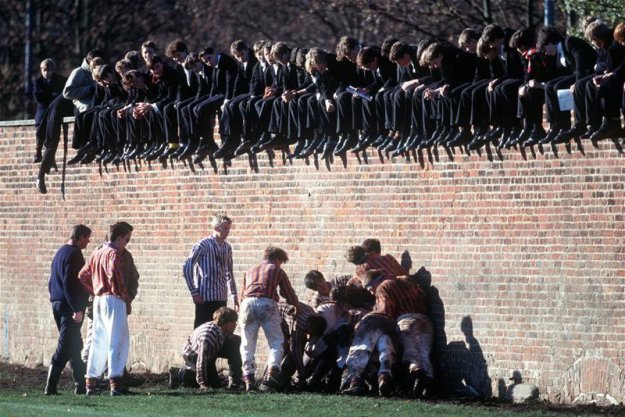
Eton schoolboys gather to watch The Wall Game.
“Class and football is inseparable as far as England is concerned. No other nation outside of the British Isles seems to hold the same pretensions and stresses over the social strata that its footballers and football supporters belong to, or appear to belong to, as England does. Though the late-19th Century public schools may have moulded and codified its laws, and helped spread the sport across the world through the networks of the empire and enterprise, it is unquestionably the game of the working class. Urbanisation and industrialisation brought people together like never before to learn, play and grow football into a national pastime, and ultimately a cultural phenomenon in its own right. But where did all the public school boys go after the masses ran away with their rule book?” Squawka
From pitch to page – a brief account of the history of football fiction
“‘The author of the best books written about English culture since the War’… reads the blurb on the cover of John King’s landmark 1996 novel ‘The Football Factory’, a rampaging yarn about a gang of miscreant Chelsea supporters strutting their stuff around a succession of English cities and football stadiums and offering an uncompromising portrayal of the dark motivation of the archetypal English ‘hoolifan’. It’s a bold assessment of a bold novel, offered by King’s contemporary and fellow Jonathan Cape stablemate, Scottish novelist Irvine Welsh. The ‘Trainspotting’ author has himself occasionally wondered onto the football fiction turf, most notably in ‘Maribou Stork Nightmares’, when protagonist Roy Strang is assessed for his ‘casual’ credentials by a group of fellow Hibs supporters on a train to Motherwell.” backpagefootball
How Football Shaped The Clash’s Greatest Album
“In 1979 the Clash wrote and recorded London Calling, the double album that was their finest artistic statement. Not released in the U.S. until January 1980, it would be hailed 10 years later by Rolling Stone as ‘the album of the decade.’ When they started work on their masterpiece, the Clash were at a low point. Having dismissed their original manager, Bernie Rhodes, and his temporary successor, the group had no one to fall back on but themselves. And it was football, as much as their supremely able songwriting abilities, that pulled them into the mental form necessary for writing and recording the album.” 8 By 8
England face tall task to beat Slovenia’s goalkeeper Samir Handanovic
“Jan Oblak performed heroics when Benfica drew 0-0 away to Juventus in the second leg of the Europa League semi-final last season. He projects a confidence that makes him appear taller than his 6ft 1in. He secured a move to Atlético Madrid at the age of 21 as the long-term replacement to Thibaut Courtois and, although he has largely played second fiddle to Miguel Ángel Moyà this season, Oblak is widely regarded as one of the best young goalkeepers in the world. He even shares a surname with probably the greatest Slovenian footballer ever, Branko Oblak, but he is some way from becoming the first choice for his country and is unlikely to face England in their Euro 2016 qualifier in Ljubljana on Sunday. It’s a joke as old as international football itself: if we’re being kind to Josip Ilicic, Slovenia probably have three top-class players; two of them are goalkeepers.” Guardian – Jonathan Wilson
Ireland versus England – The quest for footballing approval
“Relationships can be tricky at the best of times. Even when they’re over feelings can remain, passions linger, doubts about whether breaking up was the right decision can cloud one’s judgement. The unhealthiest of relationships can provoke these reactions and much as we like to think we’ve moved on and we’re being the bigger person we still crave attention; a reaction from our former partner. Much of recent Irish history, and almost all of our football history has lived out this type of conflict with our spurned partners England. Identifying ourselves as our own strong, confident, distinct individual nation while also being constantly obsessed with either getting one over on the English (Euro 88!) or craving their attention and approval to give validation to our actions.” backpagefootball
Britain’s “other” national team: Ellan Vannin
“The four national teams of the United Kingdom are supposedly England, Wales, Scotland and Northern Ireland. Each with its own FIFA affiliated side, these nations have spanned generations and produced some wonderful footballers, and in the case of England have even won the FIFA World Cup, triumphing by a margin of 4-2 over West Germany in 1966 – a fond memory to those who witnessed that historic match.” Football Pink
Football League season review: Watford and how it all worked out in the end

“ASHLEY GREB leaves no stone unturned as he pores over Watford’s ever-eventful Championship promotion season, final day paradoxical feelings and a manager missing his lightsaber. Returning home from walking the dog – early on Monday morning – outside our expatriate abode stood two ambulances; lights still on, their engines still purring. With a headstrong schnauzer pulling on his lead, I froze. Gazing through the worm hole; our shared drive formed the backdrop as efficient medical professionals busied themselves, practically on autopilot. Fixated on the scene, I wracked my brain for the correct words to use. What should I ask? What could I even say? Emergencies of this ilk weren’t exactly what Sir Keith Joseph had us cover in German O level.” Football Pink
Talent Radar Player Rankings: Top 10 Young Forwards in 2014/15
“In the past two weeks, we’ve updated our Talent Radar player rankings in the Goalkeepers, Defenders and Midfielders section. We’re now left with this season’s final issue of the Forward Rankings. It’s common tendency that players playing up front attract the most attention, from both fans and clubs. Many of the names on this list will be the subject of transfer speculation in the coming months. We’re going to leave any kind of speculation surrounding these players out of this and give you an unbiased judgement of how the players have done this past season to let you know the reason for the hype around them.” Outside of the Boot
5 Premier League Clubs Stuck in Relegation Battle
“The moment that Chelsea wrapped up the Premier League title in England, interest switched to the race to the bottom. The grim reality of the world’s richest soccer league is that only Chelsea, Manchester City and possibly Arsenal had the players and the means to win it this season. Two-thirds of the rest of the clubs played in fear of relegation to the Championship, one league below.” NY Times
Póg Mo Goal Magazine – Issue 2 Pre-Order

“Póg Mo Goal is a new Irish football magazine focused on considered design and great quality writing from around the world. Issue 2 is now available for pre-order and will ship in a few weeks’ time. The magazine features writers, photographers and illustrators from Ireland and around the globe, including Hong Kong, USA, Brazil, Australia, The Netherlands, France, Italy and the UK. It includes Johnny Hynes of LFC magazine asking does style matter in football or is it just winning at all costs that counts. How Robbie Keane conquered America, the GAA’s ban on foreign games and famous games and events in the ‘Home of Irish Football’ Dalymount Park. David Villa’s brief cameo in the A League and the impact of the City Football group on the Australian domestic game. The Eritrean national team transplanted to the Dutch country-side. Rafael Esquer’s Studio Alfalfa reveal the inspiration behind the crest design of one of MLS’ newest franchises New York City FC. Typographer Sander Neijnens examines shirt number design. Specially commissioned pieces by illustrators Samuel Byrnes, Planning Unit, Geo Law, Ruben Gerard and more.” Póg Mo Goal
Why Newcastle United’s relegation should be a collective aspiration
“Newcastle United’s defeat to Leicester City taught us nothing we didn’t already know; they are a directionless football team with no redeeming qualities and, since the turn of the year, they have tumbled apathetically down the Premier League table. In one respect, they remain in control of their own destiny. Superficially they are well-placed to avoid relegation but, in all likelihood, they will have to rely on the ineptitude of those below them if they are to remain a Premier League side. Three games remain, but the chances of them picking up points from any of them seem remote.” Squawka
The Ibrox Disaster 1902 – A National Tragedy
“At half past one on Saturday, 5th April 1902, James Smith and John McLelland set off from the north of Glasgow for the big match, Scotland against England at Ibrox. After a hard working week, the football would be a welcome escape. John was the younger cousin of James’s wife, Elizabeth. He worked as a warehouse porter in the hat department of the wholesalers Arthur & Co. and at the age of 25, was still single and living in Duke Street in the east end of the city.” Football Pink
The persisting fall of English soccer’s Donald Sterling
“It would be an exaggeration to claim that for a few years, Wigan Athletic was English soccer’s favorite underdog tale. But it was certainly one of the nation’s favorite artificially-flavored upstarts. Dave Whelan was the kind of owner fans of small clubs fantasize about. Hartlepool, Grimsby, Exeter: they’d all have loved a man like him in charge. Because until he arrived, Wigan was smaller than even those microscopic specks on England’s soccer’s map.” Socccer Gods
Premier League and Football League: Ups and downs
“The top three teams qualify for the Champions League group stage, with the fourth-placed team entering the preceding play-off round. English clubs have three places in the Europa League – for the FA Cup winners, Capital One Cup winners and fifth-placed Premier League side.” BBC
Ireland and Poland renew friendship that has brought fond memories for blazers
“Jackie Carey is said to have written in his official report to the FAI on the game between Ireland and Poland in Katowice in May 1958 that it was ‘fitting that our association should be the first to resume international games with this predominantly Catholic country.’ This curious observation raises a couple of points. The first is: What on earth was the team ‘manager’ on about? The Poles had been back in international football for a decade by the time the game took place and their first post-war attempt to qualify for a World Cup, which included a 2-1 win over the Soviet Union in front of 93,000 in the same stadium where Ireland played, had only ended the previous year with a play-off defeat by the same opponents in ‘neutral’ East Germany.” Irish Times
Eight Bells: Football on Television
“1. Football at the Arsenal (1937). Exactly how much effort the BBC put into television during the medium’s infant years is a moot point. Take the opening day of their regular service, on Monday, 2 November 1936. At 3pm, the curtain went up for pompous welcoming speeches by various BBC grandees, blowhards and windbags. After a whopping 25 minutes of programming, the station paused for its first interval. Another 35 minutes and it was time for closedown, followed by large G&Ts all round, then a siesta. Thanks, BBC, you pissed-up shower of indolent toffs!” The Blizzard
Euro 2016: Crucial week for UK & Ireland teams on road to France
“England, Northern Ireland, Scotland, Wales and the Republic of Ireland all return to international action this week – and all have realistic hopes of qualifying for Euro 2016. The five nations have never qualified for the same major international tournament before but, after a four-month break, they can all enhance their prospects of reaching next summer’s tournament in France with positive results. Why is there such hope? For a start, the finals has been expanded from 16 to 24 teams. But a solid start from all five sides to their qualification groups has also offered encouragement. Could it finally be that Wales and Northern Ireland play in their first European Championship? Can Scotland compete in a first major tournament since 1998? This week’s matches will represent the midway point in qualifying, so just how realistic is the prospect of all five making it through to France?” BBC
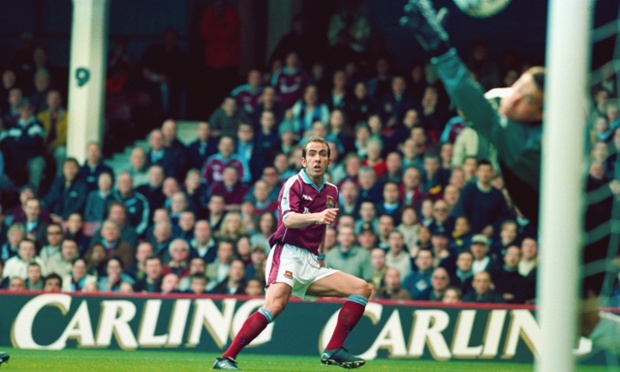
Golden goal: Paolo Di Canio for West Ham v Wimbledon (2000)

“If you came here looking for a brief recap of Paul Weiland’s 2006 film, Sixty Six, then you are in luck. The story of a Jewish boy whose Shabbos spirit was dampened by his barmitzvah tragically falling on the same day as the World Cup final between England and West Germany in 1966 (spoiler alert: England win in controversial circumstances) was a niche topic that was met with mixed reviews, but it struck a resounding chord with me.” Guardian (Video)